
Aquafeed Market Outlook: Size, Share, Trends, Growth Analysis, Competitive Landscape & Forecast, 2026-2033

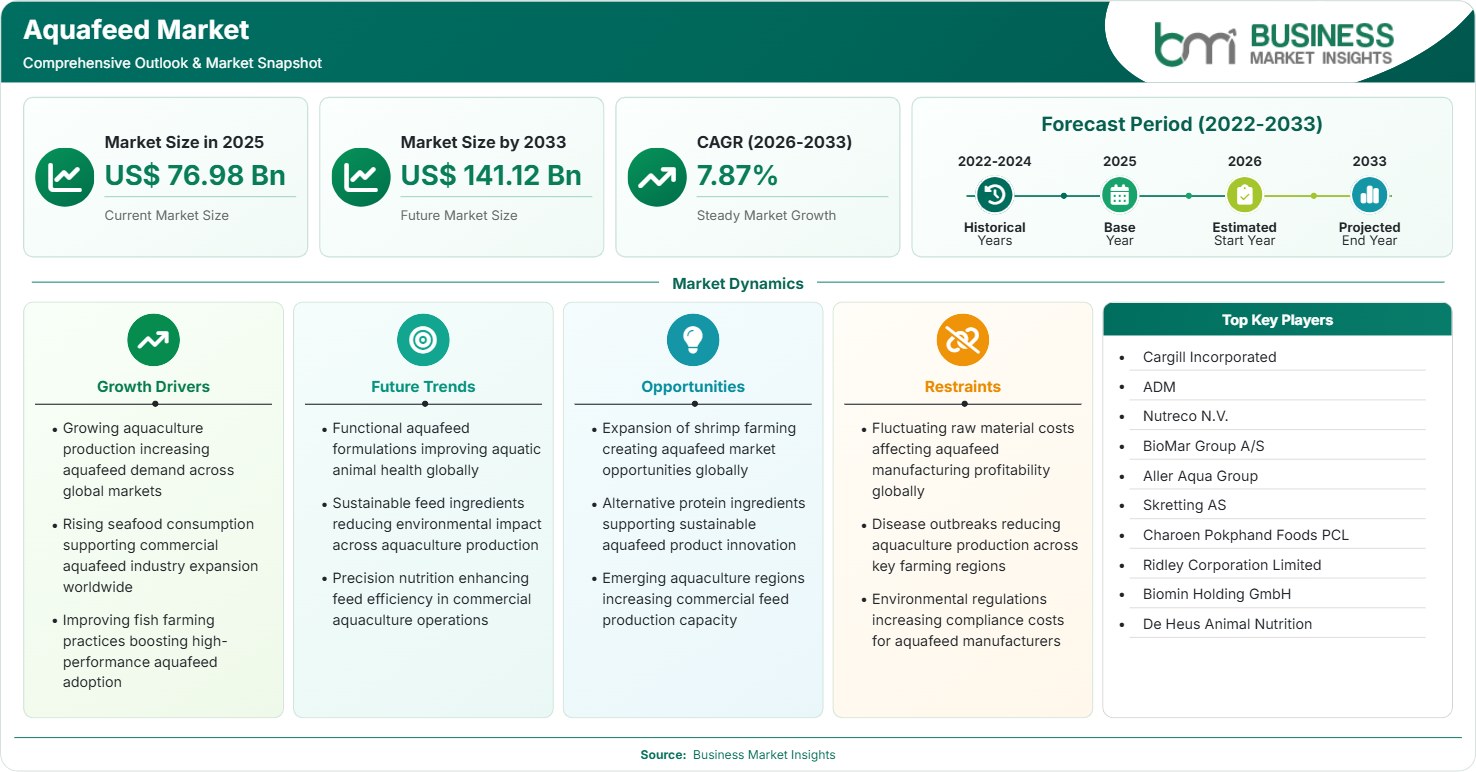
The Aquafeed Market size was valued at US$ 76.98 billion in 2025 and is projected to reach US$ 141.12 billion by 2033, growing at a CAGR of 7.87% during 2026–2033. The market expansion is driven by aquaculture production growth, rising seafood demand, improved farming efficiency, sustainable ingredients, and increasing commercial feed adoption.

Report Coverage
  • Type: Fish, Crustaceans, Mollusks, Others
  • Ingredient: Soybean, Fishmeal, Fish Oil, Corn, Additives, Others
  • Form: Dry, Wet
US$ 76.98 Bn Market size in 2025
US$ 141.12 Bn Market Size by 2033
7.87% CAGR, 2026 - 2033
2026-2033 Forecast Period

AI Overview

Aquafeed Market Summary

  • North America Region: North America holds a market share of 18%–21% in 2025, growing at a CAGR of 7.2%–7.8% during 2026–2033. Growth is supported by advanced aquaculture systems, seafood consumption, feed innovation, and sustainable farming practices. The United States market is expanding through commercial fish farming, precision aquaculture, and demand for efficient feed solutions, with a CAGR of 7.5%–8.0% during 2026–2033.
  • Fastest Growing Region: Asia Pacific represents 55%–58% market share in 2025 and is projected to grow at a CAGR of 8.0%–8.8% during 2026–2033. Growth is driven by large aquaculture production bases, seafood consumption growth, shrimp farming expansion, and increasing adoption of advanced commercial feed products across China, India, Indonesia, and Vietnam.
  • Leading Segment: Fish accounts for 65%–68% aquafeed market share in 2025 and is expected to grow at a CAGR of 7.5%–8.1% during 2026–2033. Growth is influenced by increasing fish farming activities, rising protein demand, improved feed conversion efficiency, and expansion of commercial aquaculture operations.
  • High Growth Segment: Crustaceans represent 15%–18% market share in 2025 and are projected to expand at a CAGR of 8.5%–9.2% during 2026–2033. Growth is supported by shrimp farming expansion, export demand, premium feed adoption, and increasing focus on disease-resistant aquaculture practices.
  • Key Market Opportunity: Sustainable protein ingredients, shrimp farming expansion, emerging aquaculture regions, and advanced feed formulations are creating opportunities for aquafeed manufacturers globally.
  • Major Market Players: Cargill Incorporated, ADM, Nutreco N.V., BioMar Group A/S, Aller Aqua Group, Skretting AS, Charoen Pokphand Foods PCL, Ridley Corporation Limited, Biomin Holding GmbH, De Heus Animal Nutrition.
Strategic Insights

Aquafeed Market: Strategic Insights

Aquafeed Market Strategic Framework
FREE PDF
Request your free sample
Request free sample
Stakeholder View

Key Takeaways

  • The aquafeed value chain includes ingredient suppliers, feed manufacturers, aquaculture producers, distributors, and seafood processors, creating an interconnected ecosystem focused on productivity and sustainability.
  • Shrimp farming, premium fish nutrition, and specialized formulations represent major growth opportunities as producers seek improved animal health, survival rates, and production efficiency.
  • Innovation is shifting toward alternative proteins, functional additives, probiotics, enzymes, and precision nutrition approaches designed to improve feed performance and reduce environmental impact.
  • Asia Pacific provides strong investment opportunities due to its dominant aquaculture production base, expanding seafood exports, and increasing adoption of commercial farming technologies.
  • Strategic partnerships and capacity expansions among global feed manufacturers are increasing as companies seek stronger positions in sustainable aquaculture nutrition.
  • Sustainable ingredient sourcing and advanced feed technologies are becoming important competitive factors as producers respond to environmental concerns and changing consumer preferences.
Geographic Outlook

Aquafeed Market Regional Highlights

North America Aquafeed Market

North America accounted for 18%–21% of global demand in 2025 and is expected to grow at a CAGR of 7.2%–7.8% during 2026–2033. The region benefits from advanced aquaculture technologies, increasing seafood consumption, sustainable farming initiatives, and investments in commercial fish production. The Aquafeed Market share in North America is influenced by growing demand for high-quality feed formulations, improved farm efficiency, and adoption of nutritional solutions supporting aquatic animal health.

  • The United States is driving regional demand through aquaculture innovation, seafood production expansion, and adoption of advanced feed technologies.
  • Canada is supporting growth through sustainable aquaculture practices, fish farming development, and increasing demand for efficient feed solutions.
  • Feed producers are investing in alternative ingredients to reduce dependence on traditional marine-based resources.
  • Advanced nutrition technologies are improving feed efficiency and supporting commercial aquaculture productivity.

US Aquafeed Market

The United States represented approximately 80%–84% of North America's aquafeed demand in 2025 and is projected to grow at a CAGR of 7.5%–8.0% during 2026–2033. Growth is supported by increasing aquaculture investments, seafood consumption, sustainable farming practices, and demand for specialized aquatic nutrition products. Producers are adopting advanced feed formulations to improve efficiency, reduce production costs, and maintain consistent quality in commercial aquaculture operations.

  • Fish farming expansion is increasing demand for species-specific nutrition products and performance-enhancing feed formulations.
  • Sustainable aquaculture initiatives are encouraging adoption of environmentally responsible feed ingredients.
  • Research institutions and producers are developing improved nutrition strategies for aquatic species.
  • Commercial operators are investing in efficient feeding systems to optimize production outcomes.

Europe Aquafeed Market

Europe accounted for approximately 15%–18% of global demand in 2025 and is forecast to grow at a CAGR of 7.0%–7.6% through 2033. The region benefits from advanced aquaculture standards, strong seafood markets, and increasing emphasis on sustainable production. Norway, Spain, the United Kingdom, and Greece are important markets due to salmon farming, marine aquaculture expertise, and adoption of innovative feed technologies.

  • Norway leads European demand through large-scale salmon farming and advanced aquaculture nutrition systems.
  • Spain supports market development through seafood production, fish farming activities, and commercial feed adoption.
  • The United Kingdom is increasing investment in sustainable aquaculture and responsible seafood production practices.
  • European producers are adopting alternative proteins to improve feed sustainability and resource efficiency.
  • Regulatory focus on environmental impact is encouraging innovation in feed formulations.

Asia Pacific Aquafeed Market

Asia Pacific accounted for approximately 55%–58% of global demand in 2025 and is projected to expand at a CAGR of 8.0%–8.8% during 2026–2033. The region dominates global aquaculture production due to extensive fish and shrimp farming activities, increasing seafood consumption, export-oriented aquaculture industries, and expanding feed manufacturing capacity. China, India, Indonesia, Vietnam, and Thailand remain major contributors due to established aquaculture ecosystems and rising adoption of commercial nutrition solutions.

  • China leads regional demand through large-scale aquaculture production, seafood exports, and increasing adoption of advanced fish and shrimp feed formulations.
  • India is expanding through growing inland aquaculture activities, shrimp farming development, and increasing commercial feed utilization among producers.
  • Indonesia and Vietnam are strengthening aquaculture output through export-focused shrimp production and improved farm management practices.
  • Japan and South Korea are investing in specialized feed technologies supporting efficient and sustainable aquatic production systems.
  • Regional manufacturers are increasing capacity to meet rising demand for species-specific and performance-oriented aquafeed products.

Rest of World Aquafeed Market

The Rest of World region accounted for approximately 6%–9% of global demand in 2025 and is expected to grow at a CAGR of 6.8%–7.5% during 2026–2033. Latin America, the Middle East, and Africa are gradually expanding aquaculture activities through improved farming infrastructure, seafood export opportunities, and rising investment in aquatic food production. The region is gaining attention due to untapped aquaculture potential and increasing demand for efficient feed solutions.

Latin America is benefiting from shrimp farming expansion, especially in countries with established seafood export industries, while Middle Eastern and African markets are developing aquaculture projects to improve domestic food security and reduce seafood supply dependence.

  • Brazil and Ecuador are increasing aquaculture production through shrimp farming, fish cultivation, and commercial feed adoption.
  • Middle Eastern countries are investing in aquaculture projects supported by water management technologies and food security initiatives.
  • Egypt is expanding fish farming activities through commercial production systems and improved feed utilization practices.
  • African aquaculture development is creating opportunities for feed manufacturers through increasing farming capacity and infrastructure improvements.
  • International feed companies are strengthening regional partnerships to support emerging aquaculture markets.
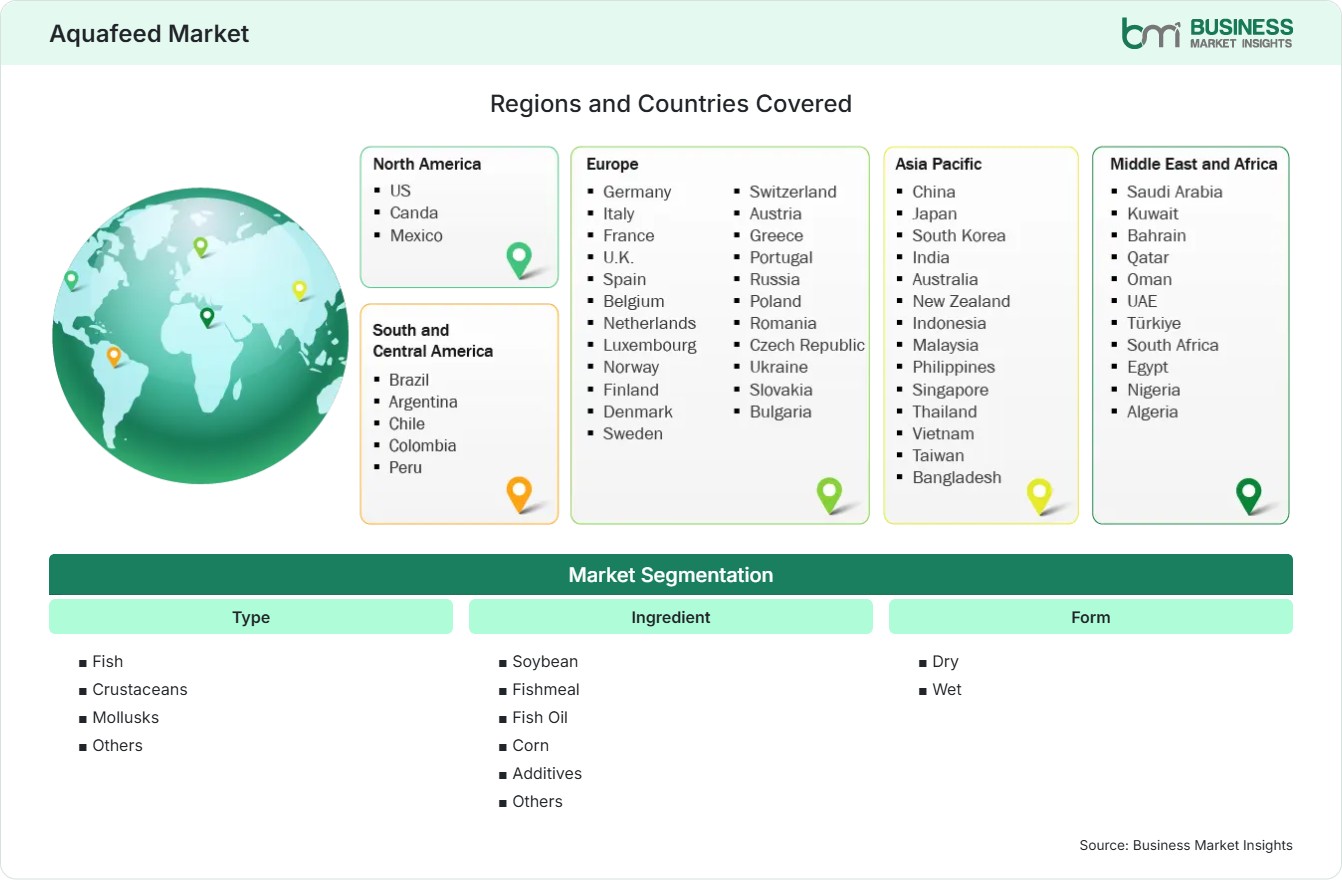
Global Market Geography
FREE PDF
Request your free sample
Request free sample
Segment Analysis

Aquafeed Market Segmentation

Type

The Type segment includes Fish, Crustaceans, Mollusks, and Others. Fish represented the leading category with 65%–68% share in 2025 and is expected to grow at a CAGR of 7.5%–8.1% during 2026–2033. Expanding fish farming activities, increasing seafood consumption, and demand for nutritional feed solutions are supporting segment development. The Aquafeed Market scope is expanding as producers adopt specialized feed formulations for different aquatic species and production environments.

  • Fish: Fish feed dominates due to large-scale aquaculture operations, increasing seafood demand, and adoption of performance-enhancing nutritional formulations.
  • Carps: Carp feed demand is supported by extensive freshwater farming, affordable protein production, and growing consumption across Asian markets.
  • Tilapias: Tilapia feed adoption is increasing through expanding commercial farming, efficient growth characteristics, and international seafood trade demand.
  • Catfish: Catfish feed demand is supported by intensive farming systems, rising market consumption, and improved feed conversion technologies.
  • Salmons: Salmon feed is growing through premium seafood demand, advanced aquaculture practices, and nutritional solutions supporting fish health.
  • Crustaceans: Crustacean feed demand is expanding through shrimp farming growth, export markets, and adoption of specialized nutrition products.
  • Mollusks: Mollusk feed solutions are developing alongside shellfish farming expansion and increasing interest in sustainable aquatic food production.
  • Others: Other aquatic species feed demand is supported by diversified aquaculture operations and development of specialized nutrition products.

Ingredient

The Ingredient segment includes Soybean, Fishmeal, Fish Oil, Corn, Additives, and Others. Soybean-based ingredients remain important due to availability, nutritional value, and increasing efforts to replace limited marine resources. The segment is expected to grow at a CAGR of 7.3%–8.0% during 2026–2033. The Aquafeed Market trends indicate increasing research into sustainable proteins, functional ingredients, and balanced formulations that improve aquatic animal growth and health.

  • Soybean: Soybean ingredients are widely used due to protein availability, cost efficiency, and suitability for multiple aquatic species.
  • Fishmeal: Fishmeal remains valuable for nutritional quality and amino acid content, especially in high-performance aquaculture feeds.
  • Fish Oil: Fish oil supports aquatic nutrition through omega-3 content and contributes to improved fish health and growth.
  • Corn: Corn ingredients provide energy sources and support formulation flexibility across different aquafeed products.
  • Additives: Additives are increasingly adopted for immunity improvement, digestion support, disease management, and enhanced feed performance.
  • Others: Other ingredients include alternative proteins and specialized components supporting sustainable aquafeed innovation.

Form

The Form segment includes Dry and Wet feed products. Dry feed accounted for the dominant position due to storage convenience, transportation efficiency, and suitability for commercial aquaculture operations. The segment is expected to grow at a CAGR of 7.5%–8.2% during 2026–2033. Dry formulations are preferred by producers seeking consistent nutrition, improved handling, and efficient feeding management across large-scale farming operations in aquafeed market.

  • Dry: Dry feed is widely adopted due to longer shelf life, easier storage, efficient transportation, and compatibility with automated feeding systems.
  • Wet: Wet feed is utilized in specific aquaculture applications where moisture content and freshness requirements support aquatic animal nutrition.
Market Forces

Aquafeed Market Dynamics

Key Market Drivers

Growing aquaculture production increasing aquafeed demand across global markets

The expansion of aquaculture production is a primary factor supporting demand for specialized feed solutions across global markets. Increasing fish and seafood farming activities are encouraging producers to adopt balanced nutrition products that improve growth rates, feed conversion efficiency, and production consistency. Rising investments in commercial aquaculture facilities are increasing requirements for species-specific formulations designed for different farming conditions. The growing need to improve productivity while reducing resource consumption is encouraging innovation in feed technologies. These developments are strengthening the market growth as producers focus on efficient farming practices. Emerging Aquafeed Market trends include sustainable ingredients, precision nutrition, and functional additives that support aquatic animal health and improve overall farm performance.

Rising seafood consumption supporting commercial aquafeed industry expansion worldwide

Increasing global seafood consumption is encouraging expansion of commercial aquaculture operations and creating sustained demand for high-quality aquatic feed products. Population growth, changing dietary preferences, and increasing demand for affordable protein sources are supporting seafood production growth across multiple regions. Aquaculture producers are adopting advanced feed formulations to maintain product quality, improve growth performance, and meet rising consumer requirements. Feed manufacturers are developing nutritional solutions that support different species, production environments, and farming intensities. The expansion of seafood processing industries and international trade is further encouraging investment in aquaculture supply chains. These factors are increasing demand for reliable aquafeed solutions across both established and emerging production markets.

Improving fish farming practices boosting high-performance aquafeed adoption

Advancements in fish farming practices are increasing adoption of high-performance aquafeed products designed to enhance productivity and aquatic animal health. Farmers are implementing improved farm management systems, monitoring technologies, and optimized feeding strategies to increase operational efficiency. High-quality feed formulations containing functional ingredients, enzymes, vitamins, and minerals are helping producers improve growth rates and reduce production challenges. The shift toward intensive aquaculture systems is increasing demand for scientifically developed nutrition solutions. Feed manufacturers are investing in research and development to create customized products for different aquatic species and farming conditions. Improved farming practices are supporting greater adoption of premium aquafeed products across commercial aquaculture operations worldwide.

Key Market Opportunities

Expansion of shrimp farming creating aquafeed market opportunities globally

The expansion of shrimp farming is creating significant opportunities for aquafeed manufacturers by increasing demand for specialized nutrition products. Shrimp producers are adopting advanced feed solutions to improve survival rates, growth performance, and disease management capabilities. Rising international demand for shrimp exports is encouraging investment in commercial farming infrastructure across Asia Pacific and Latin America. Feed companies are developing formulations containing functional additives, probiotics, and alternative ingredients to support healthier shrimp production. Increasing focus on sustainable shrimp farming practices is also creating opportunities for innovative feed solutions. Aquafeed Market Forecasts indicate that shrimp nutrition will remain an important investment area as producers seek efficient and environmentally responsible production methods.

Alternative protein ingredients supporting sustainable aquafeed product innovation

The development of alternative protein ingredients is creating opportunities for sustainable aquafeed innovation by reducing dependence on traditional marine-based resources. Feed manufacturers are researching plant-based proteins, insect meals, algae-based ingredients, and other sustainable sources to improve resource efficiency. Growing environmental concerns and pressure to maintain responsible aquaculture practices are encouraging companies to develop lower-impact feed formulations. Alternative ingredients can help improve supply chain resilience while supporting long-term production sustainability. Research collaborations between ingredient suppliers and feed producers are accelerating commercialization of new nutritional solutions. Companies investing in sustainable ingredient technologies are positioned to address evolving regulatory requirements and consumer expectations related to responsible seafood production.

Emerging aquaculture regions increasing commercial feed production capacity

Emerging aquaculture regions are creating opportunities through expanding fish farming activities, improved infrastructure, and increasing investment in commercial feed production facilities. Developing markets across Africa, Latin America, and Southeast Asia are increasing aquaculture capacity to support food security and economic development. Feed manufacturers are establishing regional production facilities and distribution networks to serve growing farmer demand. Government initiatives supporting aquaculture development are improving access to modern farming technologies and nutritional solutions. Increasing adoption of commercial feed products is helping producers transition from traditional practices toward more efficient production systems. These regional developments provide opportunities for global companies to expand their market presence and support growing aquaculture ecosystems.

Market Restraints and Challenges

Fluctuating raw material costs affecting aquafeed manufacturing profitability globally

Factor: Aquafeed production depends on raw materials including soybean, fishmeal, fish oil, grains, and functional additives, whose prices fluctuate due to supply conditions, weather factors, and global commodity market changes.

Impact: Rising raw material costs can increase manufacturing expenses, reduce profit margins, and create pricing challenges for feed producers and aquaculture operators. Companies may experience difficulty maintaining competitive product pricing while ensuring nutritional quality and consistent supply. Dependence on specific ingredients can increase vulnerability to market volatility and supply disruptions. Feed manufacturers are responding through ingredient diversification, alternative protein development, and improved formulation efficiency. Managing input cost fluctuations remains important for maintaining profitability and supporting affordable feed availability. Long-term sourcing strategies and sustainable ingredient research are becoming essential approaches for reducing cost pressures across the aquafeed value chain.

Disease outbreaks reducing aquaculture production across key farming regions

Factor: Aquaculture operations remain vulnerable to disease outbreaks caused by pathogens, environmental changes, and intensive farming conditions affecting aquatic animal health.

Impact: Disease outbreaks can reduce production volumes, increase mortality rates, raise operational costs, and lower demand for feed products in affected farming regions. Producers may face financial losses while investing additional resources in prevention, treatment, and farm management improvements. Feed manufacturers are developing functional nutrition products containing immune-supporting additives and health-enhancing ingredients to reduce disease risks. However, disease-related disruptions can continue affecting aquaculture productivity and supply stability. Strengthening biosecurity practices, improving farm monitoring, and adopting preventive nutrition strategies are becoming important measures for maintaining stable production and supporting long-term aquafeed demand.

Company Analysis

Competitive Landscape

The Aquafeed Market analysis highlights a competitive environment shaped by sustainable ingredient innovation, species-specific nutrition development, production expansion, and increasing focus on efficient aquaculture solutions. Leading companies are investing in advanced formulations, research capabilities, strategic partnerships, and regional manufacturing networks to strengthen their positions.

Company Name

Overview

Products and Services relevant to this market

Cargill Incorporated

Global food and agriculture company providing animal nutrition solutions for aquaculture producers worldwide.

Aquafeed products, fish nutrition solutions, sustainable ingredients, and specialized aquatic feed formulations.

ADM

Global nutrition and agricultural company developing feed ingredients and animal nutrition solutions.

Aquaculture feed ingredients, nutritional additives, specialty feed products, and sustainable formulation solutions.

Nutreco N.V.

Animal nutrition company focused on innovative feed solutions for livestock and aquaculture industries.

Aquafeed brands, fish nutrition products, sustainable feed technologies, and research-based formulations.

BioMar Group A/S

Aquaculture feed company specializing in high-performance nutrition products for aquatic species.

Fish feed, shrimp feed, functional nutrition products, and sustainable aquaculture feed solutions.

Aller Aqua Group

Aquaculture feed manufacturer providing nutrition solutions for freshwater and marine species.

Fish feed products, species-specific formulations, and advanced aquatic nutrition solutions.

Skretting AS

Global aquaculture nutrition company developing feed products for multiple aquatic species.

Salmon feed, shrimp feed, fish nutrition products, and sustainable aquaculture solutions.

Charoen Pokphand Foods PCL

Food and agriculture company involved in integrated aquaculture and feed production operations.

Aquafeed products, shrimp feed, fish feed, and integrated aquaculture nutrition solutions.

Ridley Corporation Limited

Australian animal nutrition company supplying feed solutions across agricultural sectors.

Aquaculture feed products, nutritional services, and customized aquatic feed solutions.

Biomin Holding GmbH

Animal nutrition company specializing in functional feed additives and health solutions.

Feed additives, mycotoxin management solutions, and aquaculture nutrition technologies.

De Heus Animal Nutrition

Global animal nutrition company producing specialized feed solutions for farming industries.

Aquaculture feeds, nutritional programs, feed formulation expertise, and farming support services.

Trust & Transparency

Research Methodology

The market analysis combines proprietary research with secondary data from government agencies, company disclosures, regulatory filings, industry databases and expert interviews. Market estimates are validated through data triangulation, cross-market benchmarking and analyst review.

View Full Research Methodology

Questions Answered

Frequently Asked Questions

What information is included in an Aquafeed Market Report?

An Aquafeed Market Report includes market size, share analysis, segmentation, regional trends, competitive landscape, growth drivers, opportunities, restraints, company developments, and future industry outlook.

Why are functional additives becoming important in aquaculture nutrition?

Functional additives support immunity, digestion, growth performance, and disease resistance, helping producers improve productivity and reduce operational challenges in intensive aquaculture systems.

Which species segments provide major growth opportunities in aquafeed?

Fish and crustacean segments provide strong opportunities due to expanding farming activities, export demand, increasing seafood consumption, and adoption of specialized nutritional products for improved production efficiency.

How are sustainable ingredients changing aquafeed development?

Sustainable ingredients such as alternative proteins, algae-based components, and plant-based sources are helping manufacturers reduce environmental impact while improving supply chain flexibility and supporting responsible aquaculture practices.

What factors are influencing demand for aquafeed products worldwide?

Demand is influenced by expanding aquaculture production, increasing seafood consumption, improved farming practices, sustainable nutrition requirements, and the need for efficient feed solutions that enhance aquatic animal growth and health.

Access the Full Aquafeed Market Report

Get segment-level forecasts, regional estimates, competitive benchmarking, company profiles and downloadable Excel datasets.

Access the full Aquafeed Market Report
350 pages PDF & Excel | 2026-08-10
Similar Research

Related Market Reports