
Natural Language Processing (NLP) Market Outlook: Size, Share, Trends, Growth Analysis, Competitive Landscape & Forecast, 2022-2033

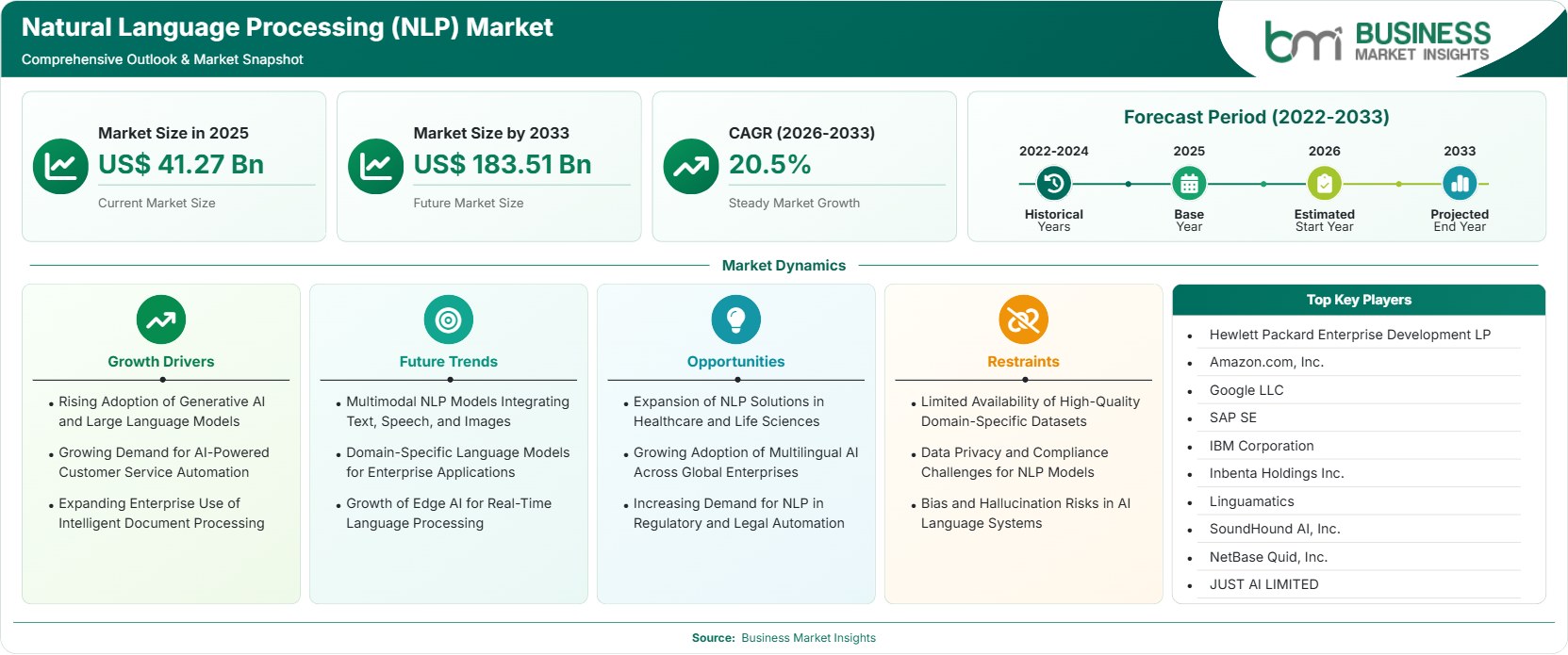
The Natural Language Processing (NLP) Market size was valued at US$ 41.27 Billion in 2025 and is projected to reach US$ 183.51 Billion by 2033, growing at a CAGR of 20.50% during 2026–2033. Rising adoption of generative AI solutions, increasing enterprise demand for conversational platforms, expanding deployment of intelligent automation technologies, and growing use of language-based analytics are supporting market expansion. Significant opportunities are emerging from customer experience enhancement, multilingual AI platforms, and AI-powered enterprise productivity solutions.

Report Coverage
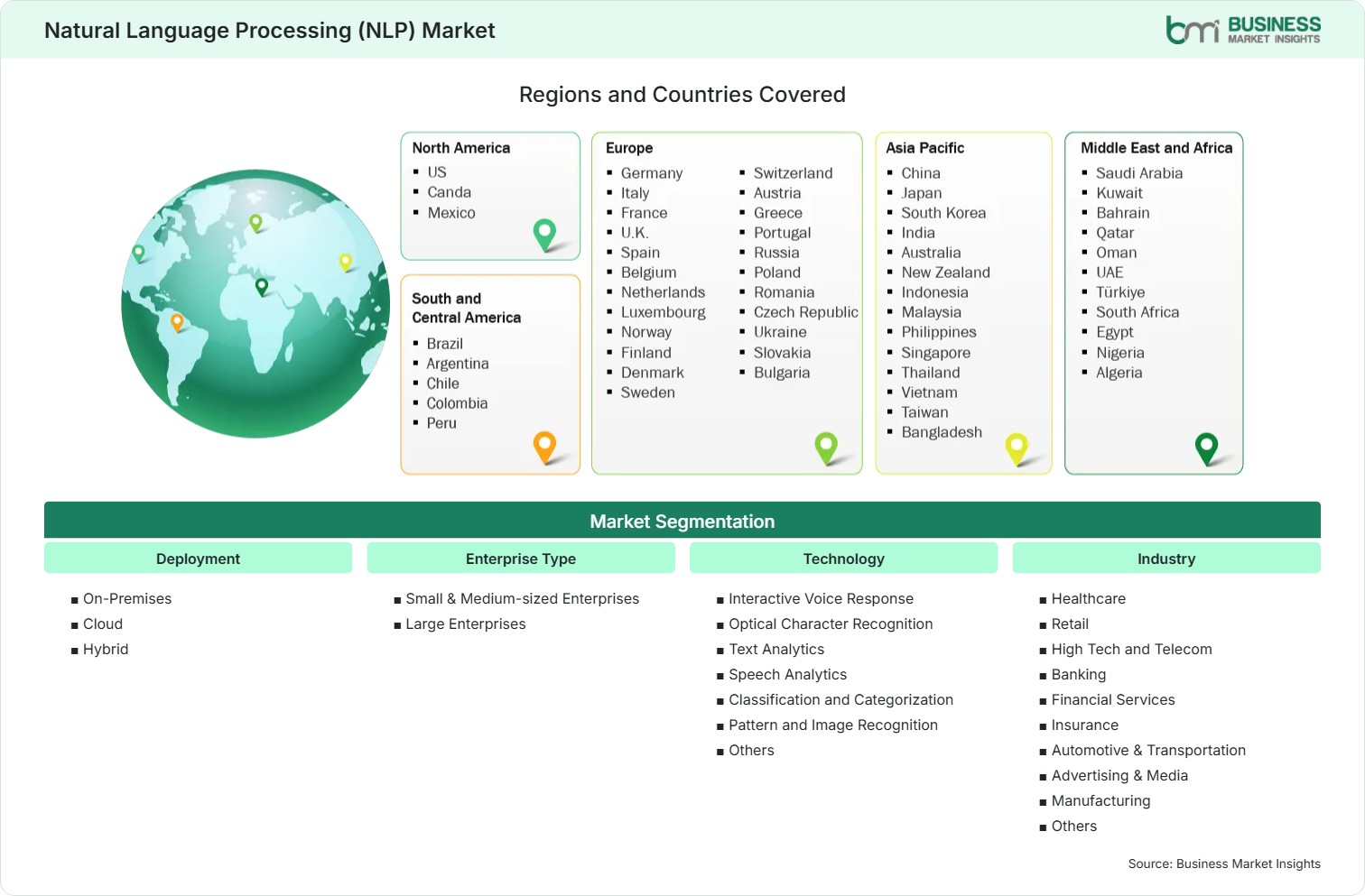
  • Deployment: On-Premises, Cloud, Hybrid
  • Enterprise Type: Small & Medium-sized Enterprises, Large Enterprises
  • Technology: Interactive Voice Response, Optical Character Recognition, Text Analytics, Speech Analytics, Classification and Categorization, Pattern and Image Recognition, Others
  • Industry: Healthcare, Retail, High Tech and Telecom, Banking, Financial Services, Insurance, Automotive & Transportation, Advertising & Media, Manufacturing, Others
US$ 41.27 Bn Market size in 2025
US$ 183.51 Bn Market Size by 2033
20.5% CAGR, 2026 - 2033
2026-2033 Forecast Period

01 AI Overview

Natural Language Processing (NLP) Market Summary

  • North America Region: North America holds a natural language processing (NLP) market share of 37%–40% in 2025 and is projected to grow at a CAGR of 19%–21% during 2026–2033. Strong AI investments, advanced cloud infrastructure, widespread enterprise digitalization, and growing adoption of generative AI applications continue supporting regional leadership. The US market is projected to grow at a CAGR of 19.5%–21.5% through 2033.
  • Fastest Growing Region: Asia Pacific accounts for 24%–27% share in 2025 and is expected to grow at a CAGR of 22%–24% during the forecast period. Increasing AI investments, digital transformation initiatives, and rapid enterprise technology adoption are fueling regional growth.
  • Leading Segment: Cloud deployment represents 52%–55% share in 2025 and is projected to grow at a CAGR of 21%–23% through 2033. Scalability, lower infrastructure costs, and ease of integration continue driving enterprise adoption.
  • High Growth Segment: Speech Analytics holds 14%–17% share in 2025 and is projected to grow at a CAGR of 24%–26% during 2026–2033. Customer experience optimization, contact center automation, and real-time sentiment analysis are accelerating demand.
  • Key Market Opportunity: Expanding adoption of generative AI assistants, multilingual conversational platforms, intelligent document processing, and industry-specific language models is creating substantial opportunities across enterprise environments.
  • Major Market Players: Hewlett Packard Enterprise Development LP, Amazon.com, Inc., Google LLC, SAP SE, IBM Corporation, Inbenta Holdings Inc., Linguamatics, SoundHound AI, Inc., NetBase Quid, Inc., and JUST AI LIMITED.
02 Strategic Insights

Natural Language Processing (NLP) Market: Strategic Insights

natural-language-processing-nlp-market-market-strategic-framework
FREE PDF
Request your free sample
Request free sample
03 Stakeholder View

Key Takeaways

  • The market ecosystem is increasingly driven by generative AI adoption, creating demand for advanced language understanding and content generation capabilities.
  • Cloud deployment remains the dominant implementation model due to scalability advantages, lower capital requirements, and simplified integration across enterprise environments.
  • Speech analytics represents one of the most attractive investment opportunities because organizations are prioritizing customer experience optimization and contact center intelligence.
  • Large enterprises continue accounting for significant adoption volumes as they pursue digital transformation and enterprise-wide AI implementation strategies.
  • Healthcare, BFSI, retail, and telecommunications industries remain among the most active adopters of NLP-driven analytics and automation solutions.
  • Organizations are increasingly investing in multilingual AI systems capable of supporting global operations and diverse customer bases.
  • The Natural Language Processing (NLP) Market trend highlights growing demand for industry-specific large language models designed to improve accuracy and regulatory compliance.
04 Geographic Outlook

Natural Language Processing (NLP) Market Regional Highlights

North America Natural Language Processing (NLP) Market

North America accounted for a 37%–40% share in 2025 and is projected to expand at a CAGR of 19%–21% during 2026–2033. The region benefits from a mature artificial intelligence ecosystem, high cloud adoption rates, strong enterprise technology spending, and the presence of major NLP solution providers. The Natural Language Processing (NLP) Market share remains concentrated in the US due to widespread deployment of generative AI solutions, enterprise automation initiatives, and continuous investments in language intelligence technologies.

  • Enterprises across industries are increasingly deploying NLP platforms to automate customer interactions, document analysis, and knowledge management workflows.
  • Rapid adoption of generative AI tools is accelerating demand for conversational interfaces, intelligent assistants, and enterprise language models.
  • Financial institutions, healthcare providers, and technology companies continue expanding investments in language-driven analytics and decision-support capabilities.
  • Strong cloud infrastructure and AI research ecosystems enable rapid commercialization of advanced NLP applications.
  • Organizations are prioritizing operational efficiency and customer experience improvements, creating sustained demand for intelligent language processing solutions.

US Natural Language Processing (NLP) Market

The US represented a 32%–35% share in 2025 and is estimated to grow at a CAGR of 19.5%–21.5% through 2033. Strong enterprise digital transformation strategies, significant investments in artificial intelligence, and increasing adoption of generative AI applications support market expansion. The Natural Language Processing (NLP) Market growth in the US is driven by widespread deployment of chatbots, intelligent virtual assistants, automated content generation tools, and advanced analytics platforms.

  • Enterprises are increasingly utilizing NLP-powered systems to improve customer engagement and automate high-volume communication processes.
  • Growing investments in large language models are enabling more advanced enterprise applications and industry-specific AI deployments.
  • Healthcare and BFSI organizations continue expanding implementation of NLP tools for compliance, documentation, and analytics functions.
  • Increasing adoption of AI-driven workplace productivity tools is supporting broader penetration across commercial sectors.

Europe Natural Language Processing (NLP) Market

Europe held a 26%–29% share in 2025 and is expected to grow at a CAGR of 18%–20% from 2026–2033. Germany, the UK, and France represent major Natural Language Processing (NLP) markets due to strong digital transformation initiatives, enterprise software investments, and increasing use of AI-driven business intelligence solutions. Germany is estimated to expand at 19%–21% CAGR, supported by Industry 4.0 initiatives and growing deployment of intelligent automation platforms.

  • Enterprises are increasingly implementing NLP technologies to improve operational efficiency and automate enterprise knowledge management processes.
  • Germany is strengthening adoption through industrial digitalization programs and increasing utilization of AI-driven analytics systems.
  • The UK benefits from significant investment in AI research, enterprise software modernization, and conversational AI deployments.
  • France continues expanding adoption through government-supported digital transformation initiatives and advanced technology investments.
  • Demand for multilingual NLP platforms is increasing as organizations seek solutions capable of supporting diverse European markets.

Asia Pacific Natural Language Processing (NLP) Market

Asia Pacific accounted for a 24%–27% share in 2025 and is projected to register a CAGR of 22%–24% during 2026–2033. China, India, Japan, and South Korea are leading markets due to rapid digital transformation, increasing cloud adoption, and significant investments in artificial intelligence technologies. China is expected to grow at 23%–25% CAGR, while India demonstrates strong expansion potential with a CAGR of 24%–26% during the forecast period.

  • Governments and enterprises are increasing investments in AI infrastructure and intelligent automation technologies across major economies.
  • China is witnessing significant NLP adoption across e-commerce, financial services, telecommunications, and government applications.
  • Japan continues investing in conversational AI, intelligent customer support systems, and enterprise automation solutions.
  • India is experiencing strong demand for multilingual NLP platforms capable of supporting diverse regional language requirements.
  • Growing digitalization of businesses and public services is accelerating deployment of advanced language processing solutions.

Rest of World Natural Language Processing (NLP) Market

Rest of World accounted for a 8%–11% share in 2025 and is expected to grow at a CAGR of 18%–20% through 2033. The Middle East, Africa, and South America are witnessing increased adoption of AI-powered business applications, cloud-based analytics platforms, and intelligent customer engagement technologies. Brazil, the UAE, and Saudi Arabia represent important growth markets as organizations accelerate digital transformation initiatives.

  • Enterprises are increasingly deploying AI-driven customer service and analytics solutions to improve operational performance and consumer engagement.
  • Saudi Arabia is supporting adoption through large-scale digital transformation programs and national artificial intelligence initiatives.
  • The UAE continues investing in advanced technologies to modernize public services and enterprise operations.
  • Brazilian organizations are leveraging NLP applications to enhance customer analytics, digital commerce, and operational efficiency.
  • Growing cloud adoption and digitalization investments are creating favorable conditions for NLP solution providers across emerging markets.
global-market-geography
FREE PDF
Request your free sample
Request free sample
05 Segment Analysis

Natural Language Processing (NLP) Market Segmentation

Deployment

Deployment models play a critical role in determining scalability, security, implementation costs, and operational flexibility for NLP solutions. Cloud Deployment accounted for 52%–55% share in 2025 and is projected to grow at a CAGR of 21%–23% through 2033 due to increasing enterprise adoption of cloud-based AI applications, lower infrastructure requirements, and easier scalability.

  • On-Premises: Preferred by organizations handling highly sensitive data and requiring greater control over security, compliance, and system management.
  • Cloud: The leading segment owing to its flexibility, cost efficiency, scalability, and ability to support rapid deployment of NLP applications across enterprises.
  • Hybrid: Gaining traction among organizations seeking a balance between cloud scalability and on-premises data security and governance.

Enterprise Type

Enterprise adoption varies based on budget availability, digital transformation priorities, and operational complexity. Large Enterprises accounted for 67%–70% share in 2025 and are expected to grow at a CAGR of 20%–22% through 2033 due to greater investments in AI infrastructure, automation technologies, and customer experience enhancement initiatives.

  • Small & Medium-sized Enterprises: Adoption is increasing as cloud-based NLP platforms become more affordable and accessible for customer service, analytics, and workflow automation.
  • Large Enterprises: The dominant segment due to extensive use of conversational AI, intelligent document processing, sentiment analysis, and enterprise-wide automation platforms.

Technology

Technology segmentation reflects the broad range of NLP capabilities being deployed across modern organizations. Text Analytics represented 22%–25% share in 2025 and is projected to grow at a CAGR of 21%–23% through 2033 due to increasing analysis of customer feedback, documents, social media content, and business communications.

  • Interactive Voice Response: Widely utilized in customer service environments for automated call handling and voice-based support.
  • Optical Character Recognition: Supports extraction and digitization of information from scanned documents, forms, and printed records.
  • Text Analytics: The leading segment due to growing demand for sentiment analysis, content classification, customer intelligence, and business insights.
  • Speech Analytics: The fastest-growing segment, projected to expand at a CAGR of 24%–26% through 2033 as organizations increasingly analyze voice interactions to improve customer experience.
  • Classification and Categorization: Used extensively for document management, content organization, compliance monitoring, and workflow automation.
  • Pattern and Image Recognition: Supports identification of data patterns and integration of visual intelligence with language-processing capabilities.
  • Others: Includes machine translation, question answering, entity recognition, summarization, and advanced generative AI language applications.

Industry

Industry adoption is expanding rapidly as organizations increasingly utilize language intelligence to improve operational efficiency, customer engagement, and decision-making capabilities. Banking, Financial Services, and Insurance (BFSI) accounted for 19%–22% share in 2025 and is projected to grow at a CAGR of 21%–23% through 2033 due to extensive use of conversational AI, fraud monitoring, compliance management, and customer analytics.

  • Healthcare: Utilizes NLP for clinical documentation, patient engagement, medical coding, and healthcare analytics.
  • Retail: Benefits from customer sentiment analysis, recommendation engines, chatbot deployment, and personalized shopping experiences.
  • High Tech and Telecom: Employs NLP for customer service automation, network support, and intelligent knowledge management.
  • Banking, Financial Services, and Insurance (BFSI): The leading segment driven by digital banking initiatives, automated customer support, risk assessment, and regulatory compliance applications.
  • Automotive & Transportation: Uses NLP for connected vehicles, virtual assistants, logistics optimization, and customer engagement platforms.
  • Advertising & Media: Leverages language analytics for content analysis, audience insights, social listening, and campaign optimization.
  • Manufacturing: Utilizes NLP for document automation, operational intelligence, predictive maintenance support, and workforce productivity enhancement.
  • Others: Includes government, education, legal services, energy, hospitality, and public sector organizations adopting advanced language intelligence solutions.
06 Market Forces

Natural Language Processing (NLP) Market Dynamics

Key Market Drivers

Rising Adoption of Generative AI and Large Language Models

The rapid adoption of generative AI and large language models (LLMs) is significantly accelerating the growth of the Natural Language Processing (NLP) Market. Organizations are deploying AI-powered assistants, enterprise chatbots, intelligent search platforms, and content generation tools to improve productivity and customer engagement. Advanced foundation models enable document summarization, software development support, and automated communication while enhancing decision-making. As enterprises expand AI adoption, demand for scalable NLP platforms, language models, and deployment services continues to grow across industries.

Growing Demand for AI-Powered Customer Service Automation

Customer experience has become a key business priority, driving widespread adoption of NLP-powered conversational AI solutions. Organizations are implementing intelligent virtual assistants and chatbots to deliver faster, personalized, and round-the-clock customer support while reducing operational costs. NLP technologies enable accurate intent recognition, sentiment analysis, and multilingual communication across digital channels. Increasing automation initiatives in retail, banking, healthcare, telecommunications, and travel are strengthening demand for advanced customer service platforms and intelligent interaction management solutions.

Expanding Enterprise Use of Intelligent Document Processing

Growing volumes of unstructured enterprise data are driving adoption of NLP-based intelligent document processing solutions. Organizations use these technologies to automate data extraction, document classification, contract analysis, invoice processing, and regulatory compliance tasks. Intelligent automation reduces manual workloads, improves accuracy, and accelerates business operations while transforming unstructured content into actionable insights. Rising digital transformation initiatives across BFSI, healthcare, legal, manufacturing, and government sectors continue to support strong demand for advanced NLP-enabled document management and workflow automation solutions.

Key Market Opportunities

Expansion of NLP Solutions in Healthcare and Life Sciences

Healthcare and life sciences organizations are increasingly adopting NLP technologies to improve clinical documentation, medical coding, patient engagement, drug discovery, and research operations. Healthcare providers generate significant volumes of unstructured information that can be transformed into actionable insights using advanced language processing solutions. Natural Language Processing (NLP) Market Forecast indicates substantial growth opportunities as hospitals, pharmaceutical companies, and research institutions accelerate investments in artificial intelligence initiatives. NLP technologies support clinical decision-making, automate administrative processes, and improve access to valuable healthcare information. The increasing digitalization of healthcare systems and the growing importance of data-driven medicine are expected to create significant long-term opportunities for NLP solution providers serving the healthcare ecosystem.

Growing Adoption of Multilingual AI Across Global Enterprises

As organizations expand internationally, the ability to interact effectively with customers, employees, and partners across multiple languages is becoming increasingly important. Modern NLP platforms can support multilingual communication, translation, sentiment analysis, and content generation across diverse language environments. Enterprises are investing in multilingual AI solutions to improve customer experiences, expand market reach, and streamline global operations. The Natural Language Processing (NLP) Market scope is expanding as businesses seek technologies capable of addressing linguistic diversity while maintaining consistency and efficiency. Advances in transformer-based architectures and multilingual language models are improving translation quality and contextual understanding, making these solutions increasingly valuable for multinational organizations operating across different geographic regions.

Increasing Demand for NLP in Regulatory and Legal Automation

Regulatory compliance and legal document management remain highly resource-intensive activities across industries. NLP technologies are creating opportunities to automate contract review, regulatory monitoring, legal research, compliance reporting, and risk assessment processes. Organizations are increasingly deploying language-processing solutions to reduce manual workloads, improve accuracy, and accelerate decision-making. Financial institutions, healthcare organizations, government agencies, and legal service providers are among the leading adopters of regulatory automation technologies. As regulatory requirements grow increasingly complex, enterprises are seeking innovative solutions capable of managing large volumes of compliance-related information efficiently. This trend is expected to generate significant opportunities for NLP vendors offering specialized automation platforms designed for highly regulated industries.

Market Restraints and Challenges

Limited Availability of High-Quality Domain-Specific Datasets

Factor: Optimal functioning of advanced natural language processing (NLP) models requires a vast amount of high-quality, varied, and subject-specific data. In many sectors, there is not enough high-quality data for model training and validation.

Impact: Data scarcity may compromise model accuracy, limit the effectiveness of use cases, and complicate development. Some of the most highly specialized fields include healthcare, law, engineering, and science. The problem is that these industries are constrained by numerous data limitations due to privacy concerns and limited data availability. The process will be complicated by the implementation of NLP technology and will also lead to increased development expenses.

Data Privacy and Compliance Challenges for NLP Models

Factor: Language processing tools often deal with personal, business, financial, and medical information that is very sensitive. The companies must comply with various data protection acts and regulations when implementing language-based AI technologies.

Impact: Problems with regulatory compliance may result in increased implementation difficulties, reduced data utility flexibility, and increased costs. It is important for businesses to build robust security architectures, data governance practices, and transparency measures to ensure compliance and maintain user confidence. Questions related to data ownership, model transparency, information security, and ethical use of AI still affect the decision-making process for technology implementation.

07 Company Analysis

Competitive Landscape

The Natural Language Processing (NLP) Market analysis is characterized by intense competition among cloud providers, enterprise software developers, conversational AI specialists, analytics vendors, and artificial intelligence technology providers. Market participants are focusing on large language model development, industry-specific AI solutions, intelligent document processing platforms, speech analytics, multilingual AI capabilities, and enterprise automation technologies. Strategic collaborations between cloud providers, software vendors, and industry-specific solution providers are accelerating NLP innovation and commercialization. The market trends indicate increasing competition around generative AI integration, enterprise productivity enhancement, and domain-specific language intelligence solutions.

Company Name

Overview

Products and Services Relevant to this Market

Hewlett Packard Enterprise Development LP

Enterprise technology provider supporting AI infrastructure and analytics deployments.

AI infrastructure, data analytics platforms, enterprise AI solutions, and cloud services.

Amazon.com, Inc.

Global cloud and AI technology leader with extensive NLP capabilities.

Conversational AI, machine learning services, language processing APIs, and enterprise AI platforms.

Google LLC

Major artificial intelligence innovator with advanced language model technologies.

NLP platforms, language models, cloud AI services, and conversational AI solutions.

SAP SE

Enterprise software provider integrating AI capabilities across business applications.

Intelligent automation, document processing, analytics, and enterprise workflow solutions.

IBM Corporation

Global technology company with extensive AI and NLP expertise.

Watson AI, text analytics, conversational AI, and enterprise language intelligence solutions.

Inbenta Holdings Inc.

Specialized provider of conversational AI and customer interaction platforms.

Chatbots, virtual assistants, knowledge management, and customer experience solutions.

Linguamatics

NLP specialist focused on healthcare and scientific text analytics.

Text mining, healthcare analytics, research intelligence, and linguistic processing solutions.

SoundHound AI, Inc.

Conversational intelligence company specializing in voice-enabled technologies.

Speech recognition, voice AI, conversational platforms, and intelligent assistant solutions.

NetBase Quid, Inc.

Analytics company focused on consumer and market intelligence.

Social analytics, sentiment analysis, market intelligence, and NLP-powered business insights.

JUST AI LIMITED

Developer of conversational artificial intelligence technologies.

Virtual assistants, chatbot platforms, voice automation, and customer engagement solutions.


10 Trust & Transparency

Research Methodology

The market analysis combines proprietary research with secondary data from government agencies, company disclosures, regulatory filings, industry databases and expert interviews. Market estimates are validated through data triangulation, cross-market benchmarking and analyst review.

View Full Research Methodology

11 Questions Answered

Frequently Asked Questions

What opportunities exist for NLP solution providers?

Key opportunities include healthcare analytics, multilingual AI, intelligent document processing, regulatory automation, conversational commerce, and industry-specific language intelligence platforms.

Why does North America lead the market?

North America leads due to strong AI investments, advanced cloud infrastructure, widespread enterprise technology adoption, and the presence of major NLP technology developers and innovators.

Which technology segment is growing the fastest?

Speech Analytics is the fastest-growing technology segment due to increasing demand for contact center intelligence, customer sentiment analysis, and real-time conversational insights.

Which deployment model dominates the market?

Cloud deployment dominates the market due to its scalability, lower infrastructure costs, ease of implementation, and ability to provide continuous model updates and performance enhancements.

What is driving growth in the natural language processing (NLP) market report?

Growth is driven by increasing adoption of generative AI, expanding enterprise automation initiatives, rising demand for conversational AI platforms, and growing utilization of intelligent document processing technologies.

Access the Full Natural Language Processing (NLP) Market Report

Get segment-level forecasts, regional estimates, competitive benchmarking, company profiles and downloadable Excel datasets.

Access the full Natural Language Processing (NLP) Market Report
350 pages PDF & Excel | 2026-08-03