
Mustard Market Outlook: Size, Share, Trends, Growth Analysis, Competitive Landscape & Forecast, 2026-2033

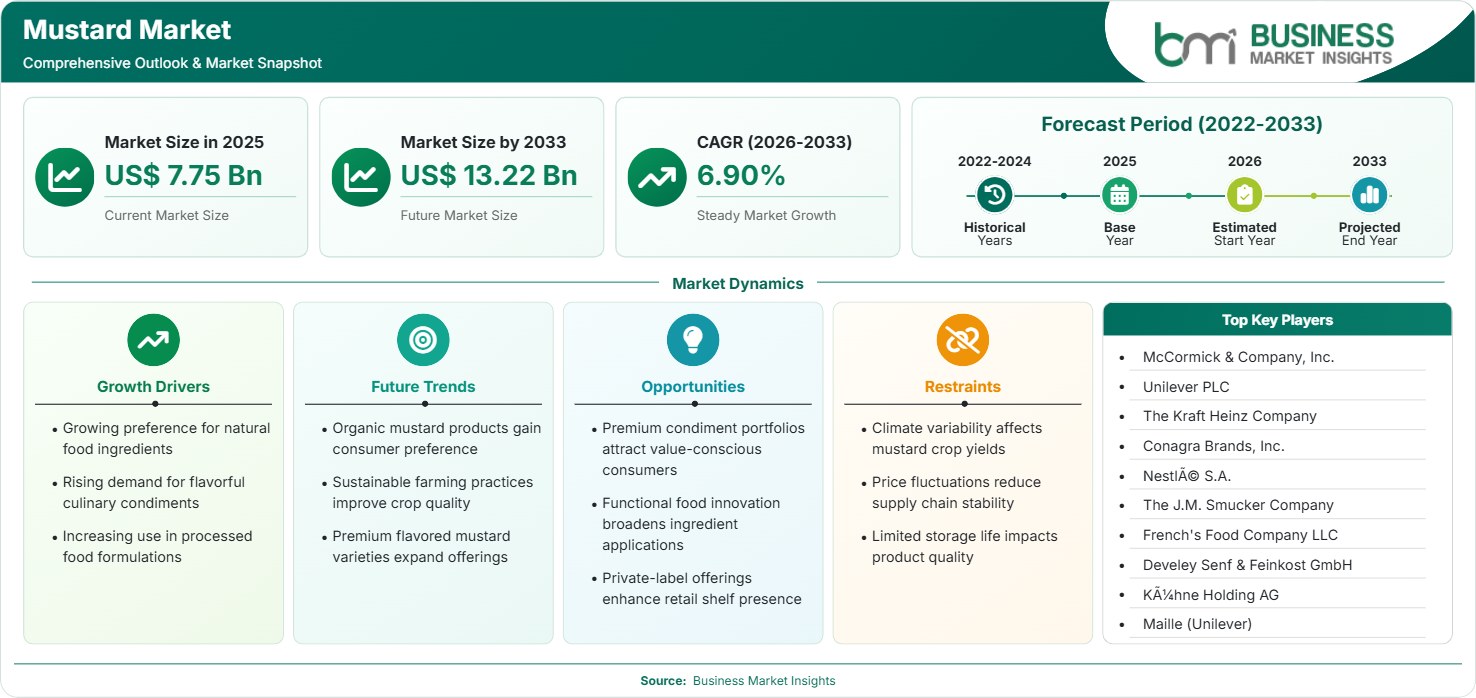
The Mustard Market size was valued at US$ 7.75 billion in 2025 and is projected to reach US$ 13.22 billion by 2033, growing at a CAGR of 6.90% during 2026–2033. Growing preference for natural food ingredients, rising demand for flavorful culinary condiments, and increasing use in processed food formulations continue to strengthen global market demand.

Report Coverage
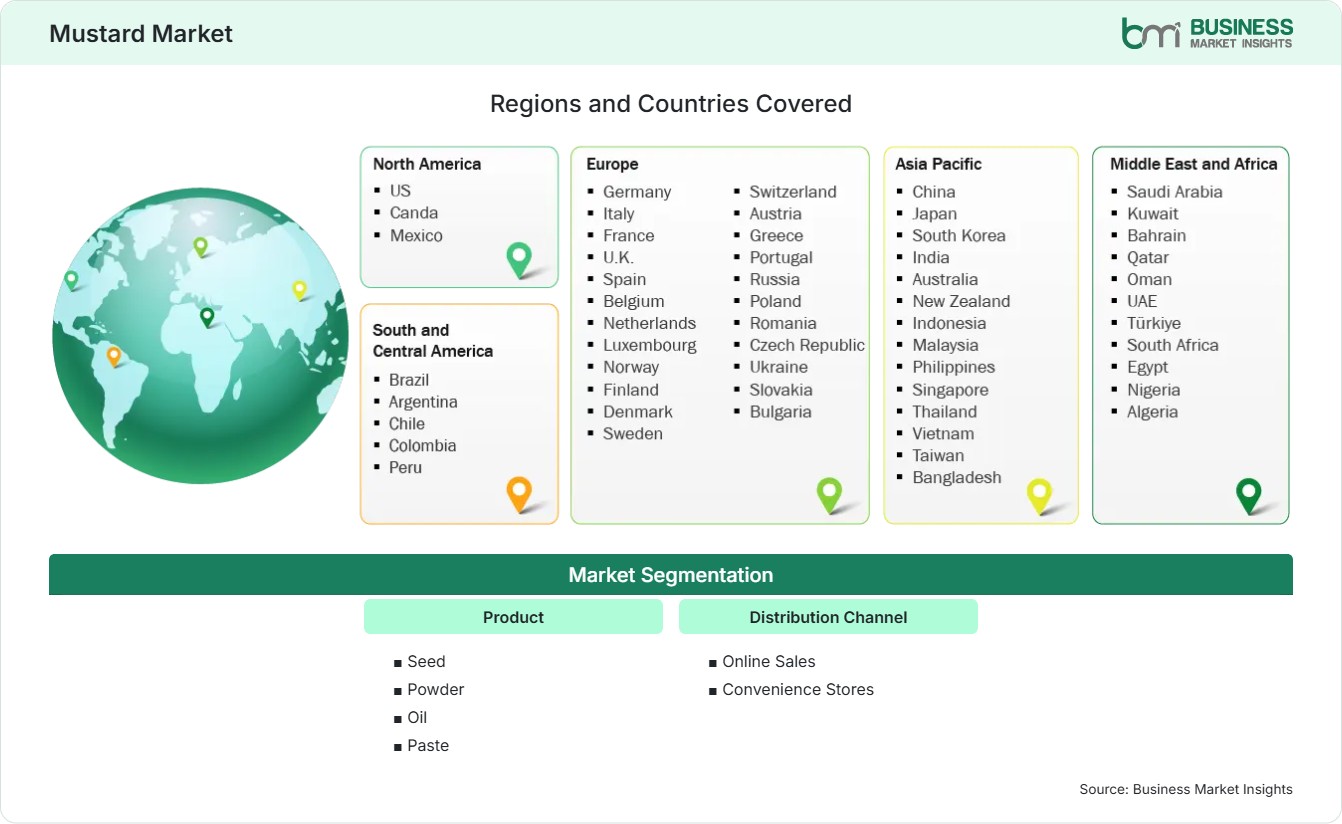
  • Product: Seed, Powder, Oil, Paste
  • Distribution Channel: Online Sales, Convenience Stores
US$ 7.75 Bn Market size in 2025
US$ 13.22 Bn Market Size by 2033
6.90% CAGR, 2026 - 2033
2026-2033 Forecast Period

01 AI Overview

Mustard Market Summary

  • North America Region: North America accounts for 33%–36% market share in 2025 and is projected to expand at a CAGR of 6.5%–7.0% during 2026–2033. Strong condiment consumption, product innovation, and premium food preferences support regional demand. The U.S. remains the largest contributor with a CAGR of 6.6%–7.1%, driven by growing demand for clean-label sauces and gourmet food products.
  • Fastest Growing Region: Asia Pacific represents 25%–28% market share in 2025 and is expected to register a CAGR of 7.5%–8.0%, supported by rising processed food consumption, expanding retail networks, changing dietary habits, and increasing demand for packaged condiments.
  • Leading Segment: Paste accounts for 38%–41% market share in 2025 and is anticipated to grow at a CAGR of 7.0%–7.5%, owing to widespread household consumption, foodservice demand, and expanding product varieties.
  • High Growth Segment: Online Sales capture 18%–21% market share in 2025 and are projected to record a CAGR of 8.0%–8.6%, driven by expanding e-commerce platforms, premium product availability, and direct-to-consumer sales strategies.
  • Key Market Opportunity: Manufacturers are expanding premium, organic, and flavored mustard portfolios while strengthening digital retail channels to meet changing consumer preferences and create higher-value product offerings.
  • Major Market Players: McCormick & Company, Inc., Unilever PLC, The Kraft Heinz Company, Conagra Brands, Inc., Nestlé S.A., The J.M. Smucker Company, French's Food Company LLC, Develey Senf & Feinkost GmbH, Kühne Holding AG, and Maille (Unilever).
02 Strategic Insights

Mustard Market: Strategic Insights

Mustard Market Strategic Framework
FREE PDF
Request your free sample
Request free sample
03 Stakeholder View

Key Takeaways

  • Food manufacturers continue strengthening relationships with mustard seed suppliers to improve supply stability, maintain product quality, and reduce procurement risks associated with agricultural production.
  • Premium condiments featuring organic ingredients, regional flavors, and clean-label positioning are creating stronger growth opportunities than conventional product categories.
  • Innovation increasingly focuses on low-sodium recipes, preservative-free formulations, and sustainable packaging to address changing consumer expectations and evolving food regulations.
  • Asia Pacific presents attractive investment opportunities as expanding urban populations and organized retail networks continue driving packaged condiment consumption.
  • Strategic partnerships, acquisitions, and product portfolio expansion remain key competitive strategies among leading condiment manufacturers seeking broader geographic presence.
  • Digital retail platforms continue reshaping purchasing behavior by increasing product visibility, improving consumer access, and supporting premium and specialty mustard brands.
04 Geographic Outlook

Mustard Market Regional Highlights

North America Mustard Market

North America represents 33%–36% Mustard Market share in 2025 and is projected to grow at a CAGR of 6.5%–7.0% during 2026–2033. Strong household consumption, an established condiment industry, and increasing demand for premium food products continue supporting market expansion. Manufacturers are introducing organic, flavored, and reduced-sodium varieties while strengthening sustainable sourcing initiatives and recyclable packaging solutions to meet evolving consumer preferences.

  • Premium condiment brands continue expanding flavored mustard portfolios targeting gourmet cooking and premium retail channels.
  • Foodservice operators increasingly incorporate specialty mustard products into sandwiches, sauces, dressings, and prepared meals.
  • Growing demand for clean-label ingredients encourages manufacturers to reduce artificial preservatives and simplify product formulations.
  • Investments in sustainable packaging and efficient manufacturing strengthen long-term competitiveness across the regional market.

US Mustard Market

The United States contributes 82%–85% of North American revenue and is expected to register a CAGR of 6.6%–7.1% during 2026–2033. Strong consumer spending, established food processing industries, and continuous product innovation support steady demand across both retail and foodservice sectors.

  • Premium and organic condiment products continue gaining popularity among health-conscious consumers.
  • Online grocery platforms improve accessibility for specialty mustard products across urban and suburban markets.
  • Manufacturers continue investing in sustainable packaging and production efficiency.
  • Restaurant chains increasingly introduce premium mustard varieties across expanding menu offerings.

Europe Mustard Market

Europe accounts for 31%–34% market share in 2025 and is forecast to grow at a CAGR of 6.4%–6.9% during the forecast period. Traditional consumption patterns, established condiment manufacturers, and growing interest in regional flavors continue supporting market demand. Germany remains the leading market, while Poland demonstrates the fastest growth through expanding food manufacturing and retail distribution.

  • Traditional mustard recipes continue maintaining strong consumer loyalty across European markets.
  • Organic and locally sourced ingredients strengthen premium condiment product development.
  • Retailers continue expanding private-label condiment portfolios across supermarket chains.
  • Sustainable production practices receive greater attention from manufacturers and consumers alike.

Asia Pacific Mustard Market

Asia Pacific holds 25%–28% market share in 2025 and is projected to record the fastest 7.5%–8.0% CAGR through 2026–2033. Rising processed food consumption, urbanization, expanding modern retail infrastructure, and increasing exposure to international cuisines continue driving regional demand for packaged mustard products.

  • Growing quick-service restaurant chains encourage wider use of condiment products across emerging markets.
  • Higher disposable incomes increase consumer spending on premium packaged food products.
  • Food manufacturers continue introducing localized flavors to strengthen regional market acceptance.
  • Expanding e-commerce platforms support greater availability of imported and premium condiment brands.

Rest of World Mustard Market

The Rest of World region represents 7%–10% market share in 2025 and is expected to expand at a CAGR of 6.8%–7.3% during 2026–2033. Growing urban populations, increasing packaged food consumption, and expanding retail infrastructure continue supporting market development across Latin America, the Middle East, and Africa.

  • Brazil leads regional condiment consumption through expanding processed food production.
  • Gulf countries continue witnessing stronger demand for premium imported condiment products.
  • Local manufacturers introduce affordable product variants targeting wider consumer groups.
  • Modern retail expansion improves distribution of branded mustard products across developing markets.

Top of Form

Bottom of Form
Global Market Geography
FREE PDF
Request your free sample
Request free sample
05 Segment Analysis

Mustard Market Segmentation

Product

The product segment forms the foundation of market demand as manufacturers continue expanding offerings for household, foodservice, and industrial food processing applications. It accounted for 38%–41% market share in 2025 and is projected to grow at a CAGR of 7.0%–7.5% during 2026–2033. Increasing demand for premium condiments and natural ingredients continues to broaden the Mustard Market scope, encouraging companies to introduce differentiated products with improved flavor profiles and clean-label positioning.

  • Seed: Widely used in spice blends, pickling, seasoning mixes, and food processing owing to its natural flavor, long shelf life, and versatility across culinary applications.
  • Powder: Preferred for dry seasoning formulations, sauces, snack products, processed foods, and industrial ingredient applications because of its easy handling and consistent flavor characteristics.
  • Oil: Increasingly utilized in cooking, food preparation, and specialty applications where consumers value its distinctive aroma, nutritional properties, and traditional culinary use.
  • Paste: Remains the leading product category due to extensive consumption in sandwiches, dressings, marinades, sauces, and ready-to-eat meals, supported by continuous flavor innovation and convenient packaging.

Distribution Channel

Distribution channels continue evolving as manufacturers strengthen both digital and physical retail presence to improve consumer accessibility. This segment represented 54%–57% market share in 2025 and is expected to register a CAGR of 7.2%–7.8% through 2026–2033. Expanding organized retail networks and changing purchasing habits continue supporting broader product availability across domestic and international markets.

  • Online Sales: Growing rapidly as consumers increasingly purchase packaged food products through e-commerce platforms offering wider product selection, promotional pricing, subscription services, and convenient home delivery.
  • Convenience Stores: Continue serving as an important retail channel by providing quick access to packaged condiments, particularly in urban locations where consumers prefer immediate product availability.

Application Insights

Although market demand is primarily categorized by product and distribution channel, purchasing patterns continue reflecting broader consumer preferences for convenience, premium quality, and natural ingredients. This category accounted for 35%–38% market share in 2025 and is projected to expand at a CAGR of 7.1%–7.6% during 2026–2033. Current Mustard Market trends indicate stronger demand for value-added products offering authentic flavors, cleaner ingredient labels, and convenient packaging formats.

  • Household Consumption: Continues driving stable demand as consumers increasingly incorporate mustard into everyday cooking, sandwiches, salads, marinades, and home-prepared meals.
  • Foodservice: Restaurants, cafés, quick-service chains, and catering providers increasingly utilize premium mustard varieties to enhance menu offerings and improve flavor differentiation.
  • Food Processing: Processed food manufacturers incorporate mustard ingredients into sauces, dressings, ready meals, snacks, and seasoning blends to enhance taste, texture, and product consistency.
  • Specialty Retail: Gourmet food stores and premium retailers continue expanding shelf space for organic, flavored, and region-specific mustard products targeting quality-conscious consumers.
06 Market Forces

Mustard Market Dynamics

Key Market Drivers

Growing preference for natural food ingredients

The increasing popularity of condiments that use familiar and unprocessed ingredients is leading companies to develop products that contain clean labels and few artificial additives. This is due to the general increase in consumer interest in natural and plant-based foods around the world. The IFIC states that consumers continue to make their food choices based on ingredient transparency. manufacturers expand organic and preservative-free product lines, Mustard Market growth is supported by stronger retail demand and wider adoption across households, restaurants, and food processing industries.

Rising demand for flavorful culinary condiments

The increased global interest in foreign cuisines and gourmet dishes has created an opportunity for more usage of specialty condiments. Mustard is now widely used in everything from sandwich spreads, salad dressings, marinades, processed meat products, to meal products ready for consumption. The food service industry is increasing its menu by using regional flavors of mustard products to cater to consumer demands. Innovation involving various mustard blends such as honey mustard, Dijon, whole grain, and spicy mustards is assisting in brand differentiation among other things.

Increasing use in processed food formulations

Mustard remains to be one of the popular ingredients being used by food manufacturers in sauces, dressings, snacks, frozen foods, and processed meats because it provides taste enhancement, emulsion, and stability to formulations. The increasing production of convenience foods will also boost the demand for industrial food processors. These developments continue shaping Mustard Market trends, allowing producers to strengthen partnerships with food manufacturers while expanding applications beyond traditional table condiments.

Key Market Opportunities

Premium condiment portfolios attract value-conscious consumers

Consumers are on the lookout for quality food experiences but not at the expense of increased expenditures within their households, thus making it important for manufacturers to come up with gourmet mustards that include regional recipes, organic materials, and unique flavors. Good packaging adds value to such products. Mustard Market Forecasts indicate sustained opportunities for manufacturers capable of combining product quality, ingredient transparency, and affordable premium pricing while strengthening customer loyalty across multiple distribution channels.

Functional food innovation broadens ingredient applications

Functional foods have become more popular, which is leading food companies to consider using ingredients from mustard that will provide extra nutrition and add flavor to the products. The study of plant-derived and clean label ingredients has widened the application scope in terms of sauces, snacks, ready-meals, and health foods. Those companies that are exploring innovative ingredients will be able to adapt their offerings to consumer needs.

Private-label offerings enhance retail shelf presence

Retailers keep expanding their private label foods range through offering competitive and high-quality condiments with good packaging. The products are targeting value-driven customers and at the same time are generating higher profit margins for retailers. Partnership between retailers and contract manufacturers is helping to make the products available in supermarkets, convenience stores, and even online. Further growth in private label foods production is likely to generate additional supply prospects for ingredient and packaging providers.

Market Restraints and Challenges

Climate variability affects mustard crop yields

Mustard cultivation remains highly dependent on weather conditions, making agricultural production vulnerable to droughts, irregular rainfall, temperature fluctuations, and other climate-related disruptions. Factor: Unpredictable growing conditions reduce crop yields and affect seed quality across key producing regions. Impact: Lower agricultural output limits raw material availability, increases procurement costs for processors, and creates supply uncertainty throughout the value chain, making production planning and long-term sourcing agreements more challenging for manufacturers.

Price fluctuations reduce supply chain stability

The mustard industry continues to experience volatility in raw material prices due to changes in agricultural output, transportation costs, and international trade conditions. Factor: Fluctuating mustard seed prices and logistics expenses increase production and procurement uncertainty for food manufacturers. Impact: Variable input costs place pressure on operating margins, complicate pricing strategies, and may reduce profitability, particularly for companies competing in highly price-sensitive retail markets where passing additional costs to consumers remains difficult.

07 Company Analysis

Competitive Landscape

The competitive landscape is characterized by continuous product innovation, premium condiment launches, sustainable ingredient sourcing, and expansion across retail and foodservice channels. Mustard Market analysis indicates that established manufacturers are strengthening their market position through organic product development, regional flavor portfolios, improved packaging formats, and wider distribution networks.

Company Name

Overview

Products and Services Relevant to this Market

McCormick & Company, Inc.

Global leader in spices, seasonings, condiments, and flavor solutions serving retail, foodservice, and industrial customers.

Mustard condiments, seasoning blends, spices, gourmet sauces, flavor solutions, and food ingredient products.

Unilever PLC

Multinational consumer goods company with an extensive portfolio of food and condiment brands distributed worldwide.

Premium mustard, sauces, dressings, condiments, food products, and retail consumer brands.

The Kraft Heinz Company

Major global food manufacturer offering a broad portfolio of sauces, condiments, and packaged food products.

Yellow mustard, flavored mustard, condiments, sauces, dressings, and packaged food products.

Conagra Brands, Inc.

North American packaged food company supplying branded grocery and frozen food products across multiple retail channels.

Condiments, prepared foods, seasoning products, packaged grocery items, and foodservice solutions.

Nestlé S.A.

International food and beverage company serving retail and foodservice markets with diversified packaged food offerings.

Culinary ingredients, sauces, condiments, packaged foods, and food manufacturing solutions.

The J.M. Smucker Company

Consumer food manufacturer recognized for spreads, condiments, beverages, and packaged grocery products.

Mustard products, condiments, sandwich spreads, sauces, and retail food products.

French's Food Company LLC

Well-known condiment manufacturer specializing in mustard products and complementary seasoning solutions.

Classic yellow mustard, spicy mustard, honey mustard, specialty condiments, and foodservice packaging.

Develey Senf & Feinkost GmbH

German producer specializing in mustard, sauces, dressings, and premium condiment products.

Dijon mustard, whole-grain mustard, gourmet sauces, dressings, and private-label manufacturing services.

Kühne Holding AG

European food company offering pickled products, sauces, vinegars, and premium condiment solutions.

Mustard varieties, sauces, gourmet condiments, dressings, and specialty food products.

Maille (Unilever)

Premium gourmet mustard brand recognized for traditional French recipes and specialty condiment products.

Dijon mustard, whole-grain mustard, gourmet mustard, flavored condiments, and premium culinary products.

10 Trust & Transparency

Research Methodology

The market analysis combines proprietary research with secondary data from government agencies, company disclosures, regulatory filings, industry databases and expert interviews. Market estimates are validated through data triangulation, cross-market benchmarking and analyst review.

View Full Research Methodology

11 Questions Answered

Frequently Asked Questions

What does the Mustard Market Report include?

The Market Report provides comprehensive insights into market size, segmentation, regional performance, competitive developments, emerging opportunities, industry trends, strategic initiatives, and future business prospects.

Which region is expected to witness the fastest growth?

Asia Pacific is projected to record the fastest expansion due to increasing urbanization, changing food consumption patterns, rising disposable incomes, and the rapid growth of organized retail and foodservice industries.

Why is online retail becoming important for mustard manufacturers?

Online platforms provide broader product visibility, easier access to premium and imported brands, competitive pricing, and direct consumer engagement, enabling manufacturers to expand market reach beyond conventional retail stores.

Which product segment accounts for the largest market share?

Paste remains the leading product segment because of its extensive use in households, restaurants, foodservice establishments, and processed food manufacturing, supported by convenient packaging and diverse flavor offerings.

What factors are supporting the growth of the Mustard Market?

Growth is supported by increasing consumer preference for natural ingredients, expanding processed food production, rising demand for premium condiments, and continuous innovation in flavor profiles, packaging, and retail distribution channels.

Access the Full Mustard Market Report

Get segment-level forecasts, regional estimates, competitive benchmarking, company profiles and downloadable Excel datasets.

Access the full Mustard Market Report
350 pages PDF & Excel | 2026-08-07