Micro Seismic Monitoring Market Regional Highlights
North America Micro Seismic Monitoring Market
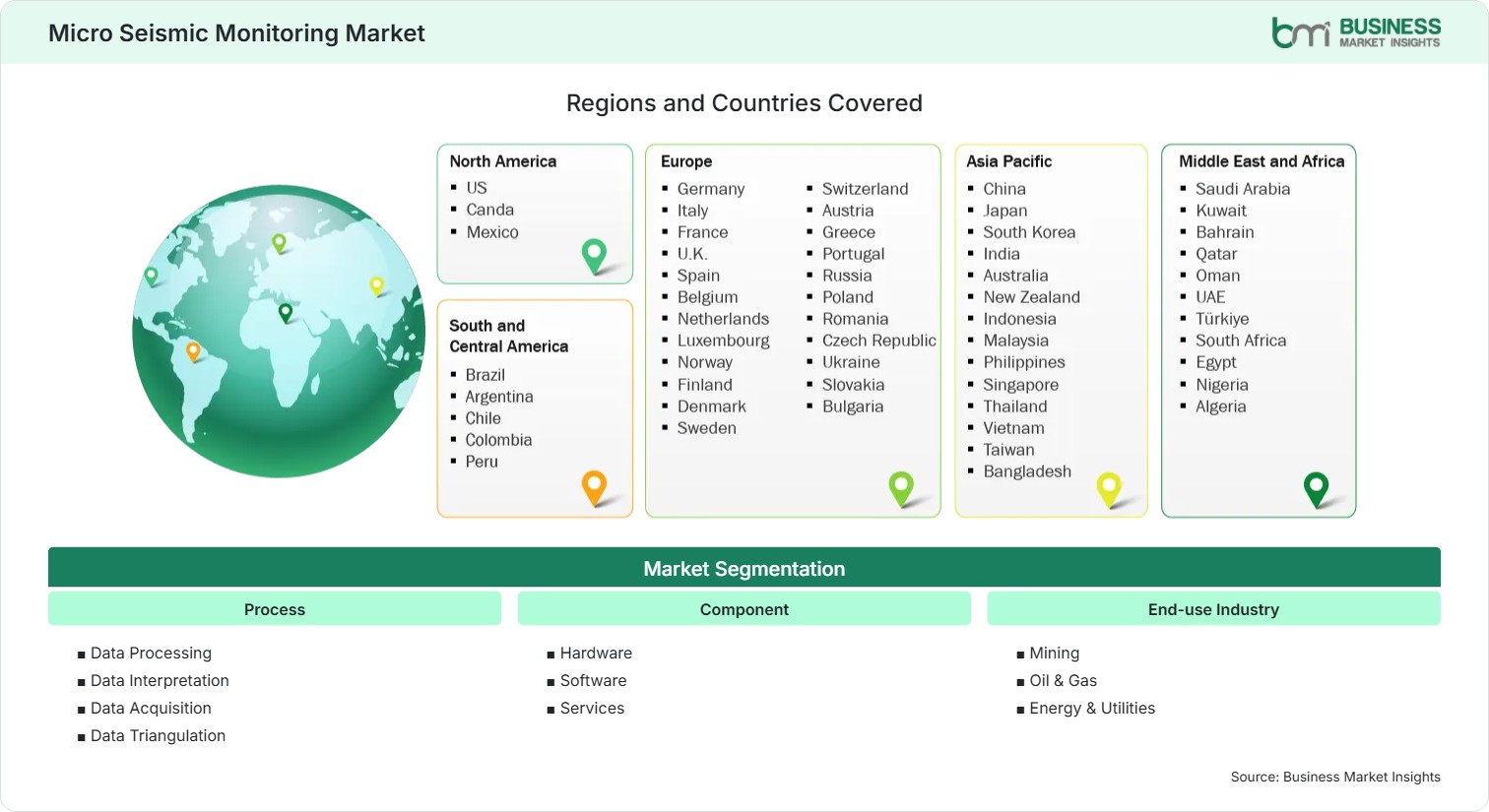
North America represented a 34%–37% share in 2025 and is projected to expand at a 7.0%–7.6% CAGR through 2033. The regional position reflects mature oil and gas operations, mining, carbon storage, geothermal projects, and established seismic technology infrastructure. The Micro Seismic Monitoring Market share is reinforced by permanent reservoir surveillance and regulatory requirements. Canada and the United States provide the principal demand base, while carbon-storage projects are increasing the role of persistent monitoring.
- Hydraulic stimulation continues to require fracture mapping and subsurface diagnostics, particularly where operators need to evaluate treatment geometry, reservoir response, and operational risk.
- Carbon-storage projects are creating demand for permanent seismic monitoring capable of identifying subsurface responses and supporting measurement, monitoring, and verification programs.
- Mining contributes through ground-control requirements, with continuous event detection helping engineers understand changing stress conditions around underground workings.
- Compact monitoring arrays can reduce surface infrastructure requirements, improving deployment economics in environmentally sensitive or operationally constrained locations.
US Micro Seismic Monitoring Market
The U.S. represented approximately 70%–74% of North American demand in 2025 and is expected to grow at a 7.1%–7.7% CAGR through 2033. Strong shale activity, mature oilfield infrastructure, carbon-storage initiatives, mining, geothermal projects, and wastewater management underpin demand. The U.S. Micro Seismic Monitoring Market growth is also supported by established specialist service providers and advanced subsurface analytics capabilities.
- Texas and other energy-producing states provide substantial application opportunities because stimulation, injection, disposal, and carbon-storage activities generate continuous subsurface monitoring requirements.
- Mining applications require real-time seismic information to recognize changing rock conditions and improve ground-control decisions in underground and high-stress environments.
- Established geophysical expertise supports adoption of automated interpretation, remote monitoring, cloud reporting, and integrated seismic workflows across energy and infrastructure projects.
Europe Micro Seismic Monitoring Market
Europe held a 23%–26% share in 2025 and is estimated to grow at a 6.7%–7.4% CAGR through 2033. The region benefits from underground gas storage, geothermal energy, carbon management, mining, and stringent induced-seismicity oversight. The United Kingdom, Germany, Norway, and Italy represent important demand centers. Italy and the United Kingdom offer relatively stronger growth opportunities because of geothermal, storage, and subsurface energy-transition activity. Long-term monitoring is particularly relevant where projects require documented reservoir integrity.
- Italy provides a strong application base for seismic surveillance around underground gas storage, injection activity, and geomechanical risk management.
- The United Kingdom offers opportunities through carbon storage, geothermal development, and broader subsurface energy-transition projects requiring continuous monitoring.
- Norway's carbon-storage ecosystem supports demand for permanent surveillance where monitoring must continue across extended storage lifecycles.
- Germany's storage and geothermal activities create opportunities for automated interpretation, remote monitoring, and integrated seismic reporting.
Asia Pacific Micro Seismic Monitoring Market
Asia Pacific held a 19%–22% share in 2025 and is projected to record an 8.0%–8.8% CAGR through 2033, making it the fastest-growing region. China, Australia, Japan, and Indonesia form key markets, while Indonesia and Australia provide comparatively strong growth prospects. The Micro Seismic Monitoring Market share is likely to benefit from investments where continuous subsurface information supports operational safety and resource productivity.
- Australia combines extensive underground mining with sophisticated geotechnical engineering, supporting demand for real-time event detection and rock-mass characterization.
- China offers substantial potential because underground mining and energy development increasingly require automated subsurface monitoring and stronger ground-control capabilities.
- Indonesia combines geothermal resources with mining activity, creating demand for monitoring systems capable of operating across complex geological environments.
- Japan's established seismic expertise and infrastructure requirements support advanced sensor deployment, high-quality acquisition, and sophisticated interpretation capabilities.
Rest of World Micro Seismic Monitoring Market
South and Central America accounted for approximately 9%–11% of global demand in 2025, while Middle East and Africa contributed roughly 8%–10%. Combined Rest of World demand therefore represented 17%–20%, with a 7.0%–8.2% CAGR through 2033. Brazil, Chile, Mexico, Saudi Arabia, South Africa, and selected Gulf markets offer opportunities across mining, oil and gas, storage, and energy projects.
- Chile's mining-intensive economy creates demand for seismic systems supporting rock-mass characterization, cave management, and ground-control decisions.
- Brazil offers opportunities across offshore energy, mining, reservoir management, and emerging carbon-management initiatives requiring improved subsurface visibility.
- Saudi Arabia and Gulf markets provide opportunities through mature hydrocarbon assets, injection projects, storage initiatives, and energy-transition investments.
- South Africa's underground mining operations sustain demand for seismic risk management, hazard identification, and continuous ground-condition monitoring.