
Continuous Emission Monitoring Systems Market Outlook: Size, Share, Trends, Growth Analysis, Competitive Landscape & Forecast, 2026-2033

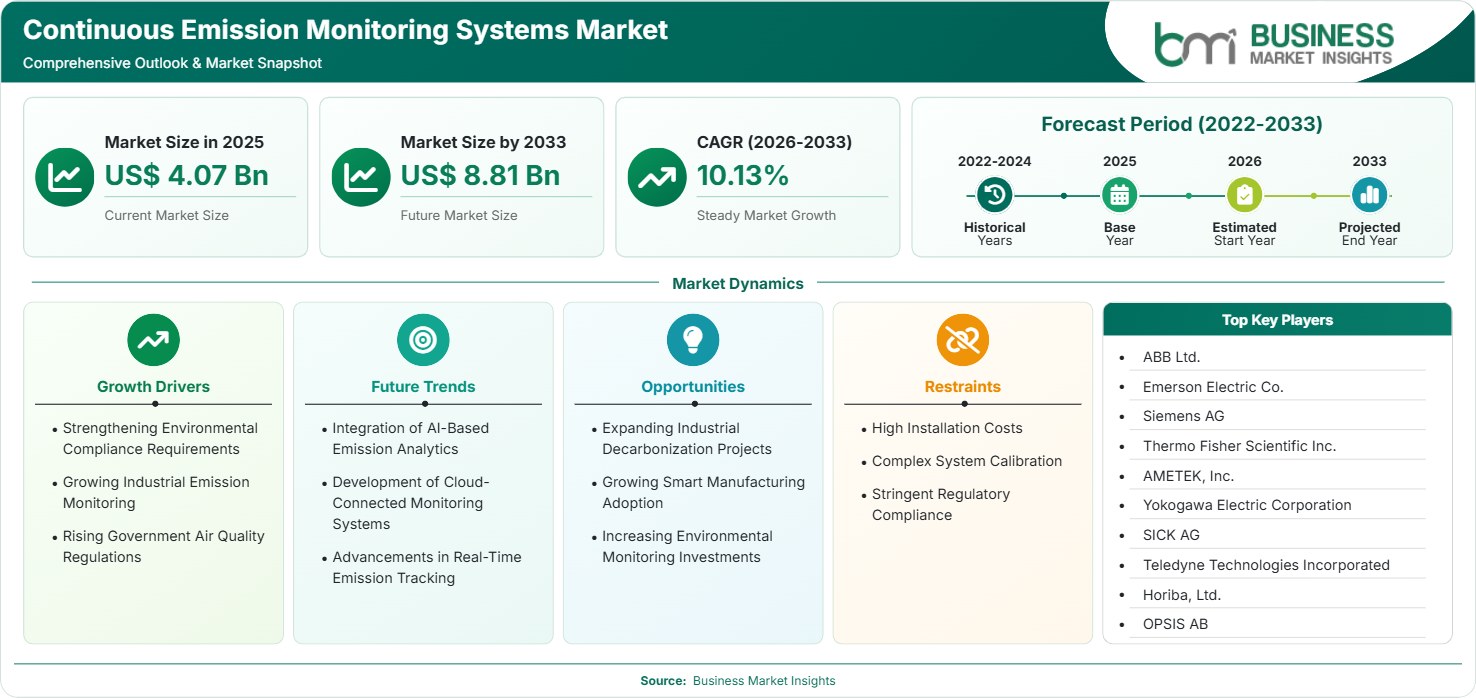
The Continuous Emission Monitoring Systems Market size was valued at US$ 4.07 Billion in 2025 and is projected to reach US$ 8.81 Billion by 2033, growing at a CAGR of 10.13% during 2026–2033, driven by stricter emission regulations, industrial decarbonization initiatives, smart monitoring adoption, and rising demand for real-time environmental compliance solutions.

Report Coverage
  • Technology: Direct Extractive CEMS, Dilution Extractive CEMS, In-situ CEMS
  • Installation Type: New Installations, Retrofit Installations/Upgrades, Replacement Installations
  • Application: Power Generation, Oil & Gas, Chemicals & Petrochemicals, Cement, Pulp & Paper, Waste Incineration, Metals & Mining, Pharmaceutical, Food & Beverage, Others
US$ 4.07 Bn Market size in 2025
US$ 8.81 Bn Market Size by 2033
10.13% CAGR, 2026 - 2033
2026-2033 Forecast Period

01 AI Overview

Continuous Emission Monitoring Systems Market Summary

  • North America Region: North America holds market share of 35%–38% in 2025, growing with a CAGR of 10.2%–10.6% influenced by environmental regulations, industrial automation, emission compliance programs, and modernization opportunities. The US market demonstrates strong adoption with a CAGR of 10.4%–10.8% due to EPA compliance requirements, power sector monitoring investments, and industrial sustainability initiatives.
  • Fastest Growing Region: Asia Pacific maintains market share of 26%–29% in 2025, expanding at a CAGR of 11.0%–11.5% supported by industrial expansion, air quality initiatives, manufacturing growth, and opportunities arising from large-scale environmental monitoring infrastructure development across emerging economies.
  • Leading Segment: In-situ CEMS represents market share of 42%–45% in 2025, achieving a CAGR of 10.5%–10.9% driven by direct measurement accuracy, reduced maintenance requirements, operational efficiency, and increasing adoption across power generation and heavy industrial facilities.
  • High Growth Segment: Retrofit Installations/Upgrades accounts for market share of 32%–35% in 2025, recording a CAGR of 11.2%–11.6% supported by aging industrial infrastructure, regulatory upgrades, digital transformation programs, and cost-effective compliance improvement strategies.
  • Key Market Opportunity: Growing integration of artificial intelligence, cloud analytics, and predictive monitoring platforms creates opportunities for advanced emission management, enabling industries to optimize operations, reduce environmental risks, and improve regulatory reporting accuracy.
  • Major Market Players: ABB Ltd., Emerson Electric Co., Siemens AG, Thermo Fisher Scientific Inc., AMETEK, Inc., Yokogawa Electric Corporation, SICK AG, Teledyne Technologies Incorporated, Horiba, Ltd., and OPSIS AB.
02 Strategic Insights

Continuous Emission Monitoring Systems Market: Strategic Insights

Continuous Emission Monitoring Systems Market Strategic Framework
FREE PDF
Request your free sample
Request free sample
03 Stakeholder View

Key Takeaways

  • The market ecosystem is evolving from standalone monitoring equipment toward integrated environmental intelligence platforms combining analyzers, data management software, communication systems, and compliance reporting capabilities.
  • Power generation, oil and gas, chemicals, and cement industries remain high-value application areas due to stringent emission regulations and continuous operational requirements.
  • Innovation is shifting toward advanced sensor technologies, artificial intelligence-based analytics, remote diagnostics, and cloud-enabled monitoring platforms.
  • Asia Pacific presents a compelling investment opportunity due to rapid industrialization, expanding manufacturing capacity, and government-led pollution control initiatives.
  • Future competitiveness will depend on the ability of providers to deliver scalable systems compatible with diverse industrial processes, evolving regulatory frameworks, and increasingly complex sustainability reporting requirements.
04 Geographic Outlook

Continuous Emission Monitoring Systems Market Regional Highlights

North America Continuous Emission Monitoring Systems Market

North America accounted for 35%–38% of the Continuous Emission Monitoring Systems Market share in 2025 and is projected to expand at a 10.2%–10.6% CAGR during 2026–2033. The region benefits from strict environmental regulations, advanced industrial infrastructure, and widespread adoption of automated compliance technologies. The United States represents the dominant contributor, supported by power generation modernization, industrial emission controls, and sustainability investments. Canada is also increasing adoption through environmental monitoring initiatives.

  • Stringent emission standards from regulatory bodies encourage industries to deploy advanced monitoring solutions for continuous compliance verification and improved environmental performance across power, manufacturing, and energy-intensive operations.
  • Digital transformation across industrial facilities is accelerating demand for connected monitoring platforms that integrate sensors, analytics, and reporting capabilities to improve operational efficiency and regulatory transparency.
  • The replacement of aging monitoring equipment with advanced analyzers and automated systems is creating opportunities for technology providers supporting industrial modernization programs.
  • Rising investments in clean energy infrastructure and carbon reduction strategies are strengthening demand for emission monitoring technologies across multiple industrial applications.

US Continuous Emission Monitoring Systems Market

The US Continuous Emission Monitoring Systems Market maintained approximately 30%–33% regional contribution in 2025 and is expected to register a 10.4%–10.8% CAGR from 2026–2033. The country benefits from established environmental compliance frameworks, including industrial monitoring requirements for power plants and manufacturing facilities. Increasing focus on greenhouse gas reporting, operational optimization, and environmental accountability is encouraging industries to upgrade monitoring infrastructure.

  • Federal and state-level environmental regulations continue driving adoption among utilities, refineries, and manufacturing facilities requiring accurate emission measurement and reporting capabilities.
  • Industrial operators are increasingly investing in automated monitoring platforms that reduce manual reporting requirements and improve compliance efficiency through real-time data availability.
  • Expansion of renewable energy integration and modernization of existing power infrastructure is supporting demand for advanced emission monitoring solutions.

Europe Continuous Emission Monitoring Systems Market

Europe represented approximately 27%–30% of the Continuous Emission Monitoring Systems Market share in 2025 and is forecast to grow at a 9.5%–10.0% CAGR during 2026–2033. Strong environmental policies, carbon reduction targets, and industrial sustainability initiatives support regional adoption. Germany, the United Kingdom, and France remain leading markets, while Nordic countries demonstrate higher adoption potential due to advanced environmental technology implementation.

  • European Union emission reduction policies are encouraging industries to implement precise monitoring systems for carbon management and regulatory reporting requirements.
  • Germany continues supporting market expansion through advanced manufacturing capabilities, industrial automation adoption, and energy transition initiatives.
  • The United Kingdom is increasing demand through environmental compliance programs and modernization of industrial monitoring infrastructure.
  • France is strengthening adoption through emissions control initiatives across energy, chemical, and manufacturing industries.

Asia Pacific Continuous Emission Monitoring Systems Market

Asia Pacific accounted for 26%–29% of the Continuous Emission Monitoring Systems Market share in 2025 and is expected to achieve the highest growth rate of 11.0%–11.5% CAGR through 2033. Rapid industrialization, expanding manufacturing capacity, and increasing air pollution control measures are driving regional adoption. China, India, Japan, and South Korea are key contributors, with emerging economies creating additional deployment opportunities.

  • China is expanding emission monitoring adoption through industrial pollution control initiatives and increasing compliance requirements for high-emission industries.
  • India is witnessing rising demand due to government-led air quality programs, industrial expansion, and modernization of environmental monitoring infrastructure.
  • Japan and South Korea are supporting technology adoption through advanced industrial automation and sustainability-focused manufacturing practices.
  • Southeast Asian countries are gradually increasing investments in emission monitoring systems as industrial activities and environmental regulations expand.

Rest of World Continuous Emission Monitoring Systems Market

Rest of World accounted for approximately 8%–10% of the Continuous Emission Monitoring Systems Market share in 2025 and is projected to grow at a 9.0%–9.5% CAGR during 2026–2033. South and Central America are adopting monitoring technologies through mining, energy, and industrial development projects. The Middle East and Africa are increasing investments due to refinery expansion, environmental initiatives, and industrial diversification programs.

  • Brazil is supporting market growth through industrial environmental compliance initiatives across energy, mining, and manufacturing sectors requiring accurate emissions monitoring solutions.
  • Mexico is experiencing increased adoption due to expanding industrial production, energy infrastructure development, and environmental reporting requirements.
  • Middle Eastern countries are deploying advanced monitoring technologies across oil and gas facilities to improve operational control and sustainability performance.
  • South Africa is creating opportunities through mining sector modernization and increasing focus on industrial emission management.
  • Gulf Cooperation Council countries are investing in environmental technologies as industrial diversification programs require improved emissions measurement capabilities.
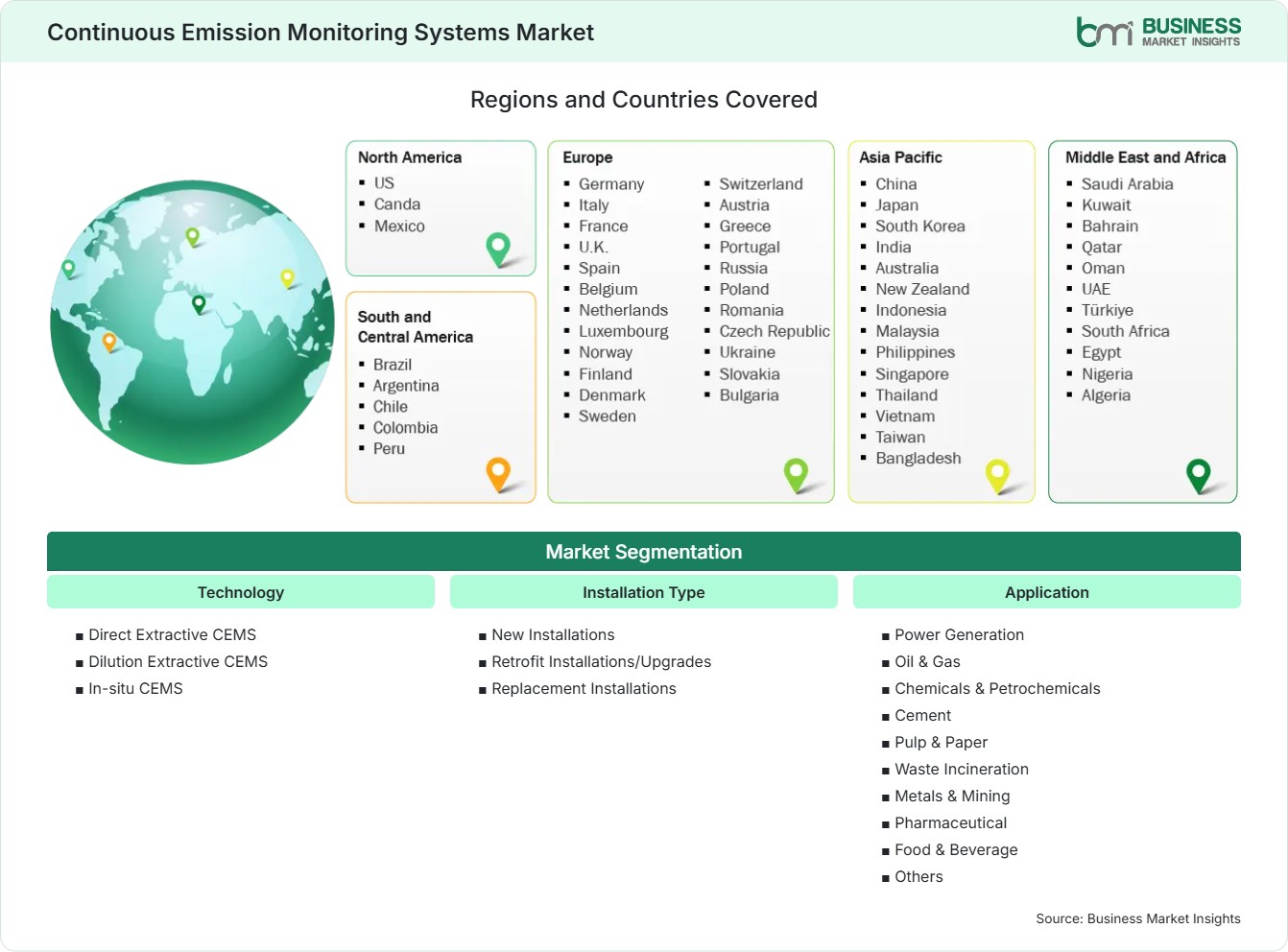
Global Market Geography
FREE PDF
Request your free sample
Request free sample
05 Segment Analysis

Continuous Emission Monitoring Systems Market Segmentation

Technology

The Technology segment represented approximately 39%–42% of revenue in 2025 and is projected to expand at a 10.4%–10.8% CAGR between 2026–2033. Technology selection depends on industrial requirements, measurement accuracy, operational conditions, and regulatory compliance needs. The segment continues shaping Continuous Emission Monitoring Systems Market trends through innovations in analyzer design, sensor performance, and automated data processing capabilities.

  • Direct Extractive CEMS: These systems collect gas samples directly from emission sources, providing accurate measurements through advanced analyzers used in demanding industrial environments.
  • Dilution Extractive CEMS: These solutions dilute emission samples before analysis, supporting applications requiring protection against moisture, corrosion, and challenging operating conditions.
  • In-situ CEMS: Direct measurement technologies enable real-time monitoring without sample extraction, improving response time, reducing maintenance requirements, and enhancing industrial efficiency.

Installation Type

The Installation Type segment accounted for nearly 31%–34% of market revenue in 2025 and is expected to register a 10.8%–11.2% CAGR through 2033. Growing modernization initiatives and regulatory upgrades are increasing demand for flexible installation approaches. Retrofit solutions are becoming increasingly important as industries upgrade existing infrastructure while maintaining operational continuity and improving compliance capabilities.

  • New Installations: New industrial facilities increasingly integrate advanced monitoring systems during construction to ensure regulatory compliance, operational efficiency, and long-term environmental management.
  • Retrofit Installations/Upgrades: Existing facilities adopt upgraded monitoring technologies to replace outdated equipment, improve data accuracy, and meet evolving emission control requirements.
  • Replacement Installations: Replacement projects support industries requiring reliable monitoring performance through updated analyzers, improved sensors, and enhanced digital connectivity solutions.

Application

The Application segment represented approximately 36%–39% of total revenue in 2025 and is projected to expand at a 10.1%–10.5% CAGR during 2026–2033. Increasing regulatory scrutiny across emission-intensive industries is strengthening adoption of monitoring technologies. The Continuous Emission Monitoring Systems Market scope continues expanding as industries integrate automated measurement solutions for compliance management, operational optimization, and sustainability reporting across diverse industrial environments.

  • Power Generation: Power plants remain major adopters due to strict emission regulations, increasing demand for real-time pollutant monitoring, and the need to optimize combustion efficiency and environmental performance.
  • Oil & Gas: Refineries and processing facilities deploy monitoring systems to track combustion emissions, improve operational control, and comply with increasingly stringent environmental regulations across upstream and downstream operations.
  • Chemicals & Petrochemicals: Chemical manufacturers utilize advanced monitoring technologies to manage complex emission profiles, enhance process safety, and maintain compliance with environmental standards governing industrial operations.
  • Cement: Cement producers adopt emission monitoring solutions to control particulate matter, nitrogen oxides, and carbon emissions while improving sustainability performance and regulatory reporting accuracy.
  • Pulp & Paper: Pulp and paper facilities implement continuous monitoring systems to measure combustion-related emissions, improve energy efficiency, and support environmental management initiatives.
  • Waste Incineration: Waste treatment facilities use monitoring technologies to ensure compliance with emission limits, optimize combustion processes, and maintain transparency in environmental performance reporting.
  • Metals & Mining: Mining and metal processing industries deploy monitoring systems to evaluate emissions from furnaces, smelting operations, and energy-intensive production processes.
  • Pharmaceutical: Pharmaceutical manufacturing facilities utilize emission monitoring solutions to maintain controlled environments, ensure regulatory compliance, and support sustainable production practices.
  • Food & Beverage: Food processing companies adopt monitoring technologies for boiler emissions, energy management, and environmental compliance across large-scale manufacturing facilities.
06 Market Forces

Continuous Emission Monitoring Systems Market Dynamics

Key Market Drivers

Strengthening Environmental Compliance Requirements

Continuous Emission Monitoring Systems Market growth is strongly influenced by increasingly stringent environmental regulations requiring industries to measure and report pollutant emissions accurately. The regulatory agencies in North America, Europe, and Asia Pacific are now implementing tougher surveillance systems for industrial units. The United States Environmental Protection Agency and environmental organizations of Europe keep stressing the importance of reporting emissions in an open manner. This is helping in the quick adoption of more sophisticated monitoring systems which can provide real time data. The Continuous Emission Monitoring Systems Market trends reveal that there is a growing inclination towards automated compliance management systems.

Growing Industrial Emission Monitoring

Industrial expansion across power generation, chemicals, metals, cement, and oil and gas sectors is increasing demand for reliable emission measurement systems. Facilities that operate on a larger scale need continuous monitoring systems to ensure optimal operations as well as comply with environmental regulations. There is a trend towards increased automation, which in turn facilitates the introduction of more advanced sensors and remote monitoring systems. Technology adoption helps to improve the visibility of emissions and employ predictive maintenance methods. Factors such as the demand for improved process control, compliance risk reduction, and sustainability reporting are driving Continuous Emissions Monitoring Systems Market growth.

Rising Government Air Quality Regulations

Government initiatives focused on improving air quality are accelerating deployment of emission monitoring technologies across industrial sectors. There has been an adoption of stricter regulatory controls on pollutants such as sulfur dioxide, nitrogen oxide, particulate matter, and greenhouse gases around the world. There have been programs for the regulation of industrial pollutants that will increase the need for precise measurement tools. There is also public pressure that has made organizations develop the right measuring systems for the environment. The Continuous Emission Monitoring Systems Market trends show that there is an increasing congruence between environmental policy goals and technological investment within industries.

Key Market Opportunities

Expanding Industrial Decarbonization Projects

Industrial decarbonization initiatives are creating new opportunities for emission monitoring providers as companies establish measurable pathways toward carbon reduction goals. Industries are using high-tech monitoring systems that monitor emissions performance, assess reduction methods, and help with sustainability reporting. When the systems are integrated with carbon management systems, it is possible for the organization to analyze operational data and enhance energy efficiency. Continuous Emission Monitoring Systems Market Forecasts show that there is an increasing demand for continuous emissions monitoring systems due to the increasing implementation of transition projects that focus on clean technology and renewable energy.

Growing Smart Manufacturing Adoption

Smart manufacturing adoption is expanding opportunities for connected emission monitoring solutions integrated with industrial automation networks. Manufacturing organizations are more dependent on systems enabled with Internet of Things, cloud computing technology, and analytics in order to enhance their operational intelligence. Such systems allow real-time tracking and reporting. Connection to already existing industrial control systems will allow manufactures to operate more efficiently and minimize environmental hazards. Future smart factories are likely to increase demand for platforms of intelligent monitoring, which can process complicated environmental data. Companies providing scalable digital solutions can capitalize on growing industrial transformation programs around the globe.

Increasing Environmental Monitoring Investments

Rising investments in environmental monitoring infrastructure are creating opportunities across emerging economies and industrializing regions. Governments and private firms are investing in pollution management plans, industrial upgrades, and sustainable development plans. Emerging nations are increasingly following international environmental norms, which will promote industries to use state-of-the-art monitoring devices. The growth in production facilities in Asia Pacific and Middle East regions will contribute to the new installation possibilities.

Market Restraints and Challenges

High Installation Costs

Factor: High capital investment requirements for advanced monitoring equipment, installation infrastructure, calibration systems, and integration services can restrict adoption among small and medium-sized industrial operators. Impact: Increased initial costs could lead to delayed implementation and cause firms to opt for continued use of outdated technology in the face of rising regulations. Installation procedures that are difficult to implement and require specialized engineering skills add to the costs of the project. Despite the long-term benefits of using such technology, cost considerations pose a significant constraint, especially where cost is an important consideration. This constraint has been met by technology suppliers through modular approaches and efficient systems.

Complex System Calibration

Factor: Continuous emission monitoring systems require regular calibration, maintenance, and technical expertise to ensure measurement accuracy across varying industrial conditions. Impact: The complexity of calibration increases the costs of operation, creates issues in maintenance, and may even influence system reliability if it is not managed efficiently. Facilities functioning under challenging environmental conditions will have some extra considerations concerning the durability of sensors, performance of analyzers, and validation of the collected data. Compliance requires qualified staff and a consistent process of monitoring. Vendors are now investing in developing automatic calibration, remote diagnostics, and innovative sensors, which would decrease operational complexity. Technical requirements should still be considered.

07 Company Analysis

Competitive Landscape

The Continuous Emission Monitoring Systems Market analysis highlights a competitive environment shaped by automation companies, environmental technology providers, analytical instrument manufacturers, and industrial solution specialists. Leading companies are focusing on advanced analyzers, digital monitoring platforms, remote diagnostics, and integrated compliance solutions to strengthen their positions across power generation, manufacturing, energy, and process industries.

Company Name

Overview

Products and Services relevant to this market

ABB Ltd.

ABB provides industrial automation and measurement solutions supporting environmental compliance across energy and process industries worldwide.

Offers continuous emission monitoring solutions, gas analyzers, process instrumentation, automation platforms, and digital emission management systems.

Emerson Electric Co.

Emerson delivers automation technologies and industrial software solutions designed for operational efficiency and environmental monitoring applications.

Provides emission monitoring systems, analytical instrumentation, gas analysis technologies, automation controls, and compliance monitoring solutions.

Siemens AG

Siemens develops industrial automation and digital infrastructure solutions serving energy, manufacturing, and environmental management sectors.

Supplies continuous emission monitoring technologies, process analyzers, automation systems, and industrial digitalization platforms.

Thermo Fisher Scientific Inc.

Thermo Fisher specializes in analytical technologies supporting environmental testing, laboratory applications, and industrial measurement requirements.

Provides emission monitoring analyzers, gas measurement instruments, environmental monitoring systems, and analytical solutions.

AMETEK, Inc.

AMETEK develops precision electronic instruments and analytical equipment for industrial and environmental applications.

Offers process analyzers, gas monitoring instruments, emission measurement systems, and industrial analytical technologies.

Yokogawa Electric Corporation

Yokogawa provides measurement, control, and automation solutions for energy and industrial process industries.

Supplies emission monitoring systems, analyzers, process instrumentation, and integrated environmental monitoring solutions.

SICK AG

SICK specializes in sensor technology and industrial automation solutions for environmental and process monitoring applications.

Provides gas analyzers, dust measurement systems, CEMS components, sensors, and emission monitoring technologies.

Teledyne Technologies Incorporated

Teledyne develops advanced instrumentation technologies supporting environmental, industrial, and scientific measurement applications.

Offers gas analysis instruments, emission monitoring equipment, environmental sensors, and analytical measurement solutions.

Horiba, Ltd.

Horiba provides analytical measurement technologies for environmental, automotive, and industrial applications globally.

Manufactures emission monitoring systems, gas analyzers, environmental measurement instruments, and monitoring platforms.

OPSIS AB

OPSIS specializes in optical emission monitoring technologies for industrial and environmental applications.

Provides cross-stack monitoring systems, DOAS-based analyzers, emission measurement solutions, and industrial monitoring software.

10 Trust & Transparency

Research Methodology

The market analysis combines proprietary research with secondary data from government agencies, company disclosures, regulatory filings, industry databases and expert interviews. Market estimates are validated through data triangulation, cross-market benchmarking and analyst review.

View Full Research Methodology

11 Questions Answered

Frequently Asked Questions

What factors influence adoption decisions for new monitoring systems?

The Continuous Emission Monitoring Systems Report evaluates regulatory requirements, operational needs, installation complexity, maintenance requirements, and long-term cost benefits influencing technology investment decisions.

Why are retrofit installations becoming important for industrial facilities?

Retrofit installations allow existing facilities to upgrade outdated monitoring infrastructure without replacing complete industrial systems, helping operators meet evolving environmental regulations cost-effectively.

What role does digitalization play in emission monitoring solutions?

Digital technologies enable remote monitoring, predictive maintenance, automated reporting, and integration with industrial control systems, improving efficiency and reducing manual intervention requirements.

What industries are adopting emission monitoring technologies most actively?

Power generation, oil and gas, chemicals, cement, metals, and waste management industries are major adopters because they operate under strict emission regulations and require continuous compliance verification.

How do Continuous Emission Monitoring Systems support industrial sustainability goals?

Continuous Emission Monitoring Systems provide real-time emission data that helps industries identify operational inefficiencies, optimize processes, reduce pollutant levels, and support transparent sustainability reporting initiatives aligned with environmental objectives.

Access the Full Continuous Emission Monitoring Systems Market Report

Get segment-level forecasts, regional estimates, competitive benchmarking, company profiles and downloadable Excel datasets.

Access the full Continuous Emission Monitoring Systems Market Report
350 pages PDF & Excel | 2026-08-21