
Metallurgical Coal Market Outlook: Size, Share, Trends, Growth Analysis, Competitive Landscape & Forecast, 2026-2033

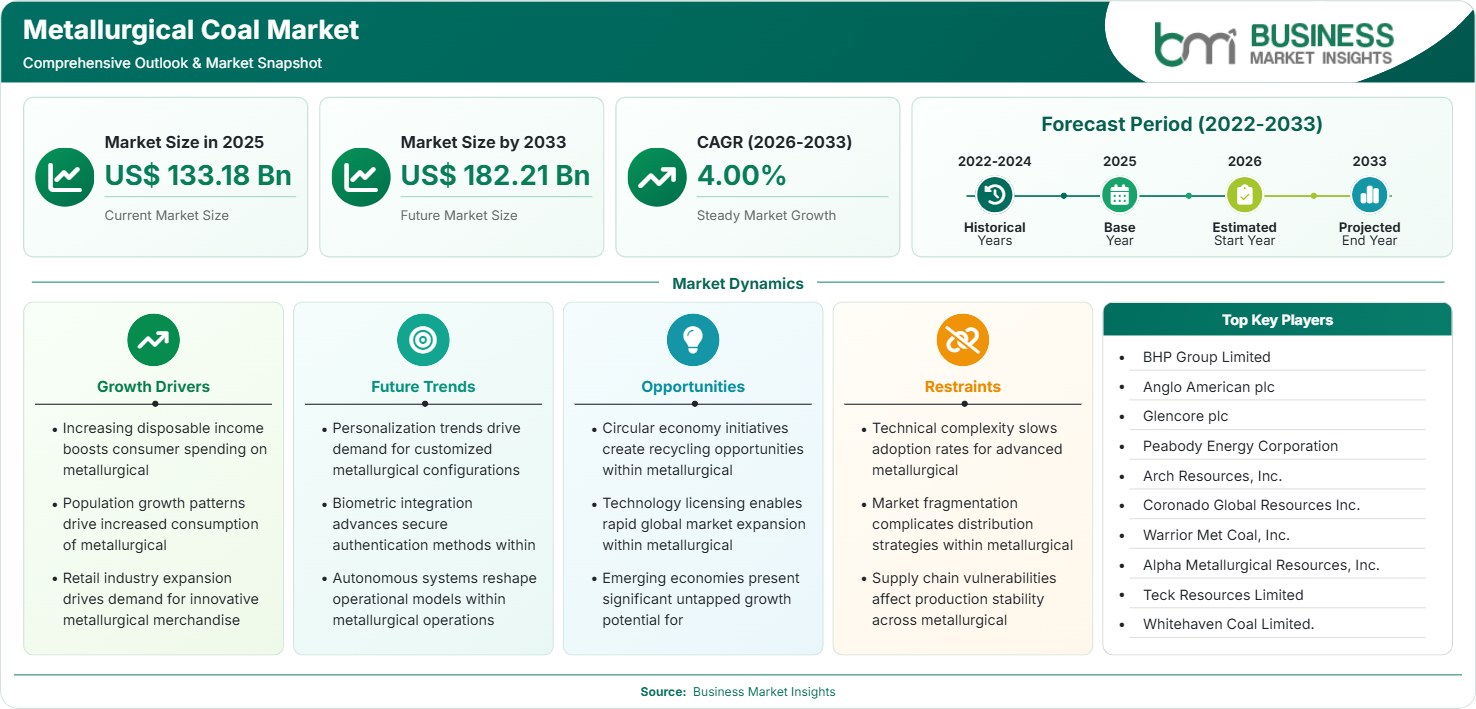
The Metallurgical Coal Market size was valued at US$ 133.18 Billion in 2025 and is projected to reach US$ 182.21 Billion by 2033, growing at a CAGR of 4.00% during 2026–2033. Demand from blast furnace steelmaking, infrastructure expansion, premium coking coal requirements, mining productivity improvements, and supply diversification initiatives continues creating growth opportunities across major steel-producing economies.

Report Coverage
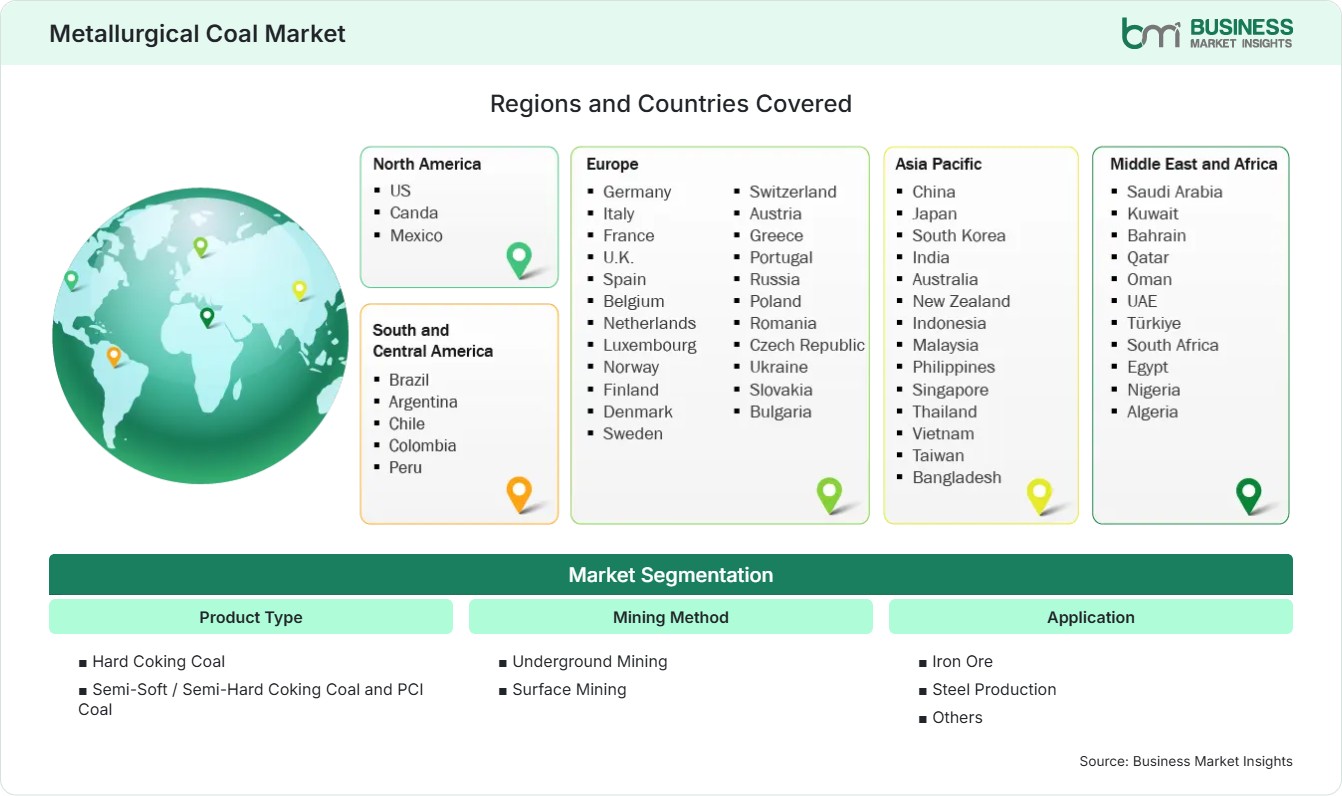
  • Product Type: Hard Coking Coal , Semi-Soft / Semi-Hard Coking Coal and PCI Coal
  • Mining Method: Underground Mining, Surface Mining
  • Application: Iron Ore, Steel Production, Others
US$ 133.18 Bn Market size in 2025
US$ 182.21 Bn Market Size by 2033
4.00% CAGR, 2026 - 2033
2026-2033 Forecast Period

AI Overview

Metallurgical Coal Market Summary

  • North America Region: Holds a market share of 18%–21% in 2025, growing at a 3.2%–3.8% CAGR during 2026–2033, supported by export-oriented production, high-quality reserves, steel investments, logistics upgrades, and supply security strategies. The U.S. market benefits from premium coking coal exports and stable steel demand, advancing at 3.3%–3.9% CAGR.
  • Fastest Growing Region: Asia Pacific accounts for 46%–50% share in 2025 and expands at 4.8%–5.4% CAGR during 2026–2033, driven by steel capacity additions, urbanization programs, industrial expansion, import dependence, and ongoing infrastructure modernization across emerging economies.
  • Leading Segment: Hard Coking Coal (HCC) represents a 52%–57% share in 2025 with a 3.8%–4.4% CAGR, supported by blast furnace productivity requirements, superior coke strength, premium steel manufacturing, operational reliability, and demand from integrated steel producers.
  • High Growth Segment: Steel Production holds a 63%–68% share in 2025 and records a 4.3%–4.9% CAGR, driven by expanding steel consumption, automotive manufacturing, construction activity, industrial investments, and development of higher-grade steel products.
  • Key Market Opportunity: Rising investments in efficient blast furnaces, strategic resource security programs, high-grade steel demand, export corridor modernization, and long-term steel capacity expansion create substantial value opportunities globally.
  • Major Market Players: BHP Group Limited, Anglo American plc, Glencore plc, Peabody Energy Corporation, Arch Resources, Inc., Coronado Global Resources Inc., Warrior Met Coal, Inc., Alpha Metallurgical Resources, Inc., Teck Resources Limited, Whitehaven Coal Limited.
Strategic Insights

Metallurgical Coal Market: Strategic Insights

Metallurgical Coal Market Strategic Framework
FREE PDF
Request your free sample
Request free sample
Stakeholder View

Key Takeaways

  • The value chain remains closely integrated with iron ore suppliers, rail operators, port infrastructure providers, coke producers, and steel manufacturers, making logistics efficiency a critical competitive differentiator.
  • Demand growth opportunities are concentrated in steelmaking applications across India, Southeast Asia, and selected Middle Eastern markets where infrastructure and manufacturing investments remain robust.
  • Advanced mine planning software, autonomous haulage systems, predictive maintenance platforms, and coal washing technologies are improving productivity while enhancing premium-grade recovery rates.
  • Australia, India, and Indonesia continue to attract strategic investments due to expanding steel production ecosystems, export capabilities, and resource development initiatives.
  • Portfolio reshaping, mine acquisitions, and asset divestitures indicate ongoing consolidation as producers seek high-quality reserves and greater exposure to seaborne coking coal markets.
  • Premium-grade coal producers are increasingly prioritizing long-term supply agreements to mitigate price volatility and strengthen downstream customer relationships.
Geographic Outlook

Metallurgical Coal Market Regional Highlights

North America Metallurgical Coal Market

North America accounted for approximately 18%–21% of global demand in 2025 and is projected to expand at 3.2%–3.8% CAGR through 2033. Regional competitiveness is supported by premium coal reserves, well-developed export infrastructure, and strong supply relationships with international steelmakers. The Metallurgical Coal Market share remains significant due to high-quality Appalachian production and sustained overseas demand. Export volumes, operational modernization, and mine productivity initiatives continue supporting long-term market positioning and profitability across major producing regions.

  • Export infrastructure investments continue improving access to European and Asian steelmakers while enhancing trade flexibility and supply reliability.
  • Premium low-volatility coking coal grades support strong international demand from blast furnace operators seeking better coke quality and efficiency.
  • Mining automation technologies improve worker safety, equipment utilization, and production consistency across major coal-producing regions.
  • Strategic contracts between miners and steel manufacturers reduce procurement risks and support stable long-term sales volumes.

US Metallurgical Coal Market

The United States represents approximately 72%–78% of the North American market and records a 3.3%–3.9% CAGR through 2033. Strong export orientation, extensive reserve availability, and established rail networks support competitiveness. Producers increasingly focus on premium coal qualities that meet stringent steel industry requirements. Continued investment in mining efficiency, processing facilities, and logistics optimization supports sustainable industry performance even amid cyclical commodity pricing and evolving trade patterns.

  • Appalachian Basin operations remain central to export growth due to internationally recognized premium metallurgical grades.
  • Increasing adoption of advanced geological modeling improves reserve management and extraction efficiency.
  • Port modernization initiatives strengthen supply chain reliability and reduce transportation bottlenecks.
  • Long-term export contracts provide revenue visibility despite volatility in global steel markets.

Europe Metallurgical Coal Market

Europe's 14%-17% share will persist until 2025, and the region’s growth will be in the range of 2.5%-3.1% CAGR. Consumption in the region is still associated with the needs of integrated steel production and industrial production. Germany dominates demand within the region, whereas steel industries in Eastern Europe make an additional contribution. In Poland, growth is relatively higher owing to the country's industrialization. The import of premium quality coal will be important for metallurgical purposes.

  • Germany remains the largest regional consumer due to its extensive industrial and engineering sectors.
  • Poland demonstrates stronger expansion driven by infrastructure investments and manufacturing capacity upgrades.
  • Supply diversification efforts are reshaping procurement strategies among major steel producers.
  • Carbon management policies encourage greater operational efficiency throughout steel production chains.

Asia Pacific Metallurgical Coal Market

Asia-Pacific is clearly dominant, holding a 46%-50% market share in 2025 and having a CAGR of 4.8%-5.4%, making it the region experiencing the fastest rate of growth. China remains the largest consumer due to its high capacity for steel production, whereas India shows the highest incremental growth in demand. Asia-Pacific plays an important role in driving global Metallurgical Coal Market growth due to urbanization, investments in infrastructure and industry, and the expansion of the region's manufacturing base.

  • India records the fastest expansion among major consumers due to infrastructure programs and industrial activity.
  • China remains the largest volume market, supported by extensive blast furnace steelmaking capacity.
  • Southeast Asian economies increasingly import premium grades to support new steel projects.
  • Port expansions and logistics investments enhance raw-material security across the region.
  • High-grade coking coal demand strengthens as producers target premium steel products.

Rest of World Metallurgical Coal Market

The Rest of World region accounts for 13%–16% market share, with a CAGR of 3.6%–4.2% through 2033. South and Central America have opportunities due to resource development and growth in steel production. The Middle East and Africa experience demand driven by diversification across industry, construction, and infrastructure development. Brazil is the largest consumer in the region, and Saudi Arabia and the UAE are considered attractive due to their industrial development strategies.

  • Brazil maintains regional leadership through established mining and steel production capabilities.
  • Gulf nations support demand through industrial diversification and large-scale infrastructure projects.
  • African industrialization initiatives gradually encourage higher steel consumption requirements.
  • Resource-rich economies attract investment in mining and logistics development.
  • Regional trade partnerships improve procurement flexibility and supply resilience.
Global Market Geography
FREE PDF
Request your free sample
Request free sample
Segment Analysis

Metallurgical Coal Market Segmentation

Product Type

Product Type had a market share of around 54%–58% in 2025 and is expected to expand at a CAGR of 3.8%–4.5%. Demand trends for the product are strongly influenced by the need for improved steelmaking efficiency, the strength of the coke produced, and the quality of the raw materials. Metallurgical Coal Market trends in this segment are increasingly toward higher-quality products that improve blast furnace productivity and support premium steel manufacturing applications.

  • Hard Coking Coal (HCC): Premium-grade material widely used for producing strong metallurgical coke, supporting efficient blast furnace operations and high-quality steel production across integrated manufacturing facilities worldwide.
  • Semi-Soft / Semi-Hard Coking Coal (SSCC): Offers cost-performance advantages and blending flexibility, enabling steel producers to optimize furnace economics while maintaining acceptable coke quality parameters.
  • PCI Coal (Pulverized Coal Injection): Supports blast furnace efficiency improvements by reducing coke consumption and helping steelmakers control operating costs through optimized fuel injection strategies.

Mining Method

Mining Method held about 28%–33% in 2025 and is projected to register a CAGR of 3.5%–4.2%. The adoption of technology, the availability of reserves, regulatory policies, and economics guide investment decisions. Mining companies continue to strike a balance among production efficiency, safety performance, and environmental goals, while improving mineral recovery from profitable reserves.

  • Underground Mining: Preferred for deeper reserves, offering access to premium coal seams while increasingly leveraging automation, monitoring systems, and advanced safety technologies.
  • Surface Mining: Supports large-scale production with comparatively lower extraction costs where geological conditions permit economical resource recovery and operational efficiency.

Application

Application accounts for roughly 63%–68% of the market in 2025 and is expected to reach a CAGR of 4.3%–4.9%. The factors that will be instrumental to growth include the need for steel, industrial production volumes, construction expenditure, and infrastructure investments. Integrated steel producers account for the highest consumption levels due to ongoing dependence on blast furnace technologies.

  • Iron Ore: Coal and iron ore procurement strategies are increasingly coordinated to enhance blast furnace performance and raw-material efficiency.
  • Steel Production: Represents the core demand center, supported by automotive manufacturing, infrastructure expansion, machinery production, and urban development projects.
Market Forces

Metallurgical Coal Market Dynamics

Key Market Drivers

Expansion of Global Steel Infrastructure Investments

Construction projects in Asia, the Middle East, and newly developing industrial economies will continue to provide strong support for metallurgical coal use. According to the World Steel Association, construction projects have always been important consumers of steel products. Urbanization and infrastructural projects need large amounts of steel, maintaining blast furnace operations. Since traditional steel production relies on coke as a raw material, demand for coking coal will remain strong. All these factors contribute to the steady purchasing strategies of steel manufacturers and favorable conditions for industry development.

Reliance on Blast Furnace Steel Production

Despite growth in the production capacity of the electric arc furnace route, the blast furnace-BOS steelmaking method will continue to provide the bulk of the world's steel production. In addition, this structural dependency means that there will be a need for high-grade coke. The importance of coke cannot be underestimated in terms of furnace permeability, heat generation, and reduction chemistry. Suppliers of coal with consistent specifications will have an advantage in securing long-term contracts at better prices. The persistence of conventional steelmaking infrastructure across major producing nations provides an important demand anchor, supporting industry stability through the forecast period.

Growth in Premium Coal Consumption for High-Grade Steel

Higher-quality steel requirements in the automotive, engineering, machinery, and advanced manufacturing industries are driving increased acquisition of high-quality coking coal to produce superior coke and improve furnace efficiency. High metallurgical performance, low impurities, and operational consistency have made high-quality coal desirable for integrated steel companies. The pursuit of productivity and differentiation by steel companies is driving the demand for high-value coals.

Key Market Opportunities

Indian Steel Capacity Expansion Programs

India will continue to be one of the largest sources of new steel demand until 2033. The expansion of integrated steel plants, infrastructure projects, and industrialization contributes to the increasing demand for imported metallurgical coal. Several capacity expansions are envisaged in several steel-producing states. This offers strong export prospects for exporters who can offer premium-quality products. Long-term agreements are expected to become increasingly important for securing raw materials.

Digital Mining and Productivity Enhancement

Automation, artificial intelligence, predictive maintenance, and intelligent mine planning solutions represent significant opportunities for value creation. Digital implementations will enable better machinery utilization, reduced downtime, improved safety performance, and increased efficiency in recovery processes. Such benefits serve as compensation for issues related to labor costs, energy use, and logistics. The more competition builds up in the sector, the more technology implementation becomes a distinct competitive advantage. Industry participants who align capital investments with operational transformation initiatives are positioned to achieve greater profitability and resilience.

Seaborne Trade Diversification and New Export Corridors

The creation of export facilities, rail transport systems, and logistics networks offers new prospects for exporters worldwide. Both governments and mining companies continue to improve their transportation efficiency to increase their competitiveness in the global market. Such efforts provide new access to demand centers and reduce the risk of dependence on a single region. Positive Metallurgical Coal Market Forecasts increasingly reflect the strategic importance of supply diversification, premium-grade availability, and trade connectivity in supporting long-term industry expansion.

Market Restraints and Challenges

Steel Industry Decarbonization and Long-Term Demand Pressure

Factor: Global decarbonization initiatives encourage steelmakers to evaluate lower-emission production pathways, including direct reduced iron and electric arc furnace technologies. Impact: potential moderation of long-term growth in conventional blast furnace capacity. While transition timelines vary significantly across regions, investment priorities increasingly include alternative technologies. Producers must therefore balance short- and medium-term demand strength against evolving environmental requirements that may influence future consumption patterns and investment decisions.

Commodity Price Volatility and Investment Uncertainty

Factor: Metallurgical coal prices remain highly sensitive to steel demand cycles, weather disruptions, trade policies, and supply constraints. Impact: Uncertainty surrounding project economics, expansion plans, and capital allocation decisions. Rapid price movements can affect profitability, contract negotiations, and financing availability. Mining companies frequently respond through operational adjustments and cost-management strategies. Sustained volatility may slow development timelines and complicate long-term planning for both producers and consumers.

Company Analysis

Competitive Landscape

The competitive environment reflects ongoing consolidation, premium resource development, and export strategy optimization. Current Metallurgical Coal Market analysis indicates strong positioning among diversified mining groups and specialist coking coal producers.

Company Name

Overview

Products and Services relevant to this market

BHP Group Limited

Global mining leader with significant metallurgical coal operations and export infrastructure.

Hard coking coal production, mining services, resource development, logistics coordination.

Anglo American plc

Major diversified miner with established steelmaking coal assets and global customer network.

Metallurgical coal mining, reserve development, processing, export supply.

Glencore plc

Integrated commodities producer and trader with extensive coal asset portfolio.

Steelmaking coal production, trading, logistics, marketing services.

Peabody Energy Corporation

Large coal producer expanding exposure to seaborne metallurgical coal markets.

Metallurgical coal mining, export supply, resource management.

Arch Resources, Inc.

U.S.-based producer focused on premium metallurgical coal grades.

High-quality coking coal production and customer supply solutions.

Coronado Global Resources Inc.

International producer serving major steel manufacturers.

Metallurgical coal extraction, processing, export distribution.

Warrior Met Coal, Inc.

Specialist producer known for premium hard coking coal reserves.

Premium HCC products for blast furnace steelmaking.

Alpha Metallurgical Resources, Inc.

Significant supplier operating multiple metallurgical coal assets.

Coking coal mining, preparation, transportation management.

Teck Resources Limited

Historically important steelmaking coal producer before portfolio transition.

Steelmaking coal operations and associated mining expertise.

Whitehaven Coal Limited

Australian mining company with growing coking coal exposure.

Metallurgical coal production, export supply, mine development.

Trust & Transparency

Research Methodology

The market analysis combines proprietary research with secondary data from government agencies, company disclosures, regulatory filings, industry databases and expert interviews. Market estimates are validated through data triangulation, cross-market benchmarking and analyst review.

View Full Research Methodology

Questions Answered

Frequently Asked Questions

Which region offers the strongest growth potential?

Asia Pacific presents the strongest expansion potential due to rising steel capacity, infrastructure investment, urbanization, and manufacturing growth across major developing economies.

What is covered in a Metallurgical Coal Market Report?

A comprehensive study typically evaluates demand trends, regional dynamics, competitive positioning, technology developments, trade flows, regulatory influences, and forecast assumptions.

How does PCI coal differ from hard coking coal?

PCI coal is injected into blast furnaces to reduce coke consumption, whereas hard coking coal is converted into coke and serves as a crucial furnace input.

What factors influence pricing within the market?

Pricing is influenced by steel demand, mining output, weather disruptions, transportation constraints, trade policies, and availability of premium hard coking coal grades.

Which industries generate the highest demand for metallurgical coal?

Steel manufacturing remains the primary demand source, particularly integrated blast furnace operations serving construction, automotive, machinery, infrastructure, and industrial production sectors worldwide.

Access the Full Metallurgical Coal Market Report

Get segment-level forecasts, regional estimates, competitive benchmarking, company profiles and downloadable Excel datasets.

Access the full Metallurgical Coal Market Report
350 pages PDF & Excel | 2026-08-31