
Coal Bed Methane Market Outlook: Size, Share, Trends, Growth Analysis, Competitive Landscape & Forecast, 2026-2033

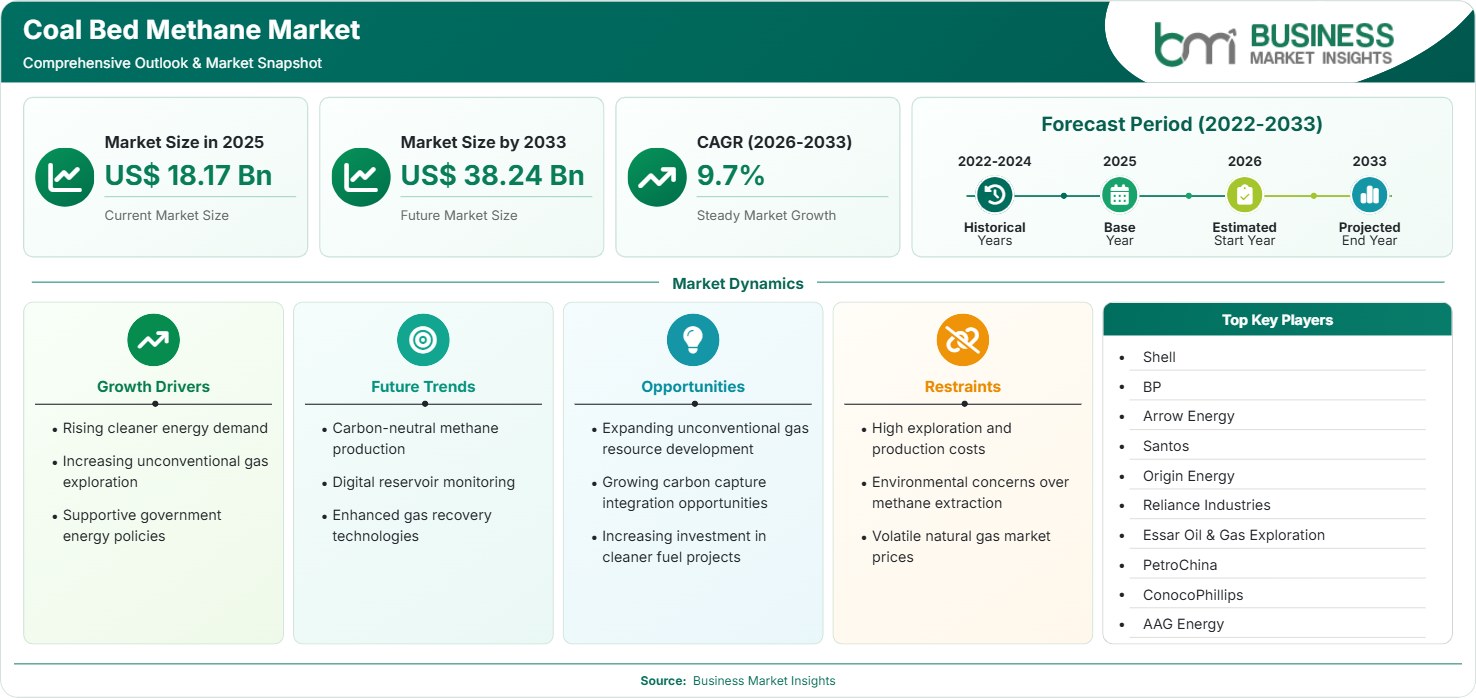
The Coal Bed Methane Market size was valued at US$ 18.17 Billion in 2025 and is projected to reach US$ 38.24 Billion by 2033, growing at a CAGR of 9.7% from 2026 to 2033, driven by cleaner energy demand, unconventional gas exploration, supportive policies, carbon capture integration, and investments in alternative natural gas resources.

Report Coverage
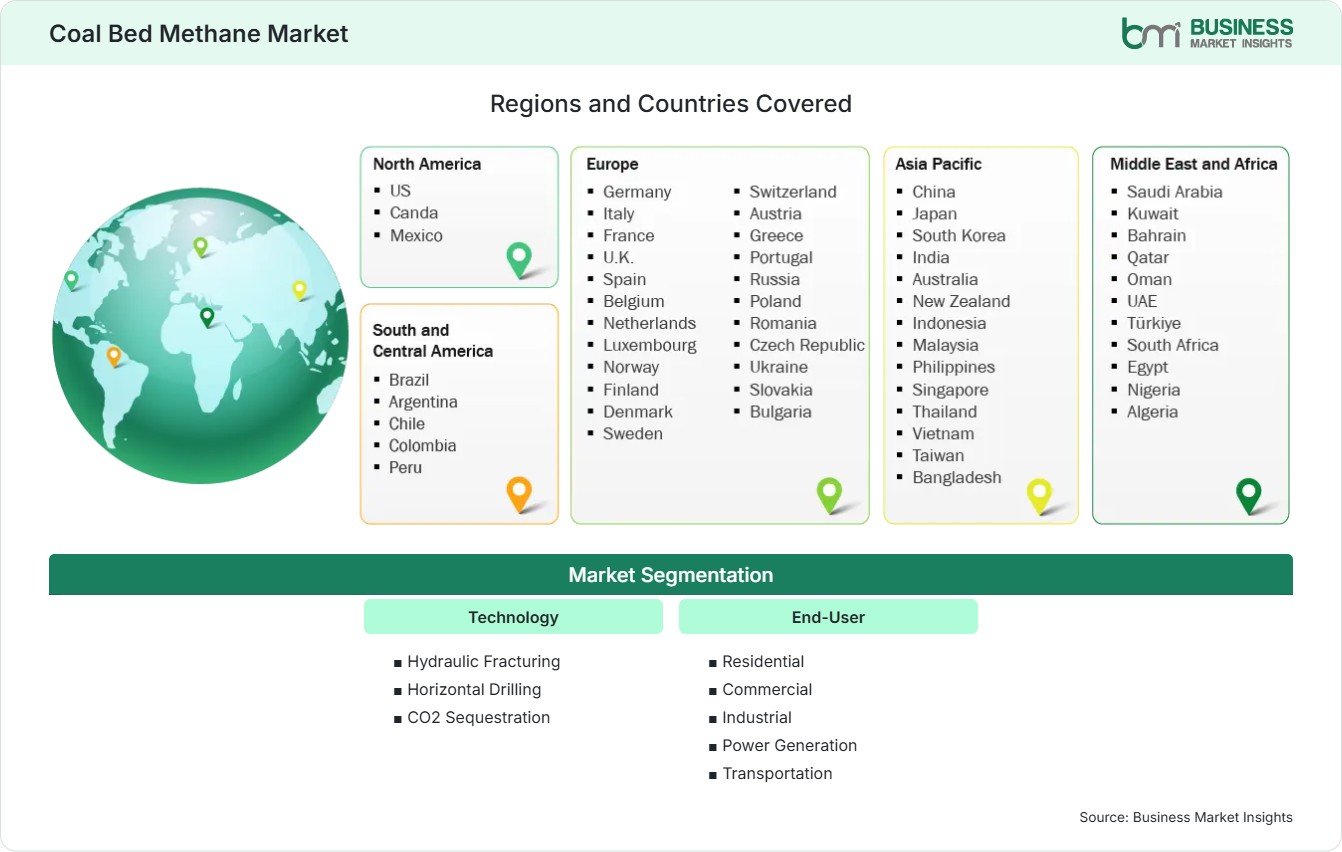
  • Technology: Hydraulic Fracturing, Horizontal Drilling, CO2 Sequestration
  • End-User: Residential, Commercial, Industrial, Power Generation, Transportation
US$ 18.17 Bn Market size in 2025
US$ 38.24 Bn Market Size by 2033
9.7% CAGR, 2026 - 2033
2026-2033 Forecast Period

01 AI Overview

Coal Bed Methane Market Summary

  • North America Region: North America holds market share of 38%–41% in 2025, growing with a CAGR of 8%–10% influenced by mature unconventional gas operations, advanced extraction technologies, infrastructure availability, and energy transition initiatives. The US market expands with a CAGR of 8%–10% during 2026–2033, supported by shale gas expertise and CBM development.
  • Fastest Growing Region: Asia Pacific represents a share range of 32%–35% in 2025, expanding with a CAGR of 11%–13% driven by rising energy demand, unconventional resource development, domestic gas security strategies, and increasing investment in cleaner fuel projects.
  • Leading Segment: Hydraulic Fracturing represents the leading technology segment with a share range of 45%–48% in 2025, growing at a CAGR of 9%–11% due to improved methane recovery efficiency and advanced reservoir stimulation techniques.
  • High Growth Segment: CO2 Sequestration demonstrates a share range of 8%–11% in 2025, expanding at a CAGR of 13%–15% due to carbon management initiatives, emissions reduction goals, and integration with cleaner energy strategies.
  • Key Market Opportunity: Market opportunities are concentrated in unconventional gas development, carbon capture integration, cleaner fuel investments, and improved methane recovery technologies.
  • Major Market Players: Shell, BP, Arrow Energy, Santos, Origin Energy, Reliance Industries, Essar Oil & Gas Exploration, PetroChina, ConocoPhillips, AAG Energy.
02 Strategic Insights

Coal Bed Methane Market: Strategic Insights

coal-bed-methane-market-market-strategic-framework
FREE PDF
Request your free sample
Request free sample
03 Stakeholder View

Key Takeaways

  • The resource ecosystem is shifting toward advanced methane extraction methods, reservoir optimization, and integrated gas production strategies.
  • Hydraulic fracturing and horizontal drilling technologies provide significant opportunities by improving recovery rates from unconventional reservoirs.
  • Carbon capture integration and emissions management solutions are becoming important innovation priorities for future projects.
  • Asia Pacific provides investment potential through rising energy consumption, domestic gas strategies, and unconventional resource development.
  • Energy companies are pursuing partnerships and investments to strengthen unconventional gas portfolios and improve production efficiency.
04 Geographic Outlook

Coal Bed Methane Market Regional Highlights

North America Coal Bed Methane Market

North America accounted for a share range of 38%–41% in 2025 and is projected to grow at a CAGR of 8%–10% during 2026–2033. The region maintains leadership due to extensive unconventional gas expertise, advanced drilling technologies, established infrastructure, and favorable energy production capabilities. The Coal Bed Methane Market share in North America is supported by domestic gas demand and resource availability.

  • The United States remains the largest contributor due to advanced unconventional gas exploration capabilities.
  • Canada supports market development through coal resource availability and energy infrastructure.
  • Producers are adopting improved recovery technologies to increase methane extraction efficiency.
  • Carbon management initiatives are influencing future unconventional gas investments.

US Coal Bed Methane Market

The US represented a share range of 30%–33% in 2025 and is expected to expand at a CAGR of 8%–10% between 2026–2033. The country remains a major market due to established natural gas infrastructure, technological expertise, and extensive unconventional resource development. Growth is supported by energy security priorities, industrial gas demand, and improved methane recovery methods.

  • Domestic natural gas infrastructure supports commercial development of CBM resources.
  • Energy companies are investing in advanced drilling and reservoir management technologies.
  • Industrial users continue evaluating natural gas as a transition fuel.
  • Environmental monitoring is influencing extraction practices and operational standards.

Europe Coal Bed Methane Market

Europe held a share range of 10%–13% in 2025, growing at a CAGR of 7%–9% during 2026–2033. The region is exploring unconventional gas opportunities to strengthen energy security and diversify supply sources. Countries including Poland, the United Kingdom, and Germany have evaluated coal seam gas potential. Regulatory considerations and environmental policies influence regional development strategies.

  • Poland represents a key European market due to coal resource availability and gas exploration interest.
  • The United Kingdom evaluates unconventional gas opportunities under evolving energy strategies.
  • Germany focuses on energy diversification and sustainable resource management.
  • Environmental regulations influence project approvals and extraction approaches.

Asia Pacific Coal Bed Methane Market

Asia Pacific accounted for a share range of 32%–35% in 2025 and is expanding at a CAGR of 11%–13% during 2026–2033. The region represents the fastest-growing market due to increasing energy consumption, rising natural gas demand, domestic resource development strategies, and investments in unconventional gas exploration. China, India, and Australia are key markets supported by coal reserves and energy security initiatives.

  • China is expanding coal bed methane production through government-supported unconventional gas development programs.
  • India is increasing exploration activities to strengthen domestic natural gas availability.
  • Australia supports CBM development through established gas production infrastructure and export opportunities.
  • Regional energy companies are investing in advanced extraction technologies to improve recovery rates.

Rest of World Coal Bed Methane Market

Rest of World represented a share range of 12%–15% in 2025, growing at a CAGR of 8%–10% during 2026–2033. Latin America, the Middle East, and Africa are evaluating unconventional gas opportunities to improve energy security and diversify fuel sources. Countries with significant coal resources are exploring methane recovery potential, supported by increasing investment in cleaner energy projects.

  • Latin American markets are assessing unconventional gas resources to support industrial energy requirements.
  • South Africa is exploring coal methane potential through resource development initiatives.
  • Middle Eastern countries are focusing on cleaner fuel investments and energy diversification.
  • Emerging economies are improving technical capabilities for unconventional gas extraction.
global-market-geography
FREE PDF
Request your free sample
Request free sample
05 Segment Analysis

Coal Bed Methane Market Segmentation

Technology

The technology segment is influenced by increasing demand for efficient methane recovery, improved reservoir management, and reduced production challenges. Hydraulic Fracturing represented the leading segment with a share range of 45%–48% in 2025 and a CAGR of 9%–11% between 2026–2034. The Coal Bed Methane Market scope is expanding through technological improvements that enhance unconventional gas extraction efficiency.

  • Hydraulic Fracturing: Hydraulic fracturing improves methane recovery by increasing reservoir permeability and enabling efficient gas extraction from coal seams.
  • Horizontal Drilling: Horizontal drilling enhances production efficiency by accessing larger coal seam areas and improving well productivity.
  • CO2 Sequestration: CO2 sequestration supports methane recovery while enabling carbon management through integration with emission reduction strategies.

End-user

The end-user segment is growing in size because businesses need a stable supply of natural gas for electricity generation, manufacturing, and transportation. Industries and electricity producers are major consumers of natural gas due to their high energy needs. Households and businesses are also increasingly using natural gas in their operations when the distribution facilities are available.

  • Residential: Residential users utilize natural gas for heating and energy needs in regions with established gas distribution systems.
  • Commercial: Commercial applications include businesses and facilities requiring reliable gas-based energy solutions for operations.
  • Industrial: Industrial users represent significant demand through manufacturing processes requiring consistent natural gas supply.
  • Power Generation: Power generation facilities use methane resources as cleaner alternatives to traditional fossil fuel sources.
  • Transportation: Transportation applications are supported by increasing interest in natural gas-based mobility solutions.
06 Market Forces

Coal Bed Methane Market Dynamics

Key Market Drivers

Rising Cleaner Energy Demand

Growing demand for cleaner energy sources is supporting the adoption of natural gas alternatives as countries seek to reduce dependence on higher-emission fuels. The Coal Bed Methane Market growth is influenced by energy transition strategies, industrial demand, and efforts to improve fuel diversification. Gas obtained through methane extraction from coal seams is yet another source of natural gas that may be used to produce power, run industries, and provide fuel for transport purposes. Both governments and energy firms are emphasizing the use of low-carbon energy sources without compromising on energy security. The rising demand for fuel that is cleaner-burning than coal is driving greater exploration of unconventional gas sources.

Increasing Unconventional Gas Exploration

Increasing unconventional gas exploration is driving investment in coal-bed methane projects as energy companies seek additional domestic gas resources. The Coal Bed Methane Market trends are shaped by technological improvements, resource availability, and demand for energy security. Improvements in drilling technology, reservoir assessment, and production monitoring technology are making the projects feasible. Nations with large coal reserves are considering methane extraction from coal beds as a way to use their reserves. The energy companies are focusing on exploration to find economically viable reserves. Experience gained in unconventional gas resources is helping in overcoming technical issues. Further exploration is expected to help in establishing its importance in energy policy.

Supportive Government Energy Policies

Government policies supporting domestic energy production and cleaner fuel adoption are encouraging coal-bed methane development. Energy security initiatives, resource diversification strategies, and investment incentives are influencing project development across several regions. Governments are setting up regulatory frameworks that help facilitate unconventional gas production through adherence to environmental management requirements. Such policies would aid in building up investor confidence and ensure cooperation between energy corporations and the public sector. Regulatory frameworks for methane management and emissions monitoring will become increasingly significant. Future government involvement will certainly impact market development in this regard.

Key Market Opportunities

Expanding Unconventional Gas Resource Development

Expansion of unconventional gas resource development provides significant opportunities as countries seek additional domestic energy supplies. Developing countries that have large reserves of coal deposits are studying their production possibilities as a means of decreasing reliance on foreign fuels. Companies involved in energy production are investing in technologies that will enable the extraction of these resources. The increased need for natural gas in the industries and the electricity generation industry has opened up avenues for projects.

Growing Carbon Capture Integration Opportunities

Carbon capture integration represents an emerging opportunity by combining methane recovery with emissions management strategies. CO2 sequestration technologies can support enhanced methane extraction while addressing carbon reduction objectives. Energy firms are developing integrated solutions where the efficiency of resource use and their impact on the environment are increased. Growing interest in carbon management and climate policies makes the development of technologies that combine energy generation and emissions control more attractive. The government and industries are considering the usage of carbon capture technology as part of a transition pathway. The development of carbon storage and methane recovery technologies may present opportunities for CBM projects.

Increasing Investment in Cleaner Fuel Projects

Funding for projects that use cleaner fuel is leading to new opportunities as industries seek energy sources that produce fewer emissions than traditional coal-based systems. Coal-bed methane can facilitate transition projects by providing natural gas to serve industry and electricity production. Energy firms are funding projects to develop resources while managing environmental impacts. The need for clean fuels in developing countries is contributing to infrastructure investments and production investments. Energy firms, technology firms, and the government could collaborate to deploy more projects faster. An increasing focus on energy transition investments is expected to support future opportunities in the market.

Market Restraints and Challenges

High Exploration and Production Costs

Factor: Coal bed methane projects require significant capital investment for geological assessment, drilling operations, reservoir evaluation, infrastructure development, and production optimization. Impact: High exploration and production costs can affect project profitability, delay investment decisions, and limit participation among smaller energy companies. CBM extraction requires specialized technologies, extensive field development, and continuous operational monitoring to maintain production efficiency. Cost pressures may increase when projects involve complex geological conditions or require additional environmental management measures. Companies are addressing these challenges through improved drilling techniques, operational efficiency programs, and technology investments. However, capital-intensive project requirements remain a major consideration influencing market expansion and investment decisions.

Environmental Concerns Over Methane Extraction

Factor: Methane extraction activities can create environmental concerns related to greenhouse gas emissions, groundwater management, land disturbance, and ecosystem impacts. Impact: Environmental concerns may lead to stricter regulations, longer approval processes, and increased compliance requirements for coal-bed methane projects. Stakeholders are demanding improved monitoring systems, emissions control measures, and responsible extraction practices. Energy companies are investing in methane leakage reduction technologies and environmental management solutions to address sustainability expectations. Regulatory authorities are implementing stricter standards to manage unconventional gas development. Balancing energy production with environmental protection remains a critical challenge affecting project acceptance and long-term market development.

07 Company Analysis

Competitive Landscape

The Coal Bed Methane Market analysis highlights a competitive environment shaped by unconventional gas exploration capabilities, production technologies, energy infrastructure, and sustainability initiatives. Leading companies are focusing on resource development, operational efficiency, carbon management integration, and strategic partnerships to strengthen their market positions.

Company Name

Overview

Products and Services relevant to this market

Shell

Global energy company operating across multiple energy sectors.

Natural gas exploration, CBM projects, energy solutions.

BP

International energy company focused on diversified energy resources.

Gas production, unconventional resources, energy transition solutions.

Arrow Energy

Australian company specializing in coal seam gas development.

Coal bed methane projects, gas production, resource development.

Santos

Energy company involved in natural gas exploration and production.

Coal seam gas, natural gas projects, energy infrastructure.

Origin Energy

Australian energy company providing integrated energy solutions.

Gas production, CBM operations, energy services.

Reliance Industries

Indian conglomerate with energy exploration operations.

Gas exploration, unconventional resources, energy solutions.

Essar Oil & Gas Exploration

Energy company focused on exploration and production activities.

Coal bed methane development, gas production services.

PetroChina

Chinese energy company with extensive gas operations.

CBM exploration, natural gas production, energy infrastructure.

ConocoPhillips

Global exploration and production company.

Natural gas resources, unconventional gas development, production technologies.

AAG Energy

China-focused CBM exploration and production company.

Coal bed methane production, unconventional gas operations.

08 Industry Activity

Recent Developments

July 2026

Reliance Industries Limited (RIL) extended its Coal Bed Methane (CBM) production drilling contract with South West Pinnacle Exploration (SWPE) for operations in Madhya Pradesh. The contract extension supports continued CBM well development and production activities, strengthening RIL’s unconventional gas production operations.

January 2026

Essar Oil & Gas Exploration & Production Ltd (EOGEPL) announced a planned investment of approximately US$ 100 million to expand production from its Raniganj East Coal Bed Methane (CBM) block in West Bengal, India. The drilling program is aimed at increasing natural gas output from one of India’s largest operating CBM projects.

June 2025

NuEnergy Gas Limited announced the commencement of drilling operations for the TE-B06001 well under its Tanjung Enim Production Sharing Contract in Indonesia, marking a major development milestone for Indonesia’s first commercial coal bed methane project.

April 2025

Government of India / Directorate General of Hydrocarbons launched an auction for new Coal Bed Methane blocks to accelerate CBM exploration and production. The bidding round offered CBM acreage across multiple sedimentary basins to attract investment and increase domestic gas production.

10 Trust & Transparency

Research Methodology

The market analysis combines proprietary research with secondary data from government agencies, company disclosures, regulatory filings, industry databases and expert interviews. Market estimates are validated through data triangulation, cross-market benchmarking and analyst review.

View Full Research Methodology

11 Questions Answered

Frequently Asked Questions

How does the Coal Bed Methane Market Report support stakeholders?

The Market provides insights into market trends, technology segments, competitive strategies, regional opportunities, and investment areas.

What challenges affect coal bed methane development?

High production costs, environmental concerns, regulatory requirements, and infrastructure limitations influence project development.

What technologies are used in coal bed methane extraction?

Hydraulic fracturing, horizontal drilling, and carbon sequestration technologies are used to improve methane recovery and operational efficiency.

How does coal bed methane contribute to the energy transition?

Coal bed methane provides an additional natural gas source that can support cleaner fuel adoption compared with higher-emission alternatives.

What factors are driving the Coal Bed Methane Market forecasts?

Cleaner energy demand, unconventional gas exploration, supportive energy policies, and investments in natural gas resources are supporting market development.

Access the Full Coal Bed Methane Market Report

Get segment-level forecasts, regional estimates, competitive benchmarking, company profiles and downloadable Excel datasets.

Access the full Coal Bed Methane Market Report
350 pages PDF & Excel | 2026-07-30