
Bio Methane Market Outlook: Size, Share, Trends, Growth Analysis, Competitive Landscape & Forecast, 2026-2033

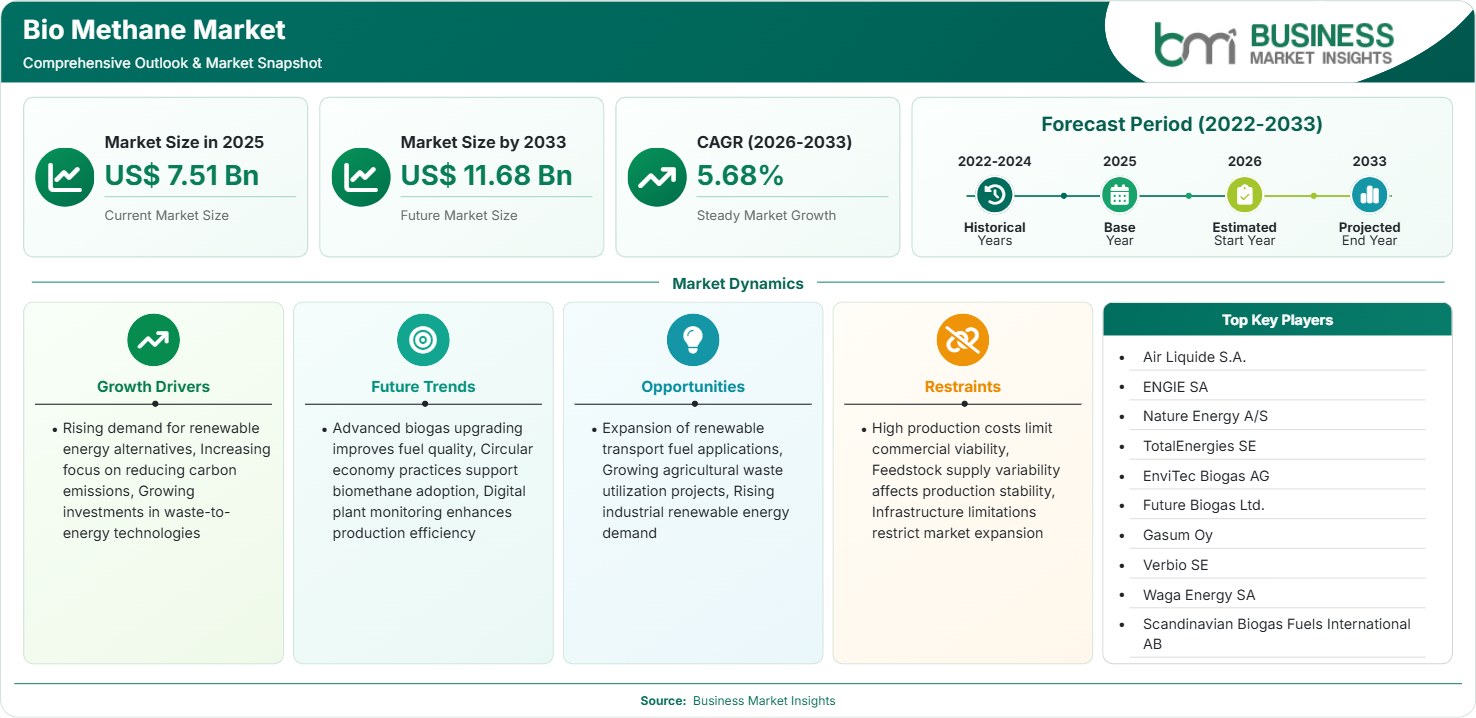
The Bio Methane Market size was valued at US$ 7.51 billion in 2025 and is projected to reach US$ 11.68 billion by 2033, growing at a CAGR of 5.68% during 2026–2033. Rising demand for renewable energy alternatives, increasing efforts to reduce carbon emissions, and growing investments in waste-to-energy technologies continue supporting market expansion.

Report Coverage
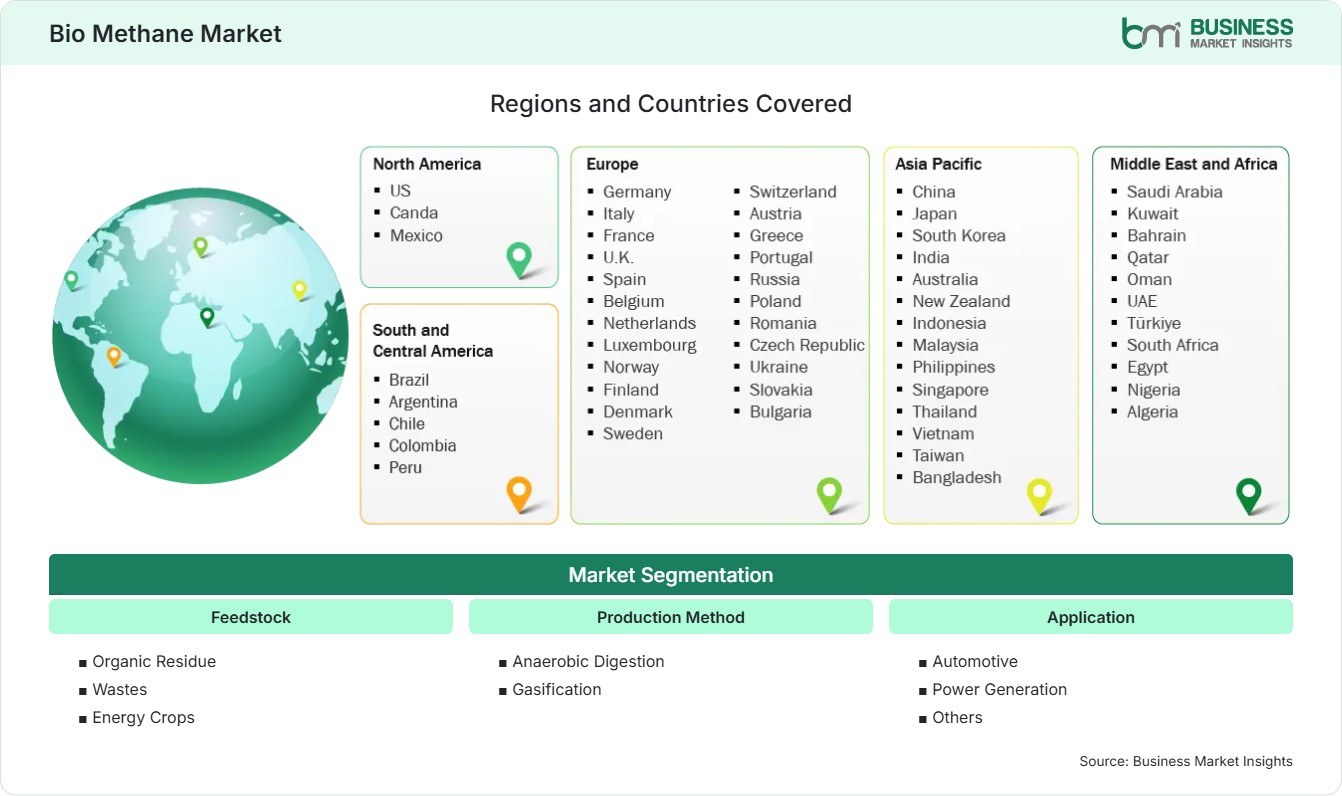
  • Feedstock: Organic Residue, Wastes, Energy Crops
  • Production Method: Anaerobic Digestion, Gasification
  • Application: Automotive, Power Generation, Others
US$ 7.51 Bn Market size in 2025
US$ 11.68 Bn Market Size by 2033
5.68% CAGR, 2026 - 2033
2026-2033 Forecast Period

01 AI Overview

Bio Methane Market Summary

  • North America Region: North America accounts for 28%–31% market share in 2025 and is projected to grow at a CAGR of 5.3%–5.8% during 2026–2033. Renewable fuel policies, landfill gas recovery projects, and expanding investments in sustainable energy infrastructure continue driving demand. The U.S. remains the leading contributor with a CAGR of 5.4%–5.9%, supported by renewable natural gas production and transportation fuel adoption.
  • Fastest Growing Region: Europe represents 35%–38% market share in 2025 and is expected to register a CAGR of 6.0%–6.5%, driven by ambitious climate targets, biomethane injection projects, circular economy initiatives, and renewable gas investments.
  • Leading Segment: Organic Residue & Wastes account for 73%–76% market share in 2025 and are anticipated to expand at a CAGR of 5.8%–6.3%, supported by increasing utilization of municipal waste, agricultural residues, and industrial organic waste.
  • High Growth Segment: Anaerobic Digestion captures 69%–72% market share in 2025 and is projected to record a CAGR of 5.9%–6.4%, driven by technological maturity, favorable government incentives, and expanding commercial-scale biogas facilities.
  • Key Market Opportunity: Growing renewable fuel demand, agricultural waste utilization, and industrial decarbonization initiatives are creating long-term opportunities for advanced biomethane production and distribution infrastructure.
  • Major Market Players: Air Liquide S.A., ENGIE SA, Nature Energy A/S, TotalEnergies SE, EnviTec Biogas AG, Future Biogas Ltd., Gasum Oy, Verbio SE, Waga Energy SA, and Scandinavian Biogas Fuels International AB.
02 Strategic Insights

Bio Methane Market: Strategic Insights

Bio Methane Market Strategic Framework
FREE PDF
Request your free sample
Request free sample
03 Stakeholder View

Key Takeaways

  • Agricultural residues, municipal waste, and organic by-products remain the primary feedstock sources, strengthening circular economy initiatives while reducing landfill dependency.
  • Renewable transport fuels continue creating strong commercial opportunities as governments promote low-carbon alternatives for heavy-duty transportation and public transit systems.
  • Technology providers are improving gas upgrading efficiency, plant automation, and feedstock utilization to enhance biomethane production economics.
  • Europe remains the most attractive investment destination due to supportive renewable energy policies, expanding gas grid infrastructure, and ambitious decarbonization commitments.
  • Strategic collaborations between energy companies, municipalities, and agricultural businesses continue accelerating development of commercial biomethane facilities.
  • Industrial consumers increasingly adopt renewable gas to reduce greenhouse gas emissions while improving long-term energy supply diversification.
04 Geographic Outlook

Bio Methane Market Regional Highlights

North America Bio Methane Market

North America accounts for 28%–31% Bio Methane Market share in 2025 and is projected to expand at a CAGR of 5.3%–5.8% during 2026–2033. Strong renewable fuel incentives, expanding renewable natural gas infrastructure, and growing landfill gas recovery projects continue supporting regional demand. Utilities and transportation companies are increasing investments in renewable gas production to achieve emission reduction goals while strengthening domestic energy security.

  • Renewable natural gas production continues expanding through landfill gas, wastewater treatment, and agricultural waste recovery projects.
  • Fleet operators increasingly adopt biomethane as a low-carbon transportation fuel for commercial vehicle operations.
  • Public investment supports expansion of renewable gas infrastructure and pipeline injection capacity.
  • Industrial facilities continue integrating renewable gas into long-term decarbonization strategies.

US Bio Methane Market

The United States contributes 82%–85% of North American revenue and is expected to grow at a CAGR of 5.4%–5.9% through 2026–2033. Renewable fuel incentives, increasing landfill gas utilization, and growing investment in renewable natural gas production continue supporting market expansion.

  • Agricultural waste projects continue increasing renewable gas production capacity across multiple states.
  • Utilities expand renewable gas integration into existing natural gas distribution systems.
  • Transportation companies increase adoption of renewable natural gas for fleet decarbonization.
  • Public policies continue encouraging investment in renewable energy infrastructure.

Europe Bio Methane Market

Europe represents 35%–38% market share in 2025 and is forecast to register a CAGR of 6.0%–6.5% during the forecast period. Renewable energy directives, circular economy policies, and expanding biomethane injection projects continue strengthening regional demand. Germany remains the largest market, while Denmark records the fastest growth through significant investments in renewable gas infrastructure.

  • Government incentives encourage development of commercial-scale anaerobic digestion facilities.
  • Renewable gas injection into national grids continues expanding across several European countries.
  • Agricultural waste utilization improves resource efficiency while supporting rural economic development.
  • Industrial decarbonization initiatives increase long-term biomethane consumption.

Asia Pacific Bio Methane Market

Asia Pacific accounts for 23%–26% market share in 2025 and is projected to register a CAGR of 5.8%–6.3% through 2026–2033. Growing energy demand, agricultural activity, and government support for renewable energy continue driving regional investment. China leads market development, while India records the fastest growth through expanding waste-to-energy initiatives and agricultural residue utilization.

  • Government renewable energy policies encourage commercial biomethane production.
  • Agricultural waste availability supports long-term feedstock security across rural regions.
  • Urban waste management projects continue creating additional renewable gas production opportunities.
  • Energy diversification strategies strengthen investment in renewable gas infrastructure.

Rest of World Bio Methane Market

The Rest of World region represents 8%–11% market share in 2025 and is expected to expand at a CAGR of 5.4%–5.9% during 2026–2033. Increasing waste management investments, renewable energy adoption, and agricultural modernization continue supporting market growth across Latin America, the Middle East, and Africa.

  • Brazil remains the leading regional market supported by abundant agricultural biomass resources.
  • GCC countries continue evaluating renewable gas projects as part of energy diversification strategies.
  • Municipal waste recovery initiatives improve feedstock availability for biomethane production.
  • Expanding industrial renewable energy demand encourages new commercial project development.
Global Market Geography
FREE PDF
Request your free sample
Request free sample
05 Segment Analysis

Bio Methane Market Segmentation

Feedstock

The feedstock segment represents the foundation of biomethane production, with organic waste remaining the preferred raw material because of its wide availability and environmental benefits. It accounted for 73%–76% market share in 2025 and is expected to register a CAGR of 5.8%–6.3% during 2026–2033. Expanding waste management programs, agricultural residue collection, and circular economy initiatives continue broadening the Bio Methane Market scope across developed and emerging economies.

  • Organic Residue & Wastes (Biowaste, Municipal Waste, Sewage Waste, Agriculture Waste, and Others): Dominates the segment as governments and industries increasingly convert organic waste streams into renewable energy while reducing landfill disposal and greenhouse gas emissions.
  • Energy Crops: Continue supporting biomethane production where dedicated biomass cultivation provides consistent feedstock quality, particularly in regions with established renewable energy policies and agricultural infrastructure.

Production Method

Production technology continues evolving as developers focus on improving conversion efficiency, operational reliability, and feedstock flexibility. This segment represented 69%–72% market share in 2025 and is anticipated to expand at a CAGR of 5.9%–6.4% through 2026–2033. Advances in plant automation, gas upgrading systems, and process optimization continue strengthening commercial biomethane production worldwide.

  • Anaerobic Digestion: Remains the preferred production route because of proven commercial performance, efficient processing of diverse organic waste streams, and compatibility with municipal, agricultural, and industrial feedstocks.
  • Gasification: Gains attention for converting dry biomass and agricultural residues into renewable gas, particularly where feedstock characteristics make conventional anaerobic digestion less suitable.

Application

Application diversity continues expanding as biomethane becomes an increasingly important renewable energy source across transportation, electricity generation, and industrial operations. The segment accounted for 41%–44% market share in 2025 and is projected to record a CAGR of 5.7%–6.2% during 2026–2033. Current Bio Methane Market trends indicate growing investment in renewable fuel infrastructure and low-carbon energy systems supporting wider commercial adoption.

  • Automotive: Commercial fleets, public transportation operators, and heavy-duty vehicle users increasingly adopt biomethane to lower emissions while complying with renewable fuel and sustainability regulations.
  • Power Generation: Utilities and independent power producers utilize biomethane for electricity generation, supporting grid stability while reducing dependence on conventional fossil fuels.
06 Market Forces

Bio Methane Market Dynamics

Key Market Drivers

Rising demand for renewable energy alternatives

The increasing concerns about climate change and energy security in the long run are driving the trend of shift towards renewables. The use of biomethane as a replacement for natural gas has gained increased prominence because it can be transported using the existing gas grid and at the same time reduce greenhouse gases emissions during the life cycle of gas. As per IEA reports, the production of renewable gas will become increasingly important in the strategy of global decarbonization. Such factors are further fuelling Bio Methane Market growth.

Increasing focus on reducing carbon emissions

Governments, utilities, and industrial organizations continue strengthening carbon reduction commitments through renewable energy adoption. Production of biomethane helps achieve goals set out in the circular economy, whereby agricultural and urban wastes and organic materials are turned into renewable energy, thereby minimizing the emission of methane into the atmosphere from landfills and waste disposal sites. Pricing policies, renewable energy obligations, and net-zero pledges are motivating more investments in biomethane plants. Renewable gas is becoming increasingly significant in decarbonization plans.

Growing investments in waste-to-energy technologies

Favorable investment in waste management facilities by both public and private organizations is contributing to an increase in opportunities for producing biomethane. Governments are working on increasing the capacity of organic waste collection, while agricultural firms are joining the ranks of companies that earn additional income through their involvement in waste-to-energy schemes. These investments continue shaping Bio Methane Market trends, supporting higher renewable gas production capacity and improved resource utilization across multiple regions.

Key Market Opportunities

Expansion of renewable transport fuel applications

Transport is still one of the sectors with the highest potential for biomethane since emission regulations are becoming stricter for commercial vehicles and public transport due to government measures. Renewable natural gas provides instant reduction of emissions, along with the usage of existing fueling stations across certain areas. Fleets continue switching from fossil fuels to biomethane without modifying their vehicles. Bio Methane Market Forecasts indicate that continued expansion of renewable transport fuel programs will create attractive long-term opportunities for biomethane producers, distributors, and infrastructure developers.

Growing agricultural waste utilization projects

Agricultural activities generate substantial volumes of crop residues, livestock manure, and organic waste that can be converted into renewable gas through anaerobic digestion. The government is promoting the involvement of farmers in integrated waste management systems that are not only resource efficient but also produce renewable energy. Such projects offer extra sources of revenue to the agricultural community, which will help achieve the renewable energy goals of the country. Collaboration between agricultural producers and energy producers will enhance sustainability.

Rising industrial renewable energy demand

Industrial manufacturers continue seeking renewable energy solutions to reduce greenhouse gas emissions and improve sustainability performance. Biomethane offers an effective alternative for industrial heating, steam generation, and process energy because it can often replace conventional natural gas with minimal infrastructure changes. Companies across food processing, chemicals, and manufacturing sectors are entering long-term renewable gas supply agreements to achieve environmental objectives. This trend is expected to encourage additional investment in large-scale biomethane production facilities.

Market Restraints and Challenges

High production costs limit commercial viability

Developing commercial biomethane facilities requires substantial investment in digestion systems, gas upgrading equipment, storage infrastructure, and distribution networks. Factor: High capital expenditure and operating costs reduce project profitability, particularly in regions with limited policy support or lower fossil fuel prices. Impact: Project developers may postpone investments or require financial incentives before proceeding with commercial-scale facilities, slowing broader market expansion despite increasing renewable energy demand.

Feedstock supply variability affects production stability

Reliable feedstock availability remains essential for maintaining continuous biomethane production. Factor: Seasonal agricultural output, inconsistent municipal waste collection, and changing organic waste composition can create fluctuations in feedstock quality and supply. Impact: Production efficiency may decline, operating costs can increase, and plant utilization rates may become inconsistent, making long-term supply agreements and diversified feedstock sourcing increasingly important for commercial project success.

07 Company Analysis

Competitive Landscape

Competition in the industry is shaped by investments in renewable gas infrastructure, advanced biogas upgrading technologies, and integrated waste-to-energy solutions. Bio Methane Market analysis indicates that leading companies are expanding production capacity, strengthening partnerships with municipalities and agricultural operators, and investing in carbon reduction technologies to enhance renewable gas availability across transportation, industrial, and power generation applications.

Company Name

Overview

Products and Services Relevant to this Market

Air Liquide S.A.

Global industrial gases company with significant investments in renewable hydrogen, biomethane, and low-carbon energy infrastructure across multiple international markets.

Biomethane production, gas upgrading technologies, renewable gas distribution, compression systems, and industrial gas solutions.

ENGIE SA

International energy company focused on renewable energy, decarbonization, and sustainable gas production through diversified energy assets.

Biomethane production, renewable gas infrastructure, energy management services, and grid injection solutions.

Nature Energy A/S

Leading biomethane producer specializing in large-scale anaerobic digestion and renewable natural gas projects.

Biomethane production plants, organic waste treatment, renewable gas upgrading, and grid injection services.

TotalEnergies SE

Global energy company expanding renewable gas production through strategic investments in biomethane facilities and low-carbon energy solutions.

Renewable natural gas production, biomethane facilities, energy distribution, and carbon reduction solutions.

EnviTec Biogas AG

German renewable energy company specializing in biogas plant engineering and biomethane technologies.

Anaerobic digestion plants, gas upgrading systems, biomethane production facilities, and plant operation services.

Future Biogas Ltd.

UK-based renewable energy developer focused on agricultural biomethane production and sustainable energy generation.

Agricultural biogas plants, biomethane production, feedstock management, and renewable gas supply solutions.

Gasum Oy

Nordic energy company promoting renewable gas and sustainable transportation across Northern Europe.

Biomethane production, renewable fuel distribution, LNG services, and transportation energy solutions.

Verbio SE

Integrated bioenergy company producing renewable fuels and biomethane from agricultural feedstocks.

Biomethane production, biofuels, gas upgrading technologies, renewable energy systems, and agricultural energy solutions.

Waga Energy SA

Renewable energy technology company specializing in landfill gas recovery and biomethane production.

Landfill gas upgrading, renewable natural gas production, gas purification technologies, and energy recovery systems.

Scandinavian Biogas Fuels International AB

Renewable energy producer focused on converting organic waste into biomethane for transport and industrial applications.

Biomethane production, organic waste processing, renewable transport fuels, and gas distribution services.

10 Trust & Transparency

Research Methodology

The market analysis combines proprietary research with secondary data from government agencies, company disclosures, regulatory filings, industry databases and expert interviews. Market estimates are validated through data triangulation, cross-market benchmarking and analyst review.

View Full Research Methodology

11 Questions Answered

Frequently Asked Questions

What does the Bio Methane Market Report include?

The Market Report provides comprehensive analysis of market dynamics, technology developments, regional outlook, competitive landscape, segmentation, regulatory trends, investment opportunities, and long-term business strategies shaping the global biomethane industry.

Which region offers the strongest growth opportunities?

Europe provides the strongest investment potential due to ambitious climate targets, renewable energy regulations, expanding biomethane grid injection infrastructure, and continuous public and private investment in renewable gas projects.

Why is anaerobic digestion the preferred production method?

Anaerobic digestion offers proven commercial performance, efficient processing of organic waste, relatively mature technology, and compatibility with agricultural, municipal, and industrial feedstocks, making it the dominant production pathway worldwide.

Which feedstock dominates biomethane production?

Organic residues and waste remain the leading feedstock because they are widely available, support circular economy objectives, reduce landfill emissions, and provide cost-effective raw materials for renewable gas production.

What factors are driving the Bio Methane Market?

The market is driven by increasing renewable energy adoption, carbon reduction initiatives, expanding waste-to-energy investments, supportive government policies, and growing demand for renewable natural gas across transportation, industrial, and power generation sectors.

Access the Full Bio Methane Market Report

Get segment-level forecasts, regional estimates, competitive benchmarking, company profiles and downloadable Excel datasets.

Access the full Bio Methane Market Report
350 pages PDF & Excel | 2026-08-11