
Circulating Fluidized Bed Boilers Market Outlook: Size, Share, Trends, Growth Analysis, Competitive Landscape & Forecast, 2022-2033

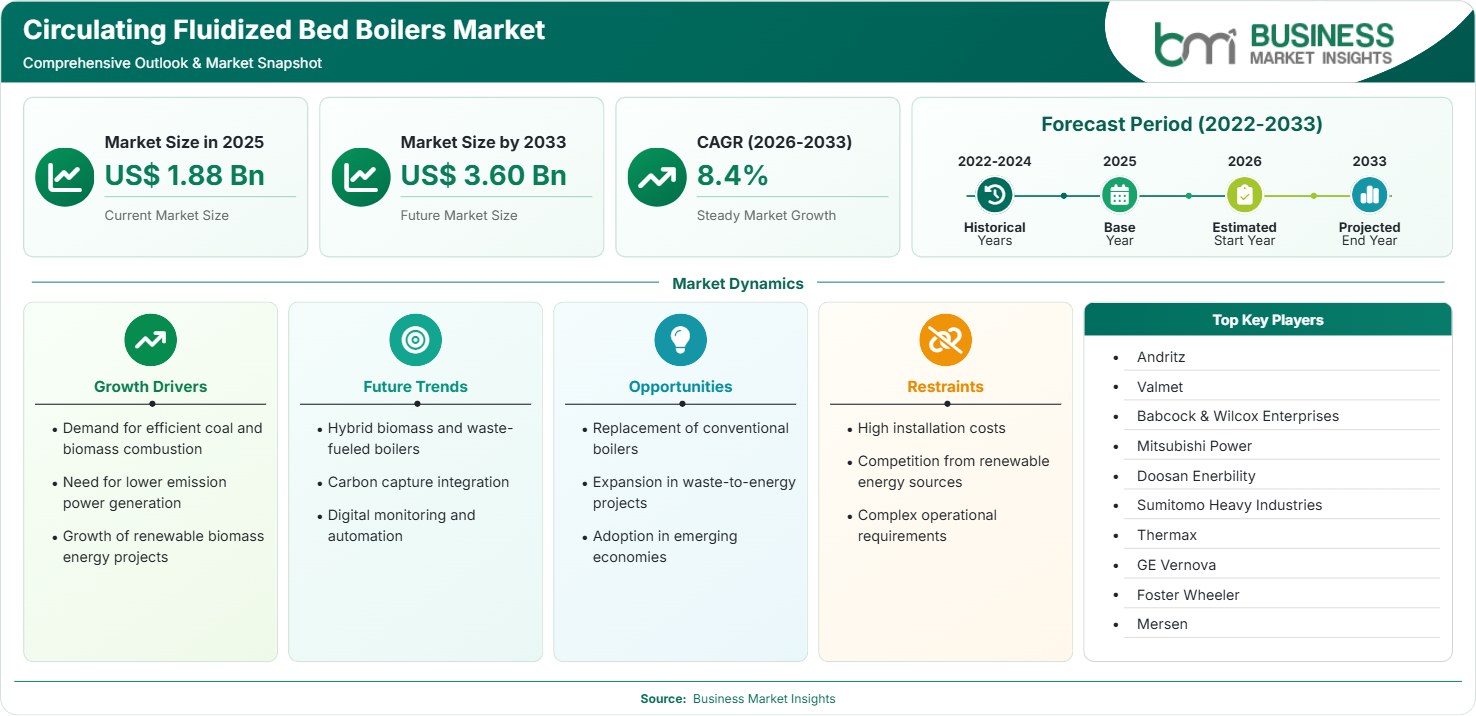
The Circulating Fluidized Bed Boilers Market size was valued at US$ 1.88 Billion in 2025 and is projected to reach US$ 3.60 Billion by 2033, growing at a CAGR of 8.4% during 2026–2033. Rising demand for efficient coal and biomass combustion technologies, increasingly stringent emission regulations, and expanding renewable biomass energy projects are driving industry growth. Additional opportunities are emerging through replacement of aging conventional boilers, expansion of waste-to-energy infrastructure, and industrialization across developing economies.

Report Coverage
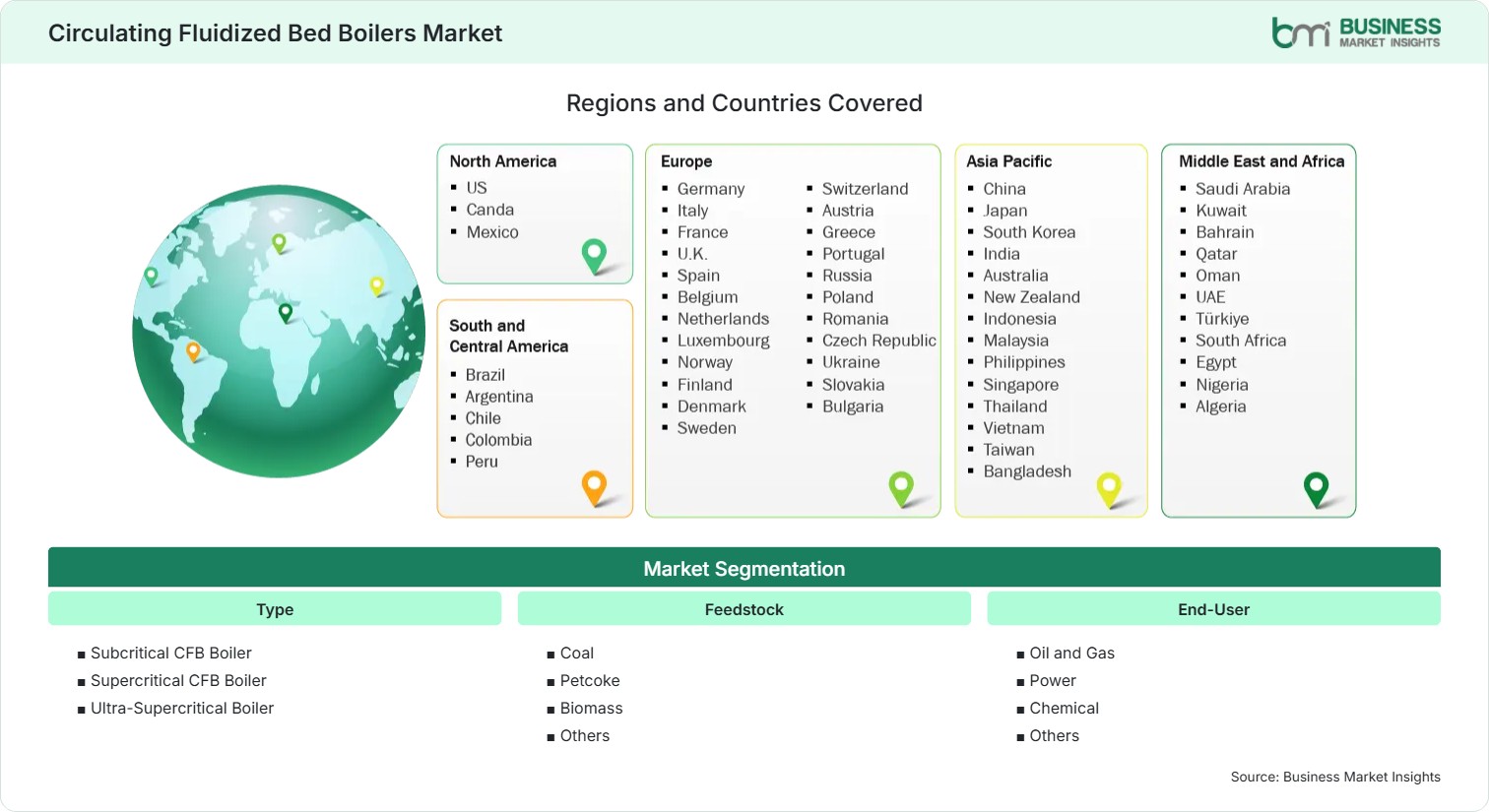
  • Type: Subcritical CFB Boiler, Supercritical CFB Boiler, Ultra-Supercritical Boiler
  • Feedstock: Coal, Petcoke, Biomass, Others
  • End-User: Oil and Gas, Power, Chemical, Others
US$ 1.88 Bn Market size in 2025
US$ 3.60 Bn Market Size by 2033
8.4% CAGR, 2026 - 2033
2026-2033 Forecast Period

01 AI Overview

Circulating Fluidized Bed Boilers Market Summary

  • North America Region: North America holds an estimated 27%–30% market share in 2025 and is projected to register a CAGR of 7.3%–7.8% during 2026–2033. Utility modernization, industrial boiler replacement, biomass co-firing initiatives, and tightening emission regulations continue supporting market expansion. The United States benefits from large-scale power plant retrofits and industrial decarbonization investments, supporting a projected CAGR of 7.5%–7.9%.
  • Fastest Growing Region: Asia Pacific accounts for approximately 40%–43% market share in 2025 and is expected to expand at a CAGR of 9.3%–9.8%. Rapid industrialization, electricity demand growth, cleaner coal technologies, and biomass-based generation projects continue accelerating regional adoption.
  • Leading Segment: Subcritical CFB Boiler represents nearly 45%–48% market share in 2025 and is forecast to grow at a CAGR of 8.0%–8.4%. Operational flexibility, fuel adaptability, and relatively lower installation costs continue supporting widespread deployment across utility and industrial facilities.
  • High Growth Segment: Biomass contributes approximately 22%–25% market share in 2025 and is projected to record a CAGR of 10.1%–10.6%. Renewable energy targets, agricultural residue utilization, and carbon reduction initiatives continue encouraging investment in biomass-fired power generation.
  • Key Market Opportunity: Rising investments in waste-to-energy facilities, industrial boiler modernization, and biomass-fired power generation are creating long-term growth opportunities for advanced circulating fluidized bed boiler manufacturers and engineering solution providers.
  • Major Market Players: ANDRITZ AG, Valmet Oyj, Babcock & Wilcox Enterprises, Inc., Mitsubishi Power, Ltd., Doosan Enerbility Co., Ltd., Sumitomo Heavy Industries, Ltd., Thermax Limited, GE Vernova Inc., Foster Wheeler AG, and Mersen S.A.
02 Strategic Insights

Circulating Fluidized Bed Boilers Market: Strategic Insights

Circulating Fluidized Bed Boilers Market Strategic Framework
FREE PDF
Request your free sample
Request free sample
03 Stakeholder View

Key Takeaways

  • The market value chain is increasingly driven by integrated engineering, procurement, construction, equipment manufacturing, and lifecycle maintenance services, enabling suppliers to provide complete boiler solutions while strengthening long-term customer relationships.
  • Biomass-fired and multi-fuel circulating fluidized bed boilers present the strongest growth opportunities as governments promote renewable energy generation, industrial decarbonization, and reduced dependence on conventional fossil fuel combustion.
  • Technological innovation is focused on higher thermal efficiency, digital boiler monitoring, predictive maintenance, advanced combustion control systems, and enhanced emission reduction technologies capable of meeting increasingly stringent environmental regulations.
  • Asia Pacific remains the most attractive regional investment destination because of rising electricity demand, industrial expansion, cleaner coal technology adoption, and continuous investments in power generation infrastructure.
  • Strategic partnerships, capacity expansion projects, and modernization contracts continue reshaping competition as leading manufacturers focus on utility retrofits, industrial boiler upgrades, and next-generation combustion technologies.
  • Increasing replacement of aging conventional boilers with fuel-flexible circulating fluidized bed systems is expected to create sustainable aftermarket opportunities for equipment suppliers and service providers.
04 Geographic Outlook

Circulating Fluidized Bed Boilers Market Regional Highlights

North America Circulating Fluidized Bed Boilers Market

North America accounted for approximately 27%–30% of global revenue in 2025 and is projected to register a CAGR of 7.3%–7.8% during 2026–2033. Demand is supported by modernization of aging thermal power infrastructure, stricter environmental regulations, and growing adoption of biomass co-firing technologies. The Circulating Fluidized Bed Boilers Market share remains strong due to utility investments in emission reduction systems, industrial steam generation, and replacement of conventional boiler systems with higher-efficiency combustion technologies.

  • Utilities across the United States and Canada continue investing in boiler retrofits to improve combustion efficiency, reduce sulfur dioxide and nitrogen oxide emissions, and extend the operational life of existing thermal power plants.
  • Industrial sectors including chemicals, pulp and paper, mining, and food processing increasingly adopt circulating fluidized bed technology because of its fuel flexibility and ability to utilize low-grade fuels efficiently.
  • Biomass co-firing projects continue expanding as governments promote renewable energy integration while enabling utilities to reduce carbon emissions without completely replacing existing infrastructure.
  • Digital monitoring systems and predictive maintenance technologies are improving boiler availability, reducing maintenance costs, and increasing operational efficiency across industrial and utility installations.
  • Engineering service providers continue benefiting from long-term maintenance contracts, performance upgrades, and modernization projects across mature power generation assets.

US Circulating Fluidized Bed Boilers Market

The United States represents nearly 22%–25% of the global market in 2025 and is forecast to expand at a CAGR of 7.5%–7.9% through 2033. Increasing investments in cleaner combustion technologies, biomass power generation, and industrial energy efficiency continue supporting sustained demand across utilities and large manufacturing facilities.

  • Federal and state emission regulations continue encouraging utilities to replace aging combustion systems with advanced circulating fluidized bed technologies capable of meeting stricter environmental standards.
  • Biomass utilization is increasing across industrial facilities seeking lower-carbon steam generation while utilizing agricultural residues and forestry waste as renewable fuel sources.
  • Power producers continue investing in digital plant optimization technologies that improve boiler efficiency, reduce unplanned outages, and enhance long-term operational reliability.
  • Industrial boiler modernization across chemical processing, pulp and paper, and manufacturing sectors continues creating stable opportunities for equipment suppliers and engineering contractors.

Europe Circulating Fluidized Bed Boilers Market

Europe accounted for approximately 23%–26% of global revenue in 2025 and is projected to expand at a CAGR of 7.1%–7.5% during the forecast period. Demand is supported by decarbonization strategies, waste-to-energy investments, and increasing biomass utilization. Germany remains the leading regional Circulating Fluidized Bed Boilers market, while Poland is expected to register the fastest growth owing to ongoing modernization of thermal generation assets and industrial infrastructure.

  • Germany leads regional adoption through advanced industrial manufacturing, district heating systems, and continuous investments in cleaner combustion technologies, with a projected CAGR of 7.0%–7.4%.
  • Poland is anticipated to emerge as the fastest-growing national market with a CAGR of 8.5%–8.9%, supported by coal power modernization, industrial investments, and emission reduction initiatives.
  • Waste-to-energy facilities continue expanding across Western Europe, creating demand for advanced circulating fluidized bed boilers capable of processing diverse feedstocks efficiently.
  • Biomass-fired combined heat and power projects continue supporting regional renewable energy targets while reducing dependence on traditional coal-fired generation.
  • Industrial decarbonization policies encourage manufacturers to invest in high-efficiency boiler technologies with lower emissions and improved fuel flexibility.

Asia Pacific Circulating Fluidized Bed Boilers Market

Asia Pacific held approximately 40%–43% of global revenue in 2025 and is forecast to register the highest CAGR of 9.3%–9.8% during 2026–2033. Rapid industrialization, rising electricity demand, expanding manufacturing activity, and cleaner coal utilization continue driving regional adoption. China remains the largest Circulating Fluidized Bed Boilers market, while India is projected to record the fastest growth because of ongoing investments in power generation and industrial infrastructure.

  • China dominates regional demand through extensive coal-fired generation capacity, industrial expansion, and continuous upgrades to improve power plant efficiency, registering a projected CAGR of 9.0%–9.4%.
  • India is expected to record the fastest regional growth with a CAGR of 10.1%–10.5%, driven by electricity demand, industrial expansion, and increasing deployment of biomass-based power projects.
  • Southeast Asian countries continue investing in industrial steam generation and power infrastructure, creating additional demand for fuel-flexible boiler technologies.
  • Government incentives supporting biomass utilization and cleaner thermal technologies continue encouraging adoption across industrial and utility applications.
  • EPC contractors are expanding regional manufacturing capabilities and engineering services to support growing demand for large-scale boiler installations.

Rest of World Circulating Fluidized Bed Boilers Market

The Rest of World region accounted for approximately 8%–11% of global revenue in 2025 and is projected to grow at a CAGR of 8.0%–8.4% during 2026–2033. South & Central America are benefiting from biomass energy investments, while the Middle East & Africa continue expanding industrial and utility infrastructure to support long-term electricity generation and steam production requirements.

  • Brazil remains the leading regional Circulating Fluidized Bed Boilers market with a projected CAGR of 8.2%–8.6%, supported by biomass power generation, sugarcane residue utilization, and industrial energy projects.
  • Saudi Arabia is expected to record the fastest growth at a CAGR of 8.8%–9.2%, driven by industrial diversification, petrochemical expansion, and investments in efficient steam generation systems.
  • Waste-to-energy initiatives continue expanding across selected Middle Eastern and Latin American economies, supporting demand for advanced combustion technologies.
  • Mining, cement, and heavy industrial sectors continue adopting circulating fluidized bed boilers because of their capability to utilize lower-grade fuels while maintaining stable thermal efficiency.
  • Government-led infrastructure development and industrial diversification strategies continue creating new opportunities for utility-scale and industrial boiler installations.
Global Market Geography
FREE PDF
Request your free sample
Request free sample
05 Segment Analysis

Circulating Fluidized Bed Boilers Market Segmentation

Type

The type segment represents a substantial share of the overall industry, supported by increasing deployment of advanced combustion systems in utility and industrial applications. The segment accounted for approximately 48%–51% market share in 2025 and is projected to register a CAGR of 8.5%–8.9% during the forecast period. The Circulating Fluidized Bed Boilers Market scope continues to expand as power producers seek high-efficiency boiler technologies capable of operating with multiple fuels while complying with increasingly stringent environmental regulations.

  • Subcritical CFB Boiler: The most widely deployed configuration because of lower capital investment, operational flexibility, fuel adaptability, and suitability for industrial steam generation and medium-capacity power plants.
  • Supercritical CFB Boiler: Increasingly adopted by utilities seeking higher thermal efficiency, lower fuel consumption, and improved emission performance while maintaining operational flexibility across diverse fuel types.
  • Ultra-Supercritical Boiler: Demand is expanding steadily as advanced power plants pursue maximum efficiency, reduced greenhouse gas emissions, and long-term operating cost savings through higher steam temperatures and pressures.

Feedstock

The feedstock segment continues to evolve as operators diversify fuel sources to improve sustainability and fuel security. It accounted for approximately 34%–37% of the Circulating Fluidized Bed Boilers market share in 2025 and is expected to grow at a CAGR of 8.7%–9.1% through 2033. Growing renewable energy initiatives, improved combustion technologies, and increasing adoption of multi-fuel boiler systems are encouraging utilities and industrial operators to optimize fuel selection based on availability, economics, and emission requirements.

  • Coal: Continues to dominate installations where abundant reserves, established infrastructure, and dependable baseload power generation support long-term utilization despite tightening environmental regulations.
  • Petcoke: Widely utilized in energy-intensive industries because of its high calorific value, cost competitiveness, and compatibility with circulating fluidized bed combustion technology.
  • Biomass: Experiencing the fastest adoption due to renewable energy policies, agricultural residue utilization, carbon reduction targets, and increasing investments in sustainable power generation facilities.

End-User

The end-user segment remains the principal source of equipment demand, accounting for approximately 52%–55% market share in 2025 while expanding at a CAGR of 8.3%–8.7% during the forecast period. Rising electricity demand, industrial steam requirements, and investments in cleaner combustion systems continue supporting the Circulating Fluidized Bed Boilers market expansion across multiple industries. Modernization of existing thermal assets further strengthens equipment replacement and upgrade opportunities.

  • Oil and Gas: Refineries and upstream processing facilities increasingly deploy high-efficiency boiler systems to improve steam generation reliability, enhance fuel utilization, and reduce operational emissions.
  • Power: Represents the largest application owing to continuous investments in thermal power generation, biomass-fired plants, utility modernization, and replacement of aging conventional boiler technologies.
  • Chemical: Chemical manufacturing facilities rely on circulating fluidized bed boilers for dependable steam production, fuel flexibility, and efficient process heating across diverse production operations.
06 Market Forces

Circulating Fluidized Bed Boilers Market Dynamics

Key Market Drivers

Demand for efficient coal and biomass combustion

The growing need for highly efficient combustion technologies is a major driver supporting deployment of circulating fluidized bed (CFB) boilers across utility and industrial applications. Unlike conventional boilers, CFB systems can efficiently burn low-grade coal, biomass, petroleum coke, and mixed fuels while maintaining high combustion efficiency and stable operating temperatures. This capability enables operators to reduce fuel costs and improve operational flexibility. The Circulating Fluidized Bed Boilers Market growth is further supported by increasing investments in industrial steam generation, district heating, and captive power plants where multi-fuel capability provides significant economic advantages.

Need for lower emission power generation

Governments worldwide are implementing stricter environmental regulations to reduce sulfur dioxide (SO₂), nitrogen oxide (NOₓ), and particulate emissions from thermal power plants. Circulating fluidized bed boilers inherently produce lower emissions because combustion occurs at relatively lower temperatures and allows in-furnace sulfur capture through limestone injection. This minimizes the need for expensive downstream emission control systems while helping operators comply with increasingly stringent environmental standards. Utilities and industrial facilities are therefore investing in CFB technology to modernize aging power infrastructure, improve environmental performance, and reduce operating costs associated with emission compliance.

Growth of renewable biomass energy projects

Increasing renewable energy targets and government incentives for biomass utilization continue driving adoption of circulating fluidized bed boilers worldwide. These systems efficiently utilize agricultural residues, forestry waste, municipal biomass, and other renewable feedstocks without significant modifications to boiler design. Growing investments in combined heat and power (CHP) plants, district heating projects, and waste biomass utilization are strengthening Circulating Fluidized Bed Boilers Market trends across developed and emerging economies. Continuous advancements in combustion optimization and fuel handling systems further improve operational reliability, allowing operators to maximize renewable energy utilization while reducing greenhouse gas emissions and dependence on conventional fossil fuels.

Key Market Opportunities

Replacement of conventional boilers

Large numbers of aging coal-fired boilers across power generation and industrial facilities present a substantial replacement opportunity for advanced circulating fluidized bed technologies. Many existing systems no longer meet modern efficiency or environmental standards, encouraging utilities and industrial operators to invest in next-generation boiler solutions. Circulating Fluidized Bed Boilers Market Forecasts indicate that retrofit and modernization projects will remain an important revenue source throughout the forecast period.

Expansion in waste-to-energy projects

Growing municipal solid waste generation and stricter landfill regulations are encouraging governments to invest in waste-to-energy infrastructure. Increasing urbanization, expanding waste management programs, and rising energy recovery initiatives across Europe, Asia Pacific, and the Middle East continue creating attractive opportunities for technology providers capable of delivering high-efficiency waste combustion systems with advanced environmental performance.

Adoption in emerging economies

Rapid industrialization, rising electricity demand, and expanding manufacturing capacity across emerging economies continue generating strong demand for efficient steam generation technologies. Countries across Asia Pacific, Latin America, the Middle East, and Africa are investing heavily in thermal power modernization, industrial infrastructure, and biomass-based energy projects. Strategic local partnerships and regional manufacturing capabilities are expected to improve competitiveness while supporting long-term Circulating Fluidized Bed Boilers market expansion.

Market Restraints and Challenges

High installation costs

Factor: Circulating fluidized bed boiler systems require substantial capital investment because of their complex combustion technology, specialized refractory materials, sophisticated fuel feeding systems, and advanced emission control equipment.

Impact: The high initial expenditure can discourage adoption, particularly among small and medium-sized industrial operators with limited capital budgets.

Competition from renewable energy sources

Factor: The rapid deployment of renewable energy technologies such as solar photovoltaic, wind power, and battery energy storage systems is reshaping global electricity generation.

 Impact: Reduced investments in new coal-based generating capacity may limit demand for circulating fluidized bed boilers in certain developed markets.

07 Company Analysis

Competitive Landscape

The competitive environment is characterized by established boiler manufacturers, engineering companies, and industrial equipment suppliers investing in high-efficiency combustion technologies, digital plant automation, and emission reduction solutions. The circulating fluidized bed boilers market analysis indicates that companies are strengthening their positions through strategic partnerships, technology licensing, capacity expansion, and comprehensive lifecycle service offerings to address increasing demand from utilities and industrial customers.

Company Name

Overview

Products and Services Relevant to this Market

ANDRITZ AG

Global engineering company specializing in industrial process technologies and advanced energy systems for power and industrial applications.

Circulating fluidized bed boilers, biomass boilers, EPC services, plant modernization, automation, and lifecycle maintenance solutions.

Valmet Oyj

Leading technology provider delivering sustainable energy and industrial process solutions across global markets.

Biomass-fired CFB boilers, automation systems, plant optimization, emissions control, and engineering services.

Babcock & Wilcox Enterprises, Inc.

International supplier of thermal power generation equipment and environmental technologies with extensive boiler expertise.

Utility boilers, CFB boiler systems, waste-to-energy technologies, aftermarket services, and emissions control solutions.

Mitsubishi Power, Ltd.

Global manufacturer of advanced power generation equipment emphasizing high-efficiency thermal technologies and decarbonization solutions.

CFB boilers, steam generators, power plant engineering, digital monitoring, and maintenance services.

Doosan Enerbility Co., Ltd.

Engineering company providing large-scale power generation equipment and integrated energy infrastructure solutions.

Supercritical CFB boilers, EPC services, plant upgrades, industrial steam systems, and operational support.

Sumitomo Heavy Industries, Ltd.

Industrial equipment manufacturer supplying energy, environmental, and heavy engineering technologies worldwide.

Biomass CFB boilers, industrial boilers, waste-to-energy systems, and engineering services.

Thermax Limited

Leading provider of energy and environmental solutions serving industrial and commercial customers globally.

Industrial CFB boilers, biomass combustion systems, utility boilers, waste heat recovery, and aftermarket support.

GE Vernova Inc.

Energy technology company delivering advanced power generation equipment and plant modernization services.

Boiler technologies, plant automation, emissions reduction systems, digital optimization, and engineering solutions.

Foster Wheeler AG

Recognized engineering company with longstanding expertise in circulating fluidized bed combustion technologies.

CFB boiler design, engineering consulting, utility boiler systems, and plant modernization solutions.

Mersen S.A.

Global industrial solutions provider supporting thermal power and process industries through advanced materials and electrical technologies.

Graphite components, thermal management products, corrosion-resistant materials, and industrial equipment solutions.

08 Industry Activity

Recent Developments

May 2025

Babcock & Wilcox Enterprises, Inc. continued expansion of its renewable and waste-to-energy technology portfolio, including advanced combustion systems designed to convert waste and alternative fuels into electricity and steam while improving emissions performance.

April 2025

Valmet Oyj announced the delivery of a new biomass-fired power plant boiler technology project incorporating Valmet’s circulating fluidized bed (CFB) boiler solutions. The company continues to support flexible fuel utilization, renewable energy generation, and reduced emissions through advanced boiler technologies.

September 2024

ANDRITZ AG announced progress on biomass energy projects utilizing its circulating fluidized bed boiler technology. The company continues to supply renewable energy solutions focused on fuel flexibility, efficient combustion, and industrial decarbonization.

June 2024

Mitsubishi Power, Ltd. expanded digital power plant optimization capabilities through its TOMONI™ digital solutions, supporting improved operational efficiency, reliability, and performance monitoring for thermal power facilities.

10 Trust & Transparency

Research Methodology

The market analysis combines proprietary research with secondary data from government agencies, company disclosures, regulatory filings, industry databases and expert interviews. Market estimates are validated through data triangulation, cross-market benchmarking and analyst review.

View Full Research Methodology

11 Questions Answered

Frequently Asked Questions

What does the Circulating Fluidized Bed Boilers Market Report provide?

The Circulating Fluidized Bed Boilers Report provides insights into market size, competitive developments, regional performance, technology trends, segmentation analysis, growth opportunities, challenges, and strategic factors influencing future industry investments.

How are environmental regulations influencing the market?

Environmental regulations are encouraging utilities and industrial operators to adopt advanced combustion systems capable of meeting emission standards. CFB boilers support compliance through lower combustion temperatures, improved sulfur capture, and efficient fuel utilization.

Why are industries replacing conventional boilers with CFB technology?

Industries are replacing conventional boilers because CFB systems offer improved fuel adaptability, better combustion efficiency, reduced emissions, and the ability to utilize diverse fuel sources including biomass, petcoke, and low-grade coal.

Which feedstock segment is expected to experience the fastest growth?

Biomass is expected to experience the fastest growth due to increasing renewable energy targets, government incentives, agricultural residue utilization, and rising investments in biomass-fired power plants and industrial combined heat and power facilities.

What factors are driving the adoption of circulating fluidized bed boilers?

The adoption of circulating fluidized bed boilers is primarily driven by fuel flexibility, efficient combustion of coal and biomass, lower emissions compared with conventional systems, industrial steam demand, and increasing investments in cleaner thermal power generation technologies.

Access the Full Circulating Fluidized Bed Boilers Market Report

Get segment-level forecasts, regional estimates, competitive benchmarking, company profiles and downloadable Excel datasets.

Access the full Circulating Fluidized Bed Boilers Market Report
350 pages PDF & Excel | 2026-07-28