Market Summary
Executive Summary and Global Market Analysis
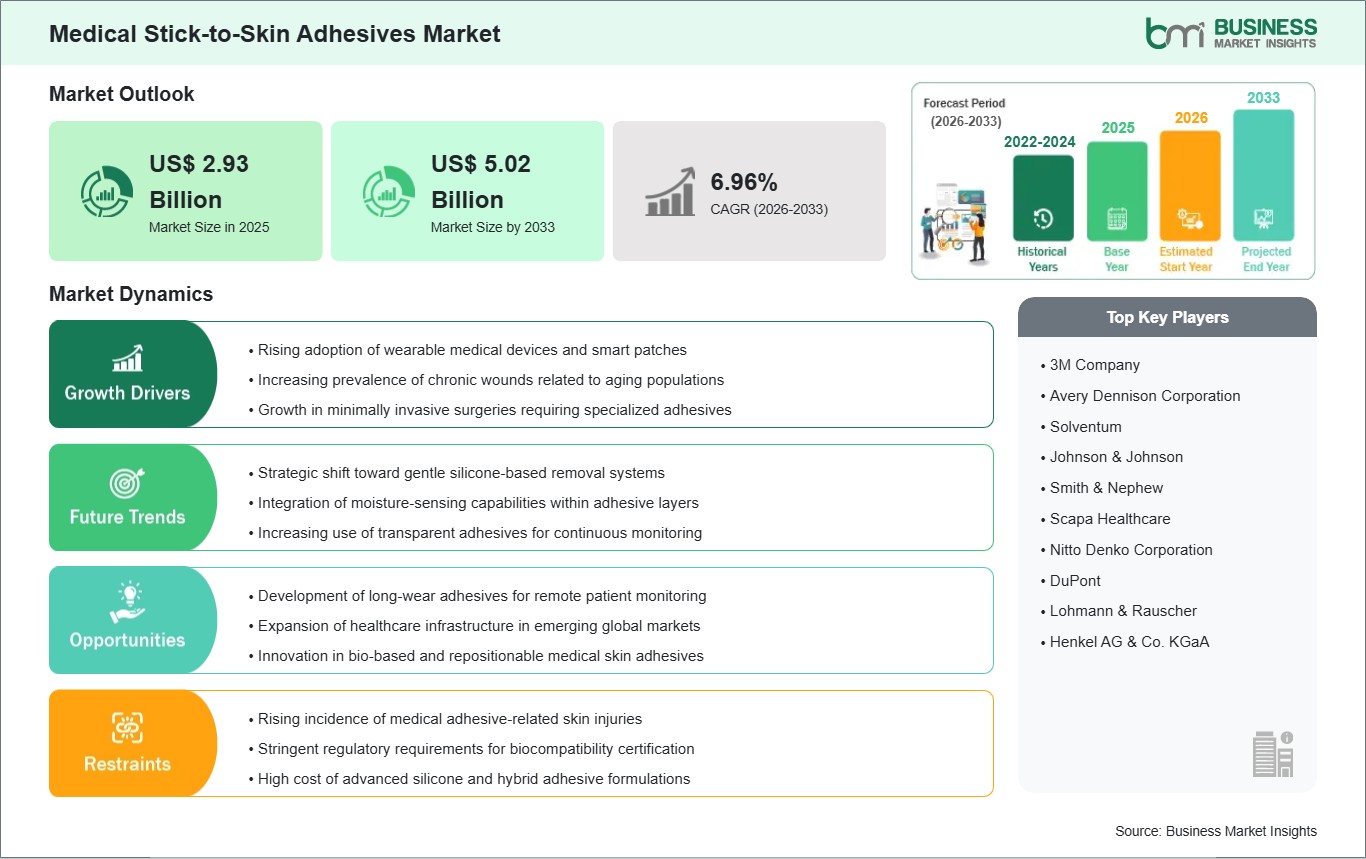
The global medical stick-to-skin adhesives market represents an important segment of the healthcare materials industry, which represents the interface between medical technologies and the human body. As medical technologies become more portable, the focus of medical care is shifting to home-based settings, creating a greater need for safe, reliable, and skin-friendly adhesives. The medical stick-to-skin adhesives market is in transition to gentle-to-skin adhesives, with the primary goal of preventing skin trauma on removal. Acrylics dominate the market by virtue of their versatility, but silicone adhesives are growing at the fastest rate for use on sensitive skin in pediatric and geriatric care.
The innovations in this segment are greatly impacted by the advent of wearables, which need adhesives that are capable of enduring wear without compromising the skin's natural integrity. There is now more emphasis on the development of multi-layer adhesive systems that provide the best combination of bond strengths and moisture management. While the process is hindered by the need for strict biocompatibility testing and the high cost of the raw materials, the market is expected to grow significantly. This is because of the increased number of surgeries worldwide and the emphasis on skin safety, which ensures that adhesives are at the heart of modern wound healing, drug delivery, and device fixation.
Segment Analysis
Medical Stick-to-Skin Adhesives Market Segmentation
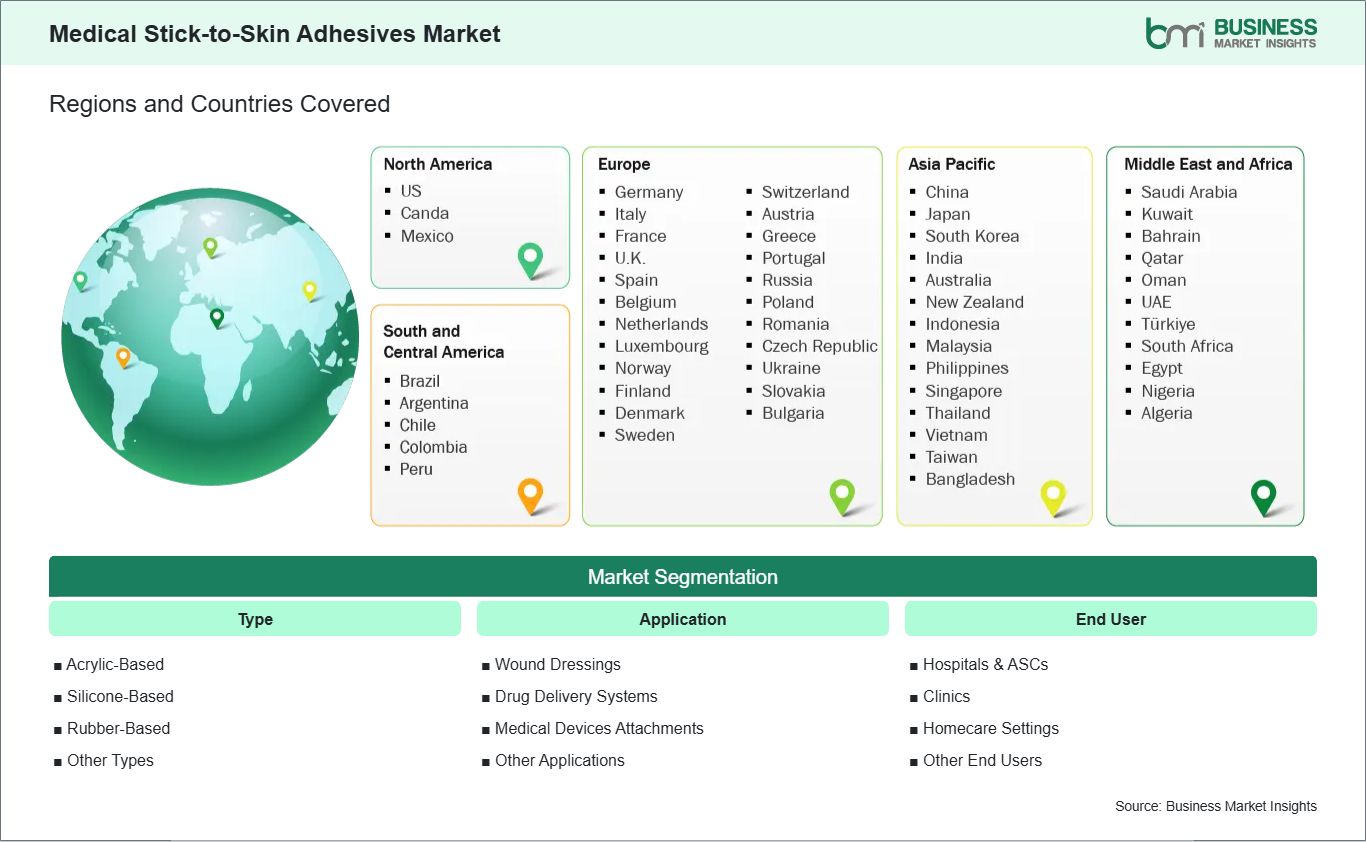
Key segments that contributed to the derivation of the Medical Stick-to-Skin Adhesives market analysis are type, application, and end user.
- By type, the medical stick-to-skin adhesives market is segmented into Acrylic-Based, Silicone-Based, Rubber-Based, and Other Types. The Acrylic-Based segment dominated the market in 2025.
- By application, the medical stick-to-skin adhesives market is segmented into Wound Dressings, Drug Delivery Systems, Medical Devices Attachments, and Other Applications. The Wound Dressings segment dominated the market in 2025.
- By end user, the medical stick-to-skin adhesives market is segmented into Hospitals & ASCs, Clinics, Homecare Settings, and Other End Users. The Hospitals & ASCs segment dominated the market in 2025.
Market Forces
Medical Stick-to-Skin Adhesives Market Drivers and Opportunities
Rising adoption of wearable medical devices and smart patches
The proliferation of wearable health technologies, such as continuous glucose monitors, heart rate monitors, and remote patient monitoring devices, has significantly changed the demand curve for stick-to-skin adhesives. These devices require adhesives that can bond for long periods of time without causing irritation to the user. This is because of the increasing adoption of telehealth technologies, which allow for the management of chronic diseases. It is essential for such devices to maintain constant, accurate data, which can only be achieved by sticking to the skin for long periods of time. Adhesive manufacturers are now developing breathable adhesives to manage sweat, which can cause detachment from the skin.
As wearable devices become smaller and more integrated into daily life, the demand for ultra-thin, conformable adhesives is surging. These materials must survive various environmental stressors, including showering, exercise, and changes in body temperature, without compromising the electronic interface. This evolution is pushing the industry toward specialized acrylic and silicone hybrids that offer high peel strength during use but gentle removal to protect the skin barrier. The intersection of consumer electronics and clinical healthcare ensures that the wearable sector will remain a primary engine for high-performance adhesive innovation, requiring materials that balance mechanical security with biological safety.
Development of long-wear adhesives for remote patient monitoring
Remote patient monitoring represents a significant growth frontier, particularly as healthcare systems look to reduce hospital readmission rates and manage aging populations in homecare settings. Long-wear adhesives are the critical enabling component of this technology, as they allow for the continuous attachment of diagnostic sensors without the need for frequent replacement by medical staff. The challenge for manufacturers is to develop adhesives that provide reliable securement over a week or more while minimizing the risk of skin maceration or allergic reactions. This has led to the development of porous and patterned adhesive coatings that allow for maximum moisture vapor transmission.
The opportunity in this sector extends beyond simple attachment to the development of smart adhesives that can interact with the skin or the device. Emerging research into repositionable adhesives allows for a second chance at device placement, which is vital for patients with limited dexterity who manage their own devices at home. As clinical trials increasingly incorporate wearable technology to collect real-world data, the demand for clinical-grade, long-wear securement is expected to expand into the pharmaceutical research sector. By solving the technical hurdles of long-term skin adherence, adhesive providers are positioning themselves as essential partners in the digital health revolution, enabling a more data-driven approach to medicine.
Size and Share Analysis
Medical Stick-to-Skin Adhesives Market Size and Share Analysis
The global Medical Stick-to-Skin Adhesives market is experiencing steady growth, with market size and share analysis reflecting evolving treatment preferences and competitive dynamics among key players. The report evaluates important subsegments categorized within type, application, and end user, highlighting their respective contributions to overall market performance.
By type, the Acrylic-Based subsegment dominated the market in 2025 due to its exceptional balance of strong initial tack, long-term durability, and cost-effectiveness, making it the industry standard for high-volume surgical drapes and long-wear medical tapes.
By application, the Wound Dressings subsegment dominated the market in 2025 because of the high global incidence of acute and chronic wounds that require reliable, breathable adhesive barriers to protect the healing environment and prevent bacterial contamination.
By end user, the Hospitals & ASCs subsegment dominated the market in 2025 as these facilities perform the vast majority of surgical and diagnostic procedures that necessitate sterile, medical-grade skin contact adhesives for securement and closure.
Report Coverage
Medical Stick-to-Skin Adhesives Market Report Coverage and Deliverables
The "Medical Stick-to-Skin Adhesives Market Size and Forecast (2022 - 2033)" report provides a detailed analysis of the market covering below areas:
- Medical Stick-to-Skin Adhesives market size and forecast at the regional and country levels for segments covered under the scope
- Medical Stick-to-Skin Adhesives market trends, as well as drivers, restraints, and opportunities
- Medical Stick-to-Skin Adhesives market analysis covering key trends, regional framework, major players, regulations, and recent developments
- Industry landscape and competition analysis covering market concentration, heat map analysis, prominent players, and recent developments for the Medical Stick-to-Skin Adhesives market
- Detailed company profiles, including SWOT analysis
Geographic Insights
Medical Stick-to-Skin Adhesives Market Geographic Insights
The geographical scope of the Medical Stick-to-Skin Adhesives market report is divided into: North America, Asia Pacific, Europe, Middle East & Africa, and South & Central America. North America held the largest share in 2025.
North America stands as the dominant region in the medical stick-to-skin adhesives market, supported by a highly advanced healthcare ecosystem and high patient awareness regarding advanced wound care. The United States is the global leader in the development and adoption of wearable medical devices, which has created an immediate and vast market for high-performance skin contact materials. The region's dominance is further bolstered by well-established reimbursement pathways for advanced dressings and chronic disease management tools, encouraging healthcare providers to prioritize premium, long-wear adhesive products over traditional, lower-cost alternatives.
Furthermore, North America is home to the world's most influential medical adhesive manufacturers, fostering a culture of rapid research and early-stage commercialization of new chemistries. The region's aging population and the high prevalence of chronic conditions like diabetes drive a consistent demand for specialized adhesives used in glucose monitoring and transdermal drug delivery. Additionally, stringent clinical guidelines regarding the prevention of hospital-acquired skin injuries have mandated the use of high-quality, biocompatible adhesives in clinical settings. With continued investment in digital health and a robust regulatory framework that supports medical innovation, North America is expected to maintain its primary market share as the global hub for advanced adhesive technology.
Industry Activity
Recent Developments
The Medical Stick-to-Skin Adhesives market is evaluated by gathering qualitative and quantitative data post primary and secondary research, which includes important corporate publications, association data, and databases. A few of the key developments in the Medical Stick-to-Skin Adhesives market are:
- In February 2023, 3M Company, announced the launch of 3M Medical Tape 4578, a long-wear adhesive solution capable of adhering to skin for up to 28 days, targeting wearable medical devices and patient monitoring applications.
- In October 2023, DuPont de Nemours, Inc., announced the launch of DuPont™ Liveo™ MG 7-9960 Soft Skin Adhesive, a silicone-based adhesive designed for advanced wound care and long-duration skin attachment with gentle removal.
- In July 2023, H.B. Fuller Company, announced the acquisition of Adhezion Biomedical, strengthening its portfolio in medical adhesives and expanding its presence in the healthcare and wound care segments.
Trust & Transparency
Research Methodology
The market analysis combines proprietary research with secondary data from government agencies, company disclosures, regulatory filings, industry databases and expert interviews. Market estimates are validated through data triangulation, cross-market benchmarking and analyst
review.
View Full Research Methodology
Key Sources Referred:
MedTech EuropeAdvanced Medical Technology AssociationInternational Association of Healthcare Products (IAHP)ASTM InternationalInternational Organization for Standardization (ISO)Company WebsitesCompany Annual ReportsCompany Investor Presentations