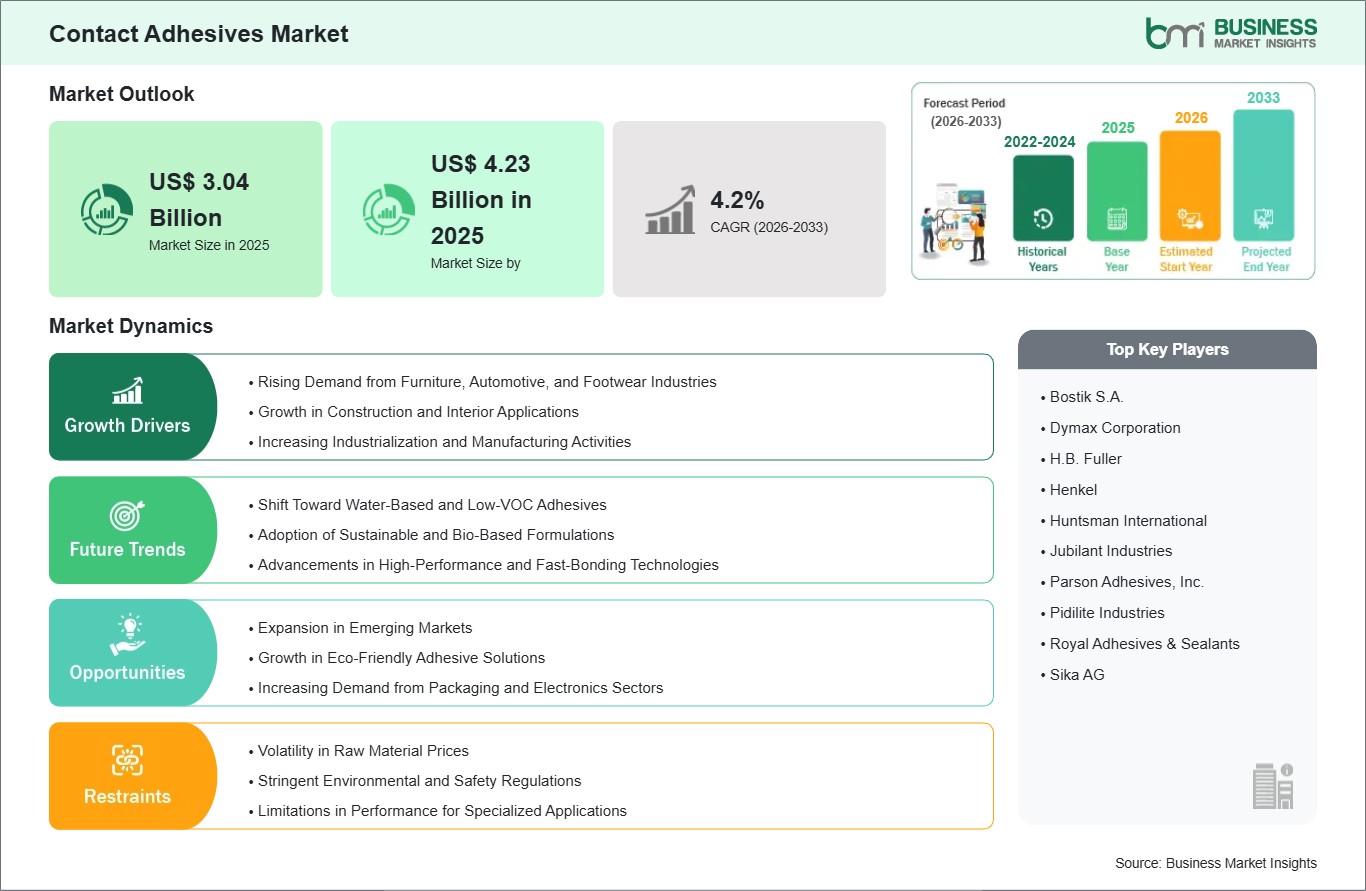
Contact Adhesives market size is expected to reach US$ 4.23 billion by 2033 from US$ 3.04 billion in 2025. The market is estimated to record a CAGR of 4.2% from 2026 to 2033.
The global contact adhesives market is an important part of the larger adhesives and construction chemicals industry. It plays a significant role in creating strong, instant bonds among various materials. Contact adhesives bond surfaces upon contact after solvents evaporate. They provide high initial strength without needing long clamping or curing times. Many industries, including construction, automotive, footwear, furniture, packaging, and electronics, rely on contact adhesives for their fast bonding, durability, and flexibility. Common types of contact adhesives include solvent-based, water-based, and hot-melt varieties, each tailored for specific uses and performance needs. They are often used in laminates, countertops, flooring, wall panels, upholstery, and insulation materials. Producing contact adhesives involves complex chemical formulas, usually based on polymers like neoprene, polyurethane, acrylics, and styrene-butadiene rubber, mixed with resins, plasticizers, solvents, or water carriers. These mixtures aim to provide optimal tack, cohesion, heat resistance, and long-lasting bonding performance. Recent technological advancements have led to low-VOC, solvent-free, and eco-friendly adhesives that meet stricter environmental and safety standards. These developments also improve application efficiency and worker safety, especially in indoor and large-scale industrial settings. Contact adhesives are essential for enhancing product durability and manufacturing efficiency. They create reliable bonds on materials such as wood, metal, plastic, rubber, and textiles. In construction and interior design, they help maintain structural integrity and aesthetic appeal. In the automotive and footwear sectors, they contribute to lightweight designs and flexible assembly methods. Their resistance to heat, moisture, and chemicals makes them ideal for tough conditions and long-term use. Market growth is fueled by rising demand from construction and furniture sectors, increased automotive production, and expanding footwear manufacturing, especially in developing countries. Rapid urbanization, infrastructure development, and growth in consumer goods also drive demand. Furthermore, the move towards sustainable materials and green manufacturing supports the use of eco-friendly adhesive solutions. However, the market faces some challenges, including fluctuations in raw material prices, regulatory pressures on solvent emissions, and the need for high-performance products in specific applications. Despite these issues, continued innovation in adhesive chemistry and processing technologies is likely to drive future growth. Manufacturers are increasingly working on high-performance, sustainable, and easy-to-use products to meet changing industry needs. Overall, the contact adhesives market is well-equipped to promote efficient manufacturing, durable product design, and sustainable development across various industries worldwide.

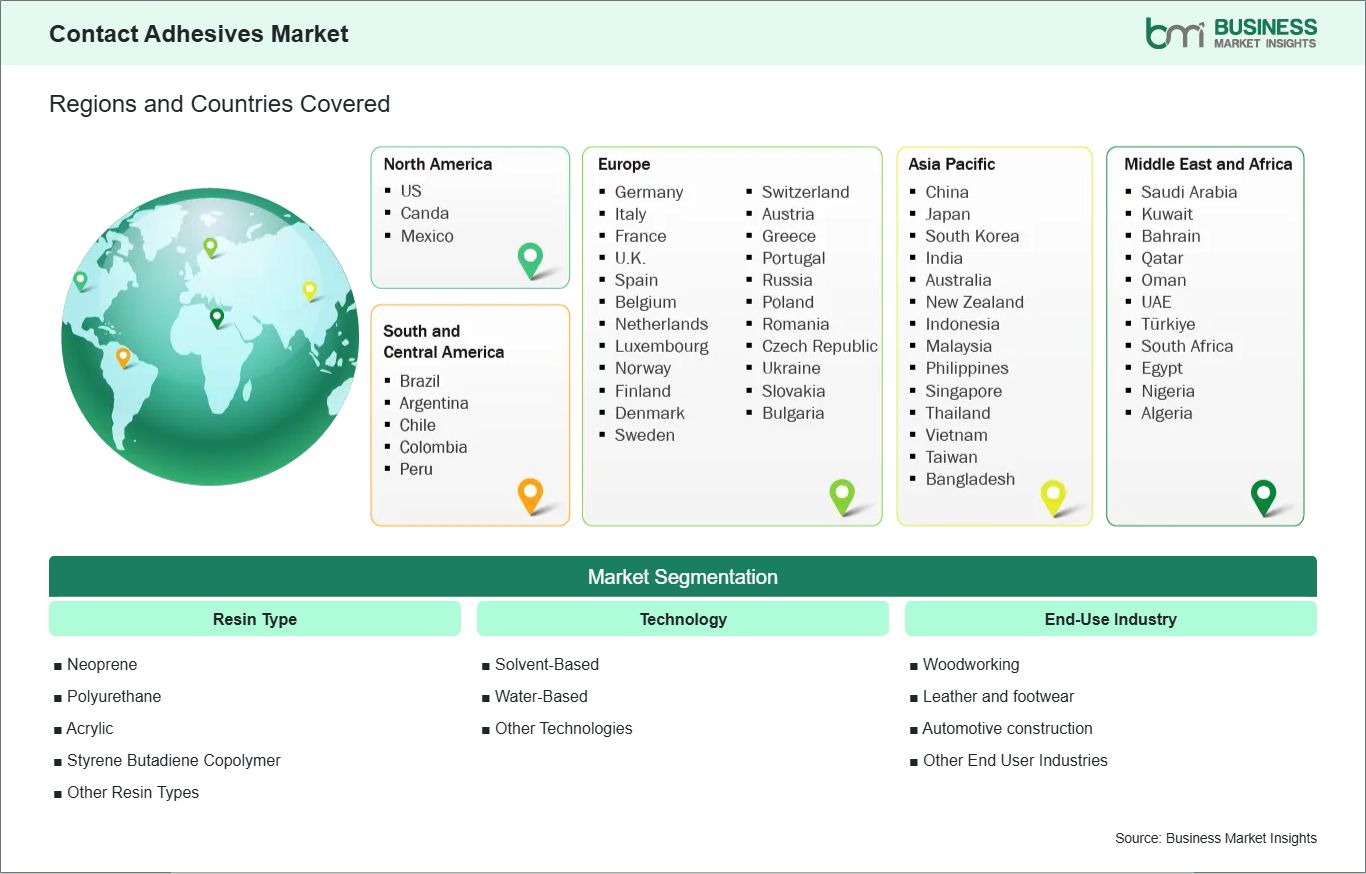
Key segments that contributed to the derivation of the Contact Adhesives market analysis are resin type, technology, and end-use industry.
The global contact adhesives market is seeing steady growth, mainly due to rising demand from key industries like furniture, automotive, footwear, and construction. Rapid urban development, increasing disposable incomes, and changing consumer habits are pushing the need for attractive and durable furniture, laminates, and interior fittings, where contact adhesives are essential for bonding surfaces such as wood, veneer, and decorative panels. In the automotive sector, the move toward lightweight materials and efficient assembly processes is increasing the use of contact adhesives to bond interior components, trims, and insulation materials. The growing global footwear industry also depends on contact adhesives for sturdy, flexible bonding of soles and uppers, ensuring durability and comfort. In construction, these adhesives are commonly used for flooring, wall panels, insulation, and decorative laminates because of their quick bonding and high initial strength. Additionally, growth in renovation and remodeling, especially in developed areas, is adding to market demand. As industrial production and consumer goods manufacturing expand worldwide, the need for effective and high-performing bonding solutions like contact adhesives is expected to keep rising.
Technological innovation is significantly influencing the global contact adhesives market, with ongoing developments aimed at boosting performance, safety, and environmental friendliness. Advances in polymer science have allowed the creation of adhesives with better bonding strength, heat resistance, flexibility, and quicker drying times, making them suitable for many demanding applications. The shift from traditional solvent-based systems to water-based and solvent-free options is gaining traction due to stricter environmental laws and growing concerns about worker safety and indoor air quality. These eco-friendly alternatives produce fewer volatile organic compound (VOC) emissions while still maintaining strong bonding performance. Modern manufacturing technologies, such as automation and precise mixing systems, are helping producers ensure consistent quality, reduce material waste, and increase operational efficiency. Additionally, manufacturers are focusing on developing bio-based adhesives and recyclable solutions to meet global sustainability goals and circular economy initiatives. Ongoing research and development aim to improve adhesion on various surfaces, extend product lifespan, and increase resistance to environmental factors like heat and moisture. As industries place more importance on sustainable and high-performance materials, innovation in contact adhesive technologies is likely to drive long-term market growth and change.
Polyurethane-based contact adhesives lead the market thanks to their strong bonding strength, flexibility, and resistance to heat, moisture, and chemicals. Their ability to work well with materials like wood, plastic, and metal makes them perfect for tough jobs in the automotive, construction, and furniture industries.
Solvent-based contact adhesives are popular because they have strong initial tack, dry quickly, and perform well under stress. They are often preferred in industrial settings such as footwear and laminates, where immediate bonding strength and durability matter most.
The leather and footwear sector takes a significant share of the market due to the common use of contact adhesives for bonding soles, uppers, and other parts. The demand for flexible, durable, and quick-setting adhesives drives growth in this segment, especially in mass footwear production.
| Report Attribute | Details |
|---|---|
| Market size in 2025 | US$ 3.04 Billion |
| Market Size by | US$ 4.23 Billion in 2025 |
| Global CAGR (2026 - 2033) | 4.2% |
| Historical Data | 2022-2024 |
| Forecast period | 2026-2033 |
| Segments Covered | By Resin Type
|
|
Regions and Countries Covered
| |
| North America | US, Canada, Mexico |
| Europe | Belgium, Austria, Finland, Denmark, Greece, Poland, Romania, Russia, Ukraine, Czech Republic, Slovakia, Bulgaria, Italy, Luxembourg, Germany, Switzerland, France, Netherlands, Norway, Portugal, Spain, Sweden, United Kingdom |
| Asia-Pacific | Australia, China, India, Japan, South Korea, Indonesia, Malaysia, Philippines, Singapore, Thailand, Vietnam, Bangladesh, New Zealand, Taiwan |
| South and Central America | Brazil, Argentina, Peru, Chile, Colombia |
| Middle East and Africa | Bahrain, Kuwait, Oman, Qatar, Saudi Arabia, United Arab Emirates, Turkiye, South Africa, Egypt, Algeria, Nigeria |
| Market leaders and key company profiles |
|
The "Contact Adhesives Market Size and Forecast (2022 - 2033)" report provides a detailed analysis of the market covering below areas:
The geographical scope of the Contact Adhesives market report is divided into five regions: North America, Asia Pacific, Europe, Middle East & Africa, and South & Central America. The Contact Adhesives market in the Asia Pacific is expected to grow significantly during the forecast period.
The Asia-Pacific Contact Adhesives market is segmented into China, Japan, South Korea, India, Australia, New Zealand, Indonesia, Malaysia, the Philippines, Singapore, Thailand, Vietnam, Taiwan, Bangladesh, and the Rest of Asia.
The Asia-Pacific region is becoming one of the fastest-growing markets for contact adhesives. This growth is fueled by rapid industrialization, urbanization, and increased manufacturing activities. Countries like China, India, Japan, and South Korea are seeing strong development in furniture, automotive, footwear, electronics, and construction sectors, all of which rely on contact adhesives for effective bonding solutions. The rising demand for ready-to-assemble furniture, decorative laminates, and interior fittings is significantly boosting adhesive use in both residential and commercial applications. At the same time, increasing automotive production and the presence of major footwear manufacturing hubs in the region are further driving market growth. A growing population, better living standards, and higher disposable incomes are leading to more consumption of consumer goods. This, in turn, strengthens the need for reliable and high-performance adhesives. Moreover, the expansion of infrastructure and renovation projects is supporting the use of contact adhesives in flooring, insulation, and panel applications, where quick bonding and durability matter. The shift towards sustainable manufacturing and eco-friendly products is also influencing the contact adhesives market in Asia-Pacific. Governments in the region are enforcing stricter environmental rules to control emissions and enhance workplace safety. This encourages manufacturers to use low-VOC, water-based, and solvent-free adhesive formulations. This transition is driving innovation in adhesive technologies, with companies working on products that deliver strong bonding performance while minimizing environmental impact. In addition, the region’s established manufacturing base, affordable labor, and easy access to raw materials support large-scale production and competitive pricing of contact adhesives. Increased investments in research and development, along with progress in polymer engineering and application techniques, are enhancing product quality, efficiency, and versatility across many industries. With ongoing growth in end-use sectors, supportive industrial policies, and a focus on sustainability, Asia-Pacific is expected to remain a key driver of innovation, production, and demand in the global contact adhesives market.

The Contact Adhesives market is evaluated by gathering qualitative and quantitative data post primary and secondary research, which includes important corporate publications, association data, and databases. A few of the key developments in the Contact Adhesives market are:
The Contact Adhesives Market is valued at US$ 3.04 Billion in 2025, it is projected to reach US$ 4.23 Billion in 2025 by .
As per our report Contact Adhesives Market, the market size is valued at US$ 3.04 Billion in 2025, projecting it to reach US$ 4.23 Billion in 2025 by . This translates to a CAGR of approximately 4.2% during the forecast period.
The Contact Adhesives Market report typically cover these key segments-
The historic period, base year, and forecast period can vary slightly depending on the specific market research report. However, for the Contact Adhesives Market report:
The Contact Adhesives Market is populated by several key players, each contributing to its growth and innovation. Some of the major players include:
The Contact Adhesives Market report is valuable for diverse stakeholders, including:
Essentially, anyone involved in or considering involvement in the Contact Adhesives Market value chain can benefit from the information contained in a comprehensive market report.
Please tell us your area of interest
(Market Segments/ Regions and Countries/ Companies)