Market Summary
Executive Summary and Global Market Analysis
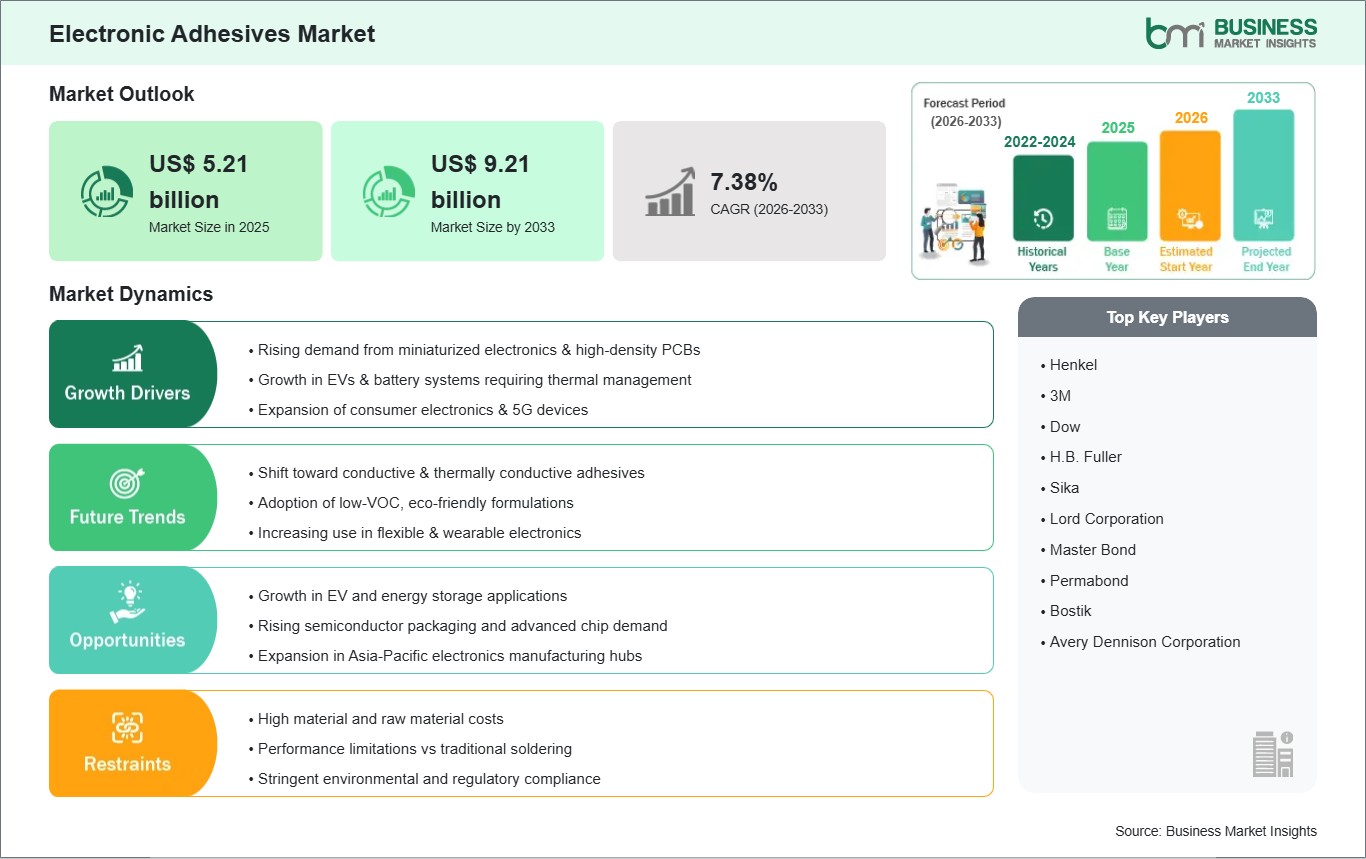
Electronic adhesives are special bonding materials that assemble and protect electronic components in many devices. These adhesives offer mechanical strength, electrical conductivity or insulation, and thermal management, making them essential in today's electronics manufacturing. They are commonly used in printed circuit boards, semiconductors, displays, consumer electronics, automotive electronics, and telecommunications equipment. Electronic adhesives come in different types, including conductive, non-conductive, thermally conductive, and UV-curable formulations. They are available in forms like liquids, pastes, and films for accurate application.
The market is growing steadily because of the increasing demand for compact and high-performance electronic devices. The fast growth of consumer electronics, along with improvements in semiconductor technologies, is increasing the need for reliable and efficient bonding solutions. The rising use of electric vehicles and advanced driver-assistance systems also boosts demand. Moreover, ongoing innovation in adhesive formulations, such as better thermal conductivity and durability, is improving product performance. As industries focus on miniaturization and device reliability, electronic adhesives are becoming a crucial part of modern electronic manufacturing processes worldwide.
Segment Analysis
Electronic Adhesives Market Segmentation
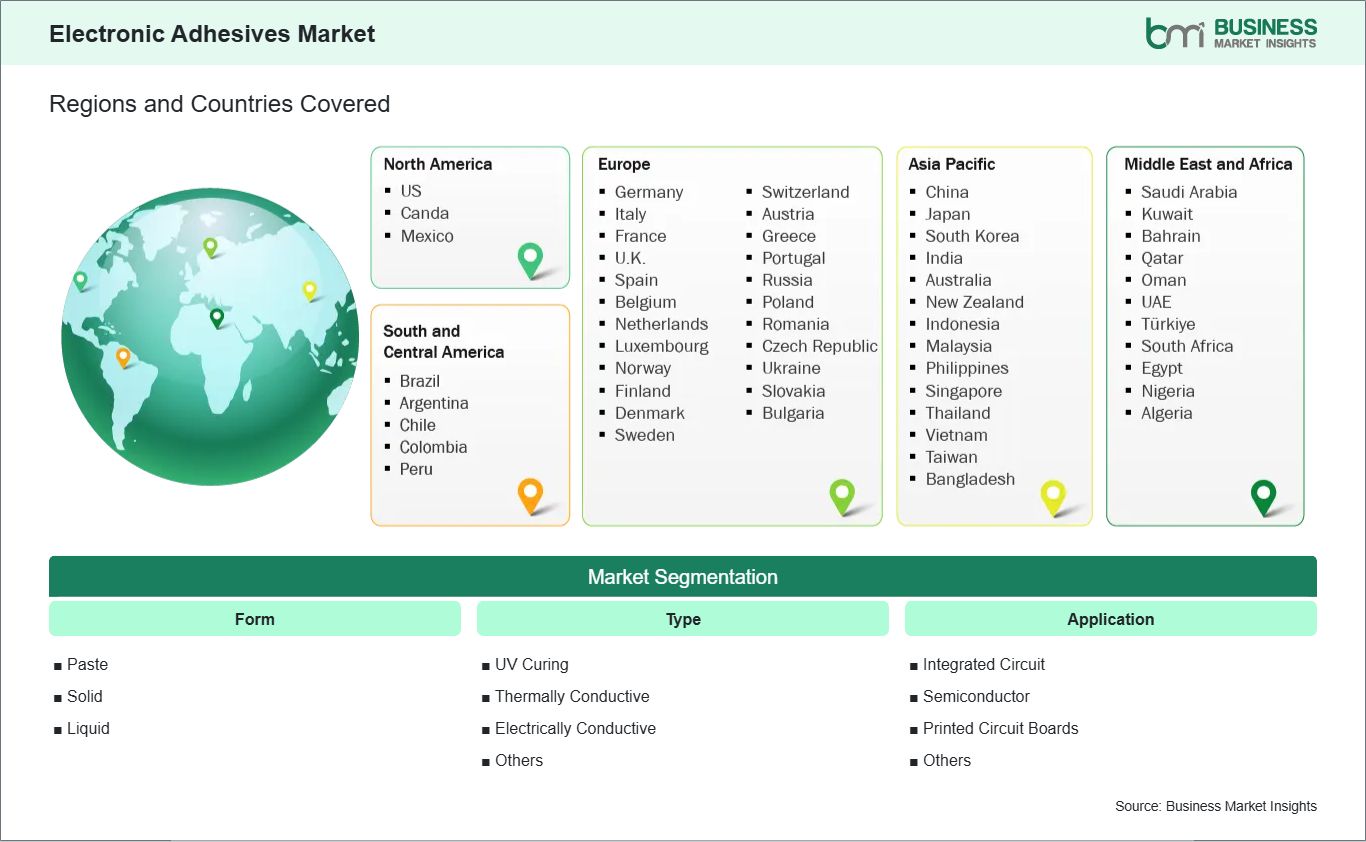
Key segments that contributed to the derivation of the electronic adhesives market analysis are form, type, and application.
- By form, the electronic adhesives market is segmented into paste, solid, and liquid. The paste segment held the largest market share in 2025.
- By type, the electronic adhesives market is segmented into UV curing, thermally conductive, electrically conductive, and others. The electrically conductive segment held the largest market share in 2025.
- By application, the electronic adhesives market is segmented into integrated circuits, semiconductors, printed circuit boards, and others. The printed circuit boards segment held the largest market share in 2025.
Market Forces
Electronic Adhesives Market Drivers and Opportunities
Rising Demand for Miniaturized and High-Performance Electronics
The growing demand for smaller, lighter, and more efficient electronic devices drives the electronic adhesives market. As consumer preferences shift toward compact and multifunctional products like smartphones, wearable devices, and portable computing systems, manufacturers are concentrating on miniaturization while maintaining performance. Electronic adhesives are essential for this trend because they provide precise bonding, electrical conductivity, and thermal management in tightly packed components. Unlike traditional fastening methods, adhesives distribute stress evenly and improve reliability in delicate electronic assemblies.
Moreover, the increasing complexity of semiconductor devices and printed circuit boards requires adhesive solutions that can handle high temperatures and perform well over time. The rise of technologies such as 5G, the Internet of Things, and advanced computing systems boosts the need for high-performance materials. Consequently, electronic adhesives are vital for driving innovation and efficiency in the changing electronics industry.
Expansion in Electric Vehicles and Automotive Electronics
The rapid growth of electric vehicles and automotive electronics offers a significant opportunity for the electronic adhesives market. Modern vehicles are increasingly equipped with electronic systems like battery management units, infotainment systems, sensors, and driver-assistance technologies. Electronic adhesives are crucial in these applications for bonding, sealing, and protecting sensitive components. They ensure thermal stability and vibration resistance.
In electric vehicles, adhesives are widely used in battery assemblies to improve safety, enhance thermal management, and lower overall weight. This leads to better performance and a longer driving range. Additionally, the shift toward autonomous driving and connected vehicle technologies is adding complexity and increasing the number of electronic components in cars. As automotive manufacturers strive to boost efficiency, safety, and durability, the need for high-performance adhesive solutions is expected to grow. This expanding role of electronics in transportation is opening new paths for innovation and long-term growth in the electronic adhesives market.
Size and Share Analysis
Electronic Adhesives Market Size and Share Analysis
The electronic adhesives market demonstrates steady growth, with size and share analysis revealing evolving trends and competitive positioning among key players. The report examines subsegments categorized within form, type, and application, offering insights into their contribution to overall market performance. By application, the printed circuit boards segment holds the largest market share. Electronic adhesives are commonly used in integrated circuits, semiconductors, and printed circuit boards for bonding, sealing, encapsulation, and thermal management. Manufacturers choose electronic adhesives because they provide strong bonding strength, electrical conductivity, thermal stability, and reliability in small electronic components compared to traditional soldering methods. The industry values electronic adhesives for supporting lightweight designs, enabling high-performance electronics, offering resistance to vibration and temperature changes, and meeting manufacturing needs. Growth in this segment comes from the rising demand for consumer electronics, rapid advancements in semiconductor technologies, increased adoption of compact and high-speed devices, and higher investments in electronics manufacturing globally.
Report Coverage
Electronic Adhesives Market Report Coverage and Deliverables
The " Electronic Adhesives Market Size and Forecast (2022 - 2033)" report provides a detailed analysis of the market covering below areas:
- Electronic adhesives market size and forecast at global, regional, and country levels for all the key market segments covered under the scope
- Electronic adhesives market trends, as well as market dynamics such as drivers, restraints, and key opportunities
- Electronic adhesives market analysis covering key market trends, global and regional framework, major players, regulations, and recent market developments
- Industry landscape and competition analysis covering market concentration, heat map analysis, prominent players, and recent developments for the electronic adhesives market
- Detailed company profiles, including SWOT analysis
Geographic Insights
Electronic Adhesives Market Geographic Insights
The geographical scope of the electronic adhesives market report is divided into five regions: North America, Asia Pacific, Europe, the Middle East & Africa, and South & Central America. Asia Pacific holds a significant share of the electronic adhesives market. This growth is due to its strong electronics manufacturing base and rapid industrial growth. The region houses major semiconductor and consumer electronics companies, especially in China, Japan, South Korea, and Taiwan. High production volumes of smartphones, computers, and other electronic devices create significant demand for high-quality adhesive solutions. Moreover, well-established supply chains and affordable manufacturing capabilities improve the region's competitiveness.
Governments in the area support domestic electronics production with favorable policies and investments, which further enhances market growth. The expanding automotive sector, particularly in electric vehicles, adds to the demand for electronic adhesives. Increasing urbanization and rising disposable incomes boost the consumption of electronic products, supporting market expansion. With ongoing technological improvements and a growing industrial infrastructure, Asia-Pacific region continues to hold its top position in the global electronic adhesives market.
Industry Activity
Recent Developments
The electronic adhesives market is evaluated by gathering qualitative and quantitative data post-primary and secondary research, which includes important corporate publications, association data, and databases. A few of the key developments in the electronic adhesives market are:
- In January 2026, Henkel launched new structural adhesives for electronics and EV applications. These materials improve bonding strength, thermal management, and support lightweight component design. They enable more efficient electronic assembly and better performance in automotive and high-density electronic systems.
- In October 2025, Wacker Chemie AG introduced new thermally conductive adhesives for e-mobility battery systems. The products combine silicone and hybrid technologies to provide better heat dissipation, flexibility, and flame resistance. This supports safer and more efficient next-generation electric vehicle electronics.
Trust & Transparency
Research Methodology
The market analysis combines proprietary research with secondary data from government agencies, company disclosures, regulatory filings, industry databases and expert interviews. Market estimates are validated through data triangulation, cross-market benchmarking and analyst
review.
View Full Research Methodology
Key Sources Referred:
World Bank - Global Trade IndicatorsWorld Trade Organization (WTO)International Monetary Fund (IMF)International Trade Administration (ITA)Company WebsitesCompany Annual ReportsCompany Investor PresentationsAdhesive and Sealant Council (ASC)Society for Adhesion and Adhesives (SAA)IPC - Association Connecting Electronics IndustriesSemiconductor Industry Association (SIA)