Market Summary
Executive Summary and Global Market Analysis
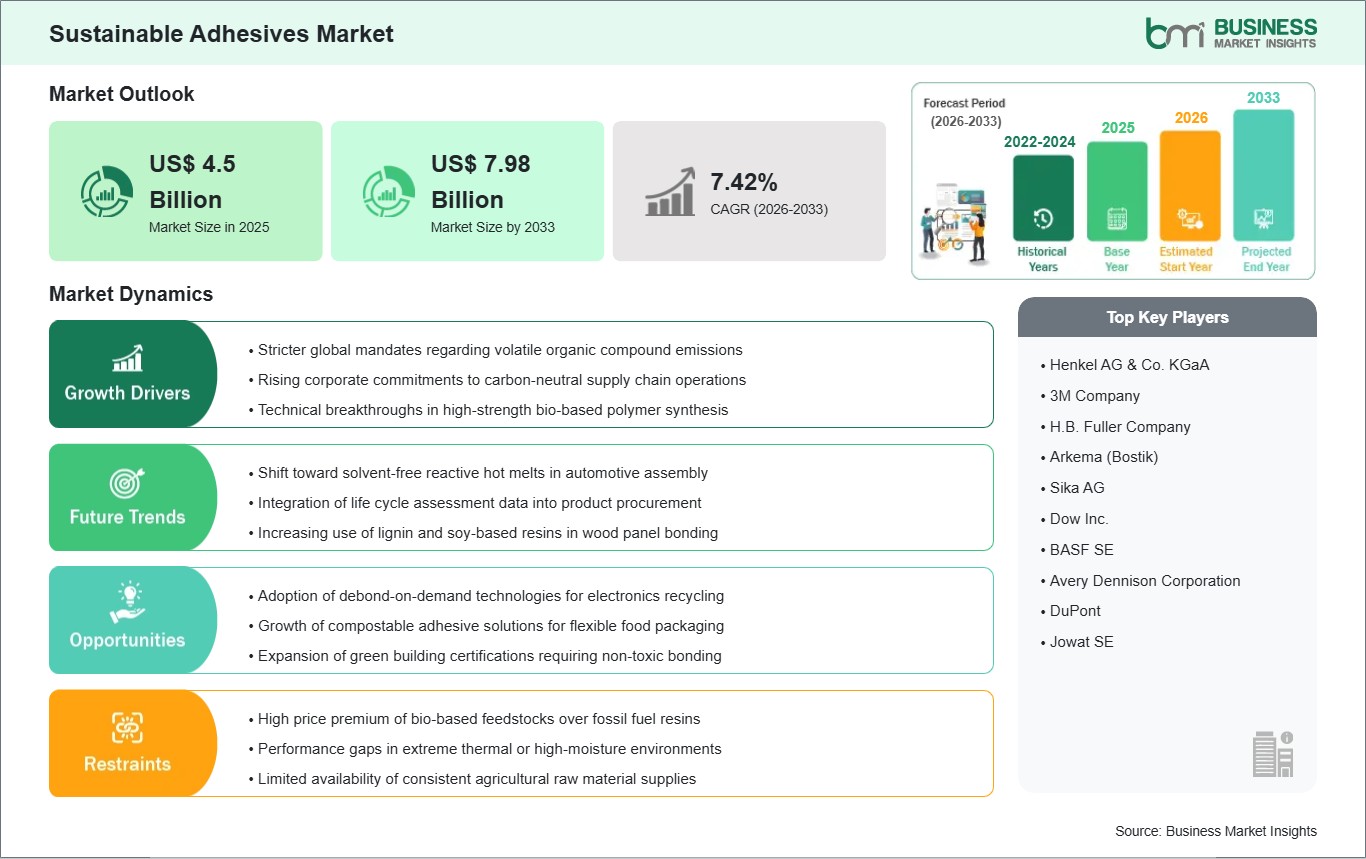
The sustainable adhesives market is going through a fundamental shift as the chemistry industry moves from petroleum dependency to more sustainable and environmentally friendly products. The sustainable adhesives market is one of the key enablers to support the move to sustainability across various industry chains, providing the necessary bonding performance to products while at the same time allowing them to be recyclable and compostable. Currently, the market is dominated by water-based and recyclable types, as they are seen as providing the most immediate and cost-effective way for companies to achieve their carbon reduction targets. The packaging industry is the largest driver, but there are increasing hotspots in the medical and automotive industries due to non-toxic and lightweighting requirements.
Technological advancements are rapidly bridging the performance gap between sustainable adhesives and conventional adhesives. Bio-based resin materials currently have the ability to provide the necessary shear strength and durability required in demanding structural applications in construction and woodworking. While there are challenges in terms of the increased costs of raw materials and supply chain volatility of agricultural feedstocks, the long-term prospects look promising. The combination of stringent environmental regulations, an increase in green procurement policies by companies, and changing consumer behavior in relation to plastic-free products provides a robust market backdrop. As technology continues to improve, there is a shift towards full cradle-to-cradle sustainability, along with smart adhesives required to enable efficient disassembly of products.
Segment Analysis
Sustainable Adhesives Market Segmentation
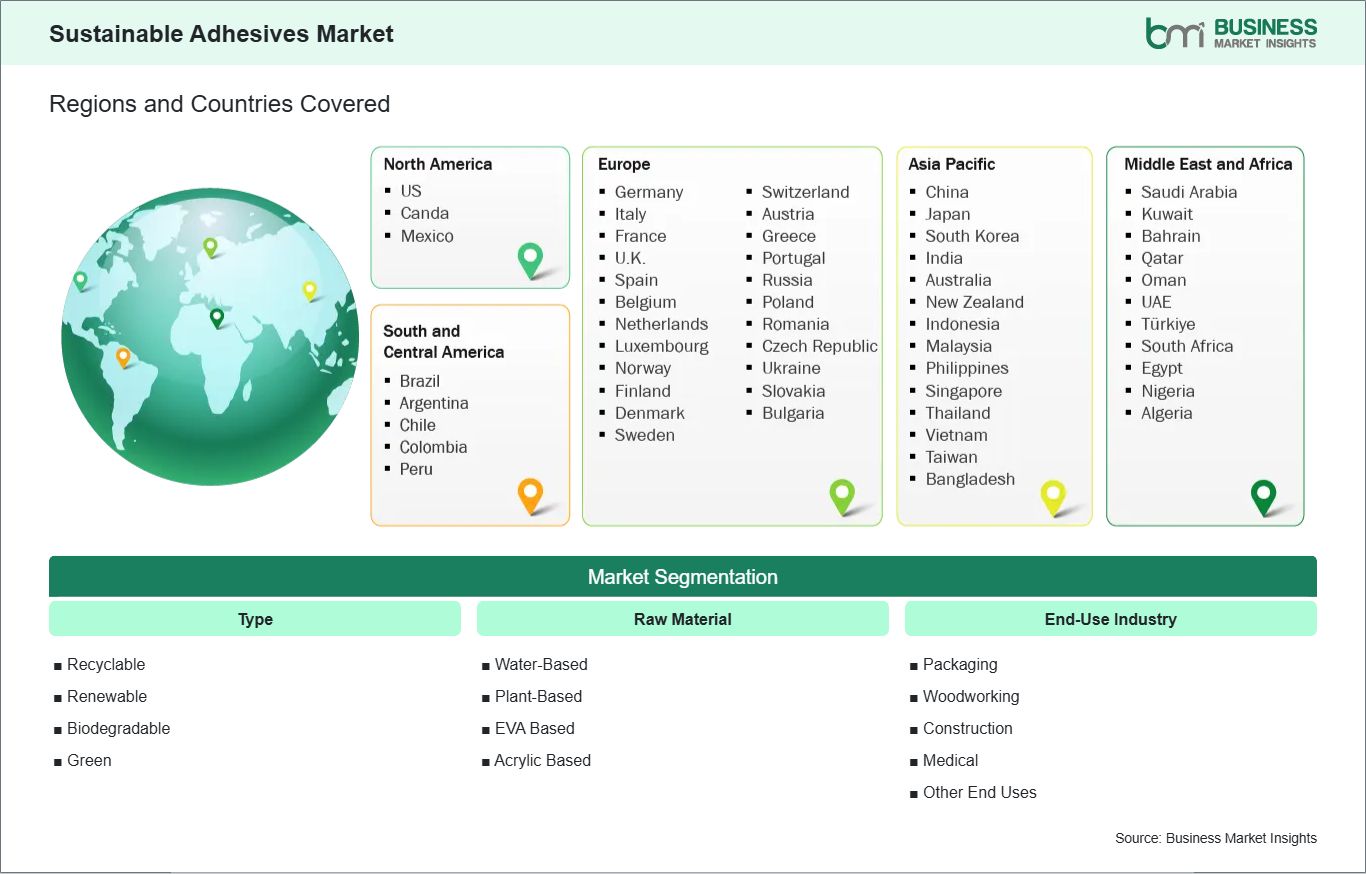
Key segments that contributed to the derivation of the Sustainable Adhesives market analysis are type, raw material, and end use industry.
- By type, the sustainable adhesives market is segmented into Recyclable, Renewable, Biodegradable, and Green. The Recyclable segment dominated the market.
- By raw material, the sustainable adhesives market is segmented into Water-Based, Plant-Based, EVA Based, and Acrylic Based. The Water-Based segment dominated the market.
- By end-use industry, the sustainable adhesives market is segmented into Packaging, Woodworking, Construction, Medical, and Others. The Packaging segment dominated the market.
Market Forces
Sustainable Adhesives Market Drivers and Opportunities
Stricter global mandates regarding volatile organic compound emissions
The primary catalyst for the sustainable adhesives market is the intensifying regulatory pressure to eliminate volatile organic compounds from industrial manufacturing. Government bodies have established rigorous air quality standards that penalize the use of traditional solvent-borne systems, which release harmful pollutants during the curing process. This legal environment has compelled manufacturers to pivot toward water-based and solvent-free technologies. By adopting these greener alternatives, companies can avoid heavy environmental fines while simultaneously improving the safety of their production facilities for workers, as these formulations significantly reduce the risk of respiratory issues and fire hazards.
Moreover, these mandates are increasingly synchronized across major trading blocs, creating a unified global standard for chemical safety. For instance, the implementation of restricted substance lists in large manufacturing hubs has made it nearly impossible for exporters to use conventional adhesives if they wish to access international markets. This regulatory landscape does not just encourage sustainable choices but effectively mandates them for any business seeking long-term operational viability. The transition to low-emission adhesives is thus viewed as a critical component of modern industrial compliance, ensuring that products meet the environmental expectations of both state regulators and institutional investors.
Adoption of debond-on-demand technologies for electronics recycling
A significant growth opportunity exists in the development and implementation of debond-on-demand adhesive systems, particularly within the electronics and automotive sectors. Traditionally, high-performance structural adhesives are designed to create permanent bonds that are extremely difficult to break without damaging the underlying components. However, the move toward a circular economy requires products that can be easily disassembled at the end of their functional life. Innovative adhesives that can be triggered to lose their bonding strength through specific stimuli, such as heat, moisture, or specialized chemical agents, allow for the efficient recovery of valuable precious metals and sensitive electronic parts.
This technology directly addresses the challenge of e-waste by facilitating a non-destructive teardown process. As manufacturers face increasing pressure through extended producer responsibility schemes, the ability to reclaim and reuse high-value substrates becomes a major economic advantage. Companies that invest in these responsive adhesive formulations can position themselves as essential partners for original equipment manufacturers looking to close the loop on their product lifecycles. Beyond electronics, this opportunity extends to the aerospace and construction industries, where modularity and the ability to replace individual segments without compromising the entire structure are becoming key design requirements for sustainable infrastructure.
Size and Share Analysis
Sustainable Adhesives Market Size and Share Analysis
The global Sustainable Adhesives market is experiencing steady growth, with market size and share analysis reflecting evolving treatment preferences and competitive dynamics among key players. The report evaluates important subsegments categorized within type, raw material, and end use industry, highlighting their respective contributions to overall market performance.
By type, the Recyclable subsegment dominated the market because these formulations allow for the clean separation of bonded materials during industrial salvage processes, directly supporting circular economy targets and the global push to reduce landfill waste from multi-material products.
By raw material, the Water-Based subsegment dominated the market due to its minimal volatile organic compound emissions and inherent safety during application, providing a versatile solution that complies with strict air quality standards across high-volume sectors like paper and board assembly.
By end-use industry, the Packaging subsegment dominated the market as the massive expansion of e-commerce and retail shipping drives an urgent need for eco-friendly carton sealing and labeling solutions that do not compromise the recyclability of corrugated fiberboard.
Report Coverage
Sustainable Adhesives Market Report Coverage and Deliverables
The "Sustainable Adhesives Market Size and Forecast (2022 - 2033)" report provides a detailed analysis of the market covering below areas:
- Sustainable Adhesives market size and forecast at the regional and country levels for segments covered under the scope
- Sustainable Adhesives market trends, as well as drivers, restraints, and opportunities
- Sustainable Adhesives market analysis covering key trends, regional framework, major players, regulations, and recent developments
- Industry landscape and competition analysis covering market concentration, heat map analysis, prominent players, and recent developments for the Sustainable Adhesives market
- Detailed company profiles, including SWOT analysis
Geographic Insights
Sustainable Adhesives Market Geographic Insights
The geographical scope of the Sustainable Adhesives market report is divided into: North America, Asia Pacific, Europe, Middle East & Africa, and South & Central America. North America held the largest share in 2025.
North America maintains a leading position in the sustainable adhesives market, a status driven by an advanced manufacturing ecosystem and a strong emphasis on technological innovation. The region dominance is particularly evident in the United States, where a massive e-commerce infrastructure and a highly mature packaging sector have accelerated the adoption of water-activated and recyclable sealing solutions. Furthermore, the presence of major global adhesive manufacturers and chemical innovators within North America provides a steady pipeline of next-generation bio-based materials. The regional market also benefits from proactive corporate sustainability initiatives among Fortune 500 companies, which often mandate the use of green materials throughout their global supply chains to mitigate environmental risks and enhance brand reputation.
The North American market is further bolstered by a growing number of green building projects and a robust automotive industry that is increasingly utilizing sustainable adhesives for vehicle lightweighting and electric vehicle battery assembly. While regulatory frameworks like those found in Europe are influential, the North American market is characterized by a high degree of private sector investment in research and development for drop-in sustainable solutions that require no modification to existing industrial equipment. This combination of high-volume consumption in the packaging sector and high-value applications in the aerospace and medical industries ensures the region remains the primary hub for market value and technical leadership. As regional supply chains for plant-based feedstocks continue to mature, North America is well-positioned to sustain its dominance through the end of the decade.
Industry Activity
Recent Developments
The Sustainable Adhesives market is evaluated by gathering qualitative and quantitative data post primary and secondary research, which includes important corporate publications, association data, and databases. A few of the key developments in the Sustainable Adhesives market are:
- In September 2023, Henkel Adhesive Technologies announced that it had published audited results for the sustainability assessment of its product portfolio. The company emphasized its Sustainability Ambition 2030, focusing on climate impact, circularity, safety, and nature. Henkel highlighted that its adhesives, sealants, and coatings are being redesigned to use low-emission raw materials and improve sustainability across more than 100,000 customers worldwide.
- In 2023, Jyoti Resins and Adhesives Limited (JRAL) announced that it had diversified its product portfolio with new adhesive launches, highlighting ESG (Environmental, Social, and Governance) commitments in its Annual Report. The company reported strong growth while integrating sustainability into its product strategy.
Trust & Transparency
Research Methodology
The market analysis combines proprietary research with secondary data from government agencies, company disclosures, regulatory filings, industry databases and expert interviews. Market estimates are validated through data triangulation, cross-market benchmarking and analyst
review.
View Full Research Methodology
Key Sources Referred:
Pressure Sensitive Tape Council (PSTC, USA) Adhesive and Sealant Council (ASC, USA) European Adhesive Tape Association (Afera) China Adhesives and Tape Industry Association (CATIA) Japan Adhesive Industry Association (JAIA) Indian Adhesives and Sealants Manufacturers Association (IASMA) Company Websites Company Annual Reports Company Investor Presentations