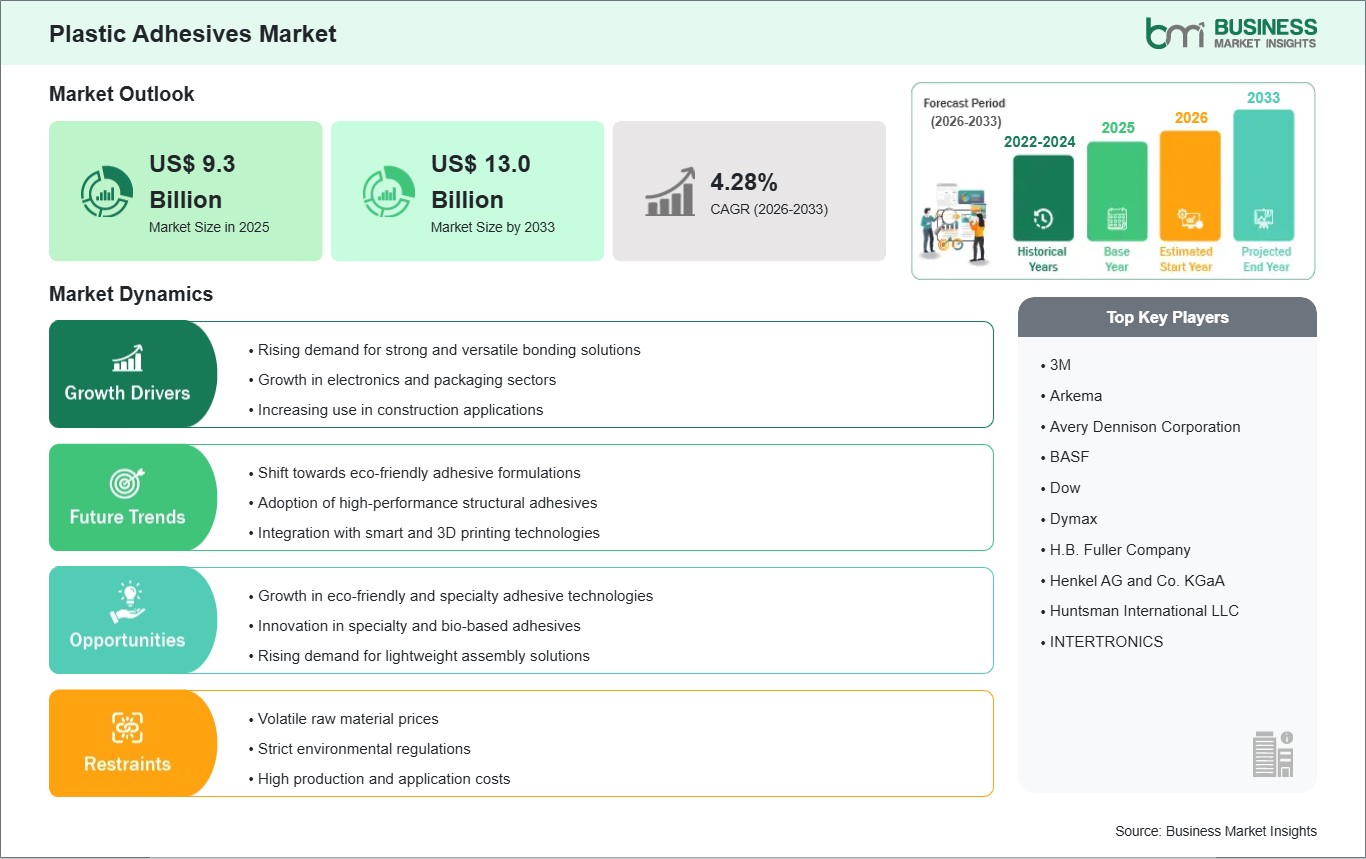
The Plastic Adhesives Market size is expected to reach US$ 13. billion by 2033 from US$ 9.3 billion in 2025. The market is estimated to record a CAGR of 4.28% from 2026 to 2033.
The plastic adhesives market is growing rapidly due to the increasing demand for lightweight and high-performance adhesives in the automotive, electrical, construction, packaging, and consumer products markets. Plastic adhesives are strong bonding agents that can bond well with different materials like polyethylene, polypropylene, polycarbonate, and PVC, thus replacing mechanical parts and reducing assembly time and improving the look of the final product. The different types of adhesives used are epoxy, polyurethane, acrylic, cyanoacrylate, and silicone adhesives.
One of the major factors affecting the plastic adhesives market is the increasing focus on lightweight materials and the use of multiple materials in different applications, especially in the automotive and electrical industries. Plastic adhesives are strong bonding agents that can bond different materials easily, thus becoming the best choice for the lightweight industry. The plastic adhesives market has seen a huge demand for adhesives with improved performance and long-term durability, UV resistance, and thermal stability in the manufacture of electrical vehicles, consumer products, and industrial equipment. Sustainability and environmental concerns are also affecting the plastic adhesives market. Manufacturers are increasingly focusing on low-VOC, solvent-free, and bio-based adhesive solutions to meet regulatory requirements and eco-conscious consumer demand.
Additionally, innovations in high-strength, fast-curing, and application-specific adhesives are enabling manufacturers to optimize production efficiency, reduce energy consumption, and improve overall product reliability. The competitive landscape features a mix of global chemical companies, specialty adhesive producers, and regional formulators. Strategic partnerships with OEMs, industrial integrators, and construction firms are increasingly utilized to enhance market penetration. Product customization, technical support, and consistent quality are key differentiators in a moderately consolidated market. The plastic adhesives market is defined by the convergence of performance-driven innovation, environmental compliance, and expanding industrial applications. Companies offering high-strength, durable, and sustainable adhesive solutions are well-positioned to capitalize on growth opportunities across automotive, electronics, construction, and consumer goods sectors.

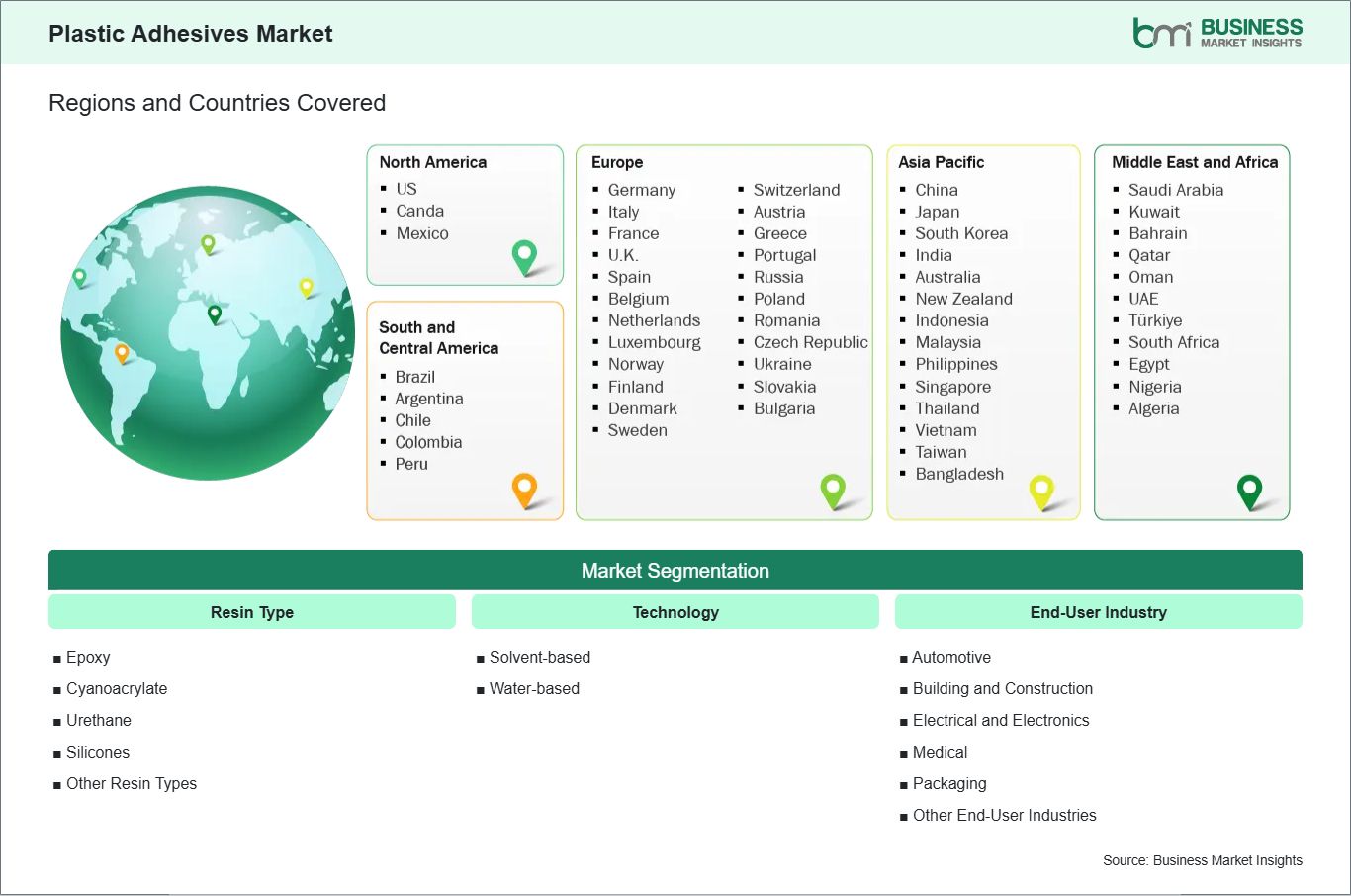
Key segments that contributed to the derivation of the plastic adhesives market analysis are resin type, technology, and end‑user industry.
The demand for plastic adhesives is on the rise as different sectors are looking for efficient bonding agents for plastics and other composite materials. Plastic adhesives have proven to have strong bonding capabilities, are durable, and flexible. They are used in different sectors, including the automotive industry, the electronics industry, the packaging industry, and the construction industry. With the development of complex and lightweight products, the use of mechanical fasteners has proven to be inadequate, and adhesives have come in handy to fill the gap.
Plastic adhesives have proven to have several advantages over other bonding agents. They are able to bond different types of plastics, including polycarbonate, polyethylene, and polypropylene. These types of plastics are difficult to bond using other adhesives. In addition, plastic adhesives are able to fill the gaps between different parts of the assembled products and are able to enhance the look of the products.
Innovation in adhesive technology is also contributing to market growth. New adhesive formulations have faster curing speeds, better chemical and heat resistance, and improved environmental safety. New and advanced adhesive formulations, including UV-cured, hot-melt, and reactive adhesives, enable industries to achieve various performance characteristics while maintaining efficiency and sustainability. With industries striving to achieve high-strength, durable, and versatile bonding agents, plastic adhesives are gradually becoming an indispensable tool in modern manufacturing processes.
The need for sustainability and environmental responsibility has become a driving force for innovation in the plastic adhesives market. Manufacturers are developing eco-friendly adhesives with low VOCs, bio-based raw materials, and energy-efficient curing technologies. These adhesives are helpful in meeting the needs of manufacturers to be more eco-friendly.
Specialty adhesives are becoming increasingly popular. They are developed to meet specific needs, like resistance to heat, chemicals, and moisture. They are used for high-performance applications in the automotive, electronics, aerospace, and packaging industries. They are used where durability and precision are necessary.
In addition, ongoing research and development activities concentrate on improving adhesive properties, including adhesive strength, versatility, and environmental characteristics. New and innovative technologies, including structural adhesives, pressure-sensitive adhesives, and hybrid adhesives, are being used to expand the scope and applications of plastic adhesives. With industries looking for dependable and efficient adhesive products that are also environment-friendly, plastic adhesives will continue to grow in the market.
The plastic adhesives market demonstrates steady growth, with size and share analysis highlighting evolving trends and competitive dynamics among key players. The report examines subsegments categorized within resin type, technology, and end‑user industry, offering insights into their contribution to overall market performance.
By Resin Type, the epoxy subsegment dominated the market in 2025, driven by its strong structural bonding capabilities and chemical resistance across automotive and industrial applications.
Based on Technology, the water‑based subsegment dominated the market in 2025, supported by increasing environmental regulations and demand for low‑VOC and recyclable adhesive solutions.
On the Basis of End‑User Industry, the building and construction subsegment dominated the market in 2025, propelled by rising infrastructure development and adoption of high‑performance plastic adhesives in structural applications.
| Report Attribute | Details |
|---|---|
| Market size in 2025 | US$ 9.3 Billion |
| Market Size by 2033 | US$ 13.0 Billion |
| Global CAGR (2026 - 2033) | 4.28% |
| Historical Data | 2022-2024 |
| Forecast period | 2026-2033 |
| Segments Covered | By Resin Type
|
|
Regions and Countries Covered
| |
| North America | US, Canada, Mexico |
| Europe | Belgium, Austria, Finland, Denmark, Greece, Poland, Romania, Russia, Ukraine, Czech Republic, Slovakia, Bulgaria, Italy, Luxembourg, Germany, Switzerland, France, Netherlands, Norway, Portugal, Spain, Sweden, United Kingdom |
| Asia-Pacific | Australia, China, India, Japan, South Korea, Indonesia, Malaysia, Philippines, Singapore, Thailand, Vietnam, Bangladesh, New Zealand, Taiwan |
| South and Central America | Brazil, Argentina, Peru, Chile, Colombia |
| Middle East and Africa | Bahrain, Kuwait, Oman, Qatar, Saudi Arabia, United Arab Emirates, Turkiye, South Africa, Egypt, Algeria, Nigeria |
| Market leaders and key company profiles |
|
The "Plastic Adhesives Market Size and Forecast (2022 - 2033)" report provides a detailed analysis of the market covering below areas:
The geographical scope of the Plastic Adhesives Market report is divided into North America, Asia Pacific, Europe, Middle East & Africa, and South & Central America. North America held the largest share in 2025.
Regional-level dynamics in the plastic adhesives market reveal distinct demand patterns shaped by industrial development, manufacturing intensity, and regulatory frameworks.
North America is the dominant market, led by the United States and Canada, where advanced automotive manufacturing, electronics production, and industrial applications drive strong demand. Adoption of lightweight materials, electric vehicle components, and sustainable adhesives reinforces market leadership, supported by robust R&D capabilities and stringent environmental regulations.
Europe represents a mature and innovation-driven market, with Germany, France, and Italy emphasizing high-performance and eco-friendly adhesives. Regulatory mandates regarding VOC emissions, sustainability, and product safety accelerate adoption of solvent-free, bio-based, and specialty adhesives in automotive, construction, and packaging applications.
Asia Pacific is experiencing rapid growth, led by China, Japan, and India, due to high manufacturing output, expanding automotive and electronics sectors, and increasing urban infrastructure projects. Local production capabilities and cost-sensitive solutions support large-scale adoption, while rising awareness of environmental standards drives demand for low-VOC and bio-based adhesives.
Middle East & Africa is an emerging market, where industrial expansion, construction projects, and energy infrastructure investments in countries such as Saudi Arabia and UAE are driving demand for durable and chemical-resistant adhesives. Adoption is concentrated in industrial and infrastructure applications with high-performance requirements.
South & Central America shows steady growth, particularly in Brazil and Argentina, driven by automotive, packaging, and industrial sectors. Market adoption is influenced by cost considerations, but increasing focus on product quality, process efficiency, and environmentally compliant adhesives is gradually driving higher uptake.

The Plastic Adhesives Market is evaluated by gathering qualitative and quantitative data post primary and secondary research, which includes important corporate publications, association data, and databases. A few of the key developments in the plastic adhesives market are:
The Plastic Adhesives Market is valued at US$ 9.3 Billion in 2025, it is projected to reach US$ 13.0 Billion by 2033.
As per our report Plastic Adhesives Market, the market size is valued at US$ 9.3 Billion in 2025, projecting it to reach US$ 13.0 Billion by 2033. This translates to a CAGR of approximately 4.28% during the forecast period.
The Plastic Adhesives Market report typically cover these key segments-
The historic period, base year, and forecast period can vary slightly depending on the specific market research report. However, for the Plastic Adhesives Market report:
The Plastic Adhesives Market is populated by several key players, each contributing to its growth and innovation. Some of the major players include:
The Plastic Adhesives Market report is valuable for diverse stakeholders, including:
Essentially, anyone involved in or considering involvement in the Plastic Adhesives Market value chain can benefit from the information contained in a comprehensive market report.
Please tell us your area of interest
(Market Segments/ Regions and Countries/ Companies)