
Meal Replacement Market Outlook: Size, Share, Trends, Growth Analysis, Competitive Landscape & Forecast, 2026–2033

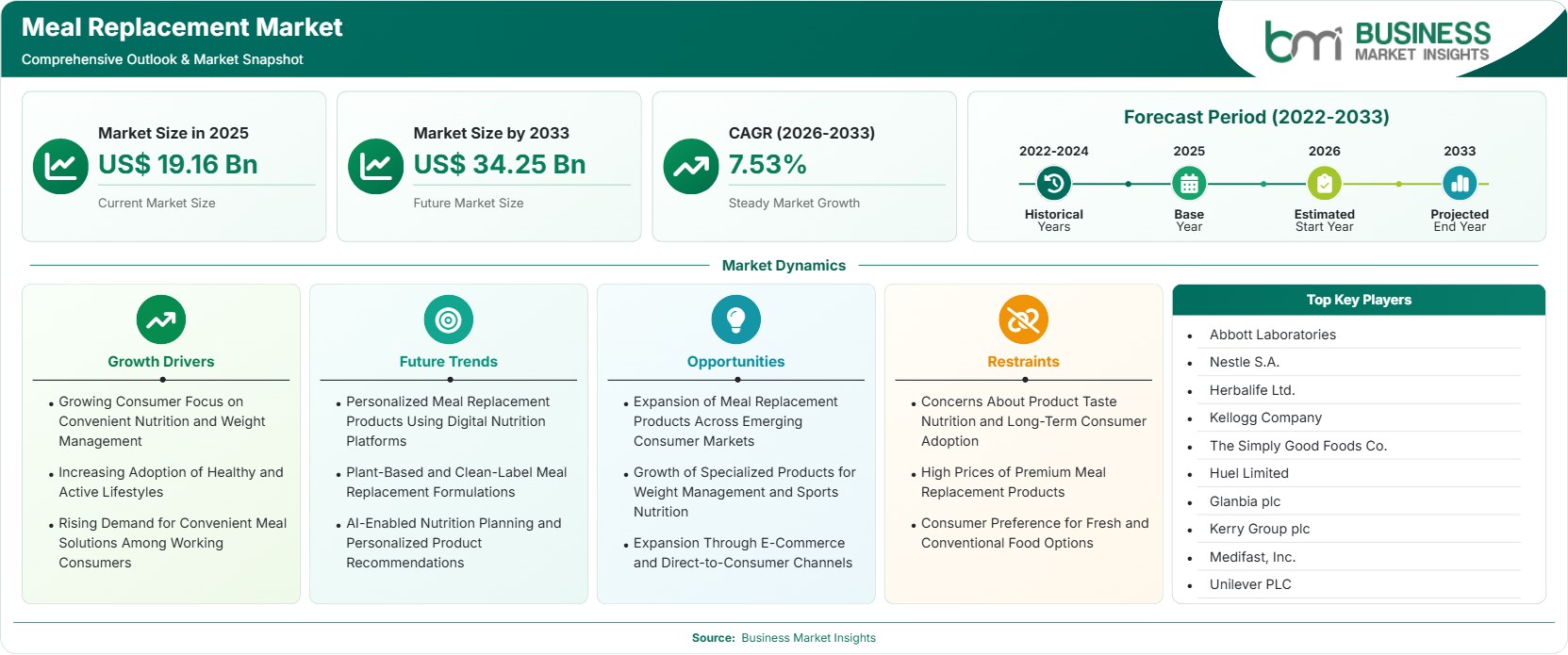
The Meal Replacement Market size was valued at US$ 19.16 Billion in 2025 and is projected to reach US$ 34.25 Billion by 2033, growing at a CAGR of 7.53% during 2026–2033, supported by convenient nutrition, weight management, active lifestyles, changing eating patterns, e-commerce expansion, and product innovation.

Report Coverage
  • Product Type: Bars, Ready-to-Drink, Powder, Others
  • Source: Animal-Based, Plant-Based
  • Distribution Channel: Supermarkets/Hypermarkets, Specialty Stores, Convenience Stores, Online Retail, Others
US$ 19.16 Bn Market size in 2025
US$ 34.25 Bn Market Size by 2033
7.53% CAGR, 2026 - 2033
2026-2033 Forecast Period

01 AI Overview

Meal Replacement Market Summary

  • North America Region: North America holds a 37%–41% share in 2025, growing at a 7.1%–7.8% CAGR during 2026–2033, supported by established nutrition-product consumption, premium product innovation, and strong digital retail penetration. The US represents 82%–86% of regional demand, expanding at a 7.2%–7.9% CAGR during 2026–2033, supported by convenience-oriented consumption, sports nutrition, weight management, product diversification, and direct-to-consumer distribution.
  • Fastest Growing Region: Asia Pacific holds a 20%–24% share in 2025, expanding at a 8.6%–9.4% CAGR during 2026–2033, supported by urbanization, increasing disposable income, changing dietary patterns, growing health awareness, expanding modern retail, and rapidly developing online food and nutrition channels.
  • Leading Segment: Powder products hold a 39%–43% share in 2025, growing at a 7.5%–8.2% CAGR during 2026–2033, supported by formulation flexibility, convenient preparation, extended shelf life, protein fortification, customization, and broad application across weight management and active nutrition.
  • High Growth Segment: Plant-Based Source holds a 34%–38% share in 2025, expanding at a 8.4%–9.2% CAGR during 2026–2033, supported by demand for plant-derived nutrition, clean-label positioning, sustainability considerations, dairy avoidance, dietary flexibility, and innovation in taste and texture.
  • Key Market Opportunity: Specialized formulations combining protein, fiber, vitamins, minerals, functional ingredients, and targeted nutrition can expand consumer adoption while creating premium positioning across wellness, sports, weight management, and active-aging applications.
  • Major Market Players: Abbott Laboratories; Nestle S.A., Herbalife Ltd., Kellogg Company, The Simply Good Foods Co., Huel Limited, Glanbia plc, Kerry Group plc, Medifast, Inc., Unilever PLC.
02 Strategic Insights

Meal Replacement Market: Strategic Insights

Meal Replacement Market Strategic Framework
FREE PDF
Request your free sample
Request free sample
03 Stakeholder View

Key Takeaways

  • The value chain is evolving from conventional nutrition manufacturing toward integrated formulation, ingredient sourcing, packaging, digital distribution, consumer analytics, and direct-to-consumer engagement.
  • Plant-based products and specialized formulations provide strong growth opportunities as consumers increasingly seek products aligned with dietary preferences, fitness objectives, weight management, and broader wellness goals.
  • Product innovation is shifting toward higher protein content, improved texture, lower sugar, cleaner labels, functional ingredients, micronutrient fortification, and better sensory performance.
  • Asia Pacific provides an attractive expansion environment because urbanization, rising health awareness, modern retail penetration, and online purchasing are increasing access to convenient nutrition products.
  • E-commerce and direct-to-consumer channels are becoming strategically important because they enable personalized product discovery, subscription purchasing, consumer feedback collection, and broader geographic reach.
  • Premium positioning can improve revenue potential, but suppliers need to demonstrate meaningful nutritional value and sensory quality to justify higher prices and sustain repeat purchases.
04 Geographic Outlook

Meal Replacement Market Regional Highlights

North America Meal Replacement Market

North America accounts for a 37%–41% share in 2025 and is projected to expand at a 7.1%–7.8% CAGR through 2033. Mature health and wellness consumption, widespread modern retail, strong sports nutrition participation, and established weight-management demand support regional adoption. The Meal Replacement Market share remains concentrated in products designed for convenience, portion control, protein intake, and active lifestyles.

  • Weight-management demand continues to support consumption as consumers seek convenient products capable of replacing selected meals while maintaining controlled calorie and nutrient intake.
  • Sports and fitness consumers provide an important customer base for protein-rich products, particularly where portability and quick consumption are priorities before or after physical activity.
  • Online retail is expanding product variety and enabling specialized formulations to reach consumers who may have limited access to physical nutrition stores.
  • Premiumization is increasing opportunities for products emphasizing higher protein, lower sugar, plant-based ingredients, functional nutrition, and recognizable ingredient profiles.

US Meal Replacement Market

The US represents 82%–86% of North American demand in 2025 and US Meal Replacement Market forecast projected to grow at a 7.2%–7.9% CAGR through 2033. Demand is supported by strong health and wellness awareness, established weight-management consumption, sports nutrition participation, and extensive retail infrastructure. Consumers increasingly prioritize portability and nutritional convenience because of busy work schedules and changing meal patterns.

  • Convenience remains a central adoption factor as working consumers increasingly seek portable products that can replace meals without requiring extensive preparation.
  • Weight-management products continue to attract consumers seeking portion-controlled nutrition, balanced macronutrients, and convenient alternatives to conventional meals.
  • Digital commerce supports specialized formulations through targeted discovery, subscription models, consumer reviews, and direct access to nutrition-focused product portfolios.

Europe Meal Replacement Market

Europe meal replacement market represents a 27%–31% share in 2025 and is projected to grow at a 6.8%–7.5% CAGR through 2033. Western European markets maintain strong demand for convenient nutrition, weight management, and premium health-oriented food products. The United Kingdom, Germany, France, Italy, and Spain are leading markets, while Spain is projected to achieve comparatively strong growth at a 7.8%–8.6% CAGR.

  • Western European consumers increasingly seek convenient nutrition products that combine portability with recognizable ingredients and clear nutritional positioning.
  • Plant-based formulations are gaining relevance as consumers evaluate dietary flexibility, sustainability considerations, and alternatives to conventional animal-derived nutrition sources.
  • Regulatory attention to nutrition labeling and product composition is encouraging manufacturers to communicate nutritional attributes clearly and strengthen formulation transparency.
  • Online channels are supporting specialist product discovery and enabling consumers to compare nutritional profiles, formats, ingredients, and prices more efficiently.

Asia Pacific Meal Replacement Market

Asia Pacific meal replacement market holds a 20%–24% share in 2025 and is projected to expand at an 8.6%–9.4% CAGR through 2033, making it the fastest-growing regional market. China, Japan, South Korea, Australia, and India are important markets, while India is projected to grow at a 9.5%–10.3% CAGR. Urbanization, changing work patterns, expanding middle-class populations, rising health awareness, and increasing digital commerce are improving adoption.

  • China provides substantial opportunity through urban consumer growth, expanding wellness awareness, digital retail penetration, and increasing demand for convenient nutrition products.
  • India offers strong growth potential as urban consumers increasingly seek portable nutrition, weight-management products, fitness-oriented foods, and convenient alternatives to conventional meals.
  • Japan and South Korea maintain sophisticated health-oriented consumer markets with demand for portion-controlled, functional, convenient, and nutritionally differentiated products.
  • Online commerce is accelerating category accessibility by allowing consumers to purchase specialized products without relying on physical specialty nutrition outlets.

Rest of World Meal Replacement Market

Rest of World represents a 10%–14% share in 2025 and is projected to grow at a 6.5%–7.3% CAGR through 2033. South and Central America are supported by increasing wellness awareness, urbanization, modern retail expansion, and changing consumer lifestyles. Brazil and Mexico are leading markets, while Mexico is projected to grow at a 7.5%–8.3% CAGR. Middle Eastern markets are developing through premium nutrition demand, fitness participation, and expanding modern retail, while selected African markets offer longer-term opportunities as packaged nutrition access improves. South and Central American consumers are increasingly exposed to convenient nutrition products through supermarkets, specialty stores, fitness channels, and online platforms. Middle Eastern demand is supported by urbanization, rising wellness spending, sports participation, and premium food consumption.

  • Brazil provides an expanding consumer base through urbanization, wellness awareness, fitness participation, and greater availability of packaged nutrition products.
  • Mexico offers strong growth potential because modern retail, online commerce, active lifestyles, and demand for convenient nutrition are developing simultaneously.
  • Middle Eastern markets offer premiumization opportunities for specialized products positioned around wellness, fitness, weight management, and nutritional convenience.
  • Emerging markets can benefit from lower-cost powder formats because they provide convenient preparation, efficient distribution, and comparatively flexible serving sizes.
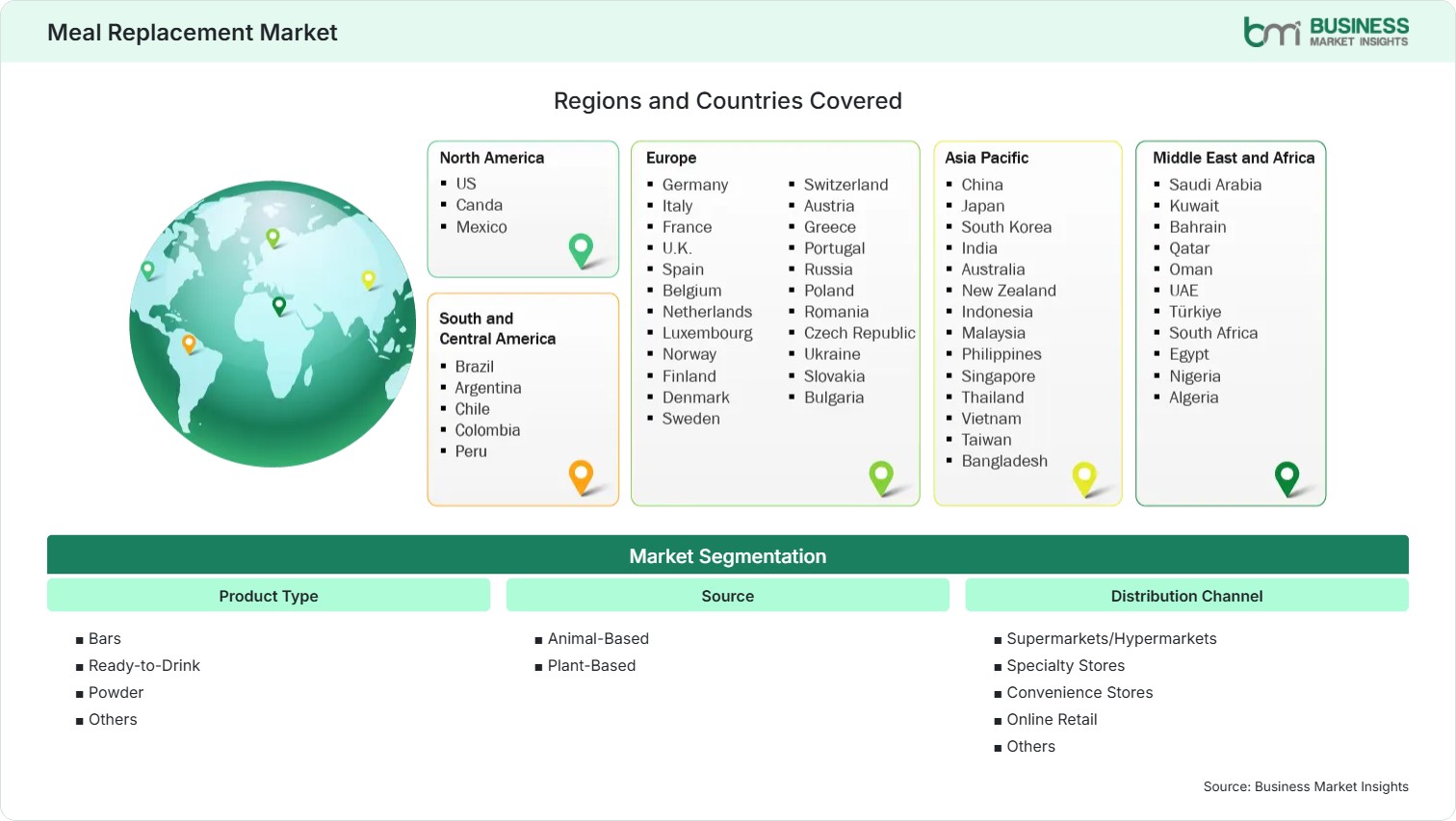
Global Market Geography
FREE PDF
Request your free sample
Request free sample
05 Segment Analysis

Meal Replacement Market Segmentation

Product Type

Product formats determine portability, preparation requirements, shelf stability, consumption occasions, and formulation flexibility. Powder holds a 39%–43% meal replacement market share in 2025 and is projected to grow at a 7.5%–8.2% CAGR through 2033. Ready-to-drink products benefit from immediate consumption, while bars support portability.

  • Bars: Provide portable nutrition for work, travel, exercise, and between-meal occasions, with demand supported by convenience, portion control, protein fortification, and improved taste profiles.
  • Ready-to-Drink: Enables immediate consumption without preparation, supporting busy consumers, fitness occasions, commuting, and situations where refrigeration and portability requirements can be accommodated.
  • Powder: Offers formulation flexibility, convenient storage, customizable serving sizes, and efficient transportation, making it suitable for protein-rich and nutritionally fortified meal-replacement products.
  • Others: Include alternative formats serving specific consumption occasions, dietary preferences, and specialized nutrition needs where differentiated delivery formats can improve convenience and product appeal.

Source

Source preferences are changing as consumers evaluate nutrition, dietary restrictions, sustainability, and ingredient transparency. Plant-Based holds a 34%–38% share in 2025 and is projected to grow at an 8.4%–9.2% CAGR through 2033, supported by expanding plant-derived ingredient availability and consumer interest in dietary flexibility.

  • Animal-Based: Provides established protein and nutrient profiles, supporting products designed for consumers prioritizing protein intake, nutritional density, established formulation characteristics, and familiar ingredients.
  • Plant-Based: Benefits from increasing demand for plant-derived nutrition, dietary flexibility, clean-label positioning, sustainability considerations, and improved formulation technologies addressing taste and texture.

Distribution Channel

Distribution is becoming more diversified as consumers combine physical retail with digital purchasing. Supermarkets/Hypermarkets hold a 34%–38% meal replacement market share in 2025, while Online Retail records comparatively strong growth at a 9.2%–10.0% CAGR through 2033. Specialty stores remain important for targeted nutrition products, while convenience stores provide access for immediate consumption occasions. Digital channels are expanding product variety and geographic availability.

  • Supermarkets/Hypermarkets: Provide broad consumer reach, product visibility, promotional opportunities, and convenient access to mainstream meal-replacement products across established grocery-shopping routines.
  • Specialty Stores: Serve consumers actively seeking sports nutrition, weight-management, wellness, and specialized dietary products supported by focused product assortments and knowledgeable retail environments.
  • Convenience Stores: Support immediate-consumption occasions by providing portable products for commuters, working consumers, travelers, and consumers seeking quick nutritional alternatives.
  • Online Retail: Expands access to specialized products, enables subscription purchasing, supports product comparison, and allows targeted marketing based on consumer interests and purchasing behavior.
  • Others: Include alternative distribution models that broaden product access through institutional, direct, fitness-oriented, and specialized nutrition channels serving targeted consumer groups.
06 Market Forces

Meal Replacement Market Dynamics

Key Market Drivers

Growing Consumer Focus on Convenient Nutrition and Weight Management

Modern consumers are more interested in getting foods that help them maintain control over their calorie intake and their nutrition without the need to prepare food using conventional methods. Meal replacements are able to offer consumers predetermined portion sizes and nutrition profiles that make them relevant to the processes of weight management and lifestyle. This trend is gaining momentum due to the interest of consumers in receiving nutrition on the go when working, traveling, commuting, and exercising. This evolution is strengthening Meal Replacement Market trends around convenience, and specialized formulations designed for different consumption occasions.

Increasing Adoption of Healthy and Active Lifestyles

Increased involvement in physical fitness, recreation exercise, health programs, and an active lifestyle is creating greater consumer demand for nutritional products. People who regularly participate in physical activities are more likely to prefer products that contain proteins, energy, and essential nutrients in an easily portable form. Meal replacement products are capable of catering to the needs of consumers both before and after exercise and during intervals depending on the nature of the product. Consumers are also becoming increasingly conscious of healthy diets and nutrition. Manufacturers are therefore developing specialized products that combine convenience with nutritional attributes relevant to active consumers.

Rising Demand for Convenient Meal Solutions Among Working Consumers

Consumers that are working experience less availability of time to prepare their meals, especially in the urban setting, where they may have long commutes, long working hours, and flexible work hours, leading to a disruption in the conventional feeding pattern. Meal replacement products offer an easier solution since they require little preparation and offer regular servings. Ready-to-drink products and bars are ideal for immediate consumption, whereas powders offer flexibility when facilities for preparation are available. This shift is creating opportunities for products designed around portability and rapid consumption across workplace and travel settings.

Key Market Opportunities

Expansion of Meal Replacement Products Across Emerging Consumer Markets

Emerging markets offer significant room for category expansion as urbanization, changing work patterns, rising health awareness, and modern retail penetration improve consumer access to packaged nutrition products. Lower-cost powder formats can provide an efficient entry point because they offer flexible serving sizes and comparatively efficient transportation. Localized flavors, dietary preferences, portion sizes, and price points can further improve adoption. Digital commerce is also reducing geographic barriers by connecting consumers with specialized products that may not be available through conventional retail.

Growth of Specialized Products for Weight Management and Sports Nutrition

Specialized product formulations present an opportunity to add value by differentiating to meet unique nutritional needs, rather than being positioned purely as meal replacement products. Weight-loss products could capitalize on portion control, protein content, fiber, and calorie management. Sports formulations may be designed around protein, energy, and recovery management, as well as the convenience of consumption. Dietary preferences such as plant-based, low-sugar, high-protein, or allergy-conscious formulations may also inform specialized product formulations. Formulation innovation could add relevance and enable premium pricing through proper nutrition.

Expansion Through E-Commerce and Direct-to-Consumer Channels

The digital commerce presents valuable channel due to the ability of marketing meal-replacement products based on individual consumer objectives, nutrition requirements, and shopping habits. The online platform is useful in providing relevant information in relation to the nutritional value, product comparisons, subscription plans, bundled packages, and education of the consumers. The direct-to-consumer distribution strategy also helps in increasing accessibility to specialized formulations and providing valuable consumer feedback in developing the products. The subscription-based purchasing model helps in encouraging regular consumption of the products.

Market Restraints and Challenges

Concerns About Product Taste Nutrition and Long-Term Consumer Adoption

Factor: Consumers may perceive some meal replacement products as less satisfying or less appealing than conventional meals because of taste, texture, ingredient composition, or concerns about nutritional completeness. Impact: Poor sensory experiences or doubts about nutritional value can reduce repeat purchasing and limit long-term adoption, requiring manufacturers to improve formulation quality and product credibility.

High Prices of Premium Meal Replacement Products

Factor: Premium formulations can involve higher-cost proteins, specialized ingredients, functional compounds, advanced packaging, and differentiated manufacturing processes. Impact: Higher retail prices can restrict adoption among price-sensitive consumers and make premium products less competitive against conventional meals, snacks, or lower-cost nutrition alternatives.

07 Company Analysis

Competitive Landscape

The Meal Replacement Market analysis highlights competition is driven by nutritional formulation, format, ingredient sourcing, brand positioning, market distribution, price, sensory and digital engagement. Businesses that compete in this market space have been expanding their portfolios across traditional and plant-based sources, powders, bars, Ready to Drink, nutrition-specific and different retail channels.

Company Name

Overview

Products and Services relevant to this market

Abbott Laboratories

Global healthcare and nutrition company with a broad portfolio of science-based nutritional products.

Nutritional shakes, powders, meal-support products, protein nutrition, specialized nutrition, and health-oriented formulations.

Nestlé S.A.

Diversified food and nutrition company with extensive consumer health and nutrition capabilities.

Nutrition beverages, meal-replacement products, protein products, functional nutrition, and convenient nutrition formats.

Herbalife Ltd.

Nutrition-focused company operating across weight management, wellness, sports nutrition, and direct-selling channels.

Meal-replacement shakes, protein products, nutrition powders, supplements, and weight-management solutions.

Kellogg Company

Food company with established packaged-food capabilities and convenient nutrition products.

Snack bars, nutrition-oriented products, convenient food formats, and packaged nutrition solutions.

The Simply Good Foods Co.

Consumer nutrition company focused on low-carbohydrate, protein-oriented, and weight-management products.

Meal-replacement shakes, bars, snacks, protein products, and weight-management nutrition.

Huel Limited

Nutrition company specializing in complete-food products designed for convenience and balanced nutrition.

Powdered meals, ready-to-drink products, bars, complete nutrition products, and plant-based formulations.

Glanbia plc

Global nutrition and ingredients company serving sports nutrition and consumer health markets.

Protein powders, nutritional beverages, sports nutrition, meal-support products, and functional ingredients.

Kerry Group plc

Global food and nutrition ingredients company providing formulation technologies and nutritional solutions.

Protein and nutritional ingredients, functional systems, taste solutions, fortification, and food formulation technologies.

Medifast, Inc.

Nutrition and weight-management company focused on structured nutrition programs and convenient products.

Meal-replacement shakes, bars, snacks, nutritional products, and structured weight-management solutions.

Unilever PLC

Consumer goods company with broad food, nutrition, wellness, and consumer-product capabilities.

Convenient nutrition products, beverages, packaged foods, plant-based offerings, and consumer wellness products.

10 Trust & Transparency

Research Methodology

The market analysis combines proprietary research with secondary data from government agencies, company disclosures, regulatory filings, industry databases and expert interviews. Market estimates are validated through data triangulation, cross-market benchmarking and analyst review.

View Full Research Methodology

11 Questions Answered

Frequently Asked Questions

What limits long-term consumer adoption?

Taste, texture, perceived nutritional completeness, price, and consumer preference for conventional meals can restrict repeat adoption. Better formulations and clearer nutritional positioning are therefore important for sustained category development.

How is e-commerce changing meal replacement distribution?

E-commerce expands geographic reach, improves access to specialized products, supports subscriptions and recurring purchases, enables detailed nutritional comparisons, and provides manufacturers with more direct consumer engagement.

Why are plant-based meal replacements gaining popularity in Meal Replacement Market report?

Plant-based products benefit from increasing consumer interest in dietary flexibility, plant-derived nutrition, sustainability considerations, clean-label positioning, and improved formulation technologies that address taste and texture.

Which product format holds the leading position?

Powder holds the leading position because it provides formulation flexibility, convenient storage, customizable serving sizes, efficient transportation, and suitability for protein-rich and nutritionally fortified formulations.

What is driving demand for meal replacement products?

Demand is being supported by convenience-oriented lifestyles, weight-management goals, active living, changing eating patterns, and increasing consumer interest in nutritionally controlled alternatives to conventional meals.

Access the Full Meal Replacement Market Report

Get segment-level forecasts, regional estimates, competitive benchmarking, company profiles and downloadable Excel datasets.

Access the full Meal Replacement Market Report
350 pages PDF & Excel | 2026-08-20