
Fish Meal Market Outlook: Size, Share, Trends, Growth Analysis, Competitive Landscape & Forecast, 2026-2033

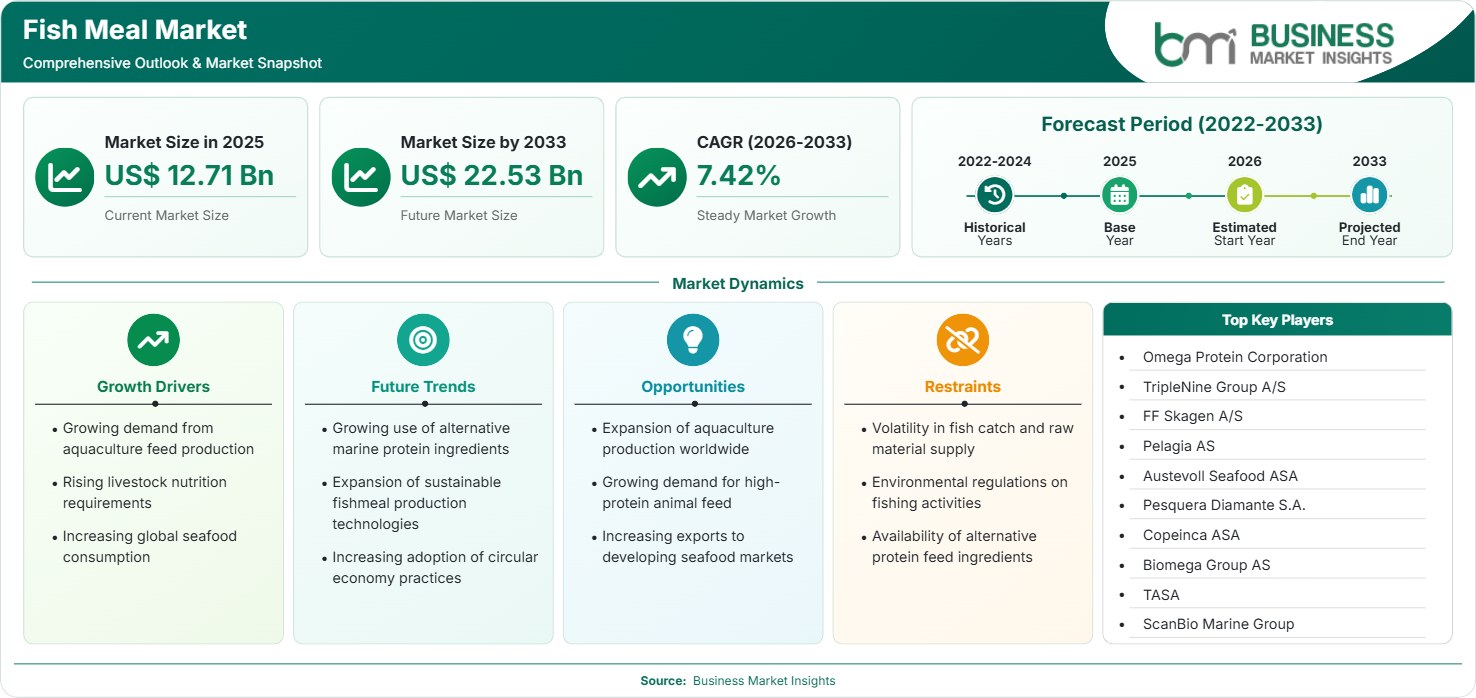
The Fish Meal Market size was valued at US$ 12.71 Billion in 2025 and is projected to reach US$ 22.53 Billion by 2033, growing at a CAGR of 7.42% from 2026 to 2033, driven by rising aquaculture feed demand, increasing livestock nutrition requirements, expanding seafood consumption, and growing adoption of high-protein feed ingredients.

Report Coverage
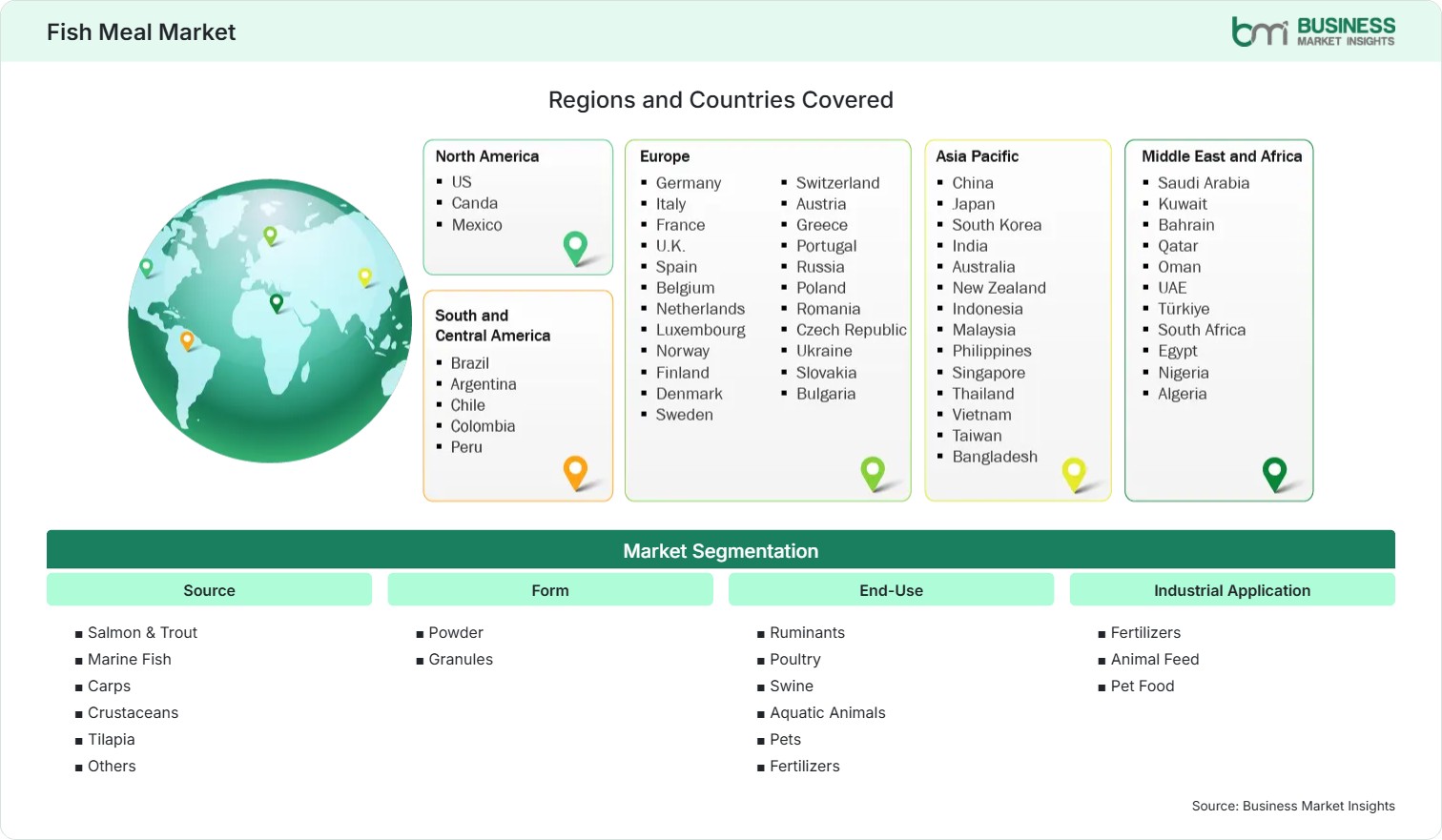
  • Source: Salmon & Trout, Marine Fish, Carps, Crustaceans, Tilapia, Others
  • Form: Powder, Granules
  • End-Use: Ruminants, Poultry, Swine, Aquatic Animals, Pets, Fertilizers
  • Industrial Application: Fertilizers, Animal Feed, Pet Food
US$ 12.71 Bn Market size in 2025
US$ 22.53 Bn Market Size by 2033
7.42% CAGR, 2026 - 2033
2026-2033 Forecast Period

01 AI Overview

Fish Meal Market Summary

  • North America Region: The market share of North America in 2025 stands at around 20% to 23%, and it will expand at a 6.5% to 7.1% CAGR from 2026 to 2033. This growth will be fueled by efficient aquaculture, flourishing animal feed industry, increased demand for pet nutrition, and the use of sustainable marine protein sources. The U.S. market is also growing at a 6.7% to 7.2% CAGR from 2026 to 2033.
  • Fastest Growing Region: The Asia-Pacific region holds around 45%-49% market share in 2025 and records a CAGR of 8.1%-8.7% during 2026-2033. The region's growth is mainly influenced by substantial aquaculture production facilities, increased demand for seafood, high livestock farming operations, enhanced feed processing facilities, and rising demand for high-protein food products in developing countries.
  • Leading Segment: Market share of Marine Fish accounts for around 38%-42% in 2025 and is expected to grow at a CAGR of 7.0%-7.6% between 2026 and 2033. The growth drivers are high nutritional value, availability, processing, and widespread application in aqua and animal feeds.
  • High Growth Segment: Market Share for Aquatic Animals within end-use applications in 2025 stands around 30%-34%, and the compound annual growth rate (CAGR) between 2026 and 2033 is expected to be 8.2%-8.8%. Growth will be driven by the growth of fish farms, aquaculture spending, and the
  • Key Market Opportunity: Expansion of aquaculture production, increasing demand for high-protein animal feed, and growing seafood exports from developing markets are creating opportunities for manufacturers to strengthen production capacity and global distribution networks.
  • Major Market Players: Omega Protein Corporation, TripleNine Group A/S, FF Skagen A/S, Pelagia AS, Austevoll Seafood ASA, Pesquera Diamante S.A., Copeinca ASA, Biomega Group AS, TASA, and ScanBio Marine Group.
02 Strategic Insights

Fish Meal Market: Strategic Insights

Fish Meal Market Strategic Framework
FREE PDF
Request your free sample
Request free sample
03 Stakeholder View

Key Takeaways

  • The value chain is becoming more integrated as fish meal producers collaborate with fisheries, aquaculture operators, and feed manufacturers to improve supply reliability and product quality. Companies with diversified sourcing networks have stronger resilience against raw material fluctuations.
  • Aquaculture remains the strongest demand area as fish farmers increasingly rely on nutrient-dense feed ingredients to improve productivity, reduce production cycles, and support higher-quality seafood output.
  • Product innovation is focusing on sustainable processing, improved protein concentration, reduced environmental impact, and alternative sourcing methods to address resource limitations and changing regulatory expectations.
  • Asia Pacific provides the strongest investment opportunity due to its dominant aquaculture industry, rising seafood consumption, expanding feed manufacturing sector, and increasing demand from emerging economies.
  • Strategic partnerships, acquisitions, and capacity expansion activities are becoming important as companies seek stable raw material access and stronger positions in international seafood supply chains.
  • Sustainability compliance is becoming a competitive factor, with manufacturers investing in responsible sourcing certifications, traceability systems, and environmentally efficient production processes.
04 Geographic Outlook

Fish Meal Market Regional Highlights

North America Fish Meal Market

North America accounted for approximately 20%–23% of global revenue in 2025 and is projected to expand at a 6.5%–7.1% CAGR during 2026–2033. The region benefits from established animal feed industries, advanced aquaculture operations, strong pet nutrition demand, and increasing preference for high-quality protein ingredients. The Fish Meal Market share in North America is supported by consistent demand from the United States and Canada, where feed producers are adopting sustainable sourcing practices and improving ingredient traceability.

  • The United States remains the dominant regional contributor due to large-scale animal feed production, growing aquaculture activities, and increasing demand for premium pet food formulations.
  • Canada is witnessing steady adoption due to expanding aquaculture operations, seafood production activities, and rising interest in sustainable marine-derived feed ingredients.
  • Feed manufacturers are investing in advanced formulation technologies to improve nutritional efficiency and optimize fish meal utilization across livestock and aquatic feed applications.
  • Sustainability initiatives are influencing sourcing strategies as companies focus on responsible fisheries management, certification programs, and improved production transparency.

US Fish Meal Market

The United States represented approximately 75%–80% of North American revenue in 2025 and is expected to grow at a 6.7%–7.2% CAGR during 2026–2033. Growth is supported by strong livestock production, increasing aquaculture feed demand, expanding pet food applications, and rising adoption of nutrient-rich feed ingredients.

  • Growing aquaculture activities in coastal regions are increasing demand for specialized feed ingredients that improve fish growth, health, and production efficiency.
  • The livestock sector continues supporting consumption through poultry and swine feed applications requiring concentrated protein sources for improved animal nutrition.
  • Premium pet food manufacturers are increasing utilization of marine proteins to develop functional nutrition products targeting health-conscious consumers.
  • Investments in sustainable sourcing and processing technologies are strengthening long-term market development across the United States.

Europe Fish Meal Market

Europe accounted for approximately 22%–25% of global revenue in 2025 and is forecast to register a 6.8%–7.4% CAGR from 2026–2033. The region benefits from advanced aquaculture industries, strict feed quality standards, and increasing demand for sustainable protein ingredients. Norway represents a leading market due to its developed salmon farming industry, while Denmark and Germany demonstrate growth through feed manufacturing capabilities and strong animal nutrition sectors.

  • Norway maintains regional leadership because of its large salmon aquaculture industry and strong demand for high-quality feed ingredients supporting fish production.
  • Denmark benefits from established fish meal processing capabilities, advanced feed manufacturing infrastructure, and strong export-oriented seafood industries.
  • Germany demonstrates steady growth through livestock nutrition demand, feed innovation, and increasing adoption of sustainable animal feed solutions.
  • European regulations promoting responsible fisheries and traceability are encouraging producers to improve sourcing transparency and environmental compliance.
  • Growing interest in alternative protein solutions is encouraging companies to optimize marine ingredient utilization within balanced feed formulations.

Asia Pacific Fish Meal Market

Asia Pacific represented approximately 45%–49% of global revenue in 2025 and is projected to achieve the fastest growth at a 8.1%–8.7% CAGR during 2026–2033. The region benefits from extensive aquaculture production, rising seafood consumption, expanding livestock farming, and increasing feed manufacturing capacity. China remains the leading market, while India, Vietnam, and Indonesia are high-growth countries due to increasing aquaculture investments and rising demand for affordable protein sources.

  • China dominates regional consumption due to its extensive aquaculture industry, large seafood production base, and significant demand for high-performance feed ingredients.
  • India is experiencing increasing demand through expanding fish farming activities, rising seafood consumption, and government support for aquaculture development.
  • Vietnam and Indonesia are growing rapidly due to shrimp farming expansion, export-oriented seafood production, and increasing investment in feed manufacturing infrastructure.
  • Regional feed producers are adopting improved processing technologies to enhance nutritional efficiency and reduce dependency on inconsistent raw material supply.
  • Rising middle-class populations are increasing seafood consumption, supporting long-term demand for aquaculture feed ingredients across Asian markets.

Rest of World Fish Meal Market

The Rest of World region accounted for approximately 7%–10% of global revenue in 2025 and is expected to expand at a 7.0%–7.8% CAGR during 2026–2033. South and Central America benefit from strong fishing resources and seafood export industries, while the Middle East and Africa region is supported by expanding aquaculture investments and increasing food security initiatives. Peru represents a leading market due to its established fish meal production industry and export capabilities.

  • Peru remains a major contributor due to abundant marine resources, established processing infrastructure, and strong international fish meal export activities.
  • Chile supports regional demand through aquaculture expansion, seafood production capabilities, and growing requirements from feed manufacturers.
  • Middle Eastern countries are investing in aquaculture projects to improve food security and reduce dependence on seafood imports.
  • African markets are developing through increasing fish farming initiatives and growing demand for affordable animal nutrition solutions.
  • Export-focused production strategies are helping regional suppliers expand their presence in international feed ingredient markets.
Global Market Geography
FREE PDF
Request your free sample
Request free sample
05 Segment Analysis

Fish Meal Market Segmentation

Source

The source segment influences nutritional value, supply availability, and application suitability. Marine Fish led with a 38%–42% share in 2025 and is projected to grow at a CAGR of 7.0%–7.6% during 2026–2033, supported by high protein content, established processing infrastructure, and wide use in aquaculture, livestock, and pet nutrition in fish meal market.

  • Salmon & Trout: Salmon and trout-based fish meal is valued for premium nutritional characteristics, high digestibility, and suitability for specialized aquaculture feed formulations requiring enhanced protein quality.
  • Marine Fish: Marine fish remains widely utilized due to established supply chains, balanced amino acid profiles, and extensive adoption in commercial aquaculture and livestock feed production.
  • Carps: Carp-derived fish meal supports regional feed requirements, particularly in freshwater aquaculture markets where cost-effective protein ingredients are required for fish farming operations.
  • Crustaceans: Crustacean-based fish meal provides nutritional benefits through marine-derived proteins and minerals, supporting specialized feed applications in aquaculture and animal nutrition.
  • Tilapia: Tilapia-based fish meal is gaining attention due to expanding tilapia farming activities and increasing demand for efficient feed solutions in developing aquaculture markets.

Form

The form segment reflects processing preferences among feed manufacturers seeking efficient handling, storage, and formulation compatibility. Powder represented the leading form category with approximately 70%–74% share in 2025 and is expected to grow at a 7.1%–7.7% CAGR during 2026–2033 in Fish Meal Market. Powdered fish meal remains preferred because of easy mixing capabilities, uniform nutrient distribution, and compatibility with industrial feed manufacturing processes.

  • Powder: Powder form maintains widespread adoption due to efficient blending properties, high processing flexibility, and suitability for large-scale animal feed manufacturing applications.
  • Granules: Granular fish meal is increasingly adopted for improved storage efficiency, reduced dust generation, and easier handling during transportation and feed production processes.

End-Use

The end-use segment is shaped by rising protein demand, expanding animal production, and increasing aquaculture output. Aquatic Animals represented approximately 30%–34% share in 2025 and are projected to grow at a 8.2%–8.8% CAGR during 2026–2033. Growth is driven by increasing global aquaculture production, seafood consumption, and demand for high-quality feed ingredients that improve fish health, growth rates, and production efficiency in Fish Meal Market.

  • Ruminants: Ruminant applications use fish meal as a protein supplement supporting livestock nutrition, improved feed efficiency, and balanced dietary formulations.
  • Poultry: Poultry producers utilize fish meal for its concentrated protein content, amino acid availability, and contribution to improved growth performance.
  • Swine: Swine feed applications benefit from fish meal’s nutritional density, supporting efficient animal growth and optimized feed formulations.
  • Aquatic Animals: Aquatic animal feed remains a major application due to aquaculture expansion, increasing seafood demand, and the need for nutrient-rich feed ingredients.
  • Pets: Pet food manufacturers are increasing marine protein usage to develop premium nutrition products focused on health, digestibility, and functional benefits.
  • Fertilizers: Fish meal is utilized in fertilizer applications due to organic nutrient content and increasing interest in natural agricultural inputs.

Industrial Application

The industrial application segment spans agriculture, animal nutrition, and specialty feed markets. Animal Feed led with a 60%–64% share in 2025 and is projected to grow at a CAGR of 7.3%–7.9% during 2026–2033, driven by livestock growth, aquaculture expansion, and demand for nutrient-rich feed ingredients. The Fish Meal Market scope is expanding into broader applications beyond traditional feed.

  • Fertilizers: Fertilizer applications are supported by increasing demand for organic agricultural inputs and growing interest in nutrient-rich alternatives for soil improvement.
  • Animal Feed: Animal feed remains the primary industrial application due to high protein requirements across aquaculture, livestock, and poultry production systems.
  • Pet Food: Pet food applications are expanding through premium product development, increasing pet ownership, and consumer demand for functional marine-based nutrition ingredients.
06 Market Forces

Fish Meal Market Dynamics

Key Market Drivers

Growing demand from aquaculture feed production

Expanding aquaculture production is one of the strongest factors supporting demand for fish meal as farmers seek high-quality protein ingredients to improve feed efficiency and aquatic animal growth. Global aquaculture continues gaining importance as seafood demand rises and wild capture fisheries face production limitations. The Fish Meal Market trends indicate increasing adoption of marine protein ingredients in shrimp, salmon, and other farmed species. According to the Food and Agriculture Organization, aquaculture has become a major contributor to global aquatic food supply, encouraging feed manufacturers to invest in efficient and nutritionally balanced formulations. This shift is strengthening long-term demand for fish meal across commercial aquaculture operations.

Rising livestock nutrition requirements

The demand to produce more livestock, coupled with the requirement of enhanced performance of livestock animals, is resulting in the increased use of protein feeds. The poultry, swine, and ruminant producers have begun using nutritional solutions that enhance growth performance, feed efficiency, and animal health. Fishmeal contains essential amino acids and digestible protein and is therefore an important component of a balanced feed ration. Rising meat and dairy consumption in developing countries is prompting feed companies to ensure the proper selection of feed ingredients.

Increasing global seafood consumption

Rising seafood consumption is supporting expansion of aquaculture industries and increasing demand for specialized feed ingredients. Population growth, changing dietary preferences, and increasing awareness of seafood as a protein source are encouraging investment in fish farming worldwide. The Fish Meal Market growth is supported by the relationship between seafood production expansion and feed ingredient requirements. Developing economies are experiencing higher seafood consumption due to urbanization and income growth, creating additional opportunities for aquaculture feed suppliers. This demand shift is encouraging manufacturers to improve production efficiency while maintaining sustainable sourcing practices.

Key Market Opportunities

Expansion of aquaculture production worldwide

Global aquaculture expansion presents a major opportunity for fish meal producers as farmed seafood production requires reliable nutritional inputs. Countries across Asia Pacific, Latin America, and the Middle East are investing in aquaculture infrastructure to strengthen food security and meet increasing seafood demand. The Fish Meal Market forecast remains supported by rising fish farming activities, particularly in shrimp, salmon, and freshwater species production. Companies expanding processing capacity, improving supply networks, and developing sustainable sourcing models can benefit from growing demand from commercial aquaculture operators.

Growing demand for high-protein animal feed

The increased demand for high-protein feed for animals is giving rise to new business prospects as livestock farmers continue to look for components that enhance performance and nutritional results. The growing poultry, pig, and fish farming businesses necessitate protein-rich feed to make their production processes efficient. Feed producers are working to formulate feed mixes that are nutritionally sound and cost-effective. Fishmeal producers have new business prospects in providing specialized feed products for specific livestock.

Increasing exports to developing seafood markets

The increase in seafood production in the emerging markets provides export opportunities to fish meal providers with well-developed production capabilities. With growing aquaculture production in various countries, there will be a need for quality feed supplies, which will help promote international trade and logistics. Fish meal providers situated near the fishing centers should take advantage of logistics, certification of quality, and relations with customers. The emerging seafood markets of Asia, Latin America, and Africa will create new demand centers because of the development of domestic aquaculture industries.

Market Restraints and Challenges

Volatility in fish catch and raw material supply

Factor: Fluctuations in fish catch volumes caused by seasonal variations, climate conditions, and changes in marine resource availability can affect raw material supply for fish meal production. Impact: Supply uncertainty can increase production costs, create pricing volatility, and challenge manufacturers’ ability to maintain consistent output. Companies are addressing this limitation through diversified sourcing strategies, improved inventory management, and investments in sustainable procurement practices. However, dependence on marine resources remains a key operational challenge for producers across major fishing regions.

Environmental regulations on fishing activities

Factor: Increasing environmental regulations related to fishing practices, marine conservation, and sustainable resource management are influencing fish meal production activities. Impact: Stricter compliance requirements can increase operational costs, limit raw material availability, and require additional investments in traceability and certification systems. Regulatory authorities are encouraging responsible fishing practices to protect marine ecosystems, requiring manufacturers to improve sourcing transparency. Companies adopting certified supply chains and environmentally responsible processing methods are better positioned to address regulatory pressures while maintaining access to international markets.

07 Company Analysis

Competitive Landscape

The competitive environment is shaped by raw material sourcing capabilities, processing efficiency, sustainability practices, and expansion of international distribution networks. The Fish Meal Market analysis indicates that major companies are focusing on production capacity enhancement, responsible sourcing, quality certifications, and partnerships with aquaculture and animal feed manufacturers to strengthen their market presence.

Company Name

Overview

Products and Services relevant to this market

Omega Protein Corporation

Marine nutrition company specializing in sustainable fish-based ingredients and processing solutions.

Produces fish meal and marine protein ingredients for animal feed and nutrition applications.

TripleNine Group A/S

Global fish meal producer with strong expertise in marine ingredient processing.

Supplies fish meal products for aquaculture, livestock feed, and nutrition industries.

FF Skagen A/S

Danish marine ingredient manufacturer focused on sustainable fish processing.

Provides fish meal and fish oil products for feed applications.

Pelagia AS

Marine biotechnology and seafood company with global processing operations.

Produces marine ingredients including fish meal for animal nutrition markets.

Austevoll Seafood ASA

Integrated seafood company with fishing, processing, and marine ingredient capabilities.

Supplies fish meal and related marine products from seafood processing operations.

Pesquera Diamante S.A.

Peru-based fishing company with significant marine resource processing expertise.

Manufactures fish meal and fish oil products for global feed markets.

Copeinca ASA

Marine ingredients producer specializing in Peruvian anchovy processing.

Provides high-quality fish meal and marine protein solutions for feed industries.

Biomega Group AS

Biotechnology company focused on sustainable marine ingredient production.

Develops fish protein products and nutritional ingredients from marine resources.

TASA

Peruvian seafood company involved in fishing and marine ingredient production.

Supplies fish meal and fish oil products for aquaculture and animal nutrition.

ScanBio Marine Group

Norwegian marine biotechnology company focused on sustainable processing.

Produces marine-derived ingredients for feed, agriculture, and biotechnology applications.

10 Trust & Transparency

Research Methodology

The market analysis combines proprietary research with secondary data from government agencies, company disclosures, regulatory filings, industry databases and expert interviews. Market estimates are validated through data triangulation, cross-market benchmarking and analyst review.

View Full Research Methodology

11 Questions Answered

Frequently Asked Questions

How does this Fish Meal Market Report help industry participants?

This report provides insights into market dynamics, regional opportunities, competitive strategies, segment performance, growth factors, and investment areas to support strategic planning and decision-making.

What applications contribute most to fish meal demand?

Animal feed applications contribute the majority of demand, supported by aquaculture, poultry, livestock, and pet food industries requiring concentrated protein ingredients for improved nutrition and productivity.

Which regions offer strong growth opportunities for fish meal market?

Asia Pacific offers major opportunities due to expanding aquaculture production, rising seafood consumption, growing feed manufacturing capacity, and increasing demand for high-protein ingredients in developing economies.

How is sustainability influencing fish meal production?

Sustainability is encouraging producers to improve traceability, adopt responsible sourcing practices, and optimize marine resource utilization. Companies are investing in certified supply chains and efficient processing technologies to meet environmental expectations.

What is driving demand for fish meal in aquaculture?

Aquaculture expansion is increasing demand for fish meal because farmers require nutrient-rich feed ingredients that support aquatic animal growth, improve feed efficiency, and maintain production quality across commercial fish farming operations.

Access the Full Fish Meal Market Report

Get segment-level forecasts, regional estimates, competitive benchmarking, company profiles and downloadable Excel datasets.

Access the full Fish Meal Market Report
350 pages PDF & Excel | 2026-08-07