Magnetic Sensors Market Outlook (2022-2033)

Historic Data: 2022-2024   |   Base Year: 2025   |   Forecast Period: 2026-2033
Report Content: Market Scope, Market Segmentation, Market Dynamics, and Competitive Analysis

Report Coverage:
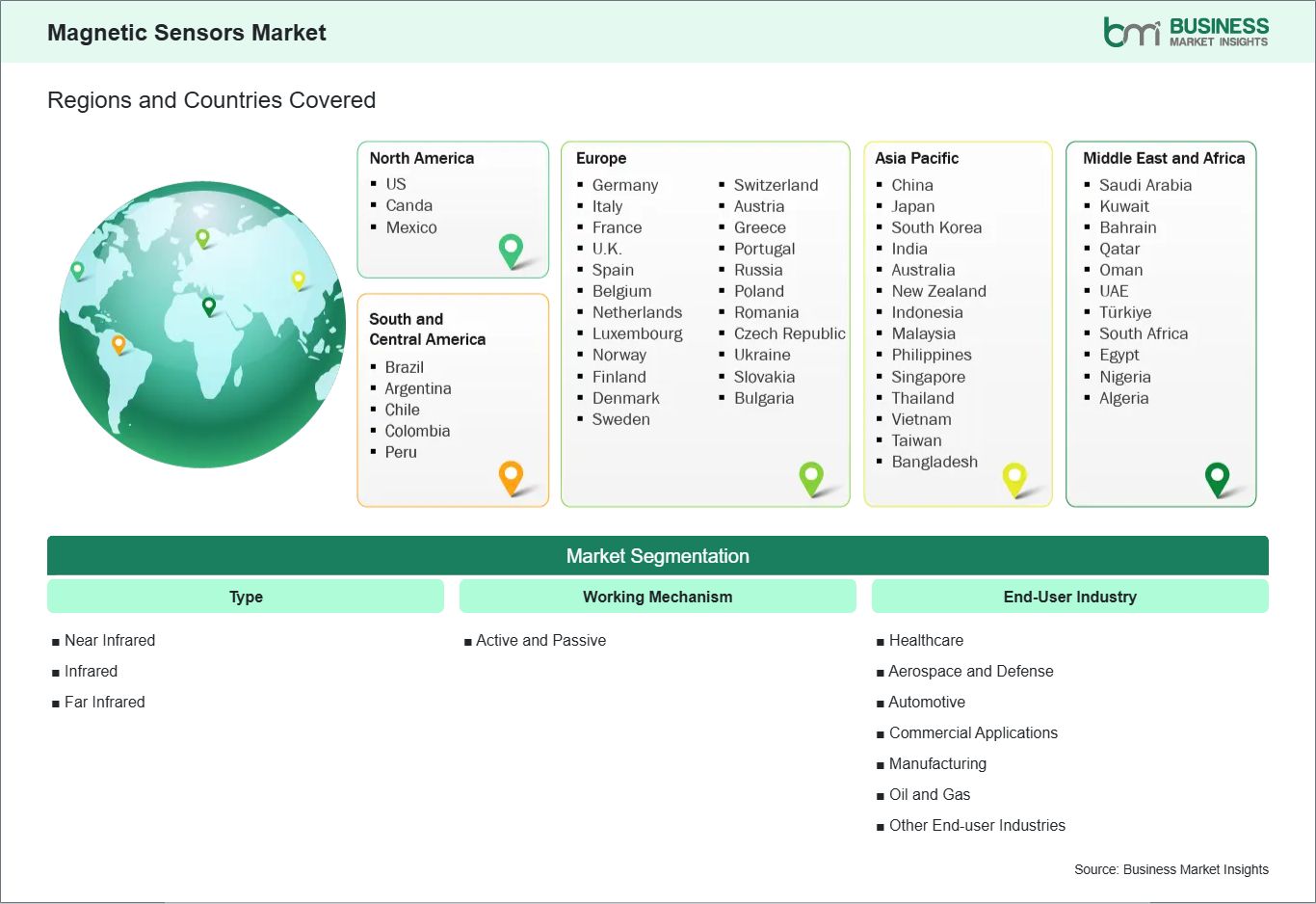
  • Type (Near Infrared, Infrared, and Far Infrared)
  • Working Mechanism (Active and Passive)
  • End-User Industry (Healthcare, Aerospace and Defense, Automotive, Commercial Applications, Manufacturing, Oil and Gas, and Other End-user Industries)

No. of Pages: 400
Report Code: BMIPUB00035092
Category: Electronics and Semiconductor
Magnetic Sensors Market

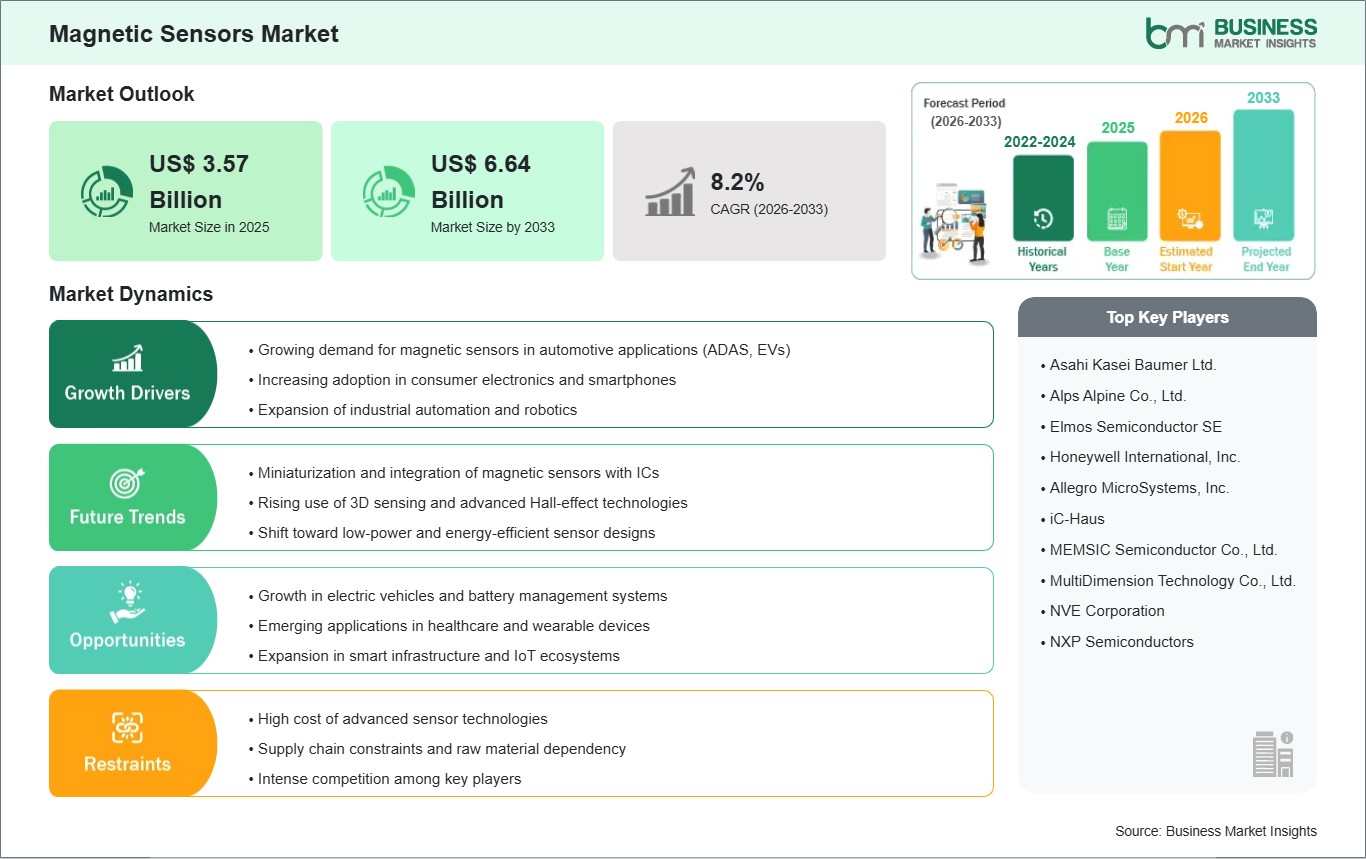
The Magnetic Sensors market size is expected to reach US$ 6.64 billion by 2033 from US$ 3.57 billion in 2025. The market is estimated to record a CAGR of 8.2% from 2026 to 2033.

Executive Summary and Global Market Analysis:

Magnetic sensors refer to specialized electronic transducers engineered to detect and convert physical magnetic field variations, such as changes in flux, strength, and direction, into measurable electrical signals. These sensors operate on various physical principles, including the Hall Effect, which detects voltage differentials across a conductor, and Magnetoresistive (xMR) technologies that measure changes in electrical resistance. Market expansion is fundamentally propelled by the exponential surge in electric vehicle (EV) production and the proliferation of advanced driver-assistance systems (ADAS), both of which require high-density sensor arrays for motor control and safety.

However, several factors may restrain market progression. The high initial development costs and complex fabrication processes associated with advanced Tunnel Magnetoresistance (TMR) technology can be prohibitive for smaller entrants. Technical challenges regarding temperature sensitivity necessitate sophisticated compensation algorithms, which can increase the total cost of ownership. Additionally, the industry faces hurdles related to supply chain complexities and shifting international trade policies that influence the procurement of critical semiconductor wafers and specialty magnetic materials.

Despite these hurdles, the market holds significant opportunities in the rise of the Internet of Things (IoT) and Industry 4.0, where magnetic sensors enable precise robotics and automated logistics. The expansion into renewable energy systems, specifically for rotor speed detection in wind turbines and current monitoring in solar inverters, and the development of medical MEMS sensors for implantable devices are expected to support long-term development. Manufacturers are also finding growth potential in ultra-low-power sensors tailored for the burgeoning wearable technology and smart home ecosystems.

Magnetic Sensors Market - Strategic Insights:

global-market-strategic-framework
Get more information on this report

Magnetic Sensors Market Segmentation Analysis:

Key segments that contributed to the derivation of the Magnetic Sensors market analysis are type, working mechanism, and end-user industry.

  • By Type, the market is segmented into Near Infrared, Infrared, and Far Infrared.
  • By Working Mechanism, the market is divided into Active and Passive.
  • By End-User Industry, the market is categorized into Healthcare, Aerospace and Defense, Automotive, Commercial Applications, Manufacturing, Oil and Gas, and Others.

Magnetic Sensors Market Drivers and Opportunities:

Automotive Electrification and ADAS Integration Driving Growth

A primary driver for the magnetic sensors market is the accelerating adoption of electric vehicles (EVs) and advanced driver-assistance systems (ADAS). Magnetic sensors, particularly Hall Effect and magnetoresistive types, are critical for enabling precise position, speed, and current sensing functions in modern vehicles. As EV penetration rises globally, these sensors are increasingly deployed in battery management systems, motor control units, and regenerative braking mechanisms to ensure efficiency, safety, and reliability. The expansion of ADAS features such as lane-keeping assistance, collision avoidance, and adaptive cruise control further amplifies demand, as magnetic sensors provide essential input for real-time decision-making and vehicle automation. Beyond automotive, industrial automation and robotics are driving adoption, with sensors used for motion detection, proximity sensing, and equipment monitoring. Consumer electronics, including smartphones, tablets, and wearables, also rely extensively on magnetic sensors for navigation, orientation, and augmented reality applications. Collectively, the convergence of EV growth, ADAS integration, and industrial automation is propelling sustained demand, positioning magnetic sensors as a cornerstone of next-generation mobility and smart device ecosystems.

3D Magnetic Sensing, IoT Expansion, and Smart Device Innovation

A significant opportunity in the magnetic sensors market lies in the advancement of 3D magnetic sensing technologies, the expansion of IoT ecosystems, and the integration of sensors into smart devices. 3D magnetic sensors, capable of measuring magnetic fields across multiple axes, are enabling new applications in robotics, augmented reality, and medical devices, where accuracy and miniaturization are critical. The rise of IoT-enabled platforms in industrial and consumer environments is further amplifying this opportunity, as magnetic sensors enhance automation, predictive maintenance, and real-time monitoring. Smart home systems, wearables, and connected healthcare devices increasingly incorporate magnetic sensors to deliver improved user experiences and operational efficiency. Additionally, manufacturers are investing heavily in the development of compact, energy-efficient sensors tailored for consumer electronics and emerging applications. Emerging markets in Asia-Pacific and Latin America present lucrative growth prospects due to rapid urbanization, rising disposable incomes, and expanding adoption of connected devices. Vendors who focus on cost-effective, high-performance, and digitally enabled magnetic sensors are well-positioned to capture new market segments. This convergence of IoT expansion, advanced sensing technologies, and smart device innovation underscores a transformative frontier for the global magnetic sensors market.

Magnetic Sensors Market Size and Share Analysis:

The Magnetic Sensors market demonstrates steady growth, with size and share analysis revealing evolving trends and competitive positioning among key players. The report examines subsegments categorized within type, working mechanism, and end-user industry, offering insights into their contribution to overall market performance.

Based on end-user industry, the Automotive subsegment represents the highest volume of consumption in the magnetic sensor market. These sensors are becoming essential for Electric Vehicle (EV) Propulsion and ADAS Safety, as they play a critical role in motor commutation, battery management, and electronic stability control. Their integration ensures precise performance, reliability, and safety across advanced automotive systems. By enabling accurate sensing in dynamic environments, magnetic sensors continue to anchor demand in this sector, maintaining their dominant influence as a foundational driver of growth in next-generation mobility and intelligent transportation technologies.

Magnetic Sensors Market Report Highlights:

Report Attribute Details
Market size in 2025 US$ 3.57 Billion
Market Size by 2033 US$ 6.64 Billion
Global CAGR (2026 - 2033)8.2%
Historical Data 2022-2024
Forecast period 2026-2033
Segments Covered By Type
  • Near Infrared
  • Infrared
  • Far Infrared
By Working Mechanism
  • Active and Passive
By End-User Industry
  • Healthcare
  • Aerospace and Defense
  • Automotive
  • Commercial Applications
  • Manufacturing
  • Oil and Gas
  • Other End-user Industries
Regions and Countries Covered
North America US, Canada, Mexico
Europe Belgium, Austria, Finland, Denmark, Greece, Poland, Romania, Russia, Ukraine, Czech Republic, Slovakia, Bulgaria, Italy, Luxembourg, Germany, Switzerland, France, Netherlands, Norway, Portugal, Spain, Sweden, United Kingdom
Asia-Pacific Australia, China, India, Japan, South Korea, Indonesia, Malaysia, Philippines, Singapore, Thailand, Vietnam, Bangladesh, New Zealand, Taiwan
South and Central America Brazil, Argentina, Peru, Chile, Colombia
Middle East and Africa Bahrain, Kuwait, Oman, Qatar, Saudi Arabia, United Arab Emirates, Turkiye, South Africa, Egypt, Algeria, Nigeria
Market leaders and key company profiles
  • Asahi Kasei Baumer Ltd.
  • Alps Alpine Co., Ltd.
  • Elmos Semiconductor SE
  • Honeywell International, Inc.
  • Allegro MicroSystems, Inc.
  • iC-Haus
  • MEMSIC Semiconductor Co., Ltd.
  • MultiDimension Technology Co., Ltd.
  • NVE Corporation
  • NXP Semiconductors
Get more information on this report

Magnetic Sensors Market Report Coverage and Deliverables:

The "Magnetic Sensors Market Size and Forecast (2022 - 2033)" report provides a detailed analysis of the market covering below areas:

  • Market size and forecast at global, regional, and country levels for all market segments covered under the scope
  • Market trends, as well as drivers, restraints, and opportunities
  • Market analysis covering key trends, global and regional framework, major players, and recent developments
  • Market concentration, heat map analysis, prominent players, and recent developments
  • Detailed company profiles, including SWOT analysis

Magnetic Sensors Market Geographic Insights:

The geographical scope of the Magnetic Sensors market report is divided into five regions: North America, Asia Pacific, Europe, Middle East & Africa, and South & Central America.

Asia-Pacific Magnetic Sensors Market serves as the primary engine for global industry expansion, anchored by the massive production of smartphones, wearables, and electric vehicles (EVs) in China, Japan, and South Korea. These nations are leading the transition toward Next-Generation Magnetoresistive Technologies, prioritizing the development of high-sensitivity TMR (Tunnel Magnetoresistance) sensors for precise motor control and navigation. China remains the dominant regional force, characterized by significant state-backed investments in semiconductor self-sufficiency and the world's largest EV market. India is witnessing a notable transition, marked by the rapid growth of its electronics manufacturing services (EMS) and the increasing adoption of smart city technologies. Market progression is further supported by a transition toward 3-Axis Magnetic Sensing and Integrated Sensor Hubs, which allow for more complex motion tracking and compass functionality in portable devices. The increasing adoption of ADAS (Advanced Driver Assistance Systems) and Industry 4.0 Robotics, alongside the strategic expansion of Renewable Energy Monitoring, solidifies the global landscape as a critical arena for the evolution and future scaling of the Magnetic Sensors market.

global-market-geography
Get more information on this report

Magnetic Sensors Market Research Report Guidance:

  • The report includes qualitative and quantitative data in the Magnetic Sensors market across type, working mechanism, end-user industry, and geography.
  • The report starts with the key takeaways (chapter 2), highlighting the key trends and outlook of the market.
  • Chapter 3 focuses on the research methodology of the study.
  • Chapter 4 includes ecosystem analysis.
  • Chapter 5 highlights the major industry dynamics in the market, including factors that are driving the market, prevailing deterrents, potential opportunities, as well as future trends. Impact analysis of these drivers and restraints is also covered in this section.
  • Chapter 6 discusses the market scenario, in terms of historical market revenues, and forecast till the year 2033.
  • Chapters 7 to 10 cover market segments by type, working mechanism, and end-user industry, and geography across North America, Europe, Asia Pacific, Middle East and Africa, and South and Central America. They cover the market revenue, forecast, and factors driving the market.
  • Chapter 11 describes the competitive analysis along with the heat map analysis for the key players operating in the market.
  • Chapter 12 describes the industry landscape analysis. It provides detailed descriptions of business activities such as market initiatives, new developments, mergers, and joint ventures globally, along with a competitive landscape.
  • Chapter 13 provides detailed profiles of the major companies operating in the market. Companies have been profiled on the basis of their key facts, business descriptions, products and services, financial overview, SWOT analysis, and key developments.
  • Chapter 14, i.e., the appendix, is inclusive of a brief overview of the company, list of abbreviations, and disclaimer.

Magnetic Sensors Market News and Key Development:

The Magnetic Sensors market is evaluated by gathering qualitative and quantitative data post primary and secondary research, which includes important corporate publications, association data, and databases. A few of the key developments in the Magnetic Sensors market are:

  • In January 2026, Maxic Technology acquired Shanghai GoChip Microelectronics, adding Hall switches, linear Hall sensors, magnetic encoders, and tactile/current sensors to its intelligent sensing lineup. This move strengthens motion control capabilities and supports cross-industry applications, boosting growth in the magnetic field sensors market.
  • In October 2025, Allegro MicroSystems introduced the ACS37100, featuring advanced TMR technology for high-speed, low-noise current sensing in EVs, clean energy, and data center applications. The launch enhances precision control in wide bandgap power electronics and supports market growth in magnetic field sensors.

Key Sources Referred:

  • World Bank & Global Trade Indicators
  • World Trade Organization (WTO)
  • (International Monetary Fund )IMF
  • International Trade Administration (ITA)
  • Company website
  • Company annual reports
  • Company investor presentations
The List of Companies - Magnetic Sensors Market
  • Asahi Kasei Baumer Ltd.
  • Alps Alpine Co., Ltd.
  • Elmos Semiconductor SE
  • Honeywell International, Inc.
  • Allegro MicroSystems, Inc.
  • iC-Haus
  • MEMSIC Semiconductor Co., Ltd.
  • MultiDimension Technology Co., Ltd.
  • NVE Corporation
  • NXP Semiconductors
Frequently Asked Questions
How big is the Magnetic Sensors Market?

The Magnetic Sensors Market is valued at US$ 3.57 Billion in 2025, it is projected to reach US$ 6.64 Billion by 2033.

What is the CAGR for Magnetic Sensors Market by (2026 - 2033)?

As per our report Magnetic Sensors Market, the market size is valued at US$ 3.57 Billion in 2025, projecting it to reach US$ 6.64 Billion by 2033. This translates to a CAGR of approximately 8.2% during the forecast period.

What segments are covered in this report?

The Magnetic Sensors Market report typically cover these key segments-

  • Type (Near Infrared, Infrared, and Far Infrared)
  • Working Mechanism (Active and Passive)
  • End-User Industry (Healthcare, Aerospace and Defense, Automotive, Commercial Applications, Manufacturing, Oil and Gas, and Other End-user Industries)

What is the historic period, base year, and forecast period taken for Magnetic Sensors Market?

The historic period, base year, and forecast period can vary slightly depending on the specific market research report. However, for the Magnetic Sensors Market report:

  • Historic Period : 2022-2024
  • Base Year : 2025
  • Forecast Period : 2026-2033
  • Who are the major players in Magnetic Sensors Market?

    The Magnetic Sensors Market is populated by several key players, each contributing to its growth and innovation. Some of the major players include:

  • Asahi Kasei Baumer Ltd.
  • Alps Alpine Co., Ltd.
  • Elmos Semiconductor SE
  • Honeywell International, Inc.
  • Allegro MicroSystems, Inc.
  • iC-Haus
  • MEMSIC Semiconductor Co., Ltd.
  • MultiDimension Technology Co., Ltd.
  • NVE Corporation
  • NXP Semiconductors
  • Who should buy this report?

    The Magnetic Sensors Market report is valuable for diverse stakeholders, including:

    • Investors: Provides insights for investment decisions pertaining to market growth, companies, or industry insights. Helps assess market attractiveness and potential returns.
    • Industry Players: Offers competitive intelligence, market sizing, and trend analysis to inform strategic planning, product development, and sales strategies.
    • Suppliers and Manufacturers: Helps understand market demand for components, materials, and services related to concerned industry.
    • Researchers and Consultants: Provides data and analysis for academic research, consulting projects, and market studies.
    • Financial Institutions: Helps assess risks and opportunities associated with financing or investing in the concerned market.

    Essentially, anyone involved in or considering involvement in the Magnetic Sensors Market value chain can benefit from the information contained in a comprehensive market report.

    Available Report Formats

    pdf-format excel-format pptx-format
    Buy Now
    Sales Assistance
    +1 646 791 7070 (US & UK)
    Customization Form

    Please tell us your area of interest
    (Market Segments/ Regions and Countries/ Companies)