
Low Emission Vehicle Technology Market Outlook: Size, Share, Trends, Growth Analysis, Competitive Landscape & Forecast, 2022-2033

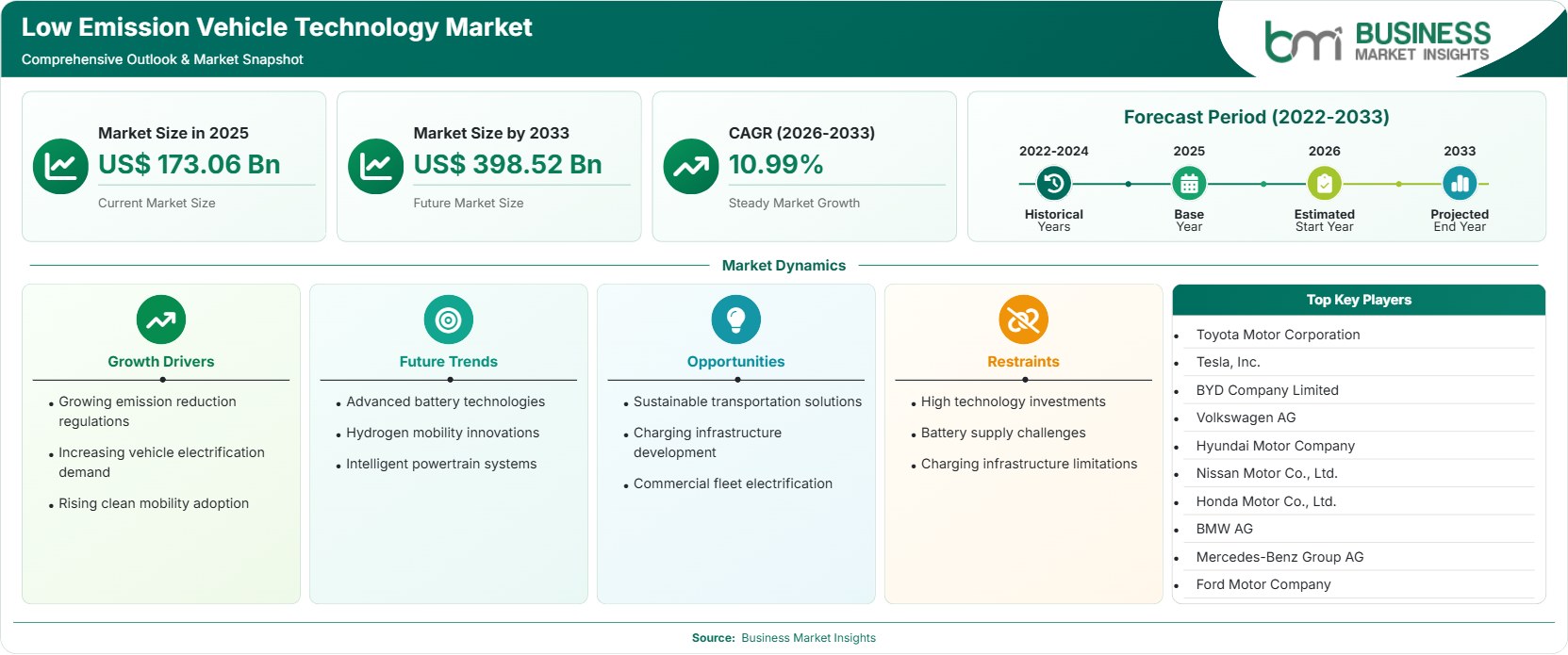
The Low Emission Vehicle Technology Market was valued at US$ 173.06 billion in 2025 and is projected to reach US$ 398.52 billion by 2033, growing at a CAGR of 10.99% during 2026–2033. Growing emission reduction regulations, increasing vehicle electrification demand, and rising clean mobility adoption are accelerating market expansion. Furthermore, sustainable transportation solutions, charging infrastructure development, and commercial fleet electrification are expected to generate substantial long-term growth opportunities for industry participants.

Report Coverage
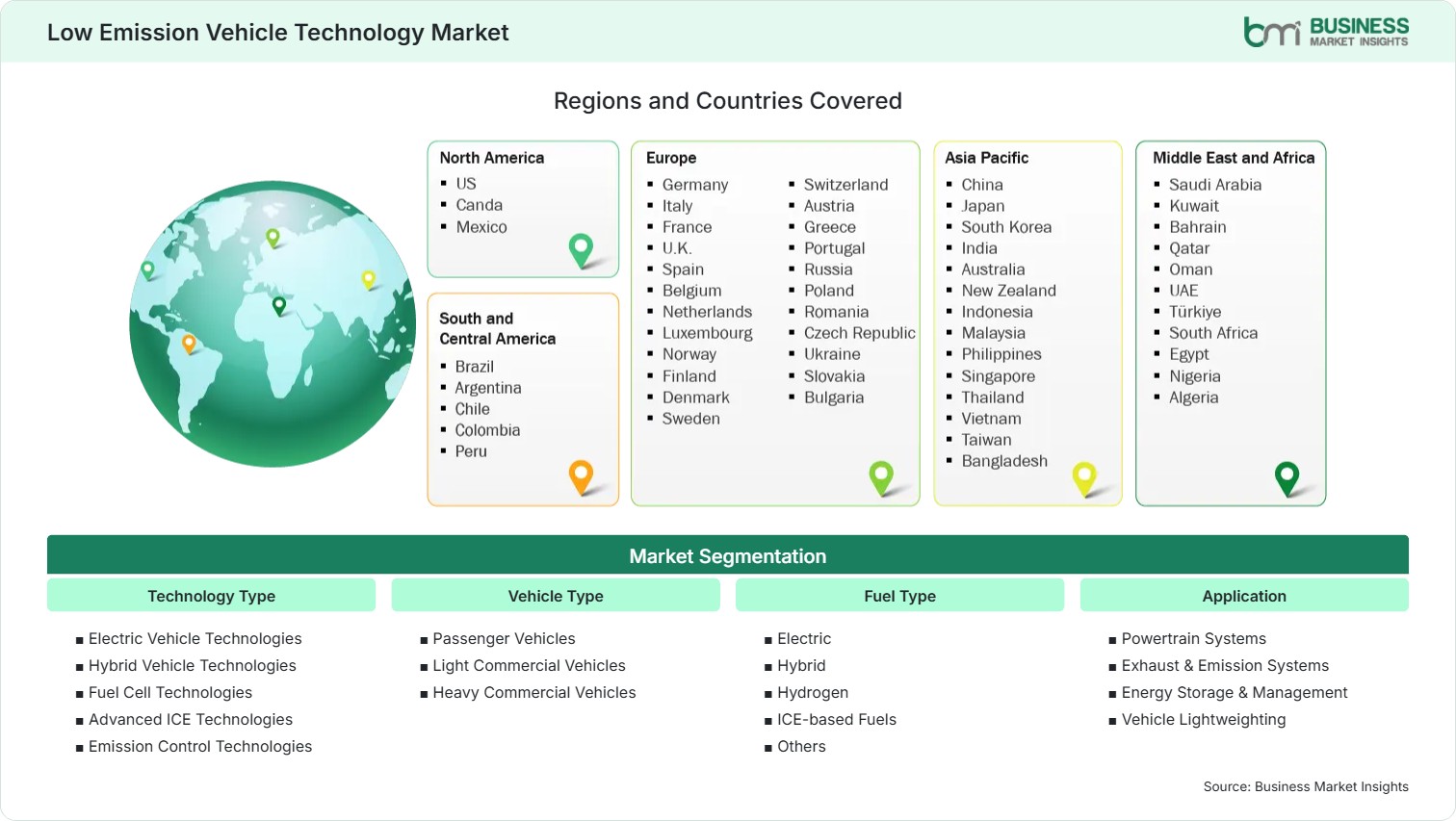
  • Technology Type: Electric Vehicle Technologies, Hybrid Vehicle Technologies, Fuel Cell Technologies, Advanced ICE Technologies, Emission Control Technologies
  • Vehicle Type: Passenger Vehicles, Light Commercial Vehicles, Heavy Commercial Vehicles
  • Fuel Type: Electric, Hybrid, Hydrogen, ICE-based Fuels, Others
  • Application: Powertrain Systems, Exhaust & Emission Systems, Energy Storage & Management, Vehicle Lightweighting
US$ 173.06 Bn Market size in 2025
US$ 398.52 Bn Market Size by 2033
10.99% CAGR, 2026 - 2033
2026-2033 Forecast Period

01 AI Overview

Low Emission Vehicle Technology Market Summary

  • North America: North America accounts for 27%–30% of the global market in 2025 and is projected to grow at a CAGR of 10.4%–11.2% through 2033. Strong regulatory support, rapid electric vehicle adoption, expanding charging infrastructure, and increasing investments in automotive innovation continue driving regional growth. The U.S. market is anticipated to register a CAGR of 10.6%–11.4% during the forecast period.
  • Fastest Growing Region: Asia Pacific holds 39%–42% market share in 2025 and is forecast to register the highest CAGR of 11.8%–12.6% through 2033. Rapid industrialization, expanding electric vehicle manufacturing, supportive government policies, and rising consumer demand for sustainable mobility continue strengthening regional leadership.
  • Leading Segment: Electric Vehicle Technologies represent 43%–46% of the market in 2025 and are projected to expand at a CAGR of 11.5%–12.3% during 2026–2033. Continuous advancements in battery technology, power electronics, and vehicle efficiency continue supporting segment dominance.
  • High Growth Segment: Energy Storage & Management accounts for 29%–32% market share in 2025 and is expected to register the fastest CAGR of 12.1%–12.9% through 2033. Increasing deployment of advanced battery management systems, energy optimization technologies, and intelligent charging solutions continues driving segment growth.
  • Key Market Opportunity: Growing investments in sustainable transportation infrastructure, commercial fleet electrification, smart charging ecosystems, and next-generation battery technologies are creating significant opportunities for automotive manufacturers and technology providers.
  • Major Market Players: Toyota Motor Corporation, Tesla Inc., BYD Company Limited, Volkswagen AG, Hyundai Motor Company, Nissan Motor Co., Ltd., Honda Motor Co., Ltd., BMW AG, Mercedes-Benz Group AG, and Ford Motor Company.
02 Strategic Insights

Low Emission Vehicle Technology Market: Strategic Insights

low-emission-vehicle-technology-market-market-strategic-framework
FREE PDF
Request your free sample
Request free sample
03 Stakeholder View

Key Takeaways

  • The low emission vehicle technology market analysis is highly competitive and innovation-driven, with leading automotive manufacturers focusing on electrification, hydrogen mobility, hybrid technologies, and advanced emission control systems. Companies continue investing in battery research, software-defined vehicles, lightweight materials, intelligent energy management, and autonomous driving technologies to strengthen product portfolios and improve vehicle efficiency. ecosystem continues evolving through battery manufacturers, automotive OEMs, component suppliers, software developers, charging infrastructure providers, and energy management solution companies.
  • Passenger vehicles, commercial transportation, fleet operators, and public mobility services represent the largest commercial opportunities owing to increasing global adoption of low-emission transportation technologies.
  • Continuous innovation in battery chemistry, hydrogen fuel cells, lightweight materials, thermal management systems, and intelligent vehicle software is significantly improving vehicle performance, energy efficiency, and environmental sustainability.
  • Asia Pacific offers the strongest long-term investment potential due to large-scale electric vehicle production, favorable government incentives, expanding charging networks, and rapidly growing automotive manufacturing capabilities.
  • Strategic collaborations among vehicle manufacturers, battery suppliers, semiconductor companies, charging infrastructure providers, and energy companies continue accelerating innovation and commercialization of next-generation low-emission mobility solutions.
04 Geographic Outlook

Low Emission Vehicle Technology Market Regional Highlights

North America Low Emission Vehicle Technology Market

North America accounts for 27%–30% of the global low emission vehicle technology market share in 2025 and is projected to expand at a CAGR of 10.4%–11.2% through 2033. Government incentives, stringent fuel economy regulations, expanding EV charging infrastructure, and rising consumer adoption of electric vehicles continue supporting regional market growth. The market share continues strengthening as manufacturers accelerate investments in advanced automotive technologies.

  • Government incentives encourage low-emission vehicle adoption.
  • Charging infrastructure investments accelerate EV deployment.
  • Automotive innovation supports advanced technology commercialization.
  • Fleet electrification initiatives strengthen regional demand.

US Low Emission Vehicle Technology Market

The United States dominates regional revenue and is expected to register a CAGR of 10.6%–11.4% during the forecast period. Strong investments in battery manufacturing, electric vehicle production, charging infrastructure expansion, and advanced mobility technologies support the Low Emission Vehicle Technology Market forecast estimates.

  • Battery manufacturing capacity continues expanding.
  • EV adoption strengthens automotive technology investments.
  • Commercial fleet electrification accelerates market development.

Europe Low Emission Vehicle Technology Market

Europe accounts for 25%-28% of the global market in 2025 and is expected to witness a CAGR of 10.2%-11.0% during 2026-2033. Demand in Germany dominates the region, while Norway has the highest growth rate due to aggressive decarbonization, higher EV adoption, and government policies.

  • Strict emission regulations accelerate technology adoption.
  • Germany leads automotive innovation and manufacturing.
  • Norway demonstrates strong electric vehicle penetration.
  • Sustainable mobility policies support low emission vehicle technology market expansion.

Asia Pacific Low Emission Vehicle Technology Market

Asia Pacific accounts for 39%–42% of global revenue in 2025 and is expected to register the highest CAGR of 11.8%–12.6% through 2033. China dominates regional demand, while India records the fastest growth supported by expanding EV manufacturing, favorable government initiatives, battery production investments, and rising demand for affordable clean mobility solutions.

  • EV manufacturing capacity expands rapidly.
  • Battery production investments strengthen supply chains.
  • Government incentives accelerate clean mobility adoption.
  • Automotive innovation supports long-term market growth.

Rest of World Low Emission Vehicle Technology Market

The Rest of World region accounts for 6%–8% of the global market in 2025 and is projected to grow at a CAGR of 9.8%–10.6% during the forecast period. Brazil, the UAE, and South Africa continue investing in electric mobility infrastructure, fleet modernization, renewable energy integration, and sustainable transportation initiatives, supporting steady adoption of low-emission vehicle technologies.

  • Charging infrastructure investments improve market accessibility.
  • Fleet modernization increases technology deployment.
  • Renewable energy integration supports clean transportation.
  • Government sustainability initiatives stimulate market growth.
global-market-geography
FREE PDF
Request your free sample
Request free sample
05 Segment Analysis

Low Emission Vehicle Technology Market Segmentation

Technology Type

The Technology Type segment accounted for the largest market share, 43% to 46%, in 2025 and is anticipated to grow at a CAGR of 11.5% to 12.3% between 2026 and 2033. The rising regulatory pressure to reduce greenhouse gas emissions, growing investments in sustainable transport technology, and technological developments in automotive engineering are key factors driving the increasing use of low-emission technology in vehicles worldwide. Automakers have been making heavy investments in battery technology, hydrogen fuel cells, hybrid propulsion systems, emissions reduction technology, and efficient internal combustion engines.

  • Electric Vehicle Technologies: Electric vehicle technologies dominate the market owing to rapid battery innovation, expanding charging infrastructure, favorable government incentives, increasing consumer demand for zero-emission mobility, and continuous improvements in vehicle range, charging speed, and energy efficiency.
  • Hybrid Vehicle Technologies: Hybrid technologies continue experiencing strong adoption by combining electric propulsion with conventional engines to improve fuel economy, reduce emissions, and provide greater driving flexibility where charging infrastructure remains limited.
  • Fuel Cell Technologies: Hydrogen fuel cell technologies are gaining momentum for long-distance transportation, heavy commercial vehicles, and industrial mobility applications because of fast refueling, extended driving range, and zero tailpipe emissions.
  • Advanced ICE Technologies: Advanced internal combustion engine technologies continue evolving through turbocharging, direct fuel injection, cylinder deactivation, variable valve timing, and advanced combustion systems that improve efficiency while lowering emissions.
  • Emission Control Technologies: Emission control technologies remain essential for reducing harmful exhaust pollutants through catalytic converters, diesel particulate filters, selective catalytic reduction systems, and advanced exhaust gas treatment solutions.

Vehicle Type

The Vehicle Type segment held a 52%-55% market share in 2025 and is estimated to grow at a steady rate until 2033. Growing consumer inclination towards efficient fuel use, modernization programs, emission control regulations, and rising funding for sustainable transport systems continue to propel demand in both passenger and commercial vehicle segments. The Low Emission Vehicle Technology Market trends show that the introduction of advanced electrified technologies in vehicles is making them safer, more energy-efficient, and more environmentally friendly.

  • Passenger Vehicles: Passenger vehicles represent the largest segment due to growing electric vehicle adoption, rising consumer awareness regarding environmental sustainability, expanding charging infrastructure, and increasing availability of affordable electrified vehicle models.
  • Light Commercial Vehicles: Light commercial vehicles are witnessing increasing electrification driven by expanding e-commerce logistics, urban delivery services, government fleet electrification initiatives, and rising demand for efficient last-mile transportation.
  • Heavy Commercial Vehicles: Heavy commercial vehicles continue adopting low-emission technologies through battery-electric trucks, hydrogen fuel cell systems, hybrid drivetrains, and advanced emission control solutions that reduce fuel consumption and support long-distance freight operations.

Fuel Type

The Fuel Type segment accounted for 40%-43% of market share in 2025 and is projected to grow substantially over the forecast period. Increasing diversification of clean energy sources, favorable environmental policies, and advances in alternative fuel technologies have been continuously propelling market growth. Manufacturers in the automobile industry are developing several types of propulsion systems to meet varied transportation needs.

  • Electric: Electric propulsion remains the fastest-growing fuel segment due to rapid battery improvements, expanding fast-charging infrastructure, declining battery costs, and increasing government incentives supporting electric vehicle adoption.
  • Hybrid: Hybrid vehicles continue providing an effective transition toward full electrification by combining electric motors with conventional engines to improve fuel efficiency and reduce emissions.
  • Hydrogen: Hydrogen-powered vehicles continue gaining attention for commercial transportation, buses, and heavy-duty logistics applications requiring long driving ranges and rapid refueling capabilities.
  • ICE-based Fuels: Advanced low-emission internal combustion technologies continue improving the efficiency of gasoline, diesel, and alternative liquid fuel vehicles through optimized combustion and emission reduction systems.
  • Others: Other emerging fuel technologies, including renewable fuels and synthetic fuels, continue supporting diversified clean mobility strategies across selected transportation applications.

Application

The Application segment was projected to be between 29% and 32% in 2025 and would experience rapid growth until 2033. Investments in energy-efficient vehicular systems, intelligent powertrains, lightweight vehicles, and batteries have been playing a key role in the increasing adoption of the technology. Advanced software, electronics, and materials technologies are being used by automotive manufacturers to make their vehicles efficient.

  • Powertrain Systems: Powertrain technologies continue improving drivetrain efficiency through advanced electric motors, hybrid systems, transmission optimization, and intelligent vehicle control systems.
  • Exhaust & Emission Systems: Advanced exhaust treatment and emission reduction technologies remain critical for meeting stringent environmental standards across hybrid and internal combustion engine vehicles.
  • Energy Storage & Management: Energy storage and management represent the fastest-growing application due to continuous advancements in battery management systems, thermal management technologies, energy optimization software, and fast-charging capabilities.
  • Vehicle Lightweighting: Lightweight materials such as aluminum, advanced steel, carbon fiber composites, and engineered plastics continue improving vehicle efficiency by reducing overall weight while maintaining safety and structural performance.
06 Market Forces

Low Emission Vehicle Technology Market Dynamics

Key Market Drivers

Growing emission reduction regulations

Increasingly strict standards for vehicle emissions and carbon reduction, along with fuel economy requirements, have been implemented worldwide to address global warming and urban air pollution. The automotive industry is working extensively on electric cars, hybrid technology, hydrogen-powered vehicles, and emission controls to meet these changing environmental regulations.

Increasing vehicle electrification demand

Increased consumer awareness of environmental sustainability, higher fuel costs, improved charging networks, and steady advances in battery technology further drive global demand for electric cars and hybrids. Car makers add more electric-drive vehicles to their ranges while making additional investments in batteries and advanced propulsion systems.

Rising clean mobility adoption

Low-emission mobility is gaining traction among public transit organizations, commercial transportation firms, logistics organizations, and private individuals to reduce operational costs and increase energy efficiency, among other benefits. Further growth in the market can be achieved through investment in charging infrastructure and energy systems alongside vehicle digitalization.

Key Market Opportunities

Sustainable transportation solutions

Growing attention to sustainability in urban transport, carbon-neutrality projects, and environmentally friendly transport systems is offering significant prospects for producers of electric vehicles, hybrid technology, hydrogen fuel cell technology, and auto parts.

Charging infrastructure development

Rapid deployment of public fast-charging stations, residential charging systems, commercial charging hubs, and smart energy management solutions is supporting wider adoption of electric vehicles while creating attractive opportunities for automotive technology providers and infrastructure developers.

Commercial fleet electrification

Fleet electrification continues to be pursued by logistics companies, public transportation organizations, municipal vehicle fleets, and corporations with vehicle fleets for reasons including reducing fuel costs, lowering emissions, increasing operational efficiency, and meeting stricter environmental laws.

Market Restraints and Challenges

High technology investments

Factor: Development of advanced battery technologies, hydrogen fuel cell systems, lightweight vehicle platforms, semiconductor integration, and intelligent power management solutions requires substantial research, engineering, manufacturing, and infrastructure investments. Impact: High capital requirements increase vehicle production costs, extend commercialization timelines, create financial pressure for manufacturers, and may slow technology adoption in cost-sensitive automotive markets.

Battery supply challenges

Factor: Growing demand for lithium, nickel, cobalt, graphite, rare earth materials, and advanced battery components continues placing pressure on global supply chains while increasing concerns regarding raw material availability and geopolitical risks. Impact: Battery supply constraints may increase production costs, delay vehicle manufacturing, create pricing volatility, and challenge the ability of automotive manufacturers to rapidly scale production and meet accelerating global demand for low-emission vehicles.

07 Company Analysis

Competitive Landscape

The Low Emission Vehicle Technology Market analysis is highly competitive and innovative, with most automobile manufacturers emphasizing electric cars, hydrogen-based mobility options, hybrids, and improved emission control systems. Battery technologies, software-controlled automobiles, lightweight materials, efficient energy systems, and autonomous driving capabilities are still areas where further investment will be made to develop better products. Cooperation with battery makers, semiconductor suppliers, charging station owners, and renewable energy generators helps commercialize the next generation of low-emission vehicles.

Company Name

Overview

Products and Services Relevant to this Market

Toyota Motor Corporation

Global automotive manufacturer and pioneer in hybrid vehicle technology.

Hybrid vehicles, fuel cell electric vehicles, battery electric vehicles, advanced powertrain technologies.

Tesla Inc.

Leading electric vehicle manufacturer specializing in battery-powered mobility solutions.

Battery electric vehicles, battery packs, charging infrastructure, vehicle software, energy management systems.

BYD Company Limited

Global manufacturer of electric vehicles and battery technologies.

Electric passenger vehicles, electric buses, battery systems, energy storage solutions, EV components.

Volkswagen AG

International automotive company accelerating vehicle electrification.

Electric vehicles, hybrid vehicles, battery platforms, charging technologies, vehicle software solutions.

Hyundai Motor Company

Automotive manufacturer focusing on electric and hydrogen mobility.

Battery electric vehicles, hydrogen fuel cell vehicles, hybrid technologies, smart mobility solutions.

Nissan Motor Co., Ltd.

Global automotive company with strong electric vehicle portfolio.

Electric vehicles, hybrid vehicles, battery technologies, intelligent driving systems.

Honda Motor Co., Ltd.

Automotive manufacturer developing sustainable mobility technologies.

Hybrid vehicles, fuel cell systems, electric vehicles, advanced engine technologies.

BMW AG

Premium automotive manufacturer investing in electrification technologies.

Electric luxury vehicles, plug-in hybrids, battery systems, digital vehicle platforms.

Mercedes-Benz Group AG

Global luxury vehicle manufacturer focused on sustainable mobility innovation.

Battery electric vehicles, hybrid vehicles, intelligent powertrains, vehicle energy management technologies.

Ford Motor Company

International automotive manufacturer expanding electric mobility portfolio.

Electric trucks, electric SUVs, hybrid vehicles, battery technologies, connected mobility solutions.

08 Industry Activity

Recent Developments

June 2025

Volvo Trucks unveiled its new FH Aero Electric for long-haul transport, offering up to 600 km of driving range on a single charge and strengthening its portfolio of low-emission heavy-duty vehicle technologies.

May 2025

Scania announced the acquisition of Northvolt Systems Industrial Division, including its battery pack business and R&D operations, to strengthen its electrification capabilities and accelerate the development of low-emission commercial vehicle technologies.

April 2025

Volvo Cars announced an expanded partnership with Google to accelerate the deployment of next-generation Android Automotive OS and AI-powered in-car technologies across its electric vehicle lineup, enhancing the digital experience for low-emission vehicles.

January 2025

Polestar announced its updated business strategy, confirming the launch of the Polestar 5 in 2025 and the development of the Polestar 7 electric SUV in Europe, while expanding its global EV portfolio and accelerating profitable growth.

10 Trust & Transparency

Research Methodology

The market analysis combines proprietary research with secondary data from government agencies, company disclosures, regulatory filings, industry databases and expert interviews. Market estimates are validated through data triangulation, cross-market benchmarking and analyst review.

View Full Research Methodology

11 Questions Answered

Frequently Asked Questions

What future opportunities are expected in the Low Emission Vehicle Technology Market?

Major opportunities include sustainable transportation solutions, charging infrastructure development, commercial fleet electrification, hydrogen mobility expansion, intelligent energy management systems, next-generation battery technologies, and software-defined vehicle platforms.

Who are the major companies operating in the market?

Leading companies include Toyota Motor Corporation, Tesla Inc., BYD Company Limited, Volkswagen AG, Hyundai Motor Company, Nissan Motor Co., Ltd., Honda Motor Co., Ltd., BMW AG, Mercedes-Benz Group AG, and Ford Motor Company.

Which technology segment holds the largest market share?

Electric Vehicle Technologies dominate the market with a 43%–46% share in 2025 owing to rapid battery advancements, expanding charging infrastructure, favorable government policies, and increasing consumer adoption of zero-emission vehicles.

Which region dominates the market?

Asia Pacific leads the market with a 39%–42% share in 2025 and is expected to register the fastest growth due to strong electric vehicle manufacturing, government incentives, battery production expansion, and increasing consumer demand for clean mobility.

What are the driving factors presented in the Low Emission Vehicle Technology Market report?

The market is driven by growing emission reduction regulations, increasing vehicle electrification demand, rising clean mobility adoption, expanding charging infrastructure, continuous battery innovation, and strong government support for sustainable transportation.

Access the Full Low Emission Vehicle Technology Market Report

Get segment-level forecasts, regional estimates, competitive benchmarking, company profiles and downloadable Excel datasets.

Access the full Low Emission Vehicle Technology Market Report
350 pages PDF & Excel | 2026-07-29