
Low Density Polyethylene Packaging Market Outlook: Size, Share, Trends, Growth Analysis, Competitive Landscape & Forecast, 2026-2033

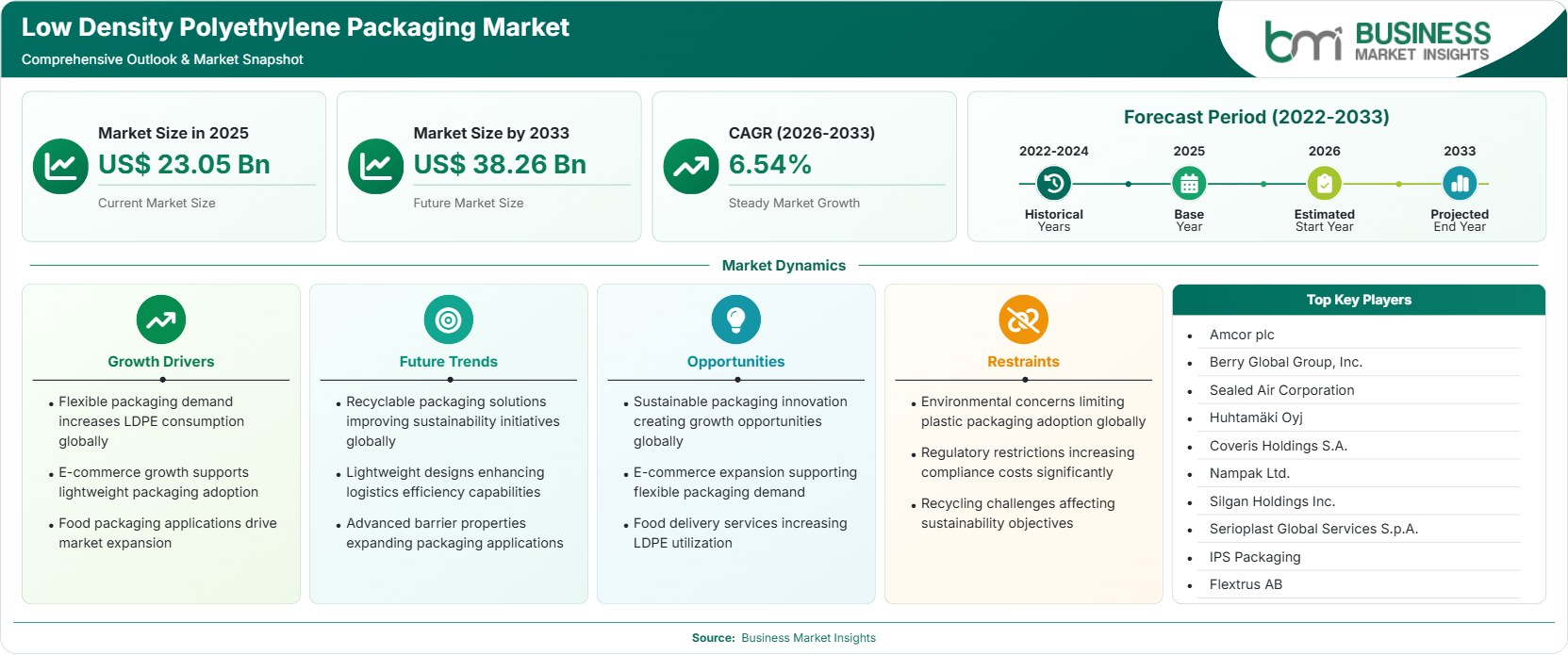
The Low Density Polyethylene Packaging Market size was valued at USD 23.05 Billions in 2025 and is projected to reach USD 38.26 Billions by 2033, growing at a CAGR of 6.54% during 2026–2033, driven by flexible packaging demand, lightweighting, e-commerce, food safety, recyclability, and circular-material adoption.

Report Coverage
  • Product Type: Films & Wraps, Bags & Sacks, Bottles & Droppers, Caps & Closures, Others
  • End Use: Food & Beverages, Personal Care & Cosmetics, Electricals & Electronics, Consumer Goods, Pharmaceuticals, E-commerce, Others
US$ 23.05 Bn Market size in 2025
US$ 38.26 Bn Market Size by 2033
6.54% CAGR, 2026 - 2033
2026-2033 Forecast Period

AI Overview

Low Density Polyethylene Packaging Market Summary

  • North America Region: North America accounts for a modeled 24%–27% share in 2025, with a 5.9%–6.7% CAGR during 2026–2033. Flexible food packaging, e-commerce fulfillment, healthcare packaging, lightweighting, and recycled-content adoption support demand.
  • Fastest Growing Region: Asia Pacific holds a modeled 39%–43% share in 2025 and is projected to grow at 7.0%–7.8% CAGR through 2033.
  • Leading Segment: Films & Wraps represents a modeled 48%–52% share in 2025 and is projected to grow at 6.3%–6.9% CAGR. Lightweighting, stretch and shrink applications, food protection, pallet stabilization, and recyclable mono-material structures support continued adoption.
  • High Growth Segment: E-commerce represents a modeled 10%–13% share within end-use demand in 2025 and is projected to grow at 7.4%–8.2% CAGR. Parcel growth, protective packaging, flexible mailers, secondary packaging, and material-efficient fulfillment solutions support expansion.
  • Key Market Opportunity: Recycle-ready PE films, PCR incorporation, downgauging, mono-material structures, advanced sorting, and closed-loop recycling provide packaging converters opportunities to satisfy regulatory requirements while maintaining barrier, sealing, strength, and cost performance.
  • Major Market Players: Amcor plc; Berry Global Group, Inc.; Sealed Air Corporation; Huhtamäki Oyj; Coveris Holdings S.A.; Nampak Ltd.; Silgan Holdings Inc.; Serioplast Global Services S.p.A.; IPS Packaging; Flextrus AB.
Strategic Insights

Low Density Polyethylene Packaging Market: Strategic Insights

Low Density Polyethylene Packaging Market Strategic Framework
FREE PDF
Request your free sample
Request free sample
Stakeholder View

Key Takeaways

  • The value chain includes ethylene and polyethylene production, resin compounding, film extrusion, printing, lamination, converting, filling, distribution, collection, sorting, and recycling, and competitive advantage is increasingly based on integration throughout these stages.
  • Films and Wraps are still the main demand center since LDPE has a combination of flexibility, sealability, transparency, impact resistance, and the ability to protect against moisture. E-commerce is also a highly attractive application, as packaging formats must strike a balance among protection, weight, machinability, and shipping efficiency.
  • There is a trend towards the use of thinner films, single-material PE constructions, a greater amount of PCR, better barrier properties, and designs that are compatible with existing recycling streams.
  • The Asia Pacific region has the most promising opportunity for structural growth since packaging production is closely linked to food processing, the manufacture of consumer goods, retail development, pharmaceutical distribution, and the rapidly growing e-commerce sector.
  • Packaging companies are now putting more money into recycling, flexible-film technologies, sustainable-material platforms, and integrated packaging capabilities, and the merger of Amcor with Berry Global has increased their scale in both flexible and rigid packaging, as well as extended their sustainability and innovation platform.
  • Those packaging suppliers who can offer proven recyclability, recycled content, traceability, and improvements in material efficiency will have a clearer advantage as growing regulatory requirements start to affect the way in which purchases are made.
Geographic Outlook

Low Density Polyethylene Packaging Market Regional Highlights

North America Low Density Polyethylene Packaging Market

North America holds a modeled 24%–27% share of the Low Density Polyethylene Packaging Market in 2025 and is projected to grow at a 5.9%–6.7% CAGR through 2033. The region benefits from sophisticated flexible-packaging conversion, extensive food and beverage production, pharmaceutical demand, retail distribution, and mature e-commerce infrastructure.

  • The production of packaged food requires a high demand for LDPE films, wraps, liners, and flexible packaging structures that are both moisture-resistant and capable of heat sealing, to enable efficient automated packaging operations.
  • In the field of e-commerce logistics, parcel fulfillment demands lightweight protective packaging that reduces shipping weight yet still provides puncture resistance, tear strength, good sealing performance, and protects the product during distribution.
  • There is a tendency for packaging producers to raise the amount of PCR they incorporate and to design recyclable PE structures to meet retailer commitments, brand sustainability targets, and the changing recycling infrastructure.
  • In the field of healthcare, the pharmaceutical and medical supply chains need reliable moisture barriers, clean packaging environments, flexible protective forms, and consistent material performance.

US Low Density Polyethylene Packaging Market

The US represents approximately 78%–82% of North American Low Density Polyethylene Packaging Market demand and is projected to grow at a 6.0%–6.8% CAGR through 2033. Strong retail activity, food processing, healthcare distribution, industrial logistics, and e-commerce support demand. Packaging producers are simultaneously responding to customer requirements for material reduction and circularity.

  • In the areas of retail and food, large consumer markets call for flexible packaging in high volumes for snacks, fresh produce, frozen products, bakery items, household goods, and other types of packaged products.
  • E-commerce has led to increased demand for polyethylene mailers, protective films, stretch solutions, and secondary packaging due to the ongoing need for efficient fulfillment materials.
  • LDPE films are used for pallet wrapping, as protective coverings, for the packaging of components, and in material handling situations where both flexibility and puncture resistance are required.

Europe Low Density Polyethylene Packaging Market

Europe accounts for a modeled 22%–25% Low Density Polyethylene Packaging Market share in 2025 and is projected to register a 5.2%–6.1% CAGR through 2033. Germany, France, Italy, the UK, and the Netherlands remain important packaging markets, while circularity requirements are accelerating material redesign.

  • In Germany, demand is met by advanced manufacturing, food processing, retail, and industrial packaging, and the need for circular design promotes the use of mono-material and recyclable constructions.
  • In France, commitments by consumers regarding packaging and a focus on sustainability are promoting downgauging, the use of recycled content, and the design of packaging structures which allow for better collection and recycling.
  • In the United Kingdom, demand for films and bags exists in the areas of flexible packaging, e-commerce, food and household products, with investment in recycling helping to promote circular PE solutions.
  • In the high-growth markets, such as Poland, the Netherlands, and some of the Central European markets, benefits are derived from investment in manufacturing, the development of logistics, progress in food processing, and the growing use of modern packaging technologies.

Asia Pacific Low Density Polyethylene Packaging Market

Asia Pacific represents a modeled 39%–43% Low Density Polyethylene Packaging Market share in 2025 and is projected to achieve a 7.0%–7.8% CAGR through 2033. China, Japan, India, South Korea, and Southeast Asian economies form major demand centers.

  • In China, large-scale manufacturing, food processing, retail distribution, and e-commerce generate a great deal of demand for films, bags, protective packaging, and industrial applications of polyethylene.
  • In India, the growing consumption of packaged foods, the development of organized retail, the expansion of pharmaceutical distribution, and the rise of e-commerce all contribute to demand for flexible packaging, while sustainability measures are promoting the use of lighter and recyclable packaging structures.
  • In the case of Japan and South Korea, the more developed packaging industries place great importance on high-performance films, lightweighting, material efficiency, advanced processing, and various technologies that enhance recyclability without affecting the functionality of the package.
  • In Southeast Asia, Indonesia, Vietnam, Thailand, Malaysia, and the Philippines provide great opportunities since the consumer markets, together with the infrastructure in the areas of food processing, modern retail, and e-commerce, are expanding.

Rest of World Low Density Polyethylene Packaging Market

South and Central America and the Middle East and Africa collectively represent a modeled 8%–11% Low Density Polyethylene Packaging Market share in 2025, with a 5.8%–7.0% CAGR through 2033. Brazil and Mexico lead Latin American demand through food, beverages, consumer products, agriculture, and retail.

  • In Brazil, demand for films, bags, wraps, and protective packaging is supported by food processing, beverage production, the modernization of the retail sector, and agricultural applications.
  • In Mexico, consumption of polyethylene packaging is well established due to manufacturing that is oriented towards exports, the production of food products, and the fact that the country is close to the North American supply chains.
  • In Saudi Arabia and the UAE, industrial diversification, logistics development, food security initiatives, and the expansion of modern retail are leading to new packaging requirements.
  • In South Africa, the established sectors which cover food, beverages, retailing, and consumer goods offer a relatively well-developed packaging industry together with opportunities relating to recyclable flexible packaging.
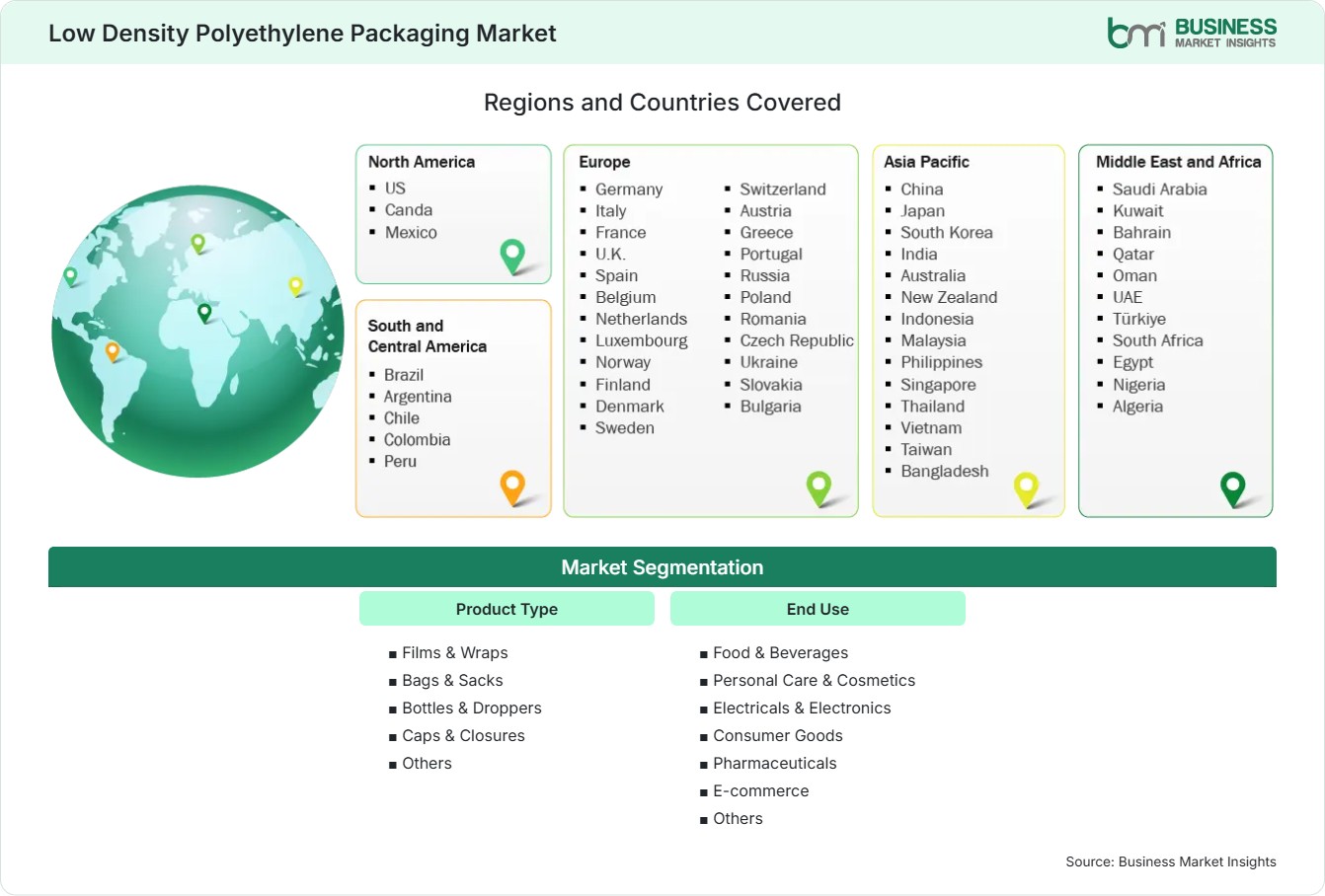
Global Market Geography
FREE PDF
Request your free sample
Request free sample
Segment Analysis

Low Density Polyethylene Packaging Market Segmentation

Product Type

Films & Wraps account for a modeled 48%–52% Low Density Polyethylene Packaging Market share in 2025 and are projected to grow at 6.3%–6.9% through 2033. Their combination of flexibility, sealability, moisture protection, low weight, and processing efficiency supports broad adoption.

  • Films & Wraps: Flexible films support food, industrial, retail, agricultural, and logistics applications through lightweight construction, sealing performance, stretchability, and moisture protection.
  • Bags & Sacks: LDPE bags provide flexibility, tear resistance, moisture protection, and economical conversion for food, retail, waste, industrial, and agricultural applications.
  • Bottles & Droppers: Flexible LDPE containers offer squeezability, chemical resistance, impact tolerance, and controlled dispensing for personal care, pharmaceutical, household, and specialty products.
  • Caps & Closures: LDPE closures provide flexibility, sealing, chemical compatibility, and user convenience across selected consumer, healthcare, and household packaging formats.

End Use

Food & Beverages remain the leading end-use category, supported by extensive flexible packaging requirements, while consumer goods, pharmaceuticals, personal care, and e-commerce provide diversified demand. The Low Density Polyethylene Packaging Market scope increasingly encompasses recyclable films, PCR-containing structures, lightweight formats, and packaging optimized for automated filling, distribution, and recovery.

  • Food & Beverages: Food packaging uses LDPE for wraps, liners, pouches, bags, seals, and flexible structures requiring moisture protection, hygiene, machinability, and reliable sealing.
  • Personal Care & Cosmetics: Flexible tubes, films, closures, liners, and protective packaging benefit from LDPE's softness, chemical resistance, flexibility, and attractive processing characteristics.
  • Electricals & Electronics: LDPE provides cushioning, insulation, moisture protection, and component protection for selected electronic products and supply-chain applications.
  • Consumer Goods: Household and general consumer products use polyethylene packaging for bags, wraps, protective films, closures, and flexible packaging requiring durability and convenience.
  • Pharmaceuticals: Pharmaceutical packaging applications value material consistency, moisture protection, flexibility, cleanliness, and compatibility with specialized packaging and dispensing formats.
  • E-commerce: Parcel-oriented packaging emphasizes low weight, puncture resistance, seal integrity, flexibility, and efficient use of material during automated fulfillment and transportation.
Market Forces

Low Density Polyethylene Packaging Market Dynamics

Key Market Drivers

Lightweighting and Material Efficiency

Lightweighting is a central demand driver because packaging producers and brand owners seek lower material consumption without sacrificing strength, seal integrity, product protection, or machine performance. LDPE is well suited to this objective because film structures can be downgauged while retaining flexibility and toughness through improved resin selection and extrusion control. Berry Global demonstrated this direction through a dry-mortar FFS film that incorporated 30% PCR while also achieving a 7% downgauging without compromising strength. These developments illustrate how Low Density Polyethylene Packaging Market growth increasingly depends on balancing material reduction with functional performance.

Expansion of Flexible Food and Consumer Packaging

Food, beverages, household products, personal care products, and consumer goods continue to require flexible packaging that protects products while remaining economical and easy to process. LDPE provides moisture resistance, flexibility, sealing capability, and impact performance, making it suitable for numerous flexible structures. The Low Density Polyethylene Packaging Market Trends highlights that Population growth, urbanization, convenience consumption, and organized retail increase the number of packaged products requiring efficient formats. Flexible packaging also supports lightweight distribution because less material is needed compared with many rigid alternatives.

Growth of E-Commerce and Distribution Packaging

E-commerce expands the requirement for packaging that can withstand automated sorting, handling, transportation, and last-mile delivery while minimizing package weight. LDPE films and mailers provide flexibility, tear resistance, moisture protection, and efficient material utilization, making them useful for many parcel applications. The Low Density Polyethylene Packaging Market growth of direct-to-consumer distribution also creates demand for secondary protective packaging and flexible formats that can accommodate different product dimensions. Packaging suppliers are therefore developing stronger films, optimized gauges, recyclable PE structures, and PCR-containing solutions.

Key Market Opportunities

Scale-Up of Recycle-Ready Mono-Material PE Packaging

The move to mono-material packaging presents a significant opportunity for producers and converters of LDPE film since PE-based packaging can make it easier to identify the material and work better with PE recycling streams when it is properly designed. Berry Global's Entour PE/PE film is offered as a mono-material solution for bags, pouches, stand-up pouches and flow wraps. Likewise, Amcor has broadened the range of its recycle-ready flexible packaging and stated that 96% of its flexible packaging range will have recycle-ready options by the end of FY25.

Expansion of PCR and Closed-Loop Recycling

PCR adoption creates opportunities across resin suppliers, recyclers, converters, and brand owners because packaging customers increasingly need reliable sources of recycled material. Amcor achieved its global target of using 10% PCR plastic by 2025, equivalent to 218,000 metric tons, demonstrating the scale of material substitution possible within a large packaging portfolio. The Low Density Polyethylene Packaging Market Forecasts therefore depend increasingly on the development of consistent recycled feedstock, advanced sorting, decontamination, and closed-loop supply chains that can meet performance and regulatory requirements.

Regulation-Driven Packaging Redesign

Regulatory changes are creating investment opportunities for packaging producers able to redesign products around recyclability and recycled content. The EU PPWR began applying on August 12, 2026, with requirements covering packaging recyclability, recycled content, labeling, waste reduction, and circularity. This regulatory direction creates demand for technical consulting, material science, film development, recycling infrastructure, testing, certification, and packaging redesign. The Low Density Polyethylene Packaging Market opportunity is particularly strong for suppliers that can combine film conversion expertise with recycling capabilities, enabling customers to transition without compromising product protection or manufacturing efficiency.

Market Restraints and Challenges

Recycling Infrastructure and Collection Limitations

The use of flexible PE packaging is widespread, but the infrastructure for collecting, sorting, washing, and recycling it varies from one country to another and from one municipality to another. As a result, packaging that has been designed to be recyclable will not reach circular recovery where appropriate collection or processing systems are not in place. Moreover, flexible films are hard to sort in conventional material recovery facilities due to their light weight and because they tend to escape from mechanical sorting systems.

Virgin Resin Volatility and Recycled Material Quality

The economics of polyethylene packaging are still affected by the prices of petrochemical feedstocks, the availability of resin, energy costs, logistics, and changes in the supply of recycled polymer. Because of this cost volatility, it becomes harder to make procurement decisions, and sustainable transitions to packaging using recycled content are more difficult if the recycled content carries premiums or has inconsistent quality. Recycled LDPE and mixed post-consumer materials need extra steps such as sorting, cleaning, and quality control to meet packaging specifications.

Company Analysis

Competitive Landscape

The Low Density Polyethylene Packaging Market analysis indicates that competition is increasingly based on film engineering, conversion scale, recycled-content availability, circularity capabilities, product customization, and customer relationships. Leading suppliers are investing in mono-material structures, PCR integration, recycling infrastructure, lightweight packaging, and differentiated flexible formats.

Company Name

Overview

Products and Services relevant to this market

Amcor plc

Global packaging producer with extensive flexible and rigid packaging capabilities serving food, healthcare, personal care, and consumer markets.

Flexible films, PE packaging, pouches, bags, wraps, recycle-ready structures, PCR solutions, and packaging design services.

Berry Global Group, Inc.

Major packaging manufacturer with broad flexible and rigid capabilities and strong investment in circular packaging technologies.

PE films, bags, pouches, stretch films, closures, containers, PCR materials, and mono-material PE packaging solutions.

Sealed Air Corporation

Packaging technology company focused on food, protective, automation, and material-efficiency applications across global supply chains.

Flexible films, protective packaging, food packaging, shrink films, industrial packaging, and recyclable packaging technologies.

Huhtamäki Oyj

Global packaging producer serving foodservice, food, beverage, and consumer applications with increasing emphasis on circularity.

Flexible packaging, films, food packaging, recyclable structures, paper-based alternatives, and sustainable packaging solutions.

Coveris Holdings S.A.

European packaging producer with integrated extrusion, printing, conversion, and recycling capabilities.

PE films, stretch and shrink films, sleeves, food packaging, recycled PE, ReCover recycling, and mono-polymer solutions.

Nampak Ltd.

African packaging manufacturer serving food, beverage, personal care, pharmaceutical, and industrial customers.

Plastic packaging, flexible formats, containers, closures, and packaging solutions for consumer and industrial applications.

Silgan Holdings Inc.

Packaging manufacturer focused on rigid containers, closures, and specialty packaging for consumer products.

Plastic containers, closures, dispensing systems, and packaging solutions for food, personal care, healthcare, and household products.

Serioplast Global Services S.p.A.

International rigid plastic packaging producer serving consumer and industrial markets through global manufacturing operations.

Plastic containers, bottles, closures, packaging development, and customized polymer packaging solutions.

IPS Packaging

Packaging supplier specializing in industrial and protective packaging solutions for manufacturing and distribution customers.

Stretch films, bags, liners, protective packaging, pallet solutions, and flexible polyethylene packaging materials.

Flextrus AB

Flexible packaging specialist serving food, healthcare, and consumer markets with film-based packaging technologies.

Flexible films, laminates, pouches, PE structures, printed packaging, and customized flexible packaging solutions.

Trust & Transparency

Research Methodology

The market analysis combines proprietary research with secondary data from government agencies, company disclosures, regulatory filings, industry databases and expert interviews. Market estimates are validated through data triangulation, cross-market benchmarking and analyst review.

View Full Research Methodology

Questions Answered

Frequently Asked Questions

What factors should packaging buyers evaluate when selecting LDPE solutions?

Buyers should assess resin quality, film thickness, tensile and puncture performance, sealing characteristics, barrier requirements, machinability, recycled-content availability, recyclability, regulatory compliance, supply reliability, and total packaging cost. The appropriate specification depends on product sensitivity, filling equipment, distribution conditions, and end-of-life infrastructure.

Why are mono-material PE structures gaining attention?

Mono-material PE structures can simplify packaging composition and support recycling when appropriate collection and processing systems exist. They can also help brands reduce dependence on difficult-to-recycle multilayer structures while maintaining sealing, flexibility, printability, and product-protection requirements.

What role does recycled content play in LDPE packaging?

Recycled content reduces dependence on virgin resin and supports circular-material strategies. However, packaging producers must maintain consistent mechanical performance, appearance, cleanliness, and processing characteristics. This makes reliable sorting, washing, decontamination, compounding, and quality-control infrastructure increasingly important.

How is regulation influencing polyethylene packaging design?

Regulation is accelerating packaging redesign toward recyclability, recycled content, lower material consumption, and improved waste management. The EU PPWR is particularly influential because it establishes requirements covering recyclability and recycled content and is being implemented progressively from 2026 onward.

What applications use low density polyethylene packaging most extensively?

LDPE packaging is widely used in films, wraps, bags, liners, protective packaging, flexible structures, selected bottles, closures, and e-commerce formats. Food and beverages remain important because LDPE provides moisture protection and reliable sealing, while logistics applications value flexibility, puncture resistance, and low material weight.

Access the Full Low Density Polyethylene Packaging Market Report

Get segment-level forecasts, regional estimates, competitive benchmarking, company profiles and downloadable Excel datasets.

Access the full Low Density Polyethylene Packaging Market Report
350 pages PDF & Excel | 2026-10-21
Similar Research

Related Market Reports