Market Summary
Executive Summary and Global Market Analysis
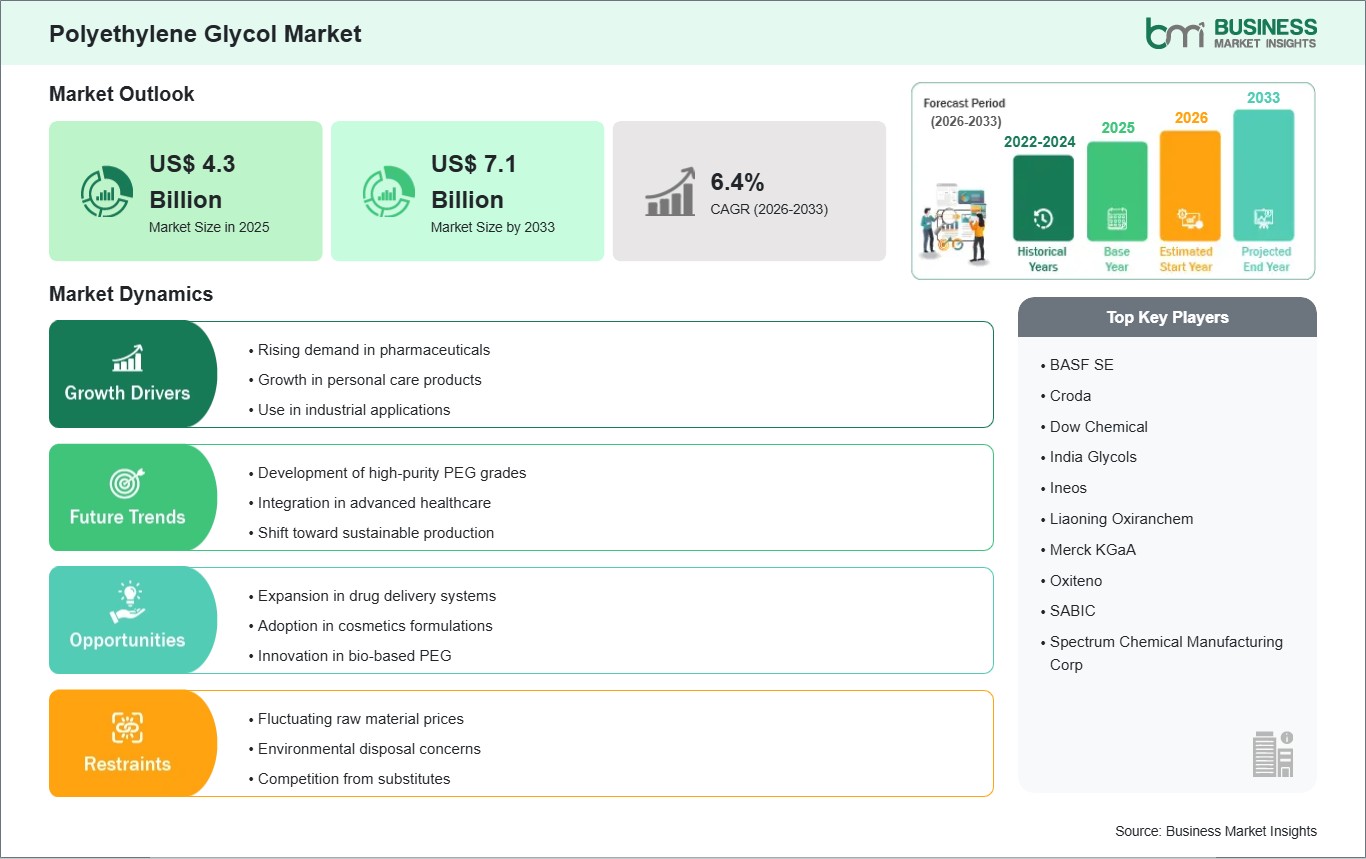
Polyethylene Glycol (PEG) is a hydrophilic, non-toxic polymer derived from ethylene oxide, available in a wide range of molecular weights that determine its physical form, from liquids to waxy solids. Its exceptional solubility, chemical stability, and low volatility make PEG a critical component across diverse industries, including pharmaceuticals, personal care, construction, and industrial applications. In pharmaceuticals, PEG plays a pivotal role in drug formulation and delivery, particularly through PEGylation technology, which enhances therapeutic efficacy and extends the half-life of biologics. In personal care, PEG's emulsifying and humectant properties enable stable, skin-compatible formulations, while in construction, PEG derivatives contribute to advanced concrete additives that improve durability and performance.
However, the PEG market faces notable challenges. Price volatility in raw materials, especially ethylene oxide linked to crude oil fluctuations, creates uncertainty in production costs. Environmental concerns persist, as higher molecular weight PEG variants are non-biodegradable, raising disposal issues and regulatory scrutiny. Compliance with stringent norms from bodies such as the FDA and ECHA adds complexity, particularly for rinse-off cosmetic products.
Despite these challenges, significant growth opportunities exist. The pharmaceutical sector’s growing use of PEGylation for next-generation biologics and the demand for advanced drug delivery systems are driving innovation in high-purity PEG grades. Sustainability trends are encouraging R&D investment in bio-based PEG from renewable feedstocks, supported by green chemistry initiatives and government incentives. The construction industry’s adoption of PEG-based superplasticizers for high-performance concrete further highlights PEG’s expanding role in infrastructure development. Together, these factors position PEG as a strategic material with strong long-term potential, even in the face of regulatory and environmental challenges.
Segment Analysis
Polyethylene Glycol Market Segmentation
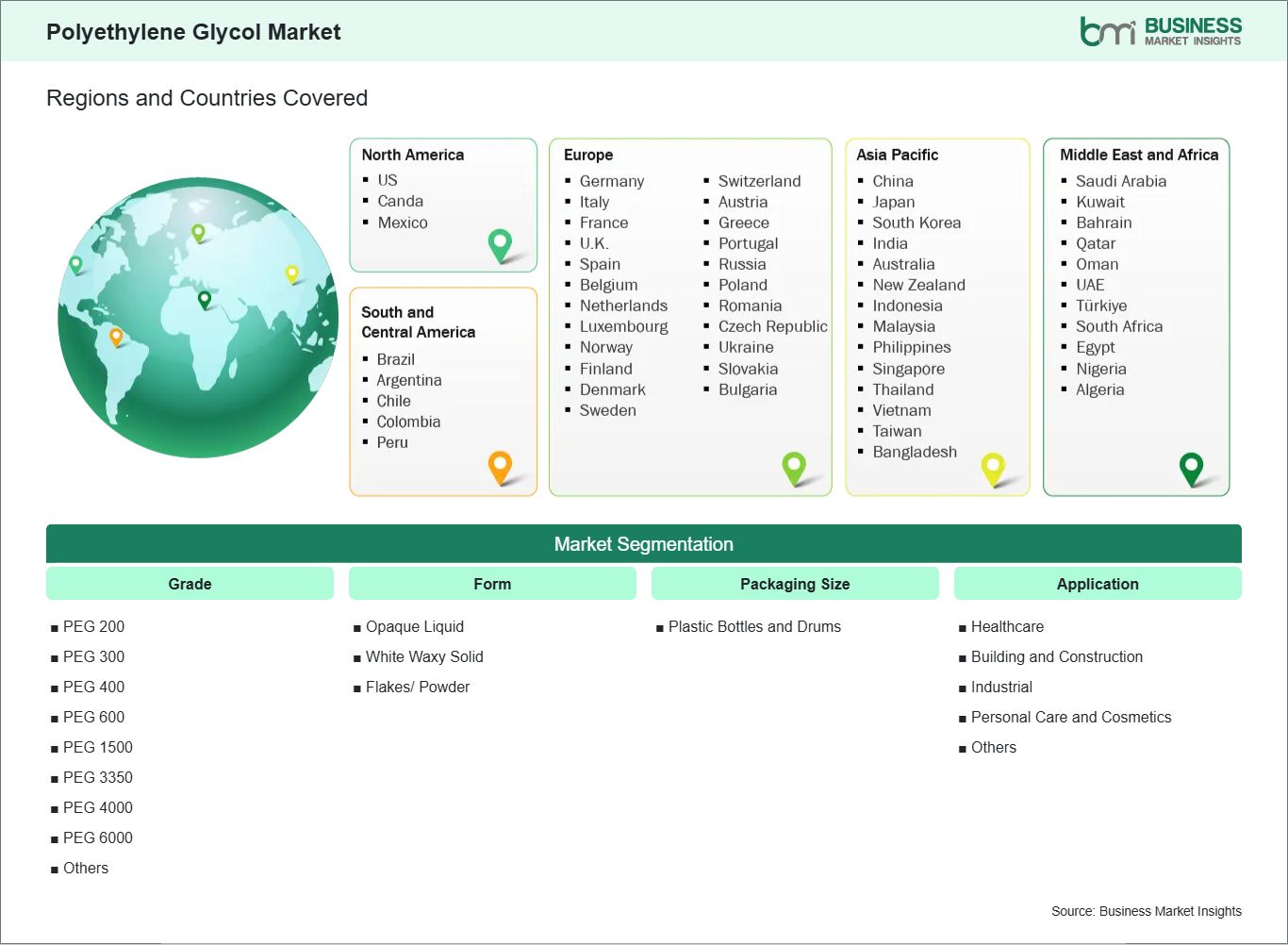
Key segments that contributed to the derivation of the Polyethylene Glycol market analysis are grade, form, packaging size, and application.
- By Grade, the market is segmented into PEG 200, PEG 300, PEG 400, PEG 600, PEG 1500, PEG 3350, PEG 4000, PEG 6000, and Others.
- By Form, the market is segmented into Opaque Liquid, White Waxy Solid, and Flakes/ Powder.
- By Packaging Size, the market is segmented into Plastic Bottles and Drums.
- By Application, the market is segmented into Healthcare, Building and Construction, Industrial, Personal Care and Cosmetics, and Others.
Market Forces
Polyethylene Glycol Market Drivers and Opportunities
Expansion of Pharmaceutical and Healthcare Applications
Polyethylene Glycol (PEG) plays a critical role in modern drug delivery systems, primarily by improving the solubility and bioavailability of poorly soluble drugs, which is essential for enhancing therapeutic efficacy. One of the most transformative applications is PEGylation technology, which involves the covalent attachment of PEG chains to therapeutic proteins and peptides. This process significantly improves drug stability, reduces immunogenicity, and prolongs circulation time in the body, thereby increasing the demand for high-purity and specialty PEG grades.
Additionally, the rising prevalence of chronic diseases such as cancer, diabetes, and cardiovascular disorders, coupled with an aging global population, is fueling the need for advanced and long-acting drug formulations. These formulations often rely on PEG-based excipients to achieve controlled release and improved patient compliance. As pharmaceutical companies continue to innovate in biologics and personalized medicine, PEG’s versatility and performance advantages position it as a cornerstone material in next-generation drug development.
Sustainability and Advanced Formulation Opportunities
Environmental and regulatory pressures are accelerating innovation in sustainable PEG variants, creating new growth opportunities for manufacturers. Increasing restrictions on petrochemical-based products and the global push toward greener alternatives have spurred significant investments in research and development for bio-based PEG derived from renewable feedstocks, such as bio-ethylene oxide. These efforts are further supported by government incentives and green chemistry initiatives aimed at reducing carbon footprints and promoting circular economy principles.
Beyond pharmaceuticals, PEG demand is expanding into construction and infrastructure sectors through advanced derivatives used in polycarboxylate ether (PCE) superplasticizers. These high-performance additives play a critical role in enhancing the workability, strength, and durability of concrete, making them indispensable for modern infrastructure projects. As global urbanization and large-scale construction activities continue to rise, the linkage between PEG-based PCE superplasticizers and sustainable building practices is becoming increasingly evident. Together, these trends underscore PEG’s evolving role, not only as a pharmaceutical excipient but also as a key enabler of eco-friendly industrial applications, positioning the market for robust, long-term growth.
Size and Share Analysis
Polyethylene Glycol Market Size and Share Analysis
The Polyethylene Glycol market demonstrates steady growth, with size and share analysis revealing evolving trends and competitive positioning among key players. The report further examines subsegments categorized within grade, form, packaging size, and application, offering insights into their contribution to overall market performance.
For instance, the PEG 400 subsegment holds a significant market share. This specific grade, often available as an Opaque Liquid, is indispensable for the Healthcare sector, where it serves as a high-performance solubilizer and lubricant in oral and injectable drug formulations. A notable trend in 2025 is the increasing adoption of high-purity, low-impurity PEG grades that enhance the bioavailability of complex active pharmaceutical ingredients (APIs). These innovations are particularly vital in advanced drug delivery systems, where they empower pharmaceutical companies to develop stable, long-acting medications that improve patient compliance and therapeutic outcomes.
Report Coverage
Polyethylene Glycol Market Report Coverage and Deliverables
The "Polyethylene Glycol Market Size and Forecast (2022–2033)" report provides a detailed analysis of the market covering below areas:
- Polyethylene Glycol Market size and forecast at global, regional, and country levels for all the key market segments covered under the scope.
- Polyethylene Glycol Market trends, as well as market dynamics such as drivers, restraints, and key opportunities.
- Polyethylene Glycol Market analysis covering key market trends, global and regional framework, major players, regulations, and recent market developments
- Industry landscape and competition analysis covering market concentration, heat map analysis, prominent players, and recent developments for the Polyethylene Glycol Market
- Detailed company profiles, including SWOT analysis
Geographic Insights
Polyethylene Glycol Market Geographic Insights
The geographical scope of the Polyethylene Glycol market report is divided into five regions: North America, Europe, Asia Pacific, the Middle East & Africa, and South & Central America.
North America maintains a strong focus on high-purity PEG grades, driven by advanced pharmaceutical R&D and stringent regulatory standards. Europe emphasizes sustainability and specialty PEG variants, aligning with its robust environmental compliance framework. Asia Pacific continues to expand rapidly, supported by large-scale pharmaceutical manufacturing and growing personal care demand. The Middle East & Africa are emerging as a promising region, leveraging abundant petrochemical feedstock and improving healthcare infrastructure. South & Central America show steady progress, with PEG adoption linked to industrial applications, construction projects, and pharmaceutical growth.
Industry Activity
Recent Developments
The Polyethylene Glycol market is evaluated by gathering qualitative and quantitative data post-primary and secondary research, which includes important corporate publications, association data, and databases. A few of the key developments in the Polyethylene Glycol market are:
- In May 2025, BASF expanded its reactive polyethylene glycol portfolio in Europe with the launch of Pluriol® A 2400 I. The isoprenol-PEG product enables the production of third-generation polycarboxylate ether (PCE) superplasticizers, improving concrete flow and durability. Pluriol® A 2400 I also offers potential applications as dispersants for inorganic pigments, contributing to raw material security and CO2 reduction through local sourcing.
- In March 2024, Dow and Procter & Gamble announced a joint development agreement (JDA) to create a new recycling technology. The vision is to enable efficient conversion of hard-to-recycle plastic packaging into recycled polyethylene with near-virgin quality and a low greenhouse gas emissions footprint. The partnership aims to support circular economy goals and enable P&G to use PCR polymers in packaging, aligning with both companies’ sustainability targets for 2030.
Trust & Transparency
Research Methodology
The market analysis combines proprietary research with secondary data from government agencies, company disclosures, regulatory filings, industry databases and expert interviews. Market estimates are validated through data triangulation, cross-market benchmarking and analyst
review.
View Full Research Methodology
Key Sources Referred:
World Bank – Global Trade Indicators
World Trade Organization (WTO)
International Monetary Fund (IMF)
International Trade Administration (ITA)
Company Websites
Company Annual Reports
Company Investor Presentations