High Density Polyethylene (HDPE) Resins Market Regional Highlights
North America High Density Polyethylene Resins Market
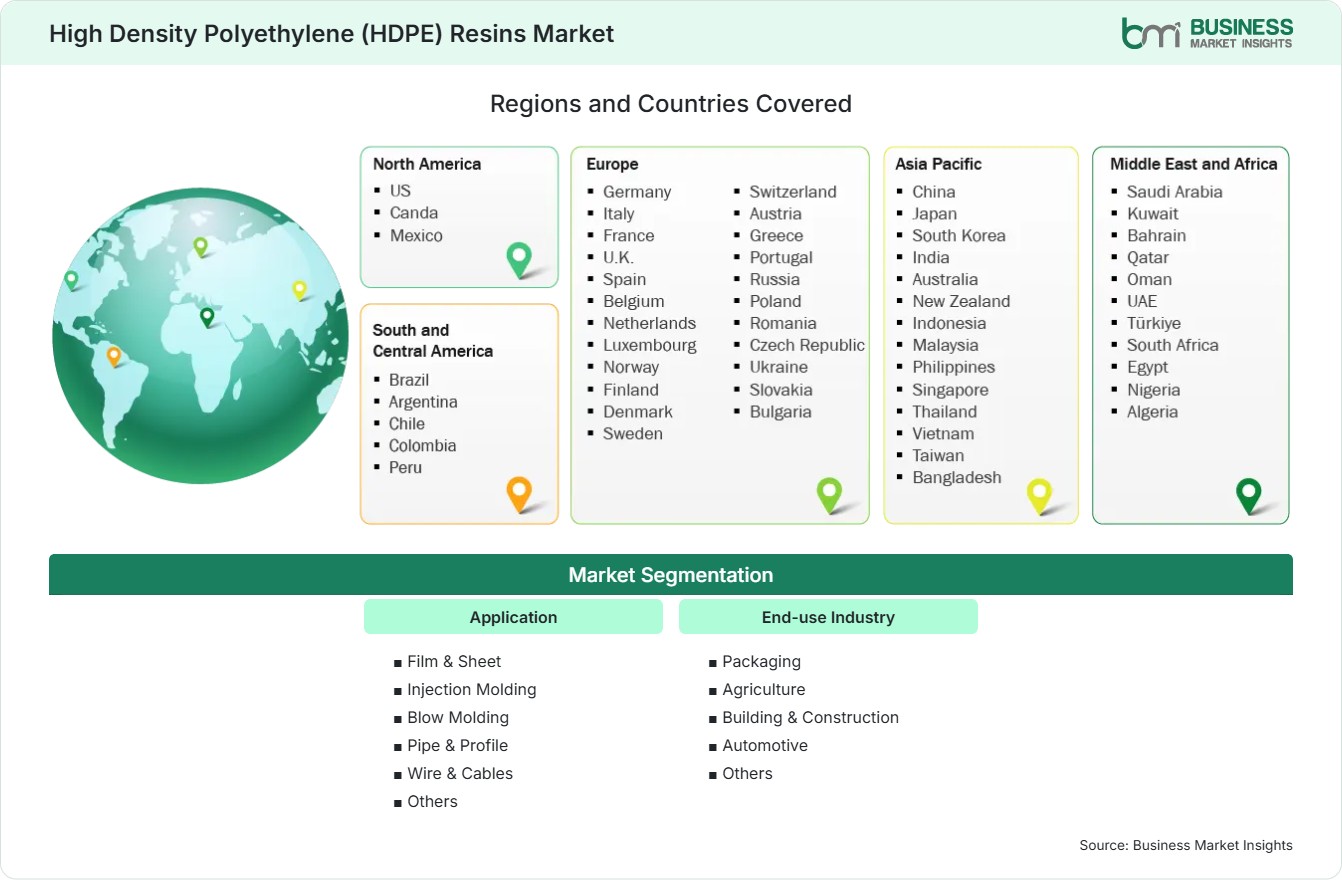
North America accounts for a 20%–23% share in 2025 and is projected to register a 5.8%–6.3% CAGR during 2026–2033 in the High Density Polyethylene Resins Market. The region benefits from established polyethylene production, sophisticated converting infrastructure, and strong demand for containers, films, pipes, agricultural products, and industrial packaging. The US remains the principal demand center because of its large packaging and construction base. Producers increasingly prioritize high-performance grades with improved environmental stress crack resistance, stiffness, toughness, and processing efficiency. Domestic resin availability also supports shorter supply chains for converters requiring consistent specifications.
- Packaging converters increasingly pursue lightweight rigid containers and films that maintain mechanical performance while reducing material consumption, creating demand for engineered HDPE grades with improved stiffness-to-weight ratios.
- Water, sewer, gas, and industrial piping applications support resin consumption as operators replace corrosion-prone materials with durable polyethylene systems offering easier installation and long service life.
- Agricultural applications remain relevant because irrigation components, chemical containers, crates, and protective products require chemical resistance, impact strength, and dependable outdoor performance.
- North American producers increasingly emphasize technical support, grade customization, and recycled-content solutions as brand owners and converters respond to circularity requirements and changing packaging specifications.
US High Density Polyethylene Resins Market
The US represents approximately 82%–86% of North American share in 2025 and is expected to grow at 5.9%–6.4% CAGR through 2033. Strong polymer production infrastructure supports domestic availability, while packaging, industrial containers, construction products, and agricultural applications sustain downstream consumption. ExxonMobil maintains a broad HDPE portfolio covering film, blow molding, rotational molding, and injection molding applications.
- Domestic converters benefit from established resin distribution networks and diversified grades serving bottles, caps, crates, pallets, tanks, films, and molded industrial components.
- Infrastructure applications create recurring demand for grades with high stiffness, toughness, and environmental stress crack resistance, particularly where long operating life influences material-selection decisions.
- Advanced packaging grades are gaining attention as converters pursue mono-material structures, downgauging, improved line productivity, and compatibility with established polyethylene recycling streams.
Europe High Density Polyethylene Resins Market
Europe accounts for 18%–21% share in 2025 and is forecast to expand at a 5.4%–6.0% CAGR during 2026–2033 in the High Density Polyethylene Resins Market. Germany represents the leading national market, while Spain and Italy provide attractive growth opportunities. European demand is strongly influenced by packaging circularity, lightweighting, infrastructure maintenance, and sustainability-oriented material selection. Producers are increasingly developing grades compatible with recyclable packaging designs and regulated applications. SABIC, for example, has developed HDPE solutions for beverage closures supporting lightweight designs, recyclability, and tethered-cap requirements.
- Germany leads regional demand through its extensive packaging, manufacturing, chemicals, automotive, and infrastructure ecosystem, creating diversified consumption opportunities for specialized polyethylene grades.
- Spain is positioned for comparatively faster growth as packaging conversion, agricultural applications, construction activity, and recycling-oriented material development expand across downstream industries.
- European converters increasingly evaluate resin selection through lifecycle performance, recyclability, downgauging potential, and compliance requirements rather than material cost alone.
- Advanced closure and packaging grades provide producers with opportunities to differentiate through stiffness, toughness, processability, food-contact suitability, and compatibility with evolving packaging formats.
Asia Pacific High Density Polyethylene Resins Market
Asia Pacific represents a 40%–44% share in 2025 and is projected to achieve a 7.1%–7.8% CAGR through 2033, making it the fastest-growing region. China remains the leading market, while India represents a major high-growth opportunity because of expanding packaging conversion, infrastructure investment, agriculture, and domestic petrochemical capacity. LyondellBasell’s 500 kiloton-per-year technology agreement with Indian Oil Corporation illustrates the region’s continuing investment in HDPE manufacturing capabilities.
- China benefits from extensive packaging conversion, industrial manufacturing, infrastructure development, and domestic polymer production, sustaining broad demand across films, containers, pipes, and molded products.
- India is emerging as a high-growth market as petrochemical integration, packaging consumption, irrigation infrastructure, construction, and organized manufacturing increase resin requirements.
- Southeast Asian economies offer additional opportunities because expanding food processing, consumer goods manufacturing, agriculture, and e-commerce distribution require durable packaging and molded polyethylene products.
- Regional producers are investing in advanced grades and larger-scale production technology to improve economies of scale, product flexibility, and competitiveness across domestic and export markets.
Rest of World High Density Polyethylene Resins Market
South and Central America combined represent a significant share of the Rest of the World market through food packaging, agricultural uses, industrial packaging, and infrastructure development. Brazil is currently the leading market, while Mexico offers a key manufacturing and packaging market. At the same time, the Middle East and Africa regions benefit through petrochemical integration, water infrastructure, agricultural applications, and construction projects. The leading market in the Middle East is Saudi Arabia, with select African countries experiencing faster downstream growth driven by increased infrastructure investments.
- Brazil benefits from a large agricultural economy and established polymer-processing base, supporting demand for packaging, irrigation products, containers, films, and molded agricultural components.
- Mexico offers growth opportunities through manufacturing integration, food processing, consumer packaging, automotive production, and proximity to major North American supply chains.
- Saudi Arabia combines feedstock advantages with downstream polymer development, while regional infrastructure programs support applications including pipes, geomembranes, construction products, and industrial containers.
- African markets provide longer-term opportunities as water networks, agricultural irrigation, waste-management infrastructure, and packaged consumer products expand across urbanizing economies.