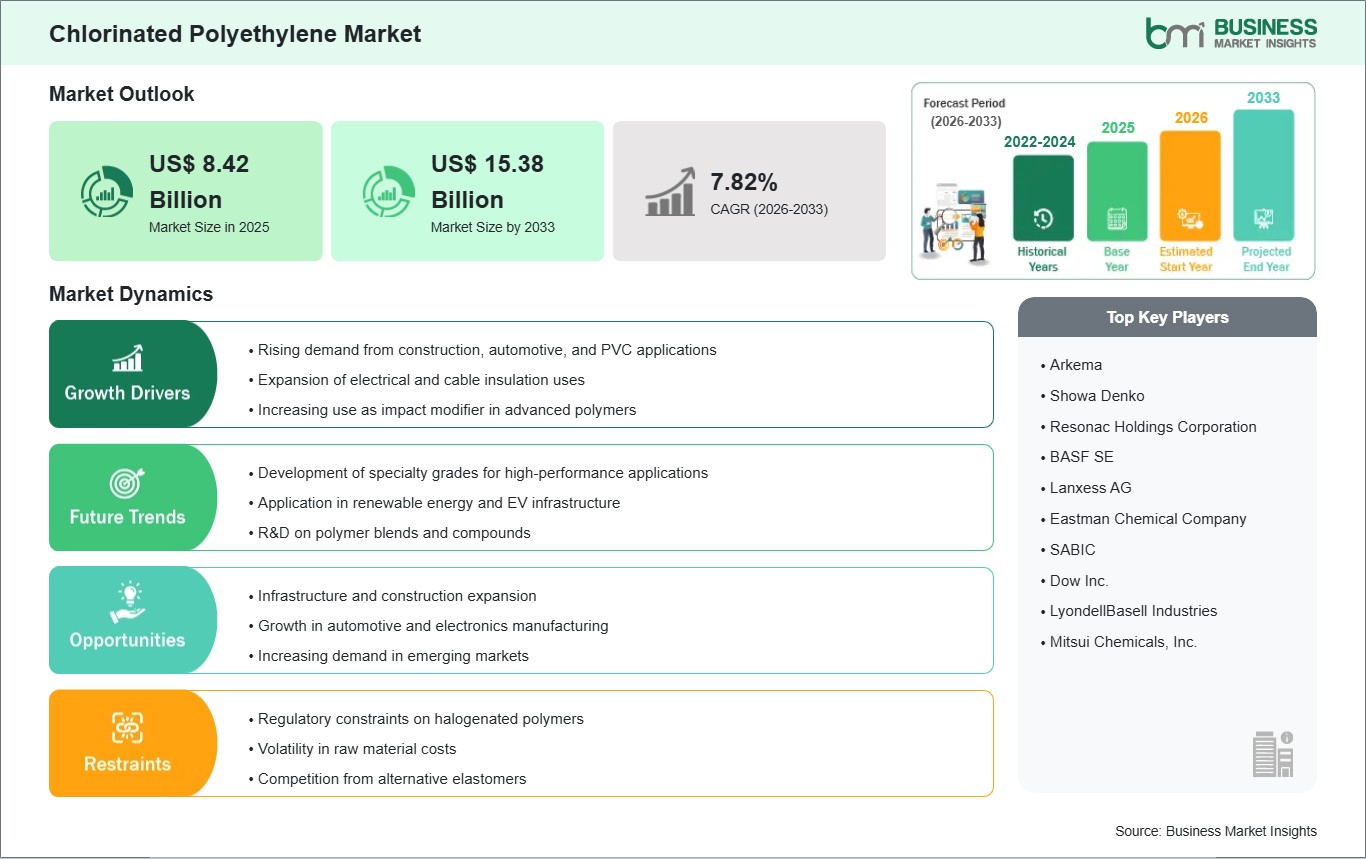
The Chlorinated Polyethylene Market size is expected to reach US$ 15.38 Billion by 2033 from US$ 8.42 Billion in 2025. The market is estimated to record a CAGR of 7.82% from 2026 to 2033.
The global chlorinated polyethylene (CPE) market is defined by its critical role as a high-performance thermoplastic elastomer used across construction, automotive, electrical, and industrial applications. CPE is produced through the chlorination of polyethylene and is valued for its superior properties, including impact resistance, flexibility, chemical stability, flame retardancy, and weather resistance. These characteristics make it a preferred material for enhancing durability and performance in demanding environments.
The market is witnessing steady growth driven by increasing demand for durable and cost-effective materials in infrastructure development and industrial manufacturing. CPE is widely used as an impact modifier in polyvinyl chloride (PVC), improving toughness and resistance in pipes, fittings, and profiles. Additionally, its use in wire and cable jacketing, hose and tubing, and specialty polymers continues to expand due to its ability to withstand harsh environmental and chemical conditions.
Competitive dynamics are shaped by product innovation, grade optimization, and application-specific formulations. Manufacturers are focusing on enhancing material performance, improving processing efficiency, and developing specialty grades to meet evolving industry requirements. Strategic expansions and integration across value chains are also influencing market positioning.
Regulatory considerations related to halogenated polymers and environmental impact are influencing product development and adoption strategies. Companies are investing in sustainable formulations and compliance with environmental standards to maintain competitiveness. As industries increasingly demand high-performance materials with durability and cost efficiency, chlorinated polyethylene continues to play a crucial role in modern industrial applications.

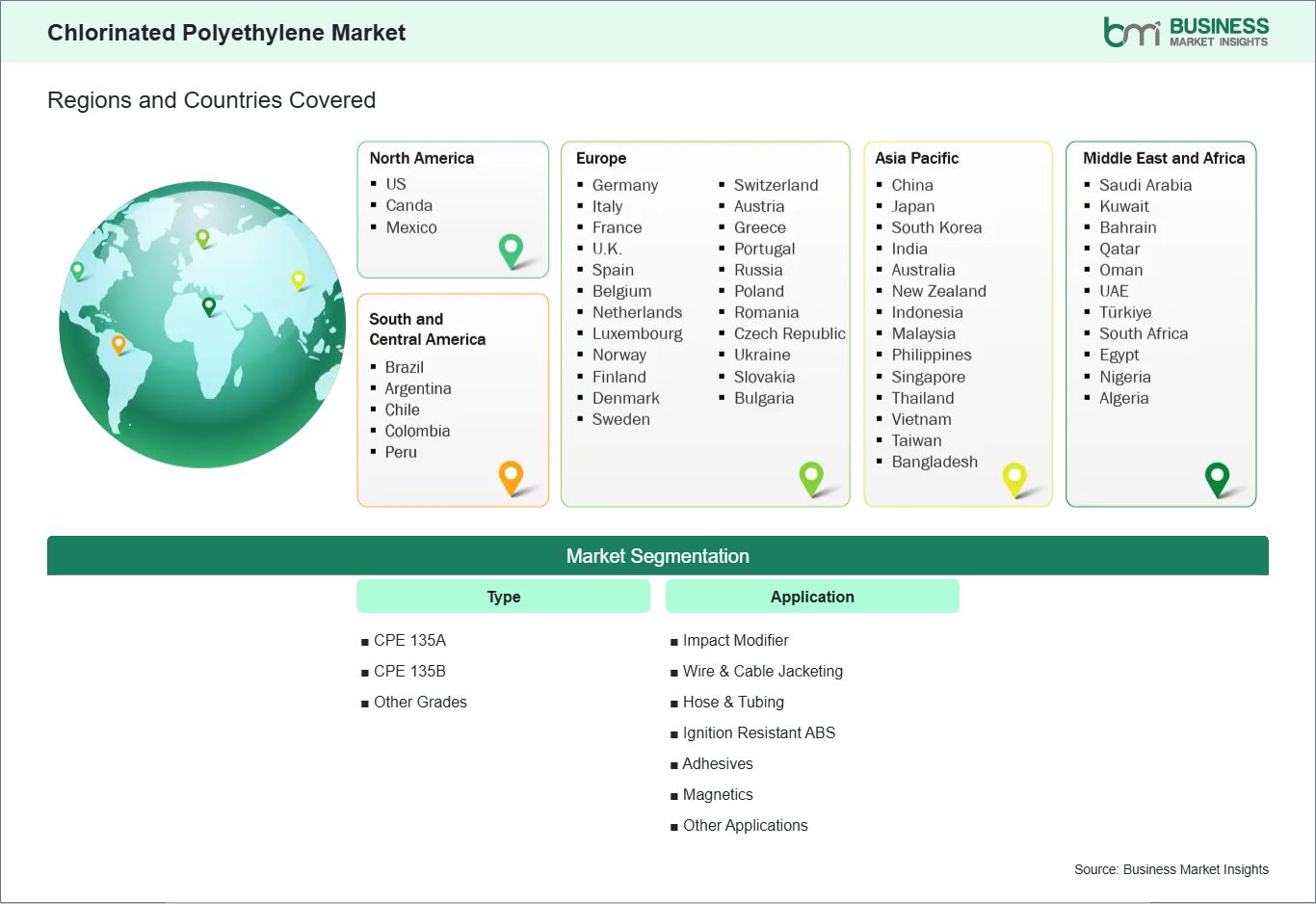
Key segments that contributed to the derivation of the chlorinated polyethylene market analysis are product and application.
The increase in need for high-performance material in the construction, automotive, and polymer processing industries drive the growth of the chlorinated polyethylene. The primary driving force in the growth of the chlorinated polyethylene market is the high demand for CPE as an impact modifier for polyvinyl chloride (PVC) products. CPE improves the strength, flexibility, and weatherability of PVC materials and is therefore utilized in construction products such as pipes, fittings, window profiles, and roofing products. As infrastructure develops globally — especially in the developing world, there is continuing demand for durable materials. CPE is also used in roofing membranes, water-proof systems, and siding materials because of its ability to withstand UV radiation, extreme temperatures, and degradation by the environment, making it suitable for long-term outdoor usage with lower maintenance costs as well as increasing the structural lifespan of building products. CPE is also a critical component of hoses, seals, and wire insulation used in the automotive industry, due to its resistance to heat, oil, and chemicals, and therefore plays an important role in ensuring the safety and performance of automobiles.
Another significant factor contributing to the chlorinated polyethylene market growth is the expanding use of CPE in the electrical and electronic industries. Much like with PVC products, CPE is extensively used in the wire and cable making industry as cable jackets because of its outstanding flame-resistance, thermal stability, and insulation characteristics. The demand for electricity and renewable energy systems continues to climb.
The chlorinated polyethylene (CPE) market is projected to have significant growth potential as demand increases in several advanced polymer systems, electrical infrastructure and other specialty materials. One key area of growth will be in the increasing use of high-performance polymer blends and compounds. With CPE being utilized in more of today’s advanced formulations to improve impact resistance, flexibility, and chemical stability; it provides many opportunities to grow in high-value applications such as specialty plastics and engineered materials.
In addition, the rapid expansion of electrical infrastructure, including renewable energy systems and electric vehicle (EV) charging networks, is presenting new opportunities for CPE. It is particularly important for use in the insulation of wire and cable applications because these materials must be able to withstand high temperatures, mechanical stress, and exposure to harsh environments. As worldwide investments continue to grow in clean energy and electrification, the need for durable, dependable cables is anticipated to rise as well.
A further opportunity area includes specialized applications such as ignition resistant acrylonitrile-butadiene-styrene (IR ABS), adhesives and magnetic products. In these applications, when added to other materials, CPE enhances flame retardant characteristics as well as improving their mechanical properties making them appropriate for use in electronic devices, automobiles and industrial equipment. The continued development of customized grades to meet specific performance specifications has the potential to add even wider usage opportunities for the specialized applications previously mentioned.
In addition, continual R&D on the applications of CPE will also provide further opportunities for growth in this market.

The Chlorinated Polyethylene Market demonstrates steady growth, with size and share analysis highlighting evolving trends and competitive dynamics among key players. The report examines subsegments categorized within product and application, offering insights into their contribution to overall market performance.
By product, the CPE 135A subsegment dominated the market in 2025, driven by its extensive use as an impact modifier in PVC applications.
In terms of application, the impact modifier subsegment dominated the market in 2025, driven by increasing demand for durable and flexible polymer materials.
| Report Attribute | Details |
|---|---|
| Market size in 2025 | US$ 8.42 Billion |
| Market Size by 2033 | US$ 15.38 Billion |
| Global CAGR (2026 - 2033) | 7.82% |
| Historical Data | 2022-2024 |
| Forecast period | 2026-2033 |
| Segments Covered | By Type
|
|
Regions and Countries Covered
| |
| North America | US, Canada, Mexico |
| Europe | Belgium, Austria, Finland, Denmark, Greece, Poland, Romania, Russia, Ukraine, Czech Republic, Slovakia, Bulgaria, Italy, Luxembourg, Germany, Switzerland, France, Netherlands, Norway, Portugal, Spain, Sweden, United Kingdom |
| Asia-Pacific | Australia, China, India, Japan, South Korea, Indonesia, Malaysia, Philippines, Singapore, Thailand, Vietnam, Bangladesh, New Zealand, Taiwan |
| South and Central America | Brazil, Argentina, Peru, Chile, Colombia |
| Middle East and Africa | Bahrain, Kuwait, Oman, Qatar, Saudi Arabia, United Arab Emirates, Turkiye, South Africa, Egypt, Algeria, Nigeria |
| Market leaders and key company profiles |
|
The "Chlorinated Polyethylene Market Size and Forecast (2022 - 2033)" report provides a detailed analysis of the market covering below areas:
The geographical scope of the Chlorinated Polyethylene Market report is divided into North America, Asia Pacific, Europe, Middle East & Africa, and South & Central America. North America held the largest share in 2025.
North America is witnessing steady growth driven by technological advancements and increasing adoption in automotive and electrical applications. Europe follows closely, supported by regulatory frameworks and demand for high-performance materials.
Asia Pacific market is growing due to rapid infrastructure development, strong manufacturing base, and increasing demand for PVC-based products. Countries such as China and India are major contributors due to large-scale construction and industrial activities.
Emerging regions such as Latin America and the Middle East & Africa are gradually expanding due to industrialization and infrastructure investments.

The Chlorinated Polyethylene Market is evaluated by gathering qualitative and quantitative data post primary and secondary research, which includes important corporate publications, association data, and databases. A few of the key developments in the chlorinated polyethylene market are:
The Chlorinated Polyethylene Market is valued at US$ 8.42 Billion in 2025, it is projected to reach US$ 15.38 Billion by 2033.
As per our report Chlorinated Polyethylene Market, the market size is valued at US$ 8.42 Billion in 2025, projecting it to reach US$ 15.38 Billion by 2033. This translates to a CAGR of approximately 7.82% during the forecast period.
The Chlorinated Polyethylene Market report typically cover these key segments-
The historic period, base year, and forecast period can vary slightly depending on the specific market research report. However, for the Chlorinated Polyethylene Market report:
The Chlorinated Polyethylene Market is populated by several key players, each contributing to its growth and innovation. Some of the major players include:
The Chlorinated Polyethylene Market report is valuable for diverse stakeholders, including:
Essentially, anyone involved in or considering involvement in the Chlorinated Polyethylene Market value chain can benefit from the information contained in a comprehensive market report.
Please tell us your area of interest
(Market Segments/ Regions and Countries/ Companies)