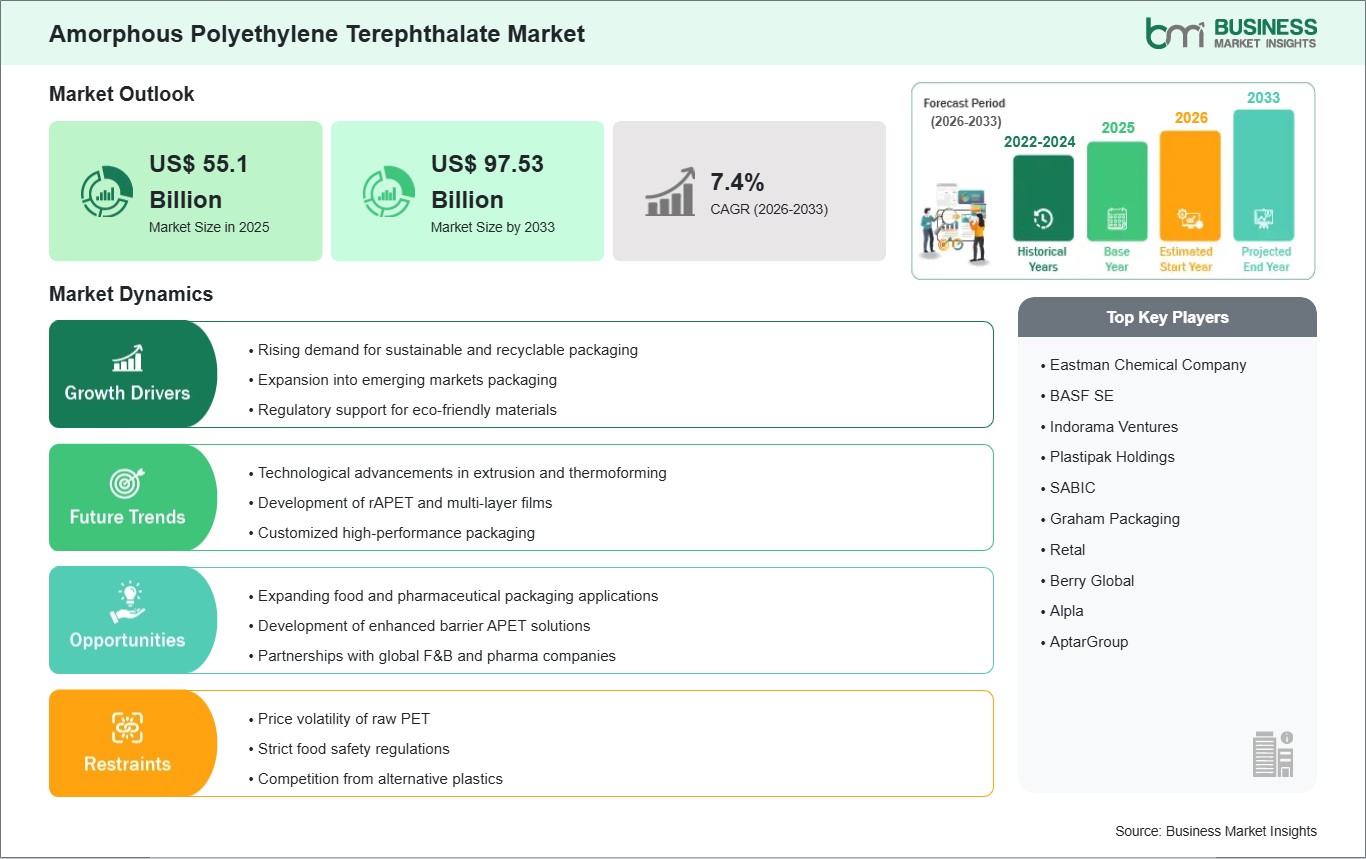
The Amorphous Polyethylene Terephthalate Market size is expected to reach US$ 97.53 Billion by 2033 from US$ 55.1 Billion in 2025 .The market is estimated to record a CAGR of 7.4% from 2026 to 2033.
The global amorphous polyethylene terephthalate (APET) market is experiencing steady growth, driven by increasing demand for transparent, lightweight, and recyclable plastic materials across packaging and industrial applications. APET is a thermoplastic polymer known for its clarity, toughness, and excellent barrier properties, making it particularly suitable for food packaging, medical packaging, and thermoforming applications.
The growing emphasis on sustainable packaging solutions is a key factor influencing the market. APET is widely recyclable and aligns with circular economy initiatives, making it a preferred material among manufacturers and regulators seeking to reduce environmental impact. Additionally, its ability to maintain product freshness and extend shelf life has strengthened its adoption in food and beverage packaging.
Manufacturers are increasingly focusing on improving material performance through innovations in processing and blending techniques. Developments in multilayer films and recycled APET (rAPET) are enhancing product sustainability while maintaining quality standards. Strategic collaborations with packaging companies and end-use industries are further driving market expansion and innovation.

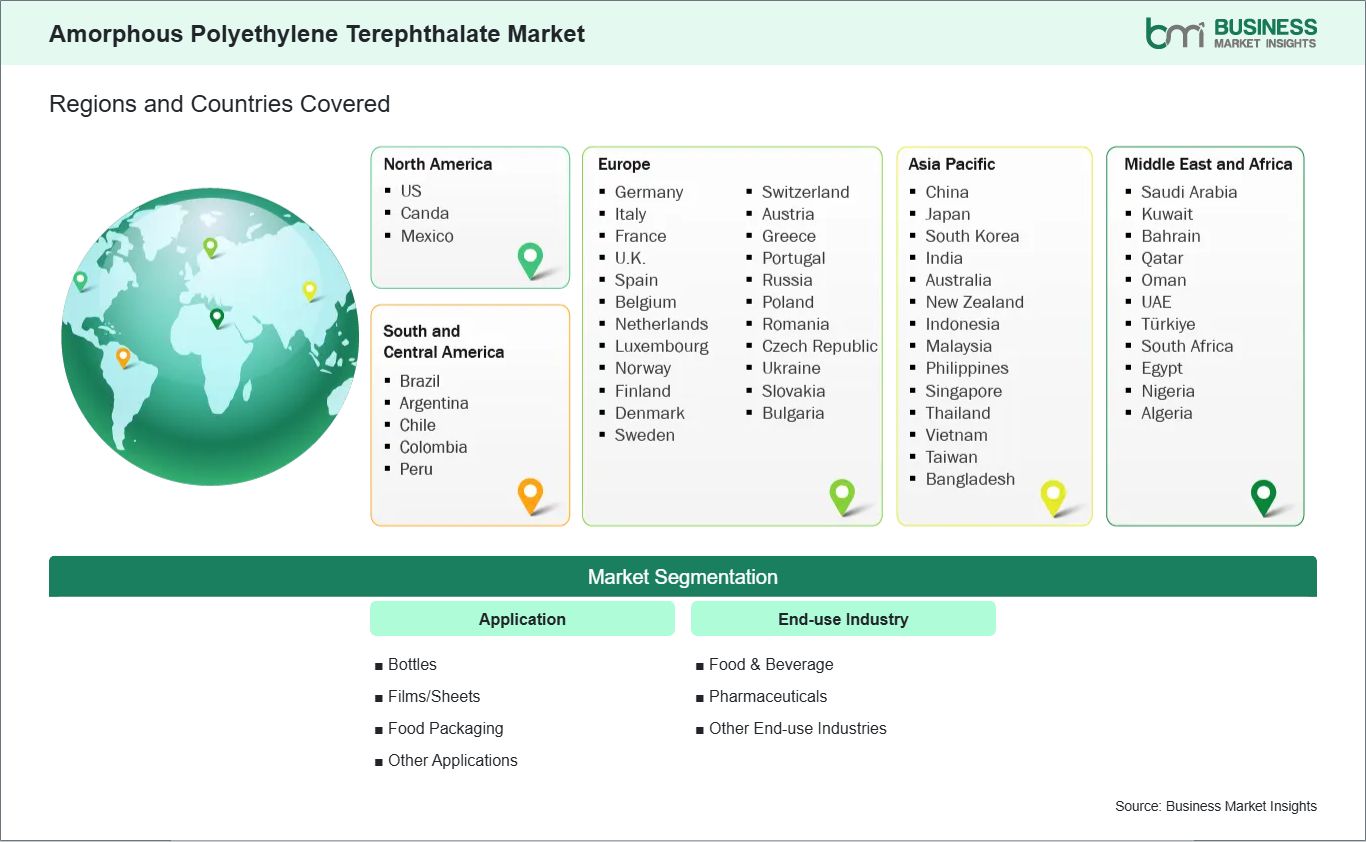
Key segments that contributed to the derivation of the amorphous polyethylene terephthalate market analysis are application and end-use industry.
Sustainability has emerged as a key focus for the global packaging industry's rapid evolution by all entities involved, including consumers and regulators alike. Numerous governments and organizations around the world are now requiring the use of sustainable packaging options to minimise plastic waste and carbon emissions. In this environment, Amorphous Polyethylene Terephthalate (APET) has become the material of choice because of its high recyclability compared to other conventional plastics, its compatibility with existing recycling systems, and the fact that it is produced with a significantly lower environmental impact. As a result, APET packaging can be collected, processed, and reused efficiently and will provide an ideal solution for companies working towards achieving the principles of the circular economy. Manufacturers are turning to APET as a packaging solution to ensure compliance with regulation and also to support consumer demand for environmentally-friendly products. APET provides the necessary clarity, strength, and versatility that businesses need to provide the same level of quality and performance in their products while at the same time reducing the carbon footprint created during the production process. As a result, retailers and foodservice operators are increasingly using APET trays, containers, and clamshells because these products combine both durability and visibility while saving packaging materials or reducing waste. Furthermore, the potential for APET to work in conjunction with emerging advanced recycling technologies strongly supports APET as a long-term recyclable solution through the continuing expansion of the global recycling infrastructure. The growth of sustainable packaging has also created opportunities for innovation as companies have begun to develop APET blends and coatings designed to enhance the barrier properties of the packaging while still being recyclable.
The food and pharmaceutical industries are among the largest consumers of APET, and their rapid expansion is fueling significant market growth. In the food and beverage sector, APET is widely used in trays, containers, and clamshell packaging due to its excellent clarity, strength, and barrier properties. These attributes help preserve freshness, protect against contamination, and extend shelf life, making APET indispensable for packaged meals, fresh produce, and ready‑to‑eat products. With rising consumer demand for convenience and safety, APET packaging has become a trusted solution for ensuring product integrity.
In pharmaceuticals, APET is increasingly adopted for blister packs, medical trays, and sterile packaging. Its durability and ability to maintain sterility are critical for safeguarding sensitive drugs and medical devices. Regulatory requirements for tamper‑evident and contamination‑resistant packaging further reinforce APET’s role in healthcare applications. The growing global demand for healthcare products, coupled with the expansion of pharmaceutical manufacturing in emerging economies, is expected to drive sustained adoption of APET.
Technological advancements in thermoforming and extrusion processes are enhancing APET’s usability, enabling manufacturers to produce customized, high‑performance packaging solutions. Innovations such as multi‑layer APET films and improved barrier coatings are expanding its application scope, allowing it to compete with more specialized materials while retaining recyclability. As food safety, healthcare accessibility, and consumer convenience remain top priorities worldwide, APET’s versatility and reliability ensure its continued growth in both food and pharmaceutical packaging markets.

The Amorphous Polyethylene Terephthalate Market demonstrates steady growth, with size and share analysis highlighting evolving trends and competitive dynamics among key players. The report examines subsegments categorized within application and end-use industry, offering insights into their contribution to overall market performance.
In terms of application, the food packaging subsegment dominated the market in 2025, driven by increasing demand for transparent and protective packaging solutions.
Based on end-use industry, the food & beverage subsegment dominated the market in 2025, driven by the rising consumption of packaged and ready-to-eat food products.
| Report Attribute | Details |
|---|---|
| Market size in 2025 | US$ 55.1 Billion |
| Market Size by 2033 | US$ 97.53 Billion |
| Global CAGR (2026 - 2033) | 7.4% |
| Historical Data | 2022-2024 |
| Forecast period | 2026-2033 |
| Segments Covered | By Application
|
|
Regions and Countries Covered
| |
| North America | US, Canada, Mexico |
| Europe | Belgium, Austria, Finland, Denmark, Greece, Poland, Romania, Russia, Ukraine, Czech Republic, Slovakia, Bulgaria, Italy, Luxembourg, Germany, Switzerland, France, Netherlands, Norway, Portugal, Spain, Sweden, United Kingdom |
| Asia-Pacific | Australia, China, India, Japan, South Korea, Indonesia, Malaysia, Philippines, Singapore, Thailand, Vietnam, Bangladesh, New Zealand, Taiwan |
| South and Central America | Brazil, Argentina, Peru, Chile, Colombia |
| Middle East and Africa | Bahrain, Kuwait, Oman, Qatar, Saudi Arabia, United Arab Emirates, Turkiye, South Africa, Egypt, Algeria, Nigeria |
| Market leaders and key company profiles |
|
The "Amorphous Polyethylene Terephthalate Market Size and Forecast (2022 - 2033)" report provides a detailed analysis of the market covering below areas:
The geographical scope of the Amorphous Polyethylene Terephthalate Market report is divided into North America, Asia Pacific, Europe, Middle East & Africa, and South & Central America. North America held the largest share in 2025.
North America and Europe are characterized by stringent environmental regulations and a strong focus on recycling and sustainable packaging solutions. These regions are witnessing increased adoption of recycled APET materials.
Asia Pacific market is growing due to strong growth in packaging industries, increasing population, and rising demand for packaged food and beverages. Countries such as China and India are key contributors due to expanding manufacturing capabilities and consumption patterns.
The Middle East & Africa and South & Central America are experiencing gradual growth, supported by rising urbanization and increasing demand for packaged consumer goods. Across all regions, sustainability initiatives and technological advancements are shaping market trends.

The Amorphous Polyethylene Terephthalate Market is evaluated by gathering qualitative and quantitative data post primary and secondary research, which includes important corporate publications, association data, and databases. A few of the key developments in the amorphous polyethylene terephthalate market are:
The Amorphous Polyethylene Terephthalate Market is valued at US$ 55.1 Billion in 2025, it is projected to reach US$ 97.53 Billion by 2033.
As per our report Amorphous Polyethylene Terephthalate Market, the market size is valued at US$ 55.1 Billion in 2025, projecting it to reach US$ 97.53 Billion by 2033. This translates to a CAGR of approximately 7.4% during the forecast period.
The Amorphous Polyethylene Terephthalate Market report typically cover these key segments-
The historic period, base year, and forecast period can vary slightly depending on the specific market research report. However, for the Amorphous Polyethylene Terephthalate Market report:
The Amorphous Polyethylene Terephthalate Market is populated by several key players, each contributing to its growth and innovation. Some of the major players include:
The Amorphous Polyethylene Terephthalate Market report is valuable for diverse stakeholders, including:
Essentially, anyone involved in or considering involvement in the Amorphous Polyethylene Terephthalate Market value chain can benefit from the information contained in a comprehensive market report.
Please tell us your area of interest
(Market Segments/ Regions and Countries/ Companies)