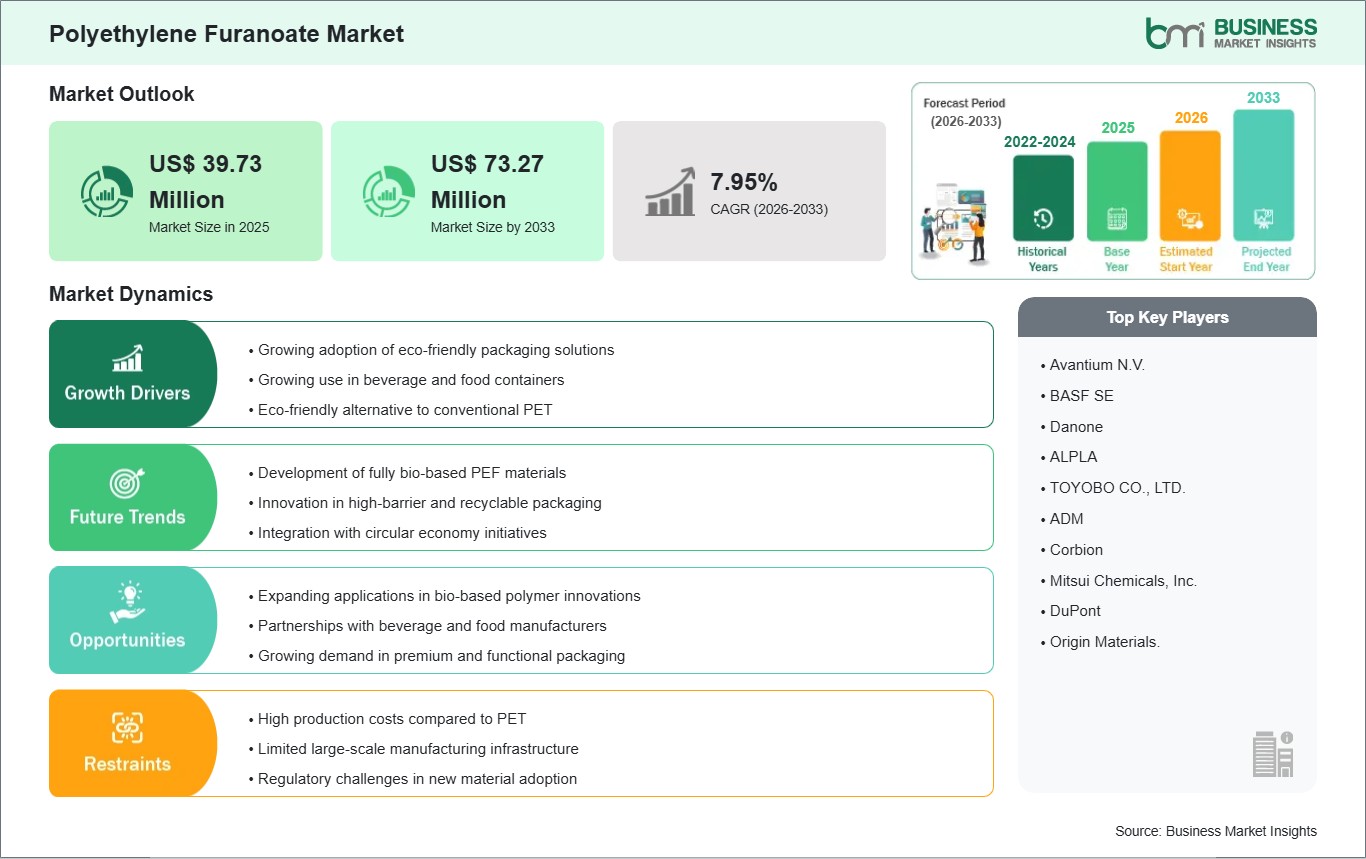
The Polyethylene Furanoate Market size is expected to reach US$ 73.27 million by 2033 from US$ 39.73 million in 2025. The market is estimated to record a CAGR of 7.95% from 2026 to 2033.
The polyethylene furanoate (PEF) market is growing steadily as industries are increasingly turning to bio-based and sustainable materials to replace traditional polyethylene terephthalate (PET) materials. PEF is a bio-based material made from renewable resources such as plant-derived sugars and provides better gas barrier properties, thermal stability, and mechanical properties compared to traditional PET materials. The PEF market is being driven by increasing environmental concerns and government regulations requiring sustainable packaging solutions and end-consumer demand for environmentally friendly products. Technological advances are another major driver of the PEF market. PEF manufacturers are constantly working on developing new and better technologies for the production of PEF materials. The development of enzymatic and chemical recycling of PEF materials is another advantage of PEF materials and provides a sustainable solution for packaging materials.
The players in the market are investing in pilot plants, increasing their production capacities, and forming strategic alliances with food and beverage companies to drive the market forward. In addition, the growing demand for bio-based films with high barriers for the electronics and pharmaceutical industries is also creating opportunities for the market to grow. The competitive landscape of the PEF market is focusing on strategic alliances, capacity expansion, and geographical expansion.
The players in the market are securing feedstock supply agreements and licensing proprietary technologies to minimize the cost of production and enhance the differentiation potential of the product. The market is still in its early stages compared to the PET market; however, the potential for the market is high with the opportunities arising from the sustainable benefits, performance advantages, and regulatory support for PEF.

Key segments that contributed to the derivation of the polyethylene furanoate market analysis are application.
Polyethylene Furanoate (PEF) is quickly becoming a material of choice in the quest for a more environmentally friendly plastic material, replacing traditional plastics in packaging applications. Being a plant-based material, PEF is in line with the current global drive towards using environmentally friendly materials in product development. The material boasts superior barrier properties, which make it suitable for food and beverage packaging, ensuring a fresh product with a long shelf life. Companies are increasingly turning to PEF as a potential material for their packaging needs, driven by the demand for a material with a reduced carbon footprint.
Apart from its superior barrier properties, PEF boasts superior thermal properties and high mechanical strength, which enable companies to manufacture a lightweight, strong material with a wide variety of manufacturing processes, such as blow molding and extrusion, making it a potential material for a wide variety of applications, from beverages to foodstuffs, in a bid to provide a sustainable solution without compromising on quality.
Consumer awareness and regulatory pressures are accelerating the adoption of bio-based materials like PEF. With growing interest in circular economy principles and the demand for recyclable and renewable packaging, PEF is positioned as a high-performance, eco-friendly polymer. Its combination of durability, sustainability, and adaptability makes it a primary driver in the transformation of the packaging industry toward greener alternatives.
The growing global focus on renewable and bio-based polymers has created substantial opportunities for Polyethylene Furanoate (PEF). Its combination of thermal stability, mechanical strength, and superior barrier performance makes it suitable for a wide variety of applications beyond packaging, including films, fibers, coatings, and specialty engineering plastics. This versatility allows manufacturers to explore sustainable alternatives across multiple sectors, from consumer goods and textiles to industrial and specialty materials, supporting environmentally responsible product innovation.
Technological advancements in PEF production, such as improved fermentation processes and chemical synthesis from plant-based sugars, have enhanced its cost efficiency and scalability. This allows for easier integration into existing polymer processing methods without requiring significant changes to production infrastructure. PEF can also be combined with bio-based composites and multilayer structures, expanding its potential for high-performance applications that require durability, flexibility, and environmental sustainability. These properties make it a valuable material for companies aiming to develop green products while maintaining functionality.
In addition, consumer and corporate demand for environmentally friendly materials is rising, with sustainability increasingly influencing purchasing and manufacturing decisions. PEF’s potential recyclability and biodegradable characteristics position it as a promising material for companies looking to meet these expectations. The growing emphasis on bio-based, high-performance polymers presents a significant opportunity to expand PEF applications across industries, enabling manufacturers to innovate while contributing to a circular and low-carbon economy. This positions PEF as a high-growth material with long-term potential in global sustainable polymer markets.

The polyethylene furanoate market demonstrates steady growth, with size and share analysis highlighting evolving trends and competitive dynamics among key players. The report examines subsegments categorized within application, offering insights into their contribution to overall market performance.
By Application, the bottles subsegment dominated the market in 2025, driven by growing demand for sustainable packaging solutions in food and beverage and consumer goods sectors.
| Report Attribute | Details |
|---|---|
| Market size in 2025 | US$ 39.73 Million |
| Market Size by 2033 | US$ 73.27 Million |
| Global CAGR (2026 - 2033) | 7.95% |
| Historical Data | 2022-2024 |
| Forecast period | 2026-2033 |
| Segments Covered | By Application
|
|
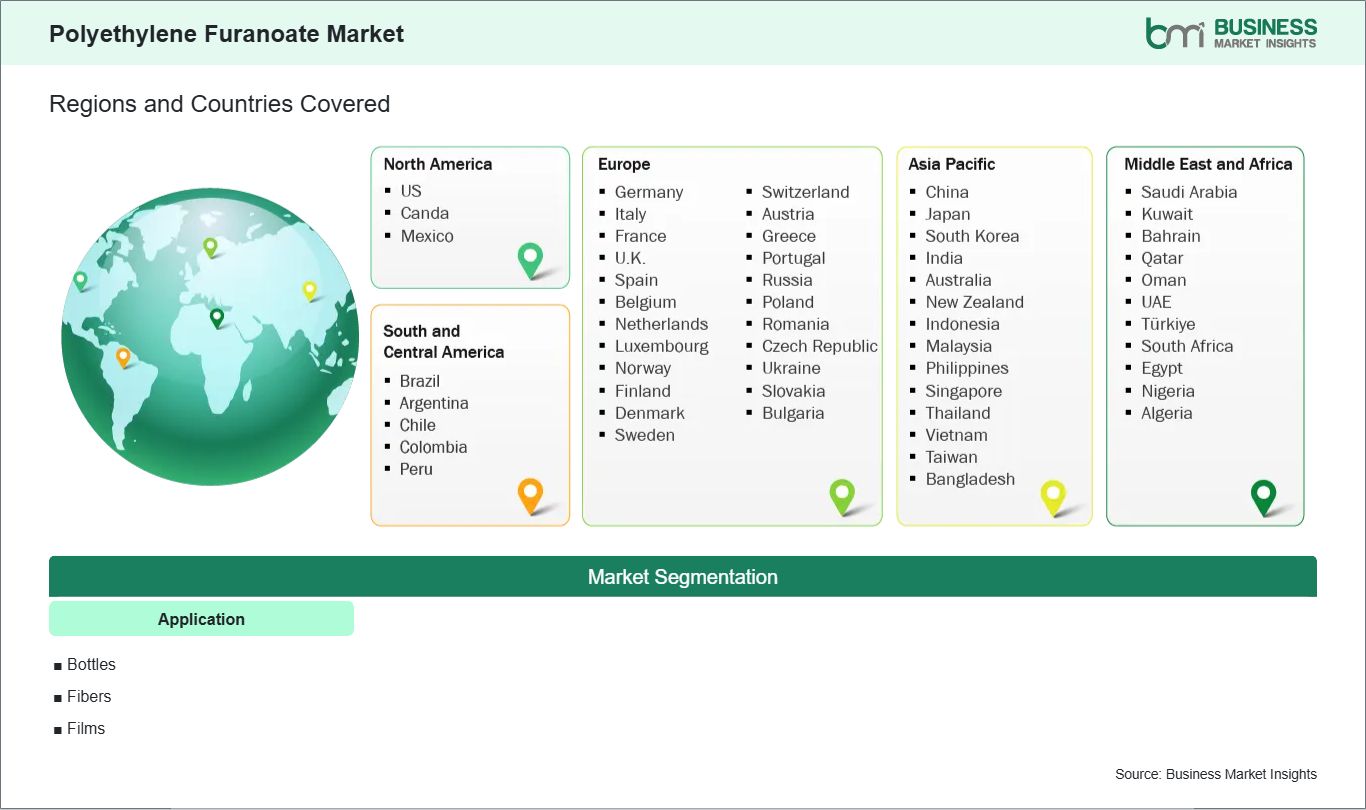
Regions and Countries Covered
| |
| North America | US, Canada, Mexico |
| Europe | Belgium, Austria, Finland, Denmark, Greece, Poland, Romania, Russia, Ukraine, Czech Republic, Slovakia, Bulgaria, Italy, Luxembourg, Germany, Switzerland, France, Netherlands, Norway, Portugal, Spain, Sweden, United Kingdom |
| Asia-Pacific | Australia, China, India, Japan, South Korea, Indonesia, Malaysia, Philippines, Singapore, Thailand, Vietnam, Bangladesh, New Zealand, Taiwan |
| South and Central America | Brazil, Argentina, Peru, Chile, Colombia |
| Middle East and Africa | Bahrain, Kuwait, Oman, Qatar, Saudi Arabia, United Arab Emirates, Turkiye, South Africa, Egypt, Algeria, Nigeria |
| Market leaders and key company profiles |
|
The "Polyethylene Furanoate Market Size and Forecast (2022 - 2033)" report provides a detailed analysis of the market covering below areas:
The geographical scope of the Polyethylene Furanoate Market report is divided into North America, Asia Pacific, Europe, Middle East & Africa, and South & Central America. North America held the largest share in 2025.
Regionally, the PEF market shows varying adoption rates influenced by industrial infrastructure, sustainability initiatives, and consumer trends. North America dominates, driven by regulatory incentives for bio-based packaging, high environmental awareness, and strong adoption in beverage and food industries. The U.S. leads in commercialization, pilot-scale plants, and collaborations with packaging and beverage companies, positioning the region as a key early adopter. Innovation in high-barrier films and specialty applications further strengthens North America’s market dominance.
In the Asia Pacific, rapid urbanization, rising disposable income, and expanding food and beverage sectors drive PEF demand. Countries such as China, Japan, and India are investing in bio-based polymer technologies, including pilot plants and R&D initiatives, to capture both domestic and export markets. Government incentives promoting sustainable materials are accelerating market adoption, particularly in high-volume packaging applications.
Europe emphasizes regulatory compliance and sustainability leadership, with Germany, France, and the Netherlands at the forefront. Adoption is fueled by stringent packaging regulations, extended producer responsibility mandates, and high consumer demand for eco-friendly products. Partnerships between polymer producers and multinational beverage companies are accelerating PEF deployment, particularly for carbonated drinks and specialty bottles.
The Middle East & Africa market is in nascent stages, primarily driven by niche industrial and packaging applications. Investment in bio-based polymer projects and regional trade initiatives in countries such as the UAE and South Africa is gradually increasing market awareness and capacity. South & Central America is developing steadily, with Brazil and Argentina exploring bio-based polymer adoption in beverage packaging and industrial films.
Government-backed sustainability initiatives and collaborations with European and North American producers are helping overcome technological and supply chain challenges, setting the stage for long-term growth in the region.

The Polyethylene Furanoate Market is evaluated by gathering qualitative and quantitative data post primary and secondary research, which includes important corporate publications, association data, and databases. A few of the key developments in the polyethylene furanoate market are:
The Polyethylene Furanoate Market is valued at US$ 39.73 Million in 2025, it is projected to reach US$ 73.27 Million by 2033.
As per our report Polyethylene Furanoate Market, the market size is valued at US$ 39.73 Million in 2025, projecting it to reach US$ 73.27 Million by 2033. This translates to a CAGR of approximately 7.95% during the forecast period.
The Polyethylene Furanoate Market report typically cover these key segments-
The historic period, base year, and forecast period can vary slightly depending on the specific market research report. However, for the Polyethylene Furanoate Market report:
The Polyethylene Furanoate Market is populated by several key players, each contributing to its growth and innovation. Some of the major players include:
The Polyethylene Furanoate Market report is valuable for diverse stakeholders, including:
Essentially, anyone involved in or considering involvement in the Polyethylene Furanoate Market value chain can benefit from the information contained in a comprehensive market report.
Please tell us your area of interest
(Market Segments/ Regions and Countries/ Companies)