
Lithium Ion Battery Market Outlook: Size, Share, Trends, Growth Analysis, Competitive Landscape & Forecast, 2026-2033

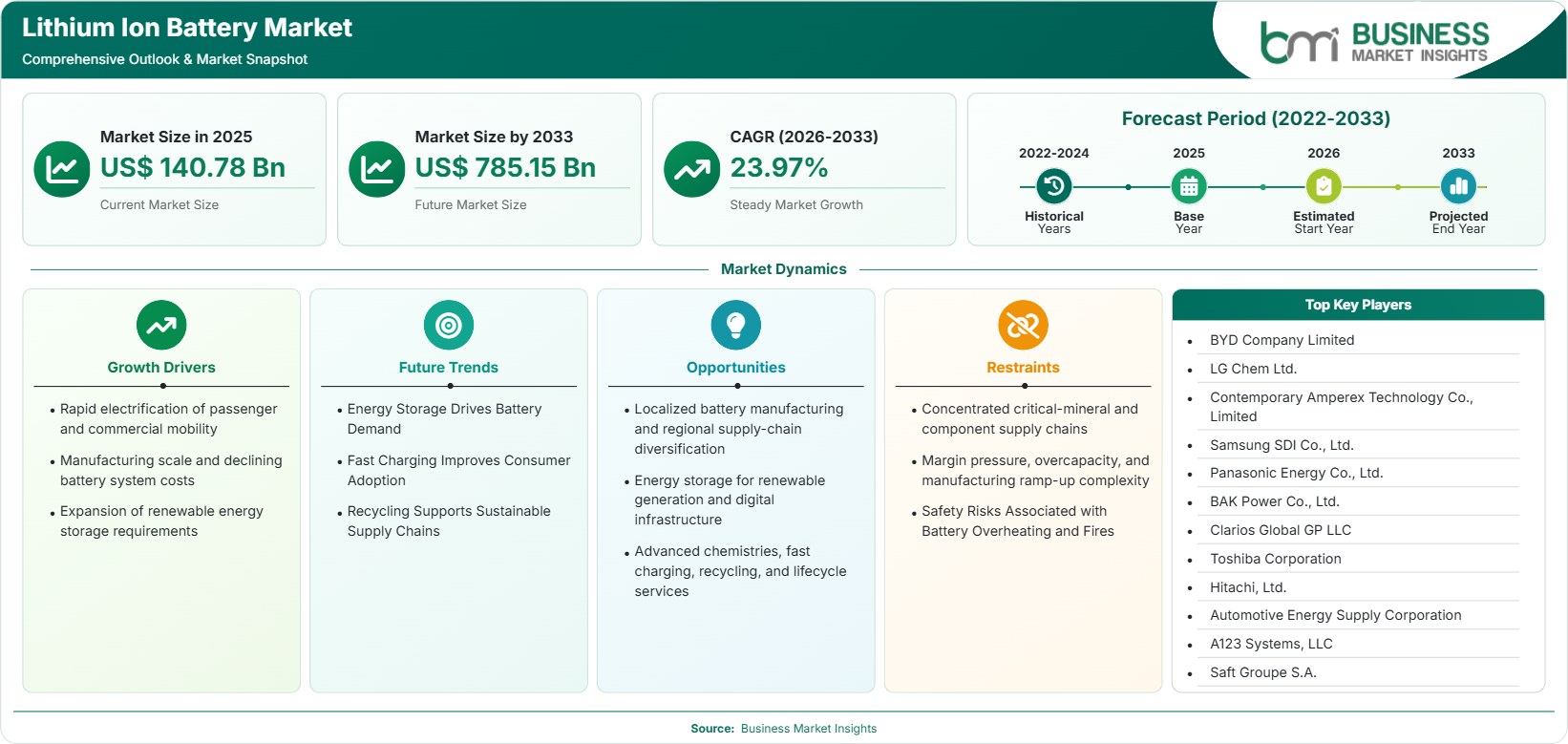
The Lithium Ion Battery Market size was valued at US$ 140.78 Billion in 2025 and is projected to reach US$ 785.15 Billion by 2033, growing at a CAGR of 23.97% during 2026–2033, driven by electric mobility, grid storage, manufacturing scale, fast charging, and battery innovation.

Report Coverage
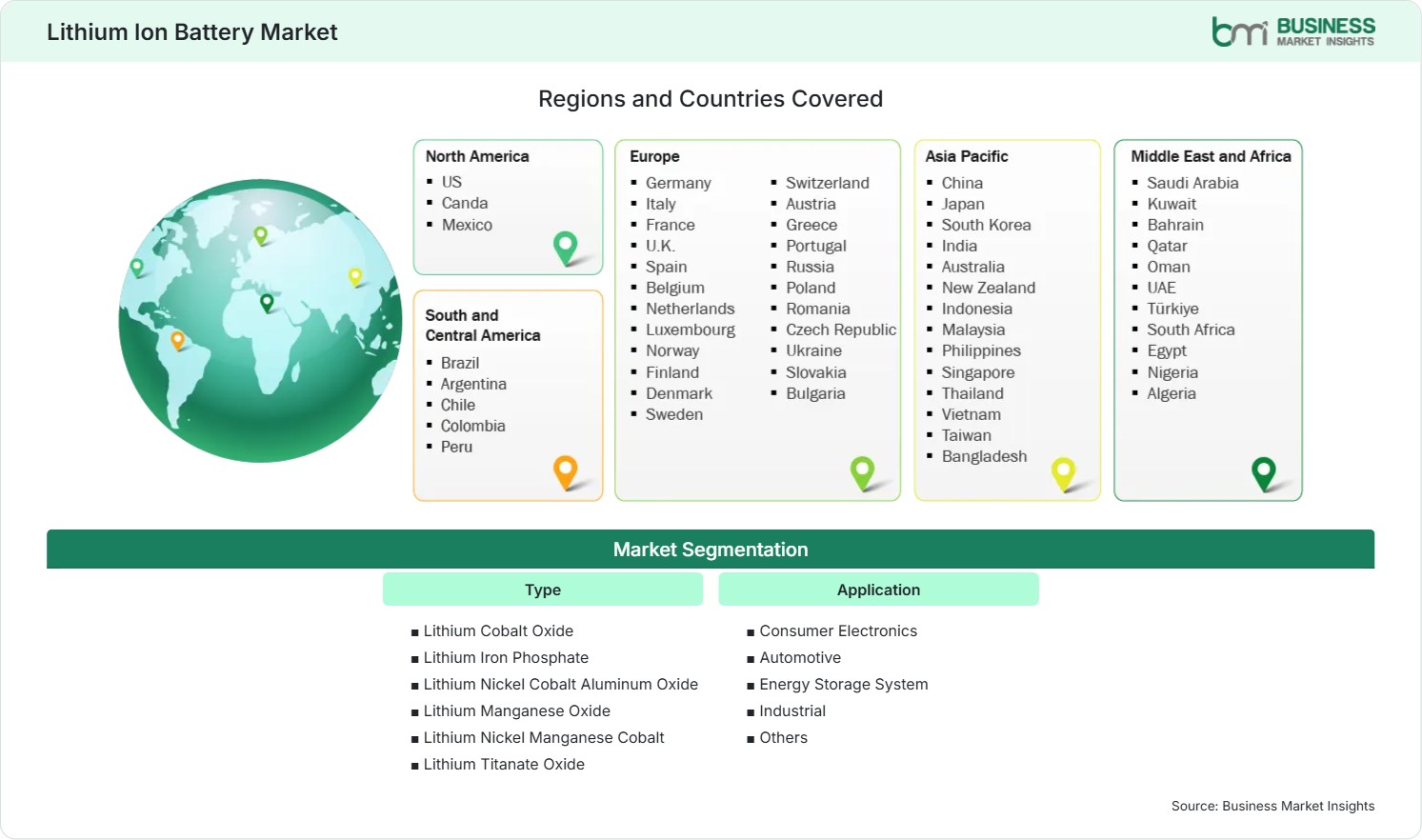
  • Type: Lithium Cobalt Oxide, Lithium Iron Phosphate, Lithium Nickel Cobalt Aluminum Oxide, Lithium Manganese Oxide, Lithium Nickel Manganese Cobalt, Lithium Titanate Oxide
  • Application: Consumer Electronics, Automotive, Energy Storage System, Industrial, Others
US$ 140.78 Bn Market size in 2025
US$ 785.15 Bn Market Size by 2033
23.97% CAGR, 2026 - 2033
2026-2033 Forecast Period

AI Overview

Lithium Ion Battery Market Summary

  • North America Region: North America holds a modeled market share of 18%–21% in 2025, growing at a 20%–23% CAGR from 2026–2033, supported by domestic battery manufacturing, EV investments, energy storage deployment, and supply-chain localization initiatives. The US remains the regional anchor, with automotive electrification, domestic cell production, and grid-scale storage sustaining 21%–24% CAGR through 2033.
  • Fastest Growing Region: Asia Pacific holds a modeled 52%–56% share in 2025 and is projected to expand at a 25%–28% CAGR from 2026–2033, supported by Chinese manufacturing scale, expanding Indian EV adoption, Japanese technology, Korean cell production, energy storage investments, and increasingly integrated regional supply chains.
  • Leading Segment: Automotive holds a modeled 58%–62% share in 2025 and is projected to grow at a 25%–28% CAGR from 2026–2033, supported by EV penetration, commercial electrification, falling cell costs, larger battery packs, fast charging, and expanding electric mobility infrastructure.
  • High Growth Segment: Energy Storage System holds a modeled 12%–15% share in 2025 and is projected to grow at a 28%–31% CAGR from 2026–2033, driven by renewable integration, peak shaving, data-center power requirements, grid balancing, and declining battery system costs.
  • Key Market Opportunity: Battery demand from renewable integration, electric commercial vehicles, autonomous mobility, data centers, and distributed storage creates opportunities for high-cycle cells, safer chemistries, modular systems, recycling, and lifecycle services.
  • Major Market Players: BYD Company Limited; LG Chem Ltd.; Contemporary Amperex Technology Co., Limited; Samsung SDI Co., Ltd.; Panasonic Energy Co., Ltd.; BAK Power Co., Ltd.; Clarios Global GP LLC; Toshiba Corporation; Hitachi, Ltd.; Automotive Energy Supply Corporation; A123 Systems, LLC; Saft Groupe S.A.
Strategic Insights

Lithium Ion Battery Market: Strategic Insights

Lithium Ion Battery Market Strategic Framework
FREE PDF
Request your free sample
Request free sample
Stakeholder View

Key Takeaways

  • Cell economics increasingly depend on integrated access to lithium, cathode and anode materials, manufacturing equipment, formation systems, software, recycling, and downstream vehicle or storage platforms. IEA identifies China as the dominant upstream and cell-production hub.
  • Automotive remains the largest demand pool, while stationary storage is gaining strategic importance as renewable generation and electricity-demand volatility increase. Battery demand for the energy sector reached 1 TWh in 2024, according to IEA.
  • LFP is moving deeper into mainstream mobility because of cost and material advantages, while NMC continues to support applications requiring higher energy density. Silicon-enhanced anodes, fast charging, thermal management, and battery intelligence are becoming key differentiation areas.
  • India, Southeast Asia, Europe, and North America offer attractive localization opportunities because manufacturers and governments seek to reduce exposure to concentrated Asian supply chains while supporting domestic EV and energy-storage ecosystems.
  • Capital allocation is moving toward gigafactories, precursor materials, recycling, battery software, and energy-storage integration. Companies with manufacturing scale, strong automotive relationships, and proprietary process technology are better positioned to withstand margin pressure.
  • Competitive advantage increasingly extends beyond cell chemistry to lifecycle management, charging infrastructure, battery swapping, digital monitoring, recycling, and financing. This broadens the addressable value chain for specialized suppliers.
Geographic Outlook

Lithium Ion Battery Market Regional Highlights

North America Lithium Ion Battery Market

North America represented a modeled 18%–21% Lithium Ion Battery Market share in 2025 and is projected to register 20%–23% CAGR from 2026–2033. US  investments underpin regional manufacturing of batteries, whereas Canadian and Mexican involvement is linked to minerals and components production as well as assembly of vehicles. Localization strategies have helped in attracting plants, yet cost competitiveness is still an issue compared to Asian battery manufacturers. Opportunities in the region now range from automotive cells, stationary storage, backup of data centers, recycling, and equipment manufacturing.

  • Domestic gigafactory construction is strengthening regional supply security, with Korean and Japanese manufacturers contributing substantially to capacity expansion.
  • EV adoption and commercial-vehicle electrification are increasing demand for high-capacity cells, durable thermal systems, and faster charging architectures.
  • Grid storage is becoming an additional demand engine as renewable penetration and electricity-load volatility increase across major US markets.
  • Mexico provides a manufacturing bridge between North American automotive production and battery supply chains, supporting localization and logistics efficiency.

US Lithium Ion Battery Market

The US represented approximately 72%–78% of the North American Lithium Ion Battery Market demand in 2025 and is projected to expand at a 21%–24% CAGR from 2026–2033. Automotive remains the largest application, while stationary storage and data-center infrastructure provide additional demand. Domestic manufacturing capacity is expanding, but imported materials and components remain important. The US market, therefore, combines strong downstream demand with continuing pressure to localize critical minerals, cathodes, anodes, recycling, and advanced cell manufacturing.

  • US battery manufacturing capacity expanded rapidly in 2025, although achieving high utilization and competitive unit economics remains critical for new facilities.
  • Energy storage is gaining relevance as data-center electricity requirements increase and utilities require flexible capacity for peak demand management.
  • Battery recycling and material recovery provide opportunities to reduce dependence on imported minerals and create secondary supply streams.

Europe Lithium Ion Battery Market

Europe held a modeled 17%–20% Lithium Ion Battery Market share in 2025 and is forecast to grow at a 22%–25% CAGR from 2026–2033. Germany remains a leading automotive and battery-production center, while Hungary and Poland support established cell manufacturing. France, Spain, and the United Kingdom offer additional growth opportunities. Chinese manufacturers are increasing their European presence, while European policymakers emphasize strategic autonomy, recycling, and localized production. Competitive pressure will increasingly favor producers capable of combining scale, automation, and low-carbon manufacturing.

  • Germany is positioned as a leading regional hub because of its automotive manufacturing base and expanding battery ecosystem.
  • Poland and Hungary remain important production locations, supported by established cell plants and proximity to European vehicle manufacturers.
  • France and Spain offer growth potential through EV manufacturing, battery investment, renewable deployment, and industrial policy support.
  • Chinese battery producers are expanding European manufacturing and market participation, increasing competitive pressure on regional manufacturers.

Asia Pacific Lithium Ion Battery Market

Asia Pacific accounted for a modeled 52%–56% Lithium Ion Battery Market share in 2025 and is projected to achieve the fastest 25%–28% CAGR from 2026–2033. China remains the dominant production and demand center, while South Korea and Japan provide advanced cell technologies. India is emerging rapidly through domestic EV manufacturing and energy storage. Southeast Asia offers additional manufacturing opportunities. China accounted for more than 80% of global battery cell production in 2025, confirming the region’s structural advantage.

  • China combines mineral processing, active materials, cell manufacturing, battery equipment, EV production, and recycling, creating substantial cost and scale advantages.
  • India is emerging as a high-growth geography as domestic EV production, renewable integration, and local battery manufacturing accelerate.
  • South Korea and Japan retain strong positions in high-performance cells, automotive partnerships, materials technology, and manufacturing equipment.
  • Southeast Asia is attracting investment as manufacturers seek diversified production locations and proximity to rapidly expanding EV markets.

Rest of World Lithium Ion Battery Market

Rest of World represented a modeled 6%–9% Lithium Ion Battery Market share in 2025 and is projected to grow at 20%–23% CAGR from 2026–2033. South and Central America benefit from lithium resources, renewable energy, and EV adoption. The Middle East and Africa are developing opportunities in grid storage, distributed power, electric mobility, and industrial electrification. Brazil, Chile, Mexico, Saudi Arabia, and the United Arab Emirates are among the more compelling investment markets because of resources, infrastructure, or policy support.

South and Central America offer upstream and downstream potential, particularly where lithium resources, renewable generation, and automotive manufacturing intersect. Brazil’s growing electrification ecosystem provides a regional demand base. Middle Eastern markets are increasingly focused on storage, renewable integration, and industrial decarbonization, while Africa offers long-term potential for distributed energy systems and mineral-linked battery value chains.

  • Chile and Brazil provide attractive opportunities around lithium resources, renewable power, electric mobility, and battery-material development.
  • Saudi Arabia and the United Arab Emirates are developing energy-storage opportunities alongside broader clean-energy investment programs.
  • Mexico remains strategically important for North American automotive and battery supply-chain localization.
  • India, Brazil, and Southeast Asian markets demonstrate how emerging economies can accelerate LFP adoption through lower-cost EV platforms.
Global Market Geography
FREE PDF
Request your free sample
Request free sample
Segment Analysis

Lithium Ion Battery Market Segmentation

Type

The Type segment is led by Lithium Iron Phosphate and Lithium Nickel Manganese Cobalt chemistries across different applications. The segment structure reflects trade-offs between cost, energy density, safety, cycle life, and material availability. Automotive demand favors chemistry optimization, while stationary storage increasingly favors durable, cost-efficient architectures. The overall Type segment remains technology-diverse through 2033.

  • Lithium Cobalt Oxide: Remains important in compact electronics because of high energy density, established manufacturing, and mature supply chains, although material cost and thermal considerations constrain broader automotive adoption.
  • Lithium Iron Phosphate: Benefits from lower material costs, safety, long cycle life, and strong suitability for EVs and storage. IEA estimates LFP represented nearly half of global EV battery demand in 2024.
  • Lithium Nickel Cobalt Aluminum Oxide: Supports high-energy automotive and specialized applications where energy density, range, and power performance justify higher material complexity and tighter thermal-management requirements.
  • Lithium Manganese Oxide: Offers strong power capability and thermal characteristics for selected mobility, medical, and industrial applications, while its comparatively lower cycle life limits broader deployment.
  • Lithium Nickel Manganese Cobalt: Remains important for high-energy EV platforms and premium applications requiring greater range, with manufacturers focusing on lower cobalt intensity, higher nickel content, and improved safety.
  • Lithium Titanate Oxide: Serves applications requiring exceptional cycle life, rapid charging, and strong low-temperature performance, including specialized transportation, industrial equipment, and grid-support systems.

Application

Application demand is dominated by Automotive, while Consumer Electronics remains a mature and technology-intensive market. Energy Storage System represents the highest-growth opportunity because renewable generation, grid flexibility, and data-center power requirements are expanding. Industrial applications benefit from electrification, automation, material-handling equipment, and backup-power requirements. Application diversification should strengthen through 2033.

  • Consumer Electronics: Demand remains concentrated in smartphones, laptops, wearables, tablets, cameras, and portable devices, with manufacturers prioritizing compact formats, energy density, safety, and faster charging.
  • Automotive: Represents the leading application with the strongest scale advantage, driven by battery-electric vehicles, hybrids, commercial fleets, electric trucks, and expanding charging infrastructure.
  • Energy Storage System: Gains momentum from solar and wind integration, grid balancing, peak shaving, backup power, and data centers, creating demand for long-cycle, high-safety battery systems.
  • Industrial: Adoption spans forklifts, automated guided vehicles, robotics, telecommunications backup, industrial equipment, and specialized mobility, supported by electrification and operational-efficiency requirements.
Market Forces

Lithium Ion Battery Market Dynamics

Key Market Drivers

Rapid electrification of passenger and commercial mobility

Electric vehicles continue to be the main demand driver. According to the report from the International Energy Agency, the total number of EV battery installations in 2025 was 1.2 TWh, which is a 30% increase from the previous year, whereby the light duty vehicle batteries take up 85% of the installations. The electric trucks became the category with the highest growth rate in battery demand. Lithium Ion Battery Market trends seem to lean towards the adoption of LFP for cost-sensitive applications and NMC for range-focused ones. Car manufacturers are also looking into localized sources for their batteries, vertical integration, and long-term purchasing arrangements.

Manufacturing scale and declining battery system costs

Manufacturing scale is improving cell economics through larger plants, automation, standardized formats, process optimization, and integrated supply chains. IEA reported that lithium-ion battery pack prices fell 20% in 2024, the largest decline since 2017, as mineral prices weakened and competition intensified. Low cost will result in lower prices for the electric vehicle market and make storage more economical. The Chinese producers certainly have many strengths in terms of integration from raw materials, machines, cell manufacturing, and applications. With growing capacity, producers are differentiating themselves with their output performance, energy density, quick charge, temperature stability, digital quality management, and recycling technology.

Expansion of renewable energy storage requirements

Grid modernization is broadening battery demand beyond transportation. Solar and wind energy need flexibility options such as moving electricity, grid stabilization, load management, and backup power generation. The use of batteries in EVs and battery energy storage surpassed the 1 TWh mark in 2024, as per the IEA. Another important consideration is the data center, since its computing activities need robust power architectures. High cycle life and long-duration applications are driving higher-format cells based on LFP chemistry, thermal solutions, energy management, and modular storage solutions. This widens the potential market for the cell, system, software, recycling, and infrastructure industries.

Key Market Opportunities

Localized battery manufacturing and regional supply-chain diversification

Regionalization creates investment opportunities across cells, cathode materials, anodes, separators, electrolyte production, recycling, equipment, and testing. China accounted for more than 80% of global battery cell production in 2025, while Europe and the US each represented only 6%–7%. This concentration creates strategic incentives for domestic manufacturing. The Lithium Ion Battery Market Forecasts indicate that there will be more capacity outside China despite the challenge of reaching competitive utilization levels. Companies seeking to enter a new region will benefit from alliances within the auto industry, government inducements, and vertical coordination of materials procurement.

Energy storage for renewable generation and digital infrastructure

Stationary storage offers a major growth pathway because renewable generation is expanding while electricity networks face rising flexibility requirements. Data centers constitute yet another area of opportunity as AI workloads drive energy usage. Batteries can deliver backup power, peak shaving, demand response, and renewable integration. Suppliers offering both the cells and the battery management system, along with thermal management, power electronics, control software, and end-of-life services, have the opportunity to realize greater margins compared to those that offer cells alone. The opportunity is especially potent in regions with grid congestion, renewables, and energy price volatility.

Advanced chemistries, fast charging, recycling, and lifecycle services

Innovation is shifting toward chemistry optimization rather than a single universal cell technology. LFP is set to gain widespread mainstream adoption, but NMC is still important for energy-demanding uses. Manganese-based cathodes, silicon-optimized anodes, sodium-ion cells, improved electrolyte designs, and solid-state battery designs might contribute to the diversification of technologies in the future. On the other hand, recycling provides another pathway through which lithium, nickel, cobalt, manganese, and other materials can be recovered. IEA notes the presence of a concentrated supply of purified phosphoric acid and manganese sulfate as emerging threats.

Market Restraints and Challenges

Concentrated critical-mineral and component supply chains

Factor: Battery manufacturing remains highly dependent on geographically concentrated processing and component capacity. China produced more than 80% of global battery cells in 2025 and about 85% of cathode active material used in electric-car batteries.

Impact: Factors such as trade barriers, logistics problems, shortage of minerals, or political tensions may lead to increased expenses and project delays outside the existing production centers. Diversification demands large investments, suppliers, expertise, and a long-term qualification period. This is especially challenging in the case of LFP due to the even greater concentration of the supply chain for its cathode and cells.

Margin pressure, overcapacity, and manufacturing ramp-up complexity

Factor: The expansion of capacity and stiff competition may lead to excess capacity in the manufacturing sector, pricing pressure, and poor use of facilities. According to IEA, global manufacturing capacity surpassed 4 TWh in 2025 whereas Chinese capacity continued to exceed demand needs.

Impact: New entrants could face challenges in generating profitable yields despite the rapid growth in demand. The plants will take many years to reach their nominal yields, thus making utilization of the plants a problem. It is for this reason that firms need to first concentrate on yields, chemistry, technology, and customer contracts, among other things.

Company Analysis

Competitive Landscape

The Lithium Ion Battery Market analysis indicates a competitive structure led by vertically integrated Asian manufacturers, diversified industrial groups, and specialist battery suppliers. Competitive advantage increasingly depends on manufacturing scale, chemistry breadth, automotive relationships, energy-storage capabilities, process efficiency, geographic footprint, and recycling integration.

Company Name

Overview

Products and Services relevant to this market

BYD Company Limited

Chinese EV and battery manufacturer with vertically integrated capabilities spanning vehicles, batteries, energy storage, and electrification technologies.

Blade Battery, LFP battery systems, EV batteries, energy-storage systems, battery packs, and integrated electrification solutions.

LG Chem Ltd.

South Korean chemical and materials company with extensive battery-material expertise and long-standing automotive-industry relationships.

Cathode materials, battery materials, advanced chemical inputs, and technologies supporting lithium-ion cell manufacturing.

Contemporary Amperex Technology Co., Limited

Major Chinese battery manufacturer serving global automotive and energy-storage customers through large-scale production and technology development.

EV battery cells, LFP and NMC technologies, energy-storage batteries, battery systems, fast-charging platforms, and lifecycle services.

Samsung SDI Co., Ltd.

South Korean battery producer focused on automotive, energy-storage, and electronic-device applications with strong cell-development capabilities.

Prismatic and cylindrical lithium-ion cells, EV batteries, energy-storage systems, and advanced battery materials.

Panasonic Energy Co., Ltd.

Japanese battery specialist supplying automotive, industrial, consumer, and energy-storage applications with advanced cylindrical-cell capabilities.

Cylindrical lithium-ion batteries, industrial batteries, consumer cells, battery modules, storage systems, and automotive battery technologies.

BAK Power Co., Ltd.

Chinese battery manufacturer specializing in cylindrical and other lithium-ion battery technologies for mobility and industrial applications.

Cylindrical lithium-ion cells, battery packs, EV batteries, energy-storage products, and customized battery solutions.

Clarios Global GP LLC

Global battery technology company serving automotive and mobility applications with expertise in energy management and battery systems.

Automotive batteries, advanced energy-storage solutions, battery management technologies, and vehicle power systems.

Toshiba Corporation

Japanese technology company developing battery technologies emphasizing safety, durability, rapid charging, and industrial performance.

SCiB lithium-ion batteries, industrial storage systems, transportation batteries, and high-cycle energy solutions.

Hitachi, Ltd.

Japanese technology and infrastructure company supporting energy, mobility, digital, and industrial applications through integrated systems.

Battery systems, energy-storage technologies, digital monitoring, industrial power solutions, and mobility-related battery applications.

Automotive Energy Supply Corporation

Japanese battery company focused on automotive lithium-ion technologies and vehicle electrification requirements.

Automotive lithium-ion battery cells, modules, battery systems, and technologies supporting electric and hybrid vehicles.

A123 Systems, LLC

US-based battery technology company known for lithium-ion solutions emphasizing power density, safety, and demanding mobility applications.

Lithium-ion cells, battery modules, energy-storage systems, automotive batteries, and specialized power solutions.

Saft Groupe S.A.

French battery manufacturer serving industrial, transportation, aviation, defense, and energy-storage markets with advanced battery systems.

Lithium-ion battery systems, industrial storage, transportation batteries, aviation solutions, energy storage, and specialized power systems.

Trust & Transparency

Research Methodology

The market analysis combines proprietary research with secondary data from government agencies, company disclosures, regulatory filings, industry databases and expert interviews. Market estimates are validated through data triangulation, cross-market benchmarking and analyst review.

View Full Research Methodology

Questions Answered

Frequently Asked Questions

What technologies could complement lithium-ion batteries?

Sodium-ion, manganese-rich cathodes, silicon-enhanced anodes, and solid-state technologies could complement established lithium-ion architectures. CATL, for example, has moved sodium-ion technology toward commercial-scale deployment, illustrating increasing chemistry diversification.

How important is battery recycling?

The Medical Devices Market Report highlights that Recycling can recover valuable materials, reduce exposure to primary mineral supply disruptions, support regulatory compliance, and create secondary feedstocks. Its strategic importance will increase as larger numbers of EV batteries reach end-of-life and manufacturers pursue circular supply chains.

Which factor will influence battery pricing most?

Battery pricing will increasingly depend on mineral costs, manufacturing utilization, process yields, chemistry, regional labor and energy costs, equipment efficiency, and competitive intensity. High manufacturing capacity can support lower prices but may also compress producer margins.

Why is LFP becoming more important?

LFP offers strong safety, long cycle life, and lower reliance on nickel and cobalt. Its cost advantages have supported wider use in electric cars and stationary storage, with LFP approaching half of the global EV battery market

What is the main application driving battery demand?

Automotive applications represent the dominant demand source because EV sales, larger battery packs, commercial electrification, electric trucks, and charging infrastructure are expanding simultaneously. IEA reported that EV batteries accounted for more than 70% of total battery deployment in 2025.

Access the Full Lithium Ion Battery Market Report

Get segment-level forecasts, regional estimates, competitive benchmarking, company profiles and downloadable Excel datasets.

Access the full Lithium Ion Battery Market Report
350 pages PDF & Excel | 2026-09-22
Similar Research

Related Market Reports