
Sodium Ion Battery Market Outlook: Size, Share, Trends, Growth Analysis, Competitive Landscape & Forecast, 2026–2033

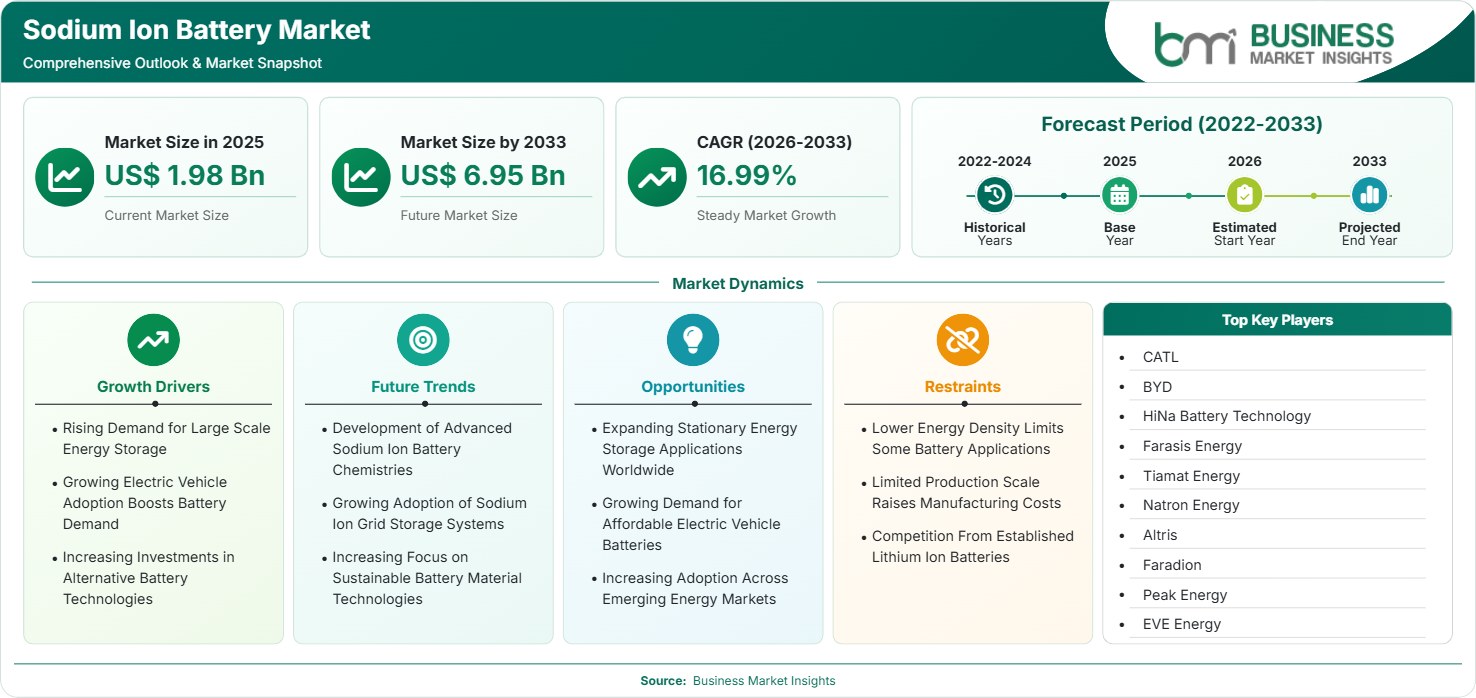
The Sodium Ion Battery Market size was valued at US$ 1.98 billion in 2025 and is projected to reach US$ 6.95 billion by 2033, growing at a CAGR of 16.99% during 2026–2033. Falling dependence on critical minerals, grid storage expansion, electric mobility, and alternative battery technology investment are creating opportunities.

Report Coverage
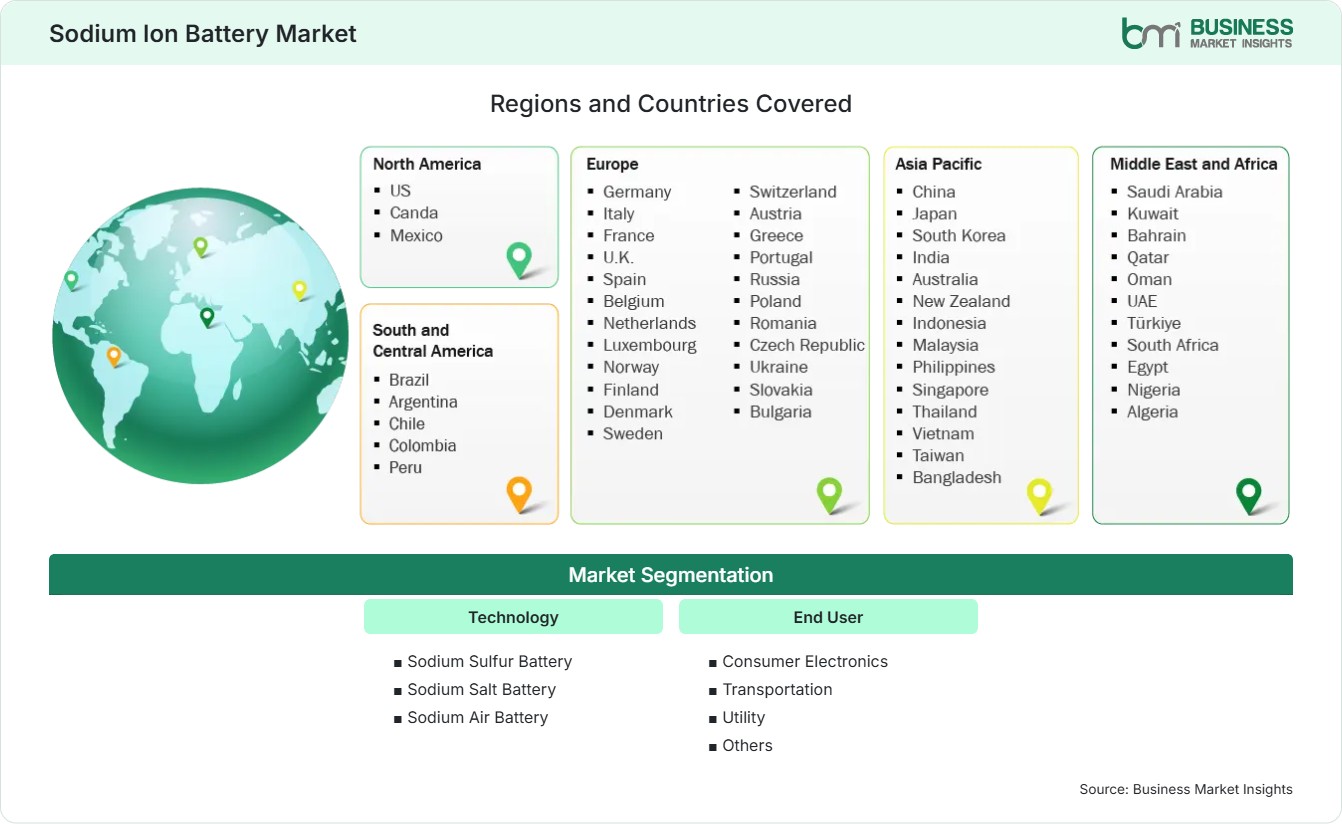
  • Technology: Sodium Sulfur Battery, Sodium Salt Battery, Sodium Air Battery
  • End User: Consumer Electronics, Transportation, Utility, Others
US$ 1.98 Bn Market size in 2025
US$ 6.95 Bn Market Size by 2033
16.99% CAGR, 2026 - 2033
2026-2033 Forecast Period

01 AI Overview

Sodium Ion Battery Market Summary

  • North America Region: North America holds a 15%–19% share in 2025 and is projected to grow at a 15.8%–17.0% CAGR through 2033, supported by grid-scale storage deployment, domestic battery investment, renewable integration, supply-chain diversification, and demand for cost-efficient storage technologies. The United States remains the principal contributor and is projected to grow at a 16.0%–17.2% CAGR.
  • Fastest Growing Region: Asia Pacific holds a 48%–54% share in 2025 and is projected to grow at a 18.0%–19.2% CAGR through 2033, supported by battery manufacturing expansion, electric mobility, renewable power integration, industrial-scale storage, and efforts to diversify lithium-based supply chains.
  • Leading Segment: Sodium Salt Battery holds a 44%–48% Sodium Ion Battery Market share in 2025 and is projected to grow at a 16.5%–17.4% CAGR through 2033, supported by scalable cell architectures, cost advantages, stationary storage suitability, and increasing industrial interest in alternative battery chemistries.
  • High Growth Segment: Transportation is projected to grow at a 18.0%–19.3% CAGR through 2033, supported by electric mobility expansion, demand for lower-cost batteries, improved cold-weather performance, and increasing interest in diversified battery chemistries.
  • Key Market Opportunity: Grid storage, low-cost electric mobility, renewable integration, domestic battery manufacturing, and applications requiring reduced dependence on lithium and other constrained materials create attractive opportunities for sodium-based battery developers.
  • Major Market Players: Contemporary Amperex Technology Co., Limited; BYD Company Limited; HiNa Battery Technology Co., Ltd.; Farasis Energy; Tiamat Energy; Natron Energy, Inc.; Altris AB; Faradion Limited; Peak Energy; EVE Energy Co., Ltd.
02 Strategic Insights

Sodium Ion Battery Market: Strategic Insights

Sodium Ion Battery Market Strategic Framework
FREE PDF
Request your free sample
Request free sample
03 Stakeholder View

Key Takeaways

  • The value chain spans active-material suppliers, cell developers, battery manufacturers, pack integrators, electric vehicle companies, energy-storage developers, power-system operators, and recycling specialists.
  • Stationary storage and cost-sensitive transportation applications provide the strongest commercial upside because they can accommodate chemistry trade-offs while benefiting from resource diversification and potentially lower material costs.
  • Technology development is focusing on improving energy density, cycle life, charging behavior, low-temperature performance, safety, and manufacturing compatibility with established battery production infrastructure.
  • Asia Pacific offers the strongest investment case because battery manufacturing capabilities, electric mobility ecosystems, renewable deployment, and industrial policy are converging around alternative cell chemistries.
  • Investment activity is increasingly directed toward pilot-scale production, cathode material development, cell manufacturing capacity, battery-pack integration, and commercial validation rather than laboratory-stage chemistry development alone.
  • Competitive positioning will depend on achieving consistent cell quality and manufacturing economics while demonstrating application-specific advantages over lithium-ion technologies.
04 Geographic Outlook

Sodium Ion Battery Market Regional Highlights

North America Sodium Ion Battery Market

North America represents 15%–19% of global demand in 2025 and is projected to grow at a 15.8%–17.0% CAGR through 2033. The region benefits from grid-storage investment, renewable integration, battery supply-chain diversification, and increasing interest in domestically produced alternatives. The United States dominates regional activity through energy-storage development and expanding battery technology investment.

  • Grid-scale storage developers are evaluating sodium-based cells where cost, safety, and material availability provide advantages over conventional battery chemistries.
  • Domestic battery manufacturing initiatives are encouraging investment in alternative chemistries and localized supply chains for stationary and mobility applications.
  • Renewable power expansion is increasing demand for economical storage technologies capable of supporting intermittent generation and grid balancing requirements.
  • Electric mobility developers are assessing sodium-based solutions for applications where range requirements allow greater emphasis on affordability and supply-chain resilience.

US Sodium Ion Battery Market

The United States represents approximately 70%–75% of North American demand in 2025 and is projected to grow at a 16.0%–17.2% CAGR through 2033. Grid modernization, renewable deployment, domestic battery manufacturing, and energy-security priorities support adoption. Commercial validation is increasingly focused on stationary storage and transportation applications where sodium-based chemistry can address specific cost and supply-chain requirements.

  • Utility-scale storage provides an important application because stationary systems can tolerate lower energy density than passenger vehicles.
  • Domestic manufacturing initiatives are encouraging development of alternative battery supply chains and reducing dependence on concentrated overseas production.
  • Renewable integration is strengthening demand for economical long-duration and grid-balancing storage technologies.

Europe Sodium Ion Battery Market

Europe accounts for 18%–22% of global demand in 2025 and is projected to grow at a 15.5%–16.7% CAGR through 2033. Germany, France, the United Kingdom, and Nordic markets are important contributors, while France and Germany provide strong high-growth opportunities through battery manufacturing, renewable integration, and electric mobility investments.

  • Germany remains a leading market due to automotive manufacturing capabilities, battery investment, and demand for diversified energy-storage technologies.
  • France represents a high-growth opportunity through battery innovation, industrial policy, and increasing interest in alternative cell chemistries.
  • European developers are assessing sodium-based batteries for stationary applications where lower material costs can improve project economics.
  • Automotive manufacturers are evaluating alternative chemistries for selected vehicle categories where range requirements are compatible with sodium-based cells.

Asia Pacific Sodium Ion Battery Market

Asia Pacific represents 48%–54% of global demand in 2025 and is projected to grow at a 18.0%–19.2% CAGR through 2033. China, India, Japan, and South Korea lead regional activity, with China providing the strongest manufacturing ecosystem. India represents a high-growth opportunity through electric mobility, renewable energy expansion, and battery localization.

  • China maintains a leading position through extensive battery manufacturing infrastructure, electric vehicle production, and large-scale energy-storage development.
  • India is emerging as a high-growth market as electric mobility and stationary storage create demand for cost-sensitive battery technologies.
  • Japan and South Korea provide opportunities through advanced battery research, industrial expertise, and diversification of cell chemistry portfolios.
  • Southeast Asian markets are expanding battery demand alongside renewable power deployment, electric mobility, and industrial electrification.

Rest of World Sodium Ion Battery Market

Rest of World represents 9%–13% of global demand in 2025 and is projected to grow at a 14.7%–16.0% CAGR through 2033. Latin America, the Middle East, and Africa are developing opportunities through renewable energy, grid expansion, electric mobility, and increasing interest in affordable energy-storage solutions.

Latin American markets offer opportunities where renewable generation and grid reliability requirements create demand for economical storage. Middle Eastern markets are evaluating alternative batteries alongside large renewable energy projects, while African markets provide longer-term potential through electrification and distributed energy systems.

  • Renewable projects are creating demand for storage solutions that can support variable solar and wind generation.
  • Emerging economies may favor sodium-based systems where affordability and material availability are prioritized over maximum energy density.
  • Industrial and commercial storage applications can provide early opportunities before widespread passenger vehicle adoption.
  • Local assembly and regional partnerships could improve project economics and reduce dependence on imported battery systems.
Global Market Geography
FREE PDF
Request your free sample
Request free sample
05 Segment Analysis

Sodium Ion Battery Market Segmentation

Technology

Sodium Salt Battery represents the leading technology category with a 44%–48% share in 2025 and a 16.5%–17.4% CAGR through 2033. Its commercial potential is supported by scalable chemistry, stationary-storage suitability, material availability, and growing industry interest in alternatives to lithium-based systems.

  • Sodium Sulfur Battery: Sodium sulfur systems support high-temperature energy-storage applications and provide opportunities where stationary storage requires extended-duration operation and efficient grid-level energy management.
  • Sodium Salt Battery: Sodium salt chemistry supports scalable battery development, cost-sensitive applications, and stationary storage requirements where material availability and operational safety are important considerations.
  • Sodium Air Battery: Sodium air technology remains an emerging category, with research focused on improving energy density, reversibility, cycle stability, and long-term commercial viability.

End User

Transportation represents the leading end-user category with a 38%–42% share in 2025 and a 18.0%–19.3% CAGR through 2033. Electric mobility provides strong demand potential because sodium-based batteries can address selected vehicle applications where affordability, safety, and supply-chain diversification are prioritized over maximum range.

  • Consumer Electronics: Consumer electronics provide selective opportunities for sodium-based cells in applications where safety, material availability, and cost can compensate for lower energy density.
  • Transportation: Transportation applications benefit from growing electric mobility and demand for affordable battery technologies, particularly for urban vehicles, commercial fleets, and shorter-range platforms.
  • Utility: Utility applications are well suited to sodium-based storage because stationary installations can prioritize cost, safety, cycle performance, and supply-chain availability over compact energy density.
  • Others: Other applications include industrial backup systems, commercial storage, microgrids, and specialized power systems requiring reliable alternative battery chemistry.
06 Market Forces

Sodium Ion Battery Market Dynamics

Key Market Drivers

Rising Demand for Large Scale Energy Storage

Energy storage solutions are gaining more relevance as electricity networks continue to rely on higher amounts of intermittent renewable energy sources. Sodium-based batteries present another solution for stationary installations, where energy density is not critical as it is in the case of mobile batteries. The benefits of cost-effectiveness and lower reliance on lithium-containing supply chains can promote the deployment of sodium-ion batteries among energy storage providers. It is, therefore, clear that the Sodium Ion Battery Market growth is highly linked to the grid flexibility needs, renewable energy integration, and the necessity for diversified energy storage solutions. Improvements in cell longevity, safety, operational characteristics, and installation are being made by manufacturers to satisfy the needs of utilities.

Growing Electric Vehicle Adoption Boosts Battery Demand

The growth of electric vehicle use will increase the need for global storage capacity of rechargeable batteries, at the same time promoting a diversification of chemical compositions in the market. Sodium cells will create an alternative for particular types of cars in which low price, safety, and abundance of material are significant criteria. This type of battery will be especially relevant for small cars, commercial fleets, urban transport, and applications with modest range demands. Car manufacturers will assess how the chemical composition can be aligned to the car design and not apply one type of battery to all types of cars. The focus of the Sodium Ion Battery Market analysis will be the economic relevance of particular applications, manufacturing, charging, and logistics.

Increasing Investments in Alternative Battery Technologies

Investments in alternative batteries will drive innovations in chemistry which will be able to solve problems of cost, availability of raw materials, safety, and stationary energy storage needs. Sodium-based batteries will greatly benefit from the whole industry's trend toward minimizing the dependency on lithium and diversifying battery supplies. Companies developing cell designs, electrodes, manufacturing technologies, and energy storage architecture are working toward making it more commercially attractive. The Sodium Ion Battery Market forecast indicates growing interest in applications in which low cost, availability of raw materials, and safety are more important than lower energy density. Further research will make improvements in the areas of performance, charging features, and integration into the system, thus giving a reason to consider sodium-ion batteries.

Key Market Opportunities

Expanding Stationary Energy Storage Applications Worldwide

The growing use of stationary energy storage solutions is providing openings for the use of sodium-ion batteries in terms of grid balancing, renewable energy storage, backup power, and distributed energy storage systems. The Sodium Ion Battery Market Trend is being increasingly driven by the growing need for economic storage solutions, which can be used alongside lithium-ion solutions where energy density is not an important aspect. Sodium-ion batteries may be able to provide certain benefits in terms of material source, safety aspects, and diversity of the supply chain. Furthermore, expansion in renewable energy capacity is fostering investments in advanced storage systems that can cope with intermittency issues. This is especially true for markets looking to diversify their batteries’ sources of supply and develop economically viable long-duration storage systems.

Growing Demand for Affordable Electric Vehicle Batteries

The promise of affordable electric cars offers a chance for new battery chemistries that can decrease reliance on more expensive or less available raw materials. Sodium-based batteries can be especially suitable for small passenger cars, two/three wheelers, city mobility solutions, and commercial vehicles where adequate range is sufficient. These segments could be addressed by optimizing the price of the battery pack, charging properties, cold weather operation, and cycle life rather than maximizing the energy density of batteries alone. Collaboration with the automotive industry would help validate this technology by finding appropriate vehicles for sodium battery chemistry. Suppliers capable of delivering high-quality batteries at automotive quantities will increase the chances of success.

Increasing Adoption Across Emerging Energy Markets

There are emerging energy market possibilities where there is a rise in demand for energy, in addition to the development of renewable energy, industrialization, and needs related to grid development. Sodium-based batteries would serve well in areas of distributed energy storage, back-up systems, micro-grids, and renewable energy applications where the cost and supply of materials are important factors. There are ways to develop such markets with the use of modular designs, which would make it easier to install and scale up. Local assembly agreements could lower logistics costs and give access to energy programs supported by the government. The suppliers of such batteries should focus on applications that can clearly yield economic gains and avoid directly replacing all batteries.

Market Restraints and Challenges

Lower Energy Density Limits Some Battery Applications

Factor: Sodium-based batteries generally provide lower gravimetric energy density than leading lithium-ion technologies, creating packaging and range constraints in applications where battery weight and volume are critical. Impact: Lower energy density can restrict adoption in long-range passenger vehicles, premium mobility platforms, and compact electronics requiring maximum stored energy. Developers can address this limitation through improved electrode materials, cell architecture, pack optimization, and application-specific design. However, increasing energy density can introduce additional material and manufacturing complexity. Commercialization is therefore more attractive in stationary storage and selected mobility applications where physical battery size is less restrictive. Continued research into cathode chemistry, anode structures, electrolytes, and cell engineering remains essential for expanding the addressable market.

Limited Production Scale Raises Manufacturing Costs

Factor: Sodium-based battery manufacturing remains less mature than established lithium-ion production, resulting in limited economies of scale, specialized material supply requirements, and fewer fully optimized manufacturing lines. Impact: Lower production volumes can increase unit costs and make sodium-based systems less competitive until commercial scale improves. Manufacturers must achieve consistent cell quality while building supply networks for active materials, separators, electrolytes, and other components. Production ramp-up also requires validation of equipment compatibility, quality-control processes, and long-term reliability. Strategic partnerships can help reduce capital requirements and accelerate manufacturing learning curves. As volumes increase, process standardization and greater supplier competition could improve economics, but achieving cost parity remains dependent on sustained commercial deployment and manufacturing scale.

07 Company Analysis

Competitive Landscape

The competitive environment is shaped by cell chemistry development, manufacturing scale, material sourcing, energy-storage partnerships, automotive validation, and production economics. The Sodium Ion Battery Market report indicates that participants are pursuing differentiated strategies across stationary storage, electric mobility, and alternative battery materials. Competitive advantage increasingly depends on demonstrating reliable cell performance, scalable production, application-specific economics, and compatibility with established battery manufacturing infrastructure.

Company Name

Overview

Products and Services relevant to this market

Contemporary Amperex Technology Co., Limited

Major battery manufacturer with broad expertise in rechargeable cells, battery systems, and electric mobility technologies.

Sodium-ion battery cells, battery packs, energy-storage systems, cell technologies, and battery integration solutions.

BYD Company Limited

Integrated electric mobility and battery company with capabilities spanning battery manufacturing and vehicle technologies.

Sodium-ion battery technologies, battery packs, electric vehicle systems, energy-storage products, and battery integration.

HiNa Battery Technology Co., Ltd.

Battery technology company focused on commercialization and development of sodium-ion battery systems.

Sodium-ion cells, battery systems, energy-storage solutions, and sodium-based battery technology development.

Farasis Energy

Battery technology developer specializing in advanced rechargeable cells and energy-storage applications.

Sodium-based battery development, advanced battery cells, energy-storage systems, and mobility-oriented battery technologies.

Tiamat Energy

Battery technology company developing sodium-ion solutions for high-performance and specialized applications.

Sodium-ion cells, battery technologies, high-power solutions, and advanced energy-storage applications.

Natron Energy, Inc.

Battery technology company focused on sodium-ion systems designed for high-power and stationary applications.

Sodium-ion batteries, energy-storage systems, data-center power solutions, and industrial battery technologies.

Altris AB

European battery technology company specializing in sodium-ion cathode materials and battery development.

Sodium-ion cathode materials, Prussian White technology, battery development, and material engineering solutions.

Faradion Limited

Sodium-ion battery technology developer focused on commercialization and intellectual property development.

Sodium-ion cells, battery technology, energy-storage applications, and mobility-oriented sodium battery solutions.

Peak Energy

Energy-storage company focused on deploying sodium-ion systems for grid-scale applications.

Sodium-ion grid-storage systems, stationary energy storage, battery systems, and storage project solutions.

EVE Energy Co., Ltd.

Battery manufacturer providing rechargeable cells and energy-storage technologies across multiple applications.

Sodium-ion battery development, energy-storage cells, battery systems, electric mobility solutions, and advanced cell technologies.

10 Trust & Transparency

Research Methodology

The market analysis combines proprietary research with secondary data from government agencies, company disclosures, regulatory filings, industry databases and expert interviews. Market estimates are validated through data triangulation, cross-market benchmarking and analyst review.

View Full Research Methodology

11 Questions Answered

Frequently Asked Questions

What does the Sodium Ion Battery Market report indicate about future competition?

The report indicates that competition will focus on manufacturing scale, energy density, cycle life, safety, material sourcing, automotive validation, and stationary-storage economics. Companies demonstrating reliable commercial performance and scalable production are positioned to strengthen their market positions.

Why are stationary storage applications creating new opportunities for sodium-based batteries?

Stationary systems place less emphasis on compact energy density than mobile applications. This allows sodium-based batteries to compete on cost, safety, material availability, cycle performance, and supply-chain diversification while supporting renewable integration and grid flexibility.

How are alternative battery chemistries influencing sodium-ion battery adoption?

Alternative chemistries are encouraging manufacturers to diversify battery portfolios and match specific technologies with application requirements. Sodium-based cells benefit from growing interest in resource availability, safety, manufacturing scalability, and reduced exposure to lithium-centered supply chains.

Which applications present the strongest opportunity in the market?

Stationary energy storage, urban electric mobility, commercial fleets, microgrids, and cost-sensitive electric vehicles present strong opportunities. These applications can accommodate the technology's energy-density limitations while benefiting from potential material-cost and supply-chain advantages.

What factors are improving Sodium Ion Battery Market return on investment?

Grid-scale storage expansion, electric mobility growth, supply-chain diversification, renewable integration, and interest in lower-cost battery materials are improving investment potential. Sodium-based technologies can create value in applications where safety, resource availability, and cost are prioritized over maximum energy density.

Access the Full Sodium Ion Battery Market Report

Get segment-level forecasts, regional estimates, competitive benchmarking, company profiles and downloadable Excel datasets.

Access the full Sodium Ion Battery Market Report
350 pages PDF & Excel | 2026-08-19