
Lipid Nutrition Market Outlook: Size, Share, Trends, Growth Analysis, Competitive Landscape & Forecast, 2026-2033

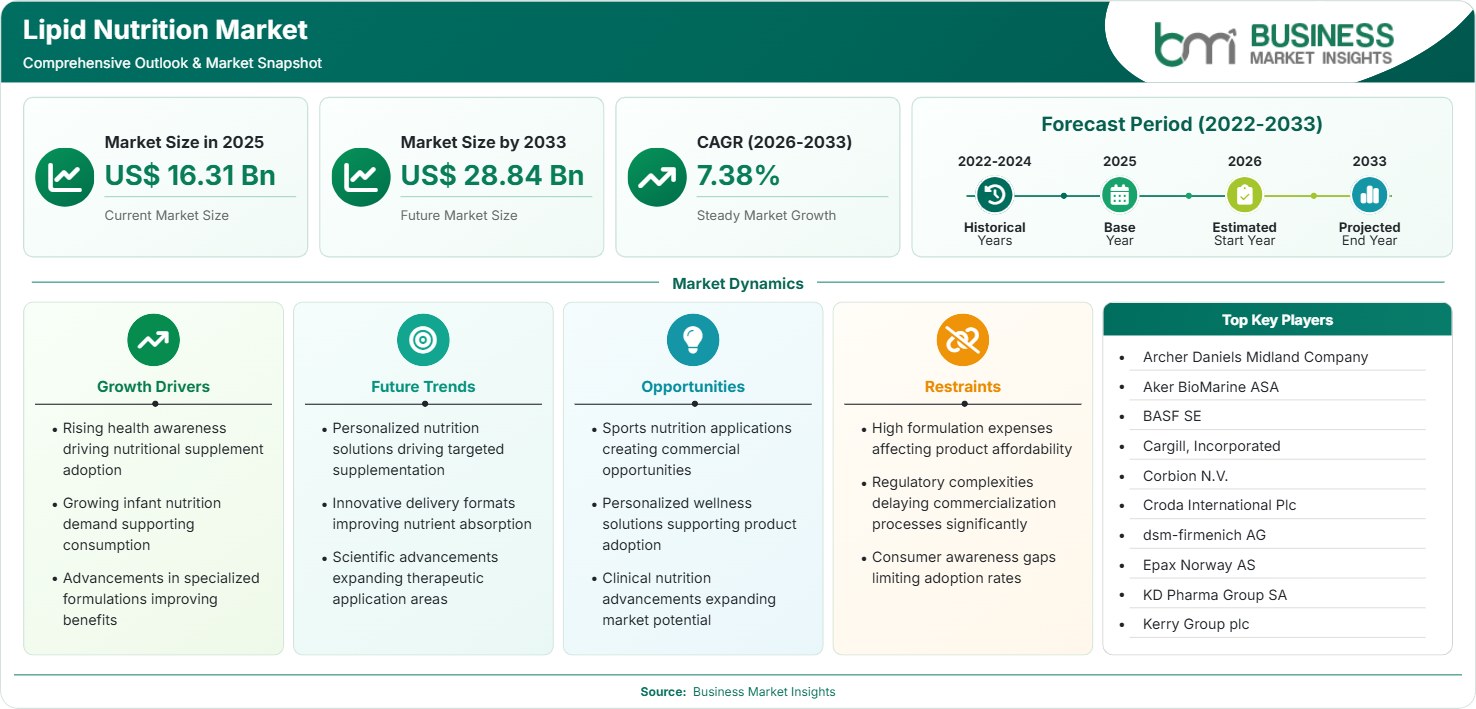
The Lipid Nutrition Market size was valued at US$ 16.31 Billion in 2025 and is projected to reach US$ 28.84 Billion by 2033, growing at a CAGR of 7.38% during 2026–2033, driven by preventive nutrition, specialty formulations, clinical applications, sustainable sourcing, and expanding opportunities in functional foods and personalized nutritional products.

Report Coverage
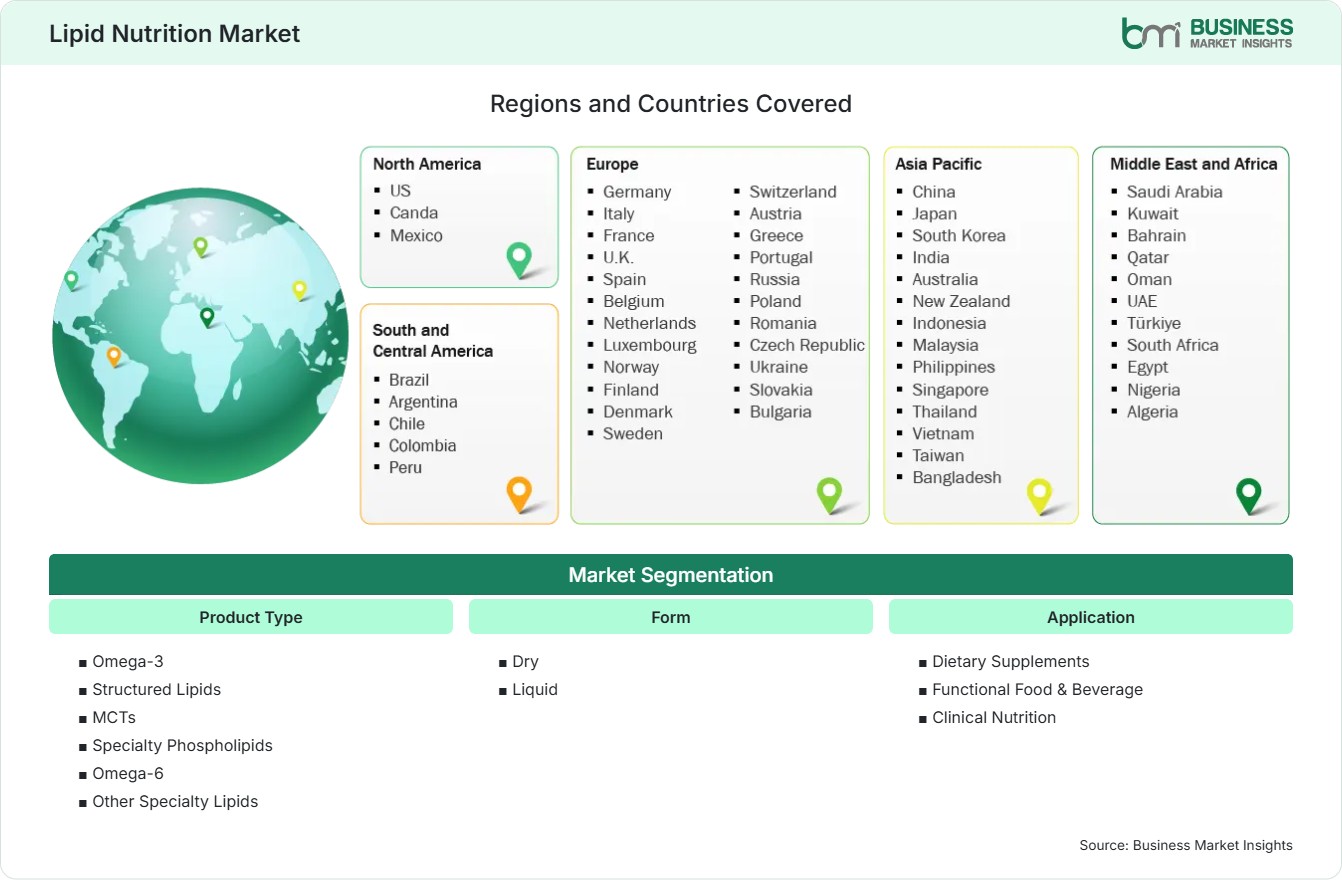
  • Product Type: Omega-3, Structured Lipids, MCTs, Specialty Phospholipids, Omega-6, Other Specialty Lipids
  • Form: Dry, Liquid
  • Application: Dietary Supplements, Functional Food & Beverage, Clinical Nutrition
US$ 16.31 Bn Market size in 2025
US$ 28.84 Bn Market Size by 2033
7.38% CAGR, 2026 - 2033
2026-2033 Forecast Period

AI Overview

Lipid Nutrition Market Summary

  • North America Region: North America holds a 35%–38% Lipid Nutrition Market share in 2025 and is growing at a CAGR of 6.8%–7.3%, supported by supplement consumption, clinical nutrition demand, advanced encapsulation, algae-derived ingredients, and premium cardiovascular and cognitive health formulations. The United States grows at 6.9%–7.4% through established nutraceutical channels and innovation in concentrated, traceable, clinically positioned specialty lipid ingredients.
  • Fastest Growing Region: Asia Pacific holds a 24%–27% Lipid Nutrition Market share in 2025 and is advancing at a CAGR of 8.8%–9.5%, driven by urbanization, rising incomes, preventive healthcare awareness, infant nutrition demand, local manufacturing investments, and expanding functional food distribution.
  • Leading Segment: Omega-3 holds a 38%–42% share in 2025 and grows at a CAGR of 7.6%–8.3%, supported by cardiovascular, cognitive, maternal, infant, and healthy-aging applications, alongside continued investment in purification, concentration, algae-based production, and bioavailability technologies.
  • High Growth Segment: Clinical Nutrition holds a 19%–23% Lipid Nutrition Market share in 2025 and expands at a CAGR of 8.7%–9.4%, as healthcare providers increasingly require specialized formulations supporting critical care, oncology, recovery, malabsorption management, and nutrition delivery across aging populations.
  • Key Market Opportunity: Sustainable algae-derived omega-3 and precision-formulated specialty lipids create opportunities for suppliers able to combine traceability, clinical substantiation, scalable fermentation, improved stability, vegetarian positioning, and customized delivery formats.
  • Major Market Players: Archer Daniels Midland Company, Aker BioMarine ASA, BASF SE, Cargill, Incorporated, Corbion N.V., Croda International Plc, dsm-firmenich AG, Epax Norway AS, KD Pharma Group SA, and Kerry Group plc.
Strategic Insights

Lipid Nutrition Market: Strategic Insights

Lipid Nutrition Market Strategic Framework
FREE PDF
Request your free sample
Request free sample
Stakeholder View

Key Takeaways

  • The industry operates through a complex value chain spanning marine and plant feedstocks, fermentation, extraction, purification, concentration, encapsulation, formulation, and branded finished products. Competitive advantage increasingly depends on controlling critical stages where quality consistency, oxidation prevention, traceability, and application performance create measurable customer value.
  • Dietary supplements remain the largest commercial outlet, but clinical nutrition offers particularly attractive upside because formulation decisions depend more heavily on technical performance, safety documentation, energy density, and specialized fatty-acid profiles than on conventional commodity ingredient pricing.
  • Innovation is shifting toward algae-derived omega-3, phospholipid-bound ingredients, structured triglycerides, concentrated EPA and DHA systems, and improved delivery technologies. Companies able to improve stability and dispersibility can address food, beverage, powder, capsule, and medical applications from broader product platforms.
  • Asia Pacific presents a compelling investment case because regional demand combines population scale with growing health expenditure, expanding middle-income consumption, infant nutrition requirements, and increasing acceptance of preventive nutritional products. Local production partnerships can improve responsiveness while reducing dependence on imported finished formulations.
  • Industry consolidation is increasingly important in specialized marine lipids. Acquisitions and portfolio transfers allow companies to obtain established brands, refining capacity, customer relationships, intellectual property, and regulated production capabilities rather than building each capability independently. The transfer of marine-lipid assets has reinforced this strategic direction.
  • Sustainability is becoming a commercial qualification alongside efficacy. Algal production, responsible marine sourcing, supply-chain documentation, and alternative lipid technologies can reduce exposure to fishery constraints while helping customers address vegetarian, traceability, and environmental positioning requirements.
Geographic Outlook

Lipid Nutrition Market Regional Highlights

North America Lipid Nutrition Market

North America holds a market share of 35%–38% in 2025 and is expected to grow at a CAGR of 6.8%–7.3% through 2033. This is because of a high intake of dietary supplements, an advanced clinical nutrition system, and a high preference for high-end functional ingredients. In the case of North America, the Lipid Nutrition Market shares gain advantages owing to existing distribution channels and product innovation. Health prevention policies encourage the consumption of unsaturated and specialized fats, in accordance with guidelines of the WHO.

  • Premium supplement manufacturers increasingly prioritize concentrated EPA and DHA, phospholipid-based delivery, and clean-label excipients, encouraging ingredient suppliers to invest in higher-purity oils, dry powder technologies, and formulation systems with improved sensory and oxidative stability.
  • Clinical and healthy-aging applications support recurring demand because nutritional formulations increasingly target energy provision, inflammatory balance, recovery, and condition-specific dietary management, requiring more technically controlled lipid profiles than conventional food oils.
  • Sustainability claims are influencing purchasing decisions, accelerating interest in algae-derived alternatives and traceable marine oils. Suppliers with documented sourcing and contaminant-control systems are better positioned in premium customer programs and regulated nutritional applications.
  • Product development increasingly combines lipids with proteins, vitamins, probiotics, and other functional ingredients, creating opportunities for suppliers capable of managing ingredient compatibility, shelf stability, emulsification, and controlled release within complex finished formulations.

US Lipid Nutrition Market

The United States accounts for 78%–82% of North America's Lipid Nutrition Market and is forecast to grow at a CAGR of 6.9%–7.4% between 2026 and 2033. It derives advantage from an extensive supplement industry ecosystem, deep retail and e-commerce presence, and significant consumption of premium nutritional forms. Consumer interest goes beyond the usual fish oil supplements to more concentrated, vegetarian, clinically distinctive, and application-based products.

  • Direct-to-consumer nutrition brands support rapid product testing and category expansion, allowing specialized lipid ingredients to enter targeted cognitive health, maternal wellness, healthy-aging, sports, and lifestyle formulations through digital-first commercial channels.
  • Clinical nutrition innovation is strengthened by advanced healthcare infrastructure and specialized care settings, supporting demand for emulsions and nutritional products requiring controlled fatty-acid composition, reliable energy density, and rigorous manufacturing quality.
  • Algae-based omega-3 adoption is gaining strategic importance as manufacturers seek alternatives that address vegetarian demand and marine-supply concerns while maintaining consistent EPA and DHA delivery characteristics across premium supplement formulations.
  • Scientific differentiation remains commercially important, encouraging suppliers to invest in bioavailability studies, stability data, formulation testing, and traceability documentation that help finished-product brands justify premium positioning and distinguish specialized ingredients from standard oils.

Europe Lipid Nutrition Market

Europe accounts for 25% - 28% market share in the Lipid Nutrition Market and is expected to grow at a CAGR of 6.7% - 7.2% until 2033. Europe has mature consumption trends for supplements, along with high regulatory standards for quality ingredients, safety, and position of the product. Germany and the UK remain dominant in terms of demand, while France and Italy offer formulation opportunities. Germany is expected to grow by 6.8% - 7.3%, while the UK is expected to grow by 7.2% - 7.8%.

  • European customers increasingly evaluate suppliers on traceability, responsible sourcing, purity, and environmental performance, encouraging greater use of documented marine supply chains, certified raw materials, and emerging fermentation-based production platforms.
  • Healthy-aging demographics support demand for formulations addressing nutritional adequacy and cardiovascular and cognitive wellness, while clinical settings require specialized lipid systems with consistent quality and defined nutritional functionality.
  • Germany benefits from strong nutraceutical manufacturing and ingredient innovation, while the United Kingdom's consumer-oriented supplement market supports rapid adoption of convenient premium formats, including capsules, powders, gummies, and fortified functional products.
  • Regulatory sophistication raises entry barriers but favors technically capable suppliers that can provide contaminant specifications, oxidation data, stability documentation, and appropriate scientific support for nutritional ingredients used across multiple finished-product categories.

Asia Pacific Lipid Nutrition Market

The Asia Pacific region holds a market share of 24%-27% in 2025 and is the fastest-growing region at a CAGR of 8.8%-9.5% in 2026-2033. China and Japan have significant existing demand, whereas India has high potential for growth due to increasing supplement usage and production capabilities. The growth in China is expected to be at a CAGR of 8.5%-9.2%, and that of India at 9.4%-10.2%. Rising health awareness, urban lifestyles, infant nutrition requirements, and wider modern retail access underpin the Lipid Nutrition Market growth outlook.

  • Growing middle-income populations are expanding spending on preventive nutrition, particularly products associated with maternal health, childhood development, cardiovascular wellness, cognitive performance, and healthy aging, creating opportunities across both premium and accessible price tiers.
  • Local manufacturers increasingly seek stable ingredient partnerships and technical support, benefiting global suppliers that can provide formulation expertise, regional regulatory assistance, and dependable supply of concentrated specialty lipid ingredients.
  • Japan supports premium, science-led products, whereas China combines significant scale with fast innovation in supplements and functional foods. India provides additional momentum through rising nutraceutical awareness and increasing interest in vegetarian omega-3 alternatives.
  • Investments in regional processing and formulation can shorten lead times and improve product customization. Fermentation and algae-based production also offer strategic routes to reduce dependence on geographically concentrated marine-resource supply chains.

Rest of World Lipid Nutrition Market

Rest of the World holds an 11%-14% share in 2025 and is forecasted to record a CAGR of 7.4%-8.1% up until 2033. South and Central America is boosted by growth in supplement distribution, with Brazil emerging as the leading regional Lipid Nutrition Market and growing at 7.5%-8.2%. The Middle East and Africa have emerged as premium nutrition and clinically oriented regions. The United Arab Emirates and Saudi Arabia are amongst the fastest-growing regions, thanks to investments in healthcare and growing health expenditure amongst consumers.

The opportunities in South and Central America include the development of locally made products, the expansion of retailers, and the recognition of the importance of preventive health care services, whereas the opportunities in the Middle East lie in their premium buying power and their investments in state-of-the-art healthcare facilities. Africa's consumption is irregular but promising for the future.

  • Brazil's scale and established supplement industry create opportunities for marine oils, MCTs, and specialty blends, although currency movements and imported raw-material exposure can influence procurement strategies and finished-product pricing.
  • Gulf markets support premium nutritional formulations through strong private healthcare, modern pharmacy networks, and wellness consumption. Specialized clinical and healthy-aging products offer differentiated opportunities beyond conventional mass-market supplements.
  • Local partnerships are increasingly important because regulatory requirements, consumer preferences, distribution structures, and pricing vary considerably across developing markets, making standardized global commercialization less effective than regionally adapted ingredient and formulation strategies.
  • Suppliers entering these regions can benefit from technology transfer and co-development arrangements, particularly where domestic manufacturers possess market access but require expertise in oxidation control, emulsification, encapsulation, concentration, and specialized nutritional applications.
Global Market Geography
FREE PDF
Request your free sample
Request free sample
Segment Analysis

Lipid Nutrition Market Segmentation

Product Type

Product Type represents the largest differentiation in the industry, wherein Omega-3 enjoys a 38% - 42% market share in 2025, growing at a 7.6% - 8.3% CAGR until 2033. Adoption is determined by application-related functionality, scientific positioning, availability of raw materials, and sustainability. The Lipid Nutrition Market is expanding in terms of scope, since structured lipids, MCTs, phospholipids, and specialty fatty acid systems meet specific nutrition needs.

  • Omega-3: Demand is supported by supplement, functional food, maternal, and healthy-aging applications, while suppliers improve concentration, bioavailability, oxidation resistance, and sourcing through fish, krill, algae, and fermentation-derived production.
  • Structured Lipids: These ingredients address controlled nutritional and metabolic functions through tailored fatty-acid arrangements, supporting infant, clinical, sports, and specialty formulations requiring application-specific performance beyond conventional edible oils.
  • MCTs: Medium-chain triglycerides benefit from demand for rapidly metabolized energy, ketogenic products, sports nutrition, and convenient powdered formats, supported by formulation innovation that improves dispersibility and sensory performance.
  • Specialty Phospholipids: Growth is linked to premium delivery, brain-health, clinical, and infant applications where membrane-related functionality, emulsification performance, and differentiated ingredient composition justify higher-value product positioning.
  • Omega-6: Demand remains connected to essential fatty-acid nutrition and broader food applications, although product development increasingly emphasizes balanced fatty-acid profiles and quality differentiation rather than simple volume expansion.

Form

Form choice is determined by production needs, shelf stability, efficiency in transportation, sensory considerations, and the final product form. The dry form accounts for 46%-50% of the total market share in 2025 and is projected to grow at a 7.9%-8.6% CAGR through 2033 in the Lipid Nutrition Market due to the popularity of powder-based formulations.

  • Dry: Encapsulated powders support easier handling and integration into tablets, sachets, nutrition powders, and functional foods, with microencapsulation helping protect sensitive fatty acids from oxidation and processing-related degradation.
  • Liquid: Liquid formats remain important for softgel filling, beverages, emulsions, medical nutrition, and direct oil consumption, particularly where high loading, rapid blending, and established manufacturing processes are commercially advantageous.

Application

The demand for applications is becoming more diverse, driven by consumer wellness, formulation science, and medical needs. The dietary supplements segment takes the lion’s share, accounting for 44%–48% of the applications in 2025 and expected to record the highest CAGR of 7.4%–8.0% in the Lipid Nutrition Market until 2033. Clinical nutrition is the fastest-growing application at 8.7%–9.4%.

  • Dietary Supplements: Supplements remain the principal outlet for concentrated omega-3, MCT, phospholipid, and specialty lipid products, supported by convenient dosage forms, direct-to-consumer marketing, and increasingly targeted health-positioning strategies.
  • Functional Food & Beverage: Fortified foods and beverages require stable, neutral-tasting ingredients with effective dispersion, creating opportunities for encapsulation and emulsification technologies that enable nutritional enhancement without compromising sensory quality.
  • Clinical Nutrition: Specialized products require controlled composition and reliable quality for hospital, recovery, elderly, and condition-specific nutritional support, encouraging demand for high-purity ingredients and technically validated lipid systems.
Market Forces

Lipid Nutrition Market Dynamics

Key Market Drivers

Preventive Nutrition and Demand for Higher-Quality Dietary Fats

According to WHO, diet quality is vital in the prevention of malnutrition and diet-induced noncommunicable diseases, but the need to substitute unhealthy saturated and trans fatty acids with more nutritious unsaturated fatty acids cannot be understated. It is said that fat is an integral component of cell functioning, and that linoleic acid and alpha-linolenic acids must be derived through the diet. This contributes to the growth environment of the Lipid Nutrition Market growth through focusing on fatty acid profile and not just fat consumption. Some of the initiatives adopted by manufacturers include the use of omega-3 concentrates, phospholipids, and structural lipids. The increased consumer demand for preventive nutrition creates further opportunities.

Expansion of Supplements and Application-Specific Formulations

The supplement market is shifting away from basic oils towards differentiated ingredients, necessitating higher concentrations, improved sensory properties, dry forms, and targeted delivery systems. The Lipid Nutrition Market trends will be supported by products formulated for particular life stages and nutritional demands such as pregnancy, infancy, sports, cognitive health, and healthy aging. Microencapsulation technologies are used to preserve oxidation sensitive ingredients and provide an opportunity for the inclusion of ingredients into powder formulations. Application-specific formulation adds more value to technical services, as the customer would need help with dosage, stability, emulsification, and ingredient interactions.

Sustainable Sourcing and the Shift Toward Algae-Derived Ingredients

Sustainability is changing the approach towards raw material sourcing due to customers' search for alternatives to traditional reliance on marine supplies. The algal omega-3 platforms can offer vegetarian sourcing, control over production and ingredient properties, while resolving issues associated with traceability and ecosystem impact. According to DSM-Firmenich, there was continued growth of the algal life’sOMEGA range in 2025 and the development of products according to customer specifications. This serves as an example of the trend towards fermentation and alternative sources. Sustainable sourcing enables the satisfaction of additional customer requirements. Businesses able to combine both gain a competitive edge in premium categories.

Key Market Opportunities

Personalized and Precision Nutrition Formulations

Personalized nutrition provides opportunities to develop lipid systems tailored to age, preferences, lifestyles, metabolic needs, and product formulation requirements. Instead of supplying a ready-made stock of oils, suppliers may provide customized ratios of EPA/DHA, structured triglycerides, phospholipid compositions, and formulation methods for each unique product concept. According to the Lipid Nutrition Market Forecasts, suppliers who engage in application science, digital nutrition platforms, and co-development have promising opportunities in the future. The precision nutrition approach will also help suppliers develop premium clinical or healthy aging products where nutritional value is more important than commodity quantity.

Clinical and Healthy-Aging Nutrition Platforms

The increased need for specialized nutrition creates an opportunity to move beyond standard wellness supplements into hospital, recovery, and aged care nutrition, as well as clinically based nutritional requirements. Such segments place value on the controlled composition, energy density, stability, purity, and consistent availability of the ingredients used in the process. Specialty lipids may provide a basis for developing unique formulas by combining them with proteins, vitamins, and other nutrition-based ingredients. Ageing demographics make the market for products designed for maintaining adequate nutrition and consumption even more commercially viable. Providers of specialty lipids with experience in regulatory and formulation documentation can enter into more profitable relationships with clinical nutrition producers.

Regional Manufacturing and Algae-Based Capacity Expansion

Regional processing, along with alternative production, may be an approach to addressing both supply security and new market demand at once. Regional processing will help to minimize complexity of logistics, engage customers into product development, and accommodate products to local regulations. Algae-based production may offer further advantages in situations where vegetarian status, traceability, and supply diversification matter. Recent developments in the industry demonstrate its continued interest in alternative omega-3 solutions and related technical capabilities. The development in Asia may prove especially beneficial due to the simultaneous growth in demand for supplements and functional foods, as well as in manufacturing capabilities.

Market Restraints and Challenges

Raw-Material Volatility and Supply-Chain Concentration

Factor: Availability of marine feedstock can be influenced by fisheries management, environmental factors, seasonality, and geographical concentration, while specialty processing requires technical control and refining/purification capabilities. Impact: Price fluctuation and shortage risk may drive up acquisition costs, disrupt production scheduling, and threaten margins of the ingredient supplier as well as the finished product producer. Other sources, such as algae and fermentation, can mitigate some of the dependency, but developing such technologies requires investment, expertise, and favorable production economics. The consumer may also encounter reformulation problems in the event of a change in the lipid source due to sensory, concentration, and stability issues.

Oxidation, Stability, and Regulatory Compliance Requirements

Factor: There are many polyunsaturated lipid components that are oxidizable and need proper management throughout the process of extraction, processing, encapsulation, storing, and production of final products. Impact: Degradation may cause issues with sensory quality, shelf-life, and performance of the product, leading to increased quality control expenses and chances of batch rejection or product reformulation. In addition, regulatory considerations necessitate proper documentation with respect to safety, purity, contaminants, labeling, and substantiation. Such demands can be even more difficult for smaller manufacturers who lack the sophisticated analytical capabilities. Encapsulation, oxygen management, packaging, and stability tests still need investment.

Company Analysis

Competitive Landscape

The competitive environment is moderately concentrated but remains technically diverse. This Lipid Nutrition Market analysis reflects competition across feedstock access, marine and algae sourcing, purification, encapsulation, formulation support, specialty applications, and global distribution. Recent portfolio transactions indicate continued consolidation around high-value omega-3 and marine-lipid capabilities.

Company Name

Overview

Products and Services relevant to this market

Archer Daniels Midland Company

Global agricultural and nutrition company with extensive ingredient-processing capabilities and broad relationships across food, beverage, and nutrition markets.

Specialty nutritional ingredients, plant-based components, formulation support, processing expertise, and ingredients serving food, beverage, supplement, and broader health and wellness applications.

Aker BioMarine ASA

Marine biotechnology specialist focused on krill-based nutritional ingredients and integrated sourcing, processing, research, and commercialization capabilities.

Krill oil, phospholipid-bound omega-3 ingredients, Superba portfolio solutions, and specialty marine nutrition ingredients for supplements, food, pharmaceutical, and related applications.

BASF SE

Global chemicals company with established expertise in nutrition-related specialty ingredients and formulation technologies, including historical leadership in omega-3 processing.

Nutrition ingredients, specialty lipids, formulation technologies, and related technical capabilities, although its Food and Health Performance Ingredients business was acquired by Louis Dreyfus Company.

Cargill, Incorporated

Global food and ingredient company with extensive agricultural sourcing, processing, formulation, and customer-support infrastructure across international nutrition markets.

Edible oils, specialty fats, nutritional ingredients, food formulation services, supply-chain support, and ingredients for functional food and beverage applications.

Corbion N.V.

Global ingredients company specializing in preservation, food technology, and algae-based ingredient innovation with fermentation and biotechnology capabilities.

Algae-derived DHA ingredients, specialty oils, fermentation-based nutrition solutions, food ingredients, and technical support for sustainable nutritional product development.

Croda International Plc

Specialty chemicals and ingredients company with strong capabilities in high-value bio-based ingredients and advanced formulation technologies.

Specialty lipids, phospholipids, delivery systems, emulsification technologies, encapsulation support, and ingredients for nutritional, pharmaceutical, and health-focused formulations.

dsm-firmenich AG

Global health, nutrition, and beauty company with extensive scientific capabilities and investment in sustainable nutritional ingredients.

life’sOMEGA algal omega-3, nutritional premixes, formulation expertise, vitamins, and application support for supplements, food, beverage, and specialized nutrition.

Epax Norway AS

Norwegian specialist focused on high-purity marine omega-3 production and concentrated EPA and DHA ingredients for premium nutritional applications.

Highly concentrated omega-3 oils, EPA and DHA ingredients, refined marine oils, customized concentrates, and ingredients for dietary supplement and pharmaceutical-oriented formulations.

KD Pharma Group SA

Specialized producer and developer of pharmaceutical and nutritional lipid ingredients with advanced purification and concentration expertise.

Omega-3 concentrates, marine lipid processing, custom lipid solutions, pharmaceutical-grade ingredients, and nutraceutical products, including acquired marine-lipid business capabilities.

Kerry Group plc

Global taste and nutrition company serving food, beverage, and nutritional customers through ingredient science, formulation, and application expertise.

Nutritional ingredients, functional food systems, encapsulation and formulation technologies, customer development services, and solutions supporting health and wellness product innovation.

Trust & Transparency

Research Methodology

The market analysis combines proprietary research with secondary data from government agencies, company disclosures, regulatory filings, industry databases and expert interviews. Market estimates are validated through data triangulation, cross-market benchmarking and analyst review.

View Full Research Methodology

Questions Answered

Frequently Asked Questions

What is the main challenge facing ingredient suppliers?

The balancing act of ensuring high quality amid feedstock uncertainties poses a huge challenge. The suppliers have to maintain standards regarding oxidation, contamination, concentration, traceability, regulation, and performance in their applications, all while being cost competitive.

Why are algae-derived lipids becoming commercially important?

The use of algal based components presents an alternative approach that helps in making the marine ingredients more vegetarian friendly, traceable, controlled, and diversified. The significance of algal ingredients increases when brands seek sustainable sources of EPA and DHA without relying solely on fish components.

How does the Lipid Nutrition Market Report support business strategy?

The Market Report helps shape strategy through analysis of product segments, uses, geographic demand trends, competitive positioning, areas for growth, supply risks, and technological advances that can affect investment, sourcing, product development, and market entry.

Which product categories have the strongest long-term innovation potential?

The innovation potential of algae-based omega-3, structured lipids, specialty phospholipids, EPA and DHA concentrates, and sophisticated dry delivery technologies is high. The development opportunities stem from issues in sustainability, bioavailability, formulations, and the increased demand for targeted nutrition products.

What factors are increasing demand for specialty nutritional lipids?

Demand is rising because consumers and manufacturers increasingly focus on fatty-acid quality, preventive nutrition, specialized delivery, and application-specific functionality. Premium opportunities are strongest where suppliers provide purity, stability, traceability, sustainability, and scientifically differentiated ingredient profiles.

Access the Full Lipid Nutrition Market Report

Get segment-level forecasts, regional estimates, competitive benchmarking, company profiles and downloadable Excel datasets.

Access the full Lipid Nutrition Market Report
350 pages PDF & Excel | 2026-09-18
Similar Research

Related Market Reports