
Liner Hanger Market Outlook: Size, Share, Trends, Growth Analysis, Competitive Landscape & Forecast, 2026-2033

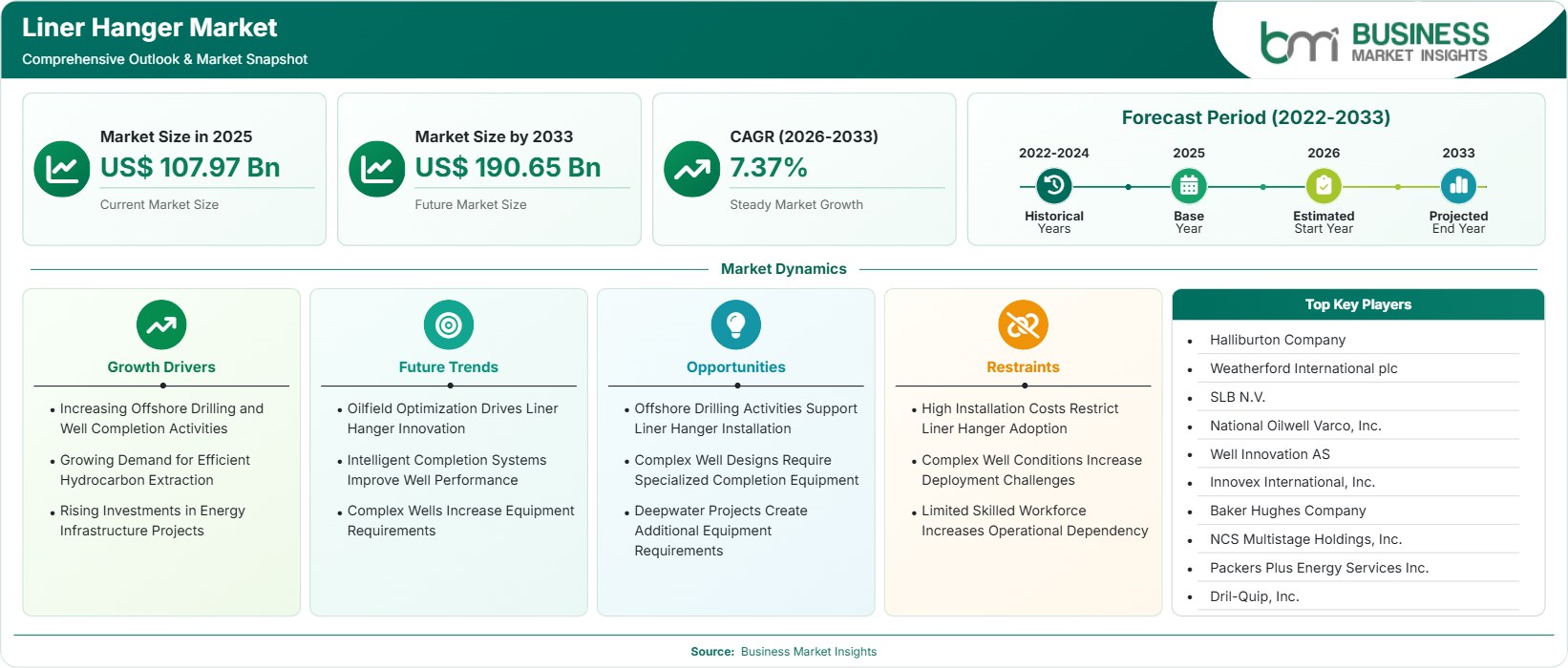
The Liner Hanger Market size was valued at US$ 107.97 Billion in 2025 and is projected to reach US$ 190.65 Billion by 2033, growing at a CAGR of 7.37% during 2026–2033, driven by directional drilling, longer laterals, well-integrity requirements, offshore development, and advanced completion technologies.

Report Coverage
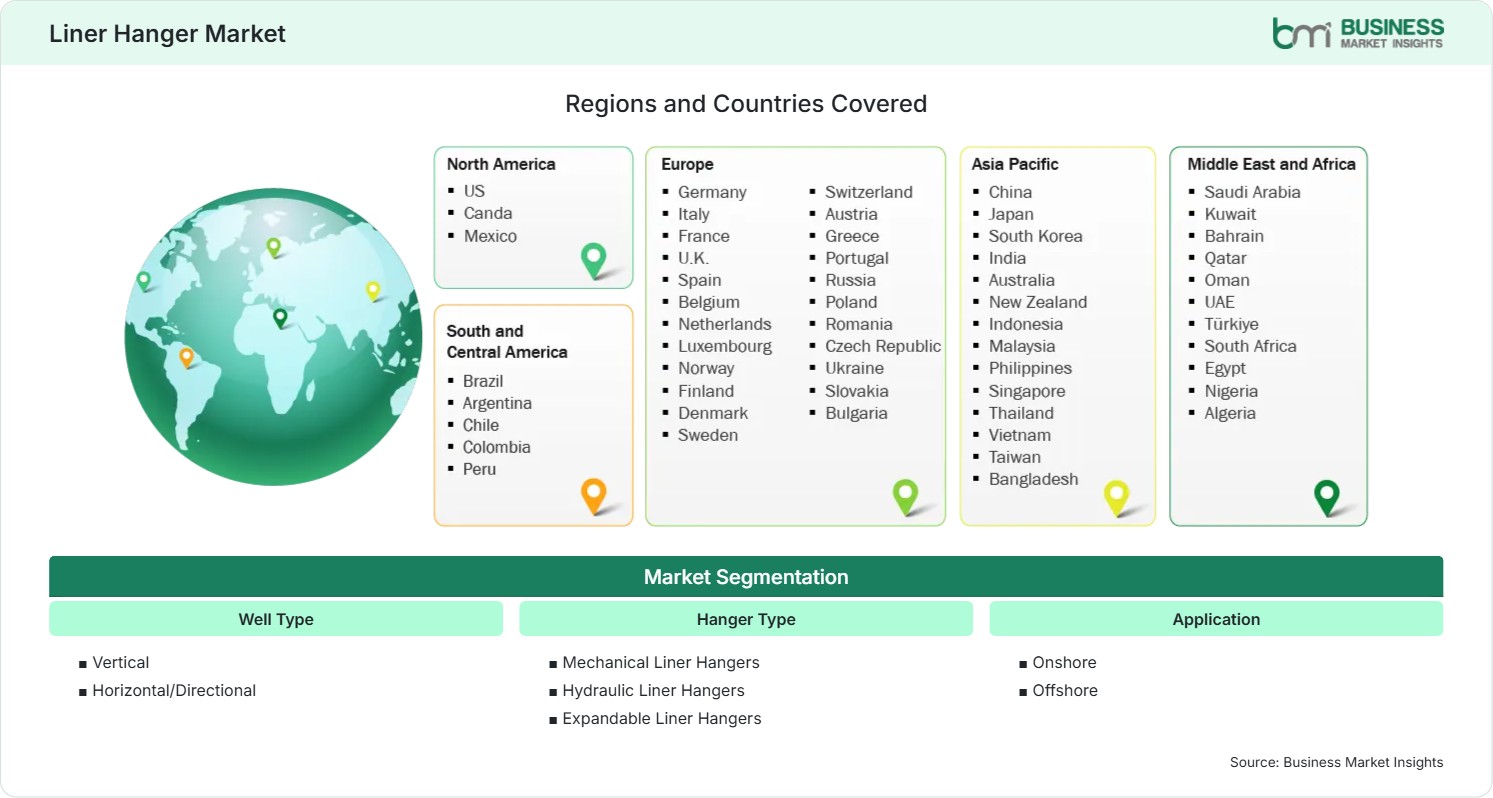
  • Well Type: Vertical, Horizontal/Directional
  • Hanger Type: Mechanical Liner Hangers, Hydraulic Liner Hangers, Expandable Liner Hangers
  • Application: Onshore, Offshore
US$ 107.97 Bn Market size in 2025
US$ 190.65 Bn Market Size by 2033
7.37% CAGR, 2026 - 2033
2026-2033 Forecast Period

AI Overview

Liner Hanger Market Summary

  • North America Region: North America holds a modeled 36%–39% Liner Hanger Market share in 2025, growing with a 6.8%–7.5% CAGR through 2033, influenced by horizontal drilling, shale redevelopment, completion optimization, and demand for high-capacity systems. The US remains the principal market, supported by established service infrastructure, extensive unconventional development, and strong adoption of hydraulic liner hangers.
  • Fastest Growing Region: Asia Pacific holds a modeled 20%–23% share in 2025, growing with an 8.4%–9.2% CAGR, supported by offshore exploration, mature-field redevelopment, expanding drilling programs, national energy security strategies, deeper reservoirs, and growing investments in complex directional and extended-reach well construction.
  • Leading Segment: Horizontal/Directional wells hold a modeled 57%–61% share in 2025, expanding at a 7.8%–8.5% CAGR, supported by longer laterals, tighter wellbore geometries, greater completion complexity, higher reservoir contact, and pressure-management requirements that favor advanced hanger designs.
  • High Growth Segment: Offshore applications hold a modeled 31%–35% share in 2025, advancing at an 8.2%–9.0% CAGR, driven by deepwater developments, high-pressure reservoirs, subsea infrastructure, limited well slots, extended-reach drilling, and demand for reliable high-load liner suspension.
  • Key Market Opportunity: Integrated hanger, packer, tieback, and running-tool systems can reduce intervention exposure, simplify well construction, improve sealing reliability, and create premium-value positions as operators prioritize fewer trips and stronger lifecycle economics.
  • Major Market Players: Halliburton Company, Weatherford International plc, SLB N.V., National Oilwell Varco, Inc., Well Innovation AS, Innovex International, Inc., Baker Hughes Company, NCS Multistage Holdings, Inc., Packers Plus Energy Services Inc., and Dril-Quip, Inc.
Strategic Insights

Liner Hanger Market: Strategic Insights

Liner Hanger Market Strategic Framework
FREE PDF
Request your free sample
Request free sample
Stakeholder View

Key Takeaways

  • The value chain is moving from standalone hanger procurement toward engineered completion packages covering the hanger, liner-top packer, running tool, tieback, setting mechanism, and technical services. Suppliers able to integrate these interfaces can influence both equipment economics and execution risk.
  • Horizontal/Directional wells provide the strongest structural upside because longer laterals increase mechanical loads, cementing complexity, equivalent circulating density constraints, and the need for rotation, reaming, and controlled deployment.
  • Product development is increasingly centered on one-piece bodies, circumferential load distribution, high-temperature seals, metal-to-metal sealing, hydraulic release, anti-preset mechanisms, and compact geometries for low-annular-clearance wells.
  • Asia Pacific offers an attractive expansion case as offshore programs, mature-field redevelopment, and technically complex wells increase demand for high-capacity and pressure-tolerant completion equipment. Growth should be strongest where local operators adopt advanced completion standards.
  • Consolidation continues to reshape the broader downhole technology ecosystem. Innovex International, Inc. acquired Citadel Casing Solutions, LLC for US$ 69.7 million in 2025, expanding its differentiated downhole technology portfolio.
  • Service providers can strengthen margins by combining equipment with installation planning, technical support, digital monitoring, and post-run analysis. This converts hanger performance from an equipment purchase into a measurable well-construction productivity proposition.
Geographic Outlook

Liner Hanger Market Regional Highlights

North America Liner Hanger Market

The Liner Hanger Market in North America represented approximately 36%–39% of 2025 demand on an analyst-modelled basis and is projected to expand at a 6.8%–7.5% CAGR through 2033. The region combines mature supply chains, sophisticated completion contractors, extensive horizontal drilling, and established unconventional plays. However, activity remains sensitive to commodity prices and operator capital discipline. Baker Hughes reported lower 2025 oilfield services activity and revenue alongside reduced rig counts, demonstrating the cyclical nature of regional demand.

  • Horizontal shale wells continue to require hydraulic and rotational hanger configurations capable of handling long liners and demanding cementing conditions.
  • Permian Basin activity supports recurring demand for compact designs, high bypass capability, and reliable deployment across high-angle wellbores.
  • Canada presents a specialized opportunity in thermal, heavy-oil, and extended-reach applications requiring stronger pressure and temperature tolerance.
  • The region favors suppliers with rapid field support, application engineering, and integrated completion-service capabilities.

US Liner Hanger Market

The United States accounted for an estimated 29%–32% of global demand in 2025 and is modeled to grow at 6.6%–7.4% through 2033. Its advantage comes from dense oilfield-service infrastructure, large unconventional reserves, horizontal drilling expertise, and rapid adoption of efficiency-focused completion technologies. At the same time, shorter investment cycles and commodity-price sensitivity create greater quarterly volatility than in long-cycle offshore markets.

  • The Permian remains central to advanced liner deployment because long laterals and complex well trajectories increase mechanical and cementing requirements.
  • Gulf of Mexico activity creates demand for high-load, pressure-capable systems with strong sealing performance and controlled running procedures.
  • US operators increasingly prioritize technologies that reduce trips, avoid casing issues, and protect production economics under volatile commodity conditions.

Europe Liner Hanger Market

The Liner Hanger Market in Europe accounted for around 17%–20% of total demand in 2025 and is forecast to grow at a modeled CAGR of 5.8%–6.6% up to 2033. The United Kingdom and Norway remain key offshore markets, and the redevelopment of mature fields and geothermal operations will increase demand for technological products. Norway will lead regional market growth with a modeled CAGR of 6.5%–7.2%, driven by the complexity of offshore wells, while the United Kingdom will see growth of 5.5%–6.3%. Premium sealing and reliable deployment remain decisive purchasing criteria.

  • Norway favors high-load, high-pressure systems because offshore wells require dependable suspension and sealing across difficult operating conditions.
  • The United Kingdom offers opportunities in mature-field optimization, subsea developments, and technically challenging offshore well architectures.
  • Germany and selected continental markets provide smaller but differentiated opportunities in geothermal liner applications and high-temperature well construction.
  • Europe’s stringent safety and environmental expectations favor designs that support predictable installation and long-term pressure integrity.

Asia Pacific Liner Hanger Market

The Asia Pacific region contributed about 20%–23% of demand in 2025 and is forecast to show a CAGR of 8.4%–9.2% through 2033, making it the fastest-growing regional block. China, India, Indonesia, Australia, and Southeast Asia have offshore production, mature field operations, rising energy needs, and challenging drilling conditions. The projected CAGR for Australia is 9.0%–9.7%, while there is good scope for growth in India and Southeast Asia, which offer strong expansion opportunities as offshore and directional drilling investments mature.

  • China benefits from domestic energy-security priorities and continued development of increasingly complex reservoirs requiring specialized completion hardware.
  • India offers expanding opportunities across offshore exploration, deepwater projects, and mature-field recovery programs where well integrity remains critical.
  • Southeast Asia favors compact and high-capacity systems for challenging offshore geometries, constrained well slots, and extended-reach development.
  • Australia supports advanced offshore and high-temperature applications, including complex wells requiring robust sealing and reliable running tools.

Rest of World Liner Hanger Market

The Liner Hanger Market in South and Central America accounted for around 11%-14% of demand in 2025 and is projected to grow at a 7.1%-8.0% CAGR from 2026 to 2033. Brazil continues to be the region’s linchpin, fueled by offshore discoveries and deepwater experience. Guyana and Argentina are high-growth opportunities due to the increased need for drilling from new and unconventional resources. Brazil will grow at around 7.8%-8.6%, owing to the added complexity of offshore completions.

The Middle East and Africa accounted for around 12%-15% of demand and are projected to grow at a 6.9%-7.8% CAGR from 2026 to 2033. Countries such as Saudi Arabia, the UAE, Qatar, and some offshore markets in Africa drive the demand for reliable, pressure-tolerant completion equipment.

  • Brazil’s deepwater and ultradeepwater activity supports premium liner systems with high load capacity and pressure integrity.
  • Argentina’s unconventional development creates demand for efficient horizontal-well completion technologies and repeatable field execution.
  • The Middle East favors dependable equipment for high-temperature, high-pressure, and mature-field applications where operational continuity is critical.
  • African offshore developments create opportunities for suppliers combining engineering support with equipment suited to remote and technically constrained operations.
Global Market Geography
FREE PDF
Request your free sample
Request free sample
Segment Analysis

Liner Hanger Market Segmentation

Well Type

The Well Type category is headed by Horizontal/Directional wells, constituting an estimated market share of 57%–61% in the Liner Hanger Market in 2025 and forecast to grow by 7.8%–8.5% through 2033. The rising complexity of these types of wells is increasing demand for reliable deployment, rotation, heavy-load suspensions, and pressure management.

  • Vertical: Vertical wells remain important for conventional developments and moderate-complexity completions, with mechanical systems favored where straightforward string manipulation supports reliable setting and predictable cementing operations.
  • Horizontal/Directional: Long laterals create greater torque, drag, ECD, and deployment challenges, increasing adoption of hydraulic, rotational, high-load, and tight-clearance hanger technologies designed for difficult well trajectories.

Hanger Type

The Hanger Type market segment can be defined by technology, geometry of the well, mode of setting, load requirements, and sealing characteristics. While mechanical and hydraulic systems continue to form the basis of technology, expandable technologies meet specialized high-load and low-clearance requirements.

  • Mechanical Liner Hangers: Mechanical systems remain attractive in vertical and lower-complexity wells because pipe manipulation can establish reliable setting without dependence on hydraulic actuation.
  • Hydraulic Liner Hangers: Hydraulic systems support highly deviated, horizontal, and HPHT wells where reliable mechanical manipulation is difficult and controlled pressure activation improves installation consistency.
  • Expandable Liner Hangers: Expandable designs address challenging clearance and sealing requirements, providing metal-to-metal contact and deployment flexibility for specialized deepwater, extended-reach, and thermal applications.

Application

The application segment is bifurcated into Onshore and Offshore segments, with Offshore applications expected to account for around 31%–35% share in 2025 and to grow at 8.2%–9.0% till 2033 due to higher technical complexities and well-slot limitations.

  • Onshore: Onshore operations represent the larger installed base, supported by unconventional drilling and repeatable completion programs, where compact systems and reduced rig time directly influence development economics.
  • Offshore: Offshore wells require higher reliability because intervention costs are substantial, making high-capacity hangers, robust seals, and integrated tieback technologies valuable for deepwater and extended-reach development.
Market Forces

Liner Hanger Market Dynamics

Key Market Drivers

Longer Laterals Are Increasing Mechanical and Cementing Complexity

Horizontal sections of large length contribute to greater drag, torque, circulation pressure, and mechanical loads on the liner string. SLB emphasizes the need for rotation capability, a tough setting, high-solids compatibility, ECD control, and dependable sealing in extended and horizontal wells. The company's Xcelis products are designed to operate in pressure environments ranging from 15,000 psi to 400°F, demonstrating the specifications needed for technically challenging jobs. All of the technical requirements mentioned above directly influence Liner Hanger Market growth, as operators will require tools that can be run to their setting depth without premature setting or other problems.

Well Integrity Requirements Are Raising Performance Standards

Pressure integrity is now being considered more as a selection criterion, with operators seeking longer production periods, improved barrier performance, and reduced intervention risk. Baker Hughes provides liner hangers and packers that combine excellent hanging capacity with V0-rated seals, whereas SLB delivers metal-to-metal tie-backs intended to improve casing integrity over time. One such product by Baker Hughes is called INLine; it is designed for tight-clearance situations and has a rated load capacity of 1 million pounds, indicating that differentiating factors for equipment are beginning to include both load capacity and sealability performance. These Liner Hanger Market trends favor products engineered as complete well-integrity systems rather than isolated suspension components.

Technology Integration Is Improving Deployment Productivity

With advancements in digital planning, remote assistance, advanced running tools, and completion-engineered procedures, there has been an increasing impact on hanger performance. The digital offerings from SLB incorporate AI, data, and technology solutions for drilling and completion operations, including advanced running tools that enable hanger deployment and retrieval without rotation in some cases. The above could ensure better preparedness and more reliable execution when conditions in the wells differ from the initial plans. The business opportunities associated with the Liner Hanger Market would extend further to engineering solutions, digital workflows, planning, and lifetime support. Suppliers with connected technical capabilities can differentiate themselves by measurable execution reliability rather than relying solely on equipment specifications.

Key Market Opportunities

Integrated Liner Hanger-Packer Systems Can Capture Higher Value

The integrated system combines the roles of suspension, sealing, and deployment into fewer interfaces, offering a clear value proposition in wells where reliability and installation time will influence costs. The company is interested in INLine, Z-Flex, and UniFlex Pro technologies for larger flows and reduced clearance. In addition, a single-piece assembly system could reduce multiple threads that might cause leakage. This offers a premium value proposition for companies that can bundle hanger, packer, setting tool, and support services in an integrated system. Integration of this kind also helps improve efficiency for operators working with standardized completion programs across multiple fields.

Asia Pacific and Offshore Development Create Expansion Headroom

Asia Pacific presents an attractive market for expansion due to rising demand for offshore field exploration, the redevelopment of mature oil fields, and complex drilling projects requiring advanced completion tools. Furthermore, energy security and the development of deeper, more technically challenging fields contribute to growth. The region’s projected CAGR of 8.4%-9.2% offers better growth potential than North America or Europe. Local partnerships, service facilities, design centers, and custom qualification programs may be considered ways to reduce response time in the region. Therefore, Liner Hanger Market Forecasts should reflect both equipment demand and the regionalization of field services, manufacturing, and technical support, as operators seek greater execution resilience.

High-Temperature and Specialized Wells Broaden the Addressable Market

The applications of geothermal and thermal energy provide an opportunity to develop liner hanger technology that can be employed during extreme temperature fluctuations. SLB provides thermal-hydraulic hanger and packer systems that do not include elastomeric components due to limitations of elastomer-based products. NOV also highlights geothermal liner systems and their installations as evidence that the technology base is becoming more relevant beyond traditional oil and gas completions. Entry into geothermal, steam recovery, and other thermal wells will increase equipment efficiency while spreading the risk of supplier dependence on the traditional drilling cycle. The success of such a venture will depend on qualification requirements, materials engineering, and reliable performance of the equipment.

Market Restraints and Challenges

Commodity-Price Volatility Can Delay Completion Equipment Spending

Factor: Volatile oil and gas prices will impact drilling activity, investment decisions, and service company pricing. The IEA's 2025 upstream oil investment forecast was around US$420 billion, a 6% decline. Furthermore, Baker Hughes reported an 8% year-on-year drop in its 2025 oilfield services revenues.

Impact: Reduced activity will result in lower equipment utilization, longer purchase cycles, increased pricing pressures, and unpredictability in demand forecasting. The effect will be felt most significantly in short-cycle markets where operators can quickly adjust their rig counts. However, companies with diversified geographical exposure and service offerings will be able to manage volume fluctuations better, but cyclicality pressure will remain an inherent part of the Liner Hanger Market.

Complex Well Conditions Increase Qualification and Execution Risk

Factor: Longer laterals, HPHT environments, high solids, tight annular clearance, and difficult formations increase engineering requirements and the consequences of equipment failure.

Impact: There is a high cost and effort required of suppliers for testing, materials, engineering, on-site services, and equipment qualification, whereas operators have increased technical due diligence when evaluating new products. Both SLB and Baker Hughes stress the importance of developing products for high-pressure, high-temperature, high-angle, and low-clearance applications, showing the technical rigor of the segment. Qualification processes can slow the adoption of new technologies when operators prioritize proven performance over experimentation.

Company Analysis

Competitive Landscape

The Liner Hanger Market analysis indicates competition is based on hanging capacity, setting reliability, sealing performance, deployment flexibility, engineering support, and installed field experience. Major suppliers increasingly differentiate through integrated systems capable of supporting directional, offshore, HPHT, geothermal, and tight-clearance applications.

Company Name

Overview

Products and Services relevant to this market

Halliburton Company

Major oilfield technology provider serving drilling, completion, production, and well-construction customers across international markets.

Completion systems, liner hanger technologies, well construction services, setting equipment, cementing support, and integrated downhole solutions.

Weatherford International plc

Global wellbore and production solutions company with broad geographic operating capability and specialized completion engineering.

Liner hanger systems, running tools, packers, completion equipment, installation services, and well-integrity technologies.

SLB N.V.

Global energy technology company with extensive liner hanger engineering and completion-system expertise across complex well conditions.

Xcelis and COLOSSUS systems, mechanical and hydraulic hangers, expandable systems, liner tiebacks, packers, and running tools.

National Oilwell Varco, Inc.

Provider of drilling and well-construction equipment with established liner deployment and completion-tool capabilities.

Liner hanger running tools, hanger systems, cementing accessories, packer actuators, setting tools, and related service equipment.

Well Innovation AS

Specialist technology provider focused on completion and well-construction solutions for demanding applications.

Liner hanger technologies, completion equipment, well-intervention solutions, and engineered downhole systems.

Innovex International, Inc.

Downhole technology company providing engineered products used throughout construction, completion, production, and intervention.

Casing and completion technologies, downhole tools, production equipment, intervention solutions, and engineered well products.

Baker Hughes Company

Energy technology company offering extensive liner hanger and integrated well-completion portfolios.

Mechanical and hydraulic hangers, INLine, Z-Flex, UniFlex Pro, liner top packers, setting tools, and engineered completion systems.

NCS Multistage Holdings, Inc.

Specialist provider of engineered products supporting well construction, completion, and field development strategies.

Completion equipment, downhole technologies, horizontal-well products, and engineered well-construction support.

Packers Plus Energy Services Inc.

Completion technology specialist focused on systems supporting efficient well completion and production.

Completion tools, isolation systems, packer-related technologies, stimulation equipment, and downhole completion services.

Dril-Quip, Inc.

Established provider of subsea, wellhead, and offshore drilling and completion equipment for demanding energy applications.

Wellhead and completion equipment, subsea systems, riser-related products, connectors, and offshore well-construction technologies.

Trust & Transparency

Research Methodology

The market analysis combines proprietary research with secondary data from government agencies, company disclosures, regulatory filings, industry databases and expert interviews. Market estimates are validated through data triangulation, cross-market benchmarking and analyst review.

View Full Research Methodology

Questions Answered

Frequently Asked Questions

What should buyers examine in a Liner Hanger Market Report?

A strong Market Report should evaluate well type, hanger architecture, application, regional demand, competitive positioning, technology differentiation, installation requirements, sealing performance, and the influence of drilling investment cycles.

How does liner hanger technology influence total well cost?

A reliable system can reduce casing requirements, simplify deployment, lower stuck-pipe risk, improve cement placement, reduce intervention exposure, and support longer productive intervals. The economic benefit therefore extends beyond the equipment purchase price.

Why are horizontal wells important for liner hanger demand?

Horizontal wells introduce greater drag, torque, ECD, cementing, and load-management challenges. Longer laterals can require rotation, high bypass capacity, robust slip designs, and reliable sealing, making advanced hanger systems increasingly relevant.

What is the difference between mechanical and hydraulic liner hangers?

Mechanical systems use controlled pipe manipulation to activate the setting mechanism, while hydraulic systems rely on applied pressure. Hydraulic designs are generally better suited to highly deviated or complex wells where mechanical manipulation may be difficult.

What factors determine liner hanger selection for a well?

Selection depends on well trajectory, liner weight, annular clearance, pressure and temperature, expected rotation, cementing conditions, setting method, sealing requirements, and whether the completion will require tieback or future intervention.

Access the Full Liner Hanger Market Report

Get segment-level forecasts, regional estimates, competitive benchmarking, company profiles and downloadable Excel datasets.

Access the full Liner Hanger Market Report
350 pages PDF & Excel | 2026-09-16
Similar Research

Related Market Reports