Kefir Market Regional Highlights
North America Kefir Market
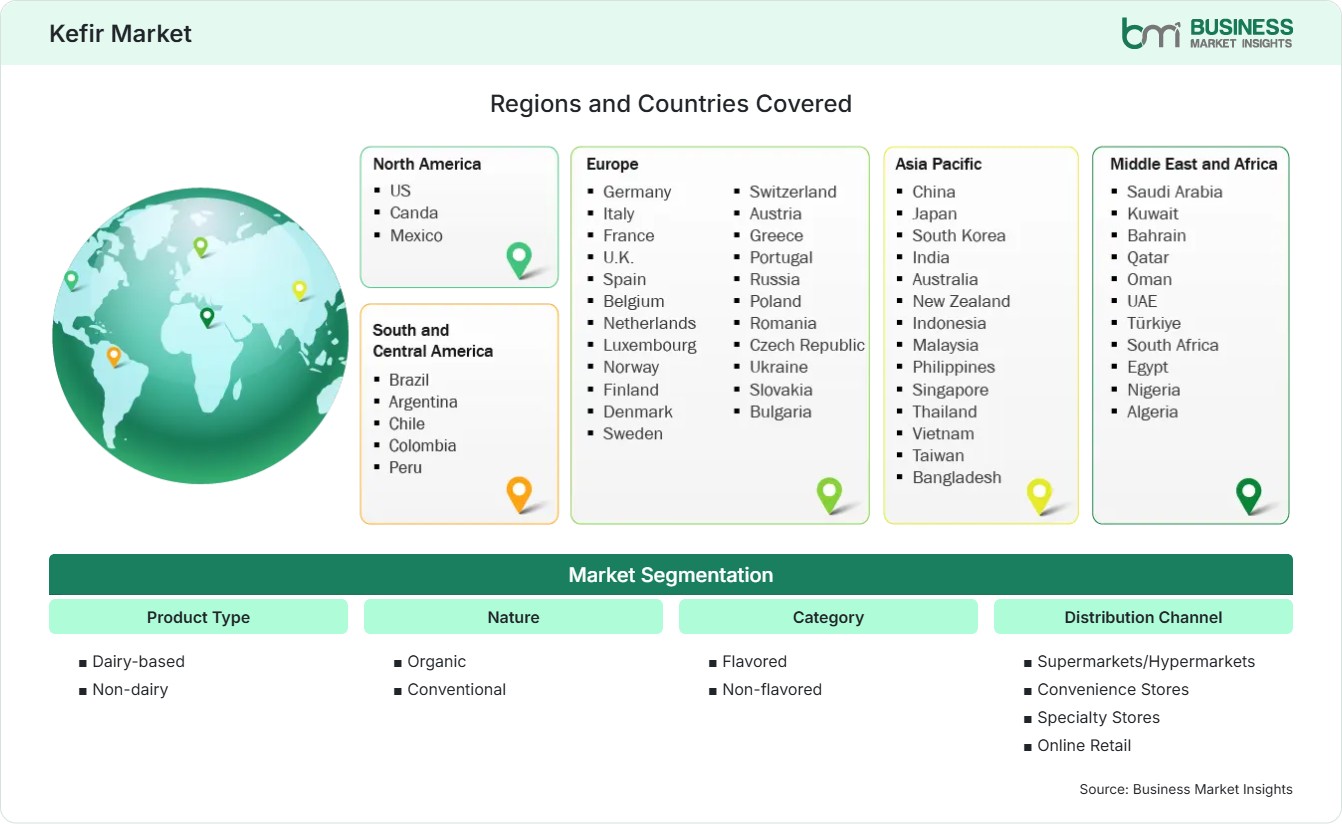
North America holds a 25%–29% share in 2025 and is projected to expand at a 9.8%–10.6% CAGR through 2033. The Kefir Market share reflects strong consumer familiarity with probiotic beverages, established refrigerated distribution, premium dairy availability, and expanding lactose-free options. The US remains the dominant country, while Canada provides additional demand through natural food retail, organic dairy, functional nutrition, and wellness-oriented grocery channels.
- The US benefits from broad supermarket penetration and an established functional dairy culture, allowing kefir brands to introduce flavors, protein-focused formats, organic products, and convenient smaller packages.
- Lactose-free positioning is widening consumer accessibility because fermentation and specialized processing can make cultured dairy more compatible with shoppers seeking easier-to-digest dairy options.
- Premium grass-fed and organic products create differentiation through sourcing credentials, clean-label positioning, and stronger alignment with consumers seeking minimally processed functional foods.
- Online grocery improves product discovery and replenishment, particularly for consumers already familiar with kefir and seeking specialized flavors or dietary attributes.
US Kefir Market
The US represents approximately 82%–86% of North American demand in 2025 and is projected to expand at a 9.8%–10.6% CAGR through 2033. Demand is supported by functional-food awareness, mature refrigerated grocery infrastructure, established probiotic consumption, premium dairy categories, and growing experimentation with plant-based alternatives.
- Product innovation is increasingly connecting kefir with protein, smoothies, breakfast occasions, cooking, and portable nutrition, expanding consumption beyond traditional beverage occasions.
- Supermarkets remain critical for scale, while natural-food retailers and online grocery provide discovery environments for organic, lactose-free, premium, and specialized formulations.
- Consumer education remains important because kefir's tart flavor and fermented character can require sampling, recipe inspiration, and clearer communication before mainstream shoppers adopt it regularly.
Europe Kefir Market
Europe holds a 29%–33% share in 2025 and is projected to expand at a 9.6%–10.5% CAGR through 2033. Germany, the UK, France, Poland, and Spain represent leading Kefir Markets, while Spain and Poland offer strong expansion potential. Established fermented-food traditions, increasing microbiome awareness, modern grocery retail, and product innovation support regional development.
- Germany provides a strong platform for fermented dairy innovation, with established refrigerated retail, health-oriented consumers, and increasing availability of mainstream branded kefir.
- The UK benefits from specialist health retail, supermarket penetration, and diversified product development spanning drinks, yogurts, organic options, and flavored varieties.
- Spain is becoming a particularly dynamic market as kefir moves from niche positioning toward broader household penetration and mainstream healthy-food consumption.
- France and Poland provide additional opportunities through established dairy consumption, fermentation familiarity, functional-food demand, and increasing premium product differentiation.
Asia Pacific Kefir Market
Asia Pacific holds a 19%–23% Kefir Market share in 2025 and is projected to expand at a 11.8%–12.8% CAGR through 2033. China, Japan, Australia, South Korea, and India are leading markets, while Southeast Asia offers substantial whitespace. Urbanization, wellness-oriented consumption, modern retail development, and interest in fermented foods are improving category awareness.
- Japan and South Korea offer technologically mature food markets where premium fermentation, digestive wellness, functional nutrition, and high-quality packaging can support differentiated positioning.
- Australia provides a favorable environment for premium dairy, organic foods, probiotic products, and health-focused grocery concepts supported by established modern retail.
- India offers longer-term potential as urban consumers increasingly explore functional foods, although pricing, cold-chain availability, and consumer education remain important commercialization factors.
- Southeast Asia provides opportunities through modern grocery expansion, rising wellness awareness, and localized functional beverages suited to younger urban consumers.
Rest of World Kefir Market
Rest of World holds a 17%–21% share in 2025 and is projected to expand at a 9.2%–10.3% CAGR through 2033. South and Central America offer opportunities through Brazil, Mexico, Chile, and Argentina, where modern grocery and health-focused consumption are developing. Middle Eastern and African demand remains more fragmented, with the UAE, Saudi Arabia, Israel, and South Africa providing stronger prospects through premium food retail and wellness-oriented consumers.
Latin American producers can benefit from localized flavors, accessible pack sizes, and distribution through supermarkets and convenience channels. In the Middle East, premium imported and locally produced functional foods can gain traction among affluent consumers, while South Africa offers selective opportunities through established dairy consumption and specialist health retail.
- Brazil and Mexico provide the strongest Latin American opportunities because modern retail, urbanization, and functional-food awareness can support category expansion.
- Gulf markets favor premium wellness products, imported functional foods, sophisticated grocery formats, and products positioned around nutrition and digestive wellbeing.
- Israel offers an innovation-oriented food environment where fermentation, functional nutrition, and specialized health products can gain visibility among educated consumers.
- South Africa provides opportunities through supermarkets, health stores, premium dairy, and expanding consumer interest in functional nutrition.