
Insulated Packaging Market Outlook: Size, Share, Trends, Growth Analysis, Competitive Landscape & Forecast, 2026–2033

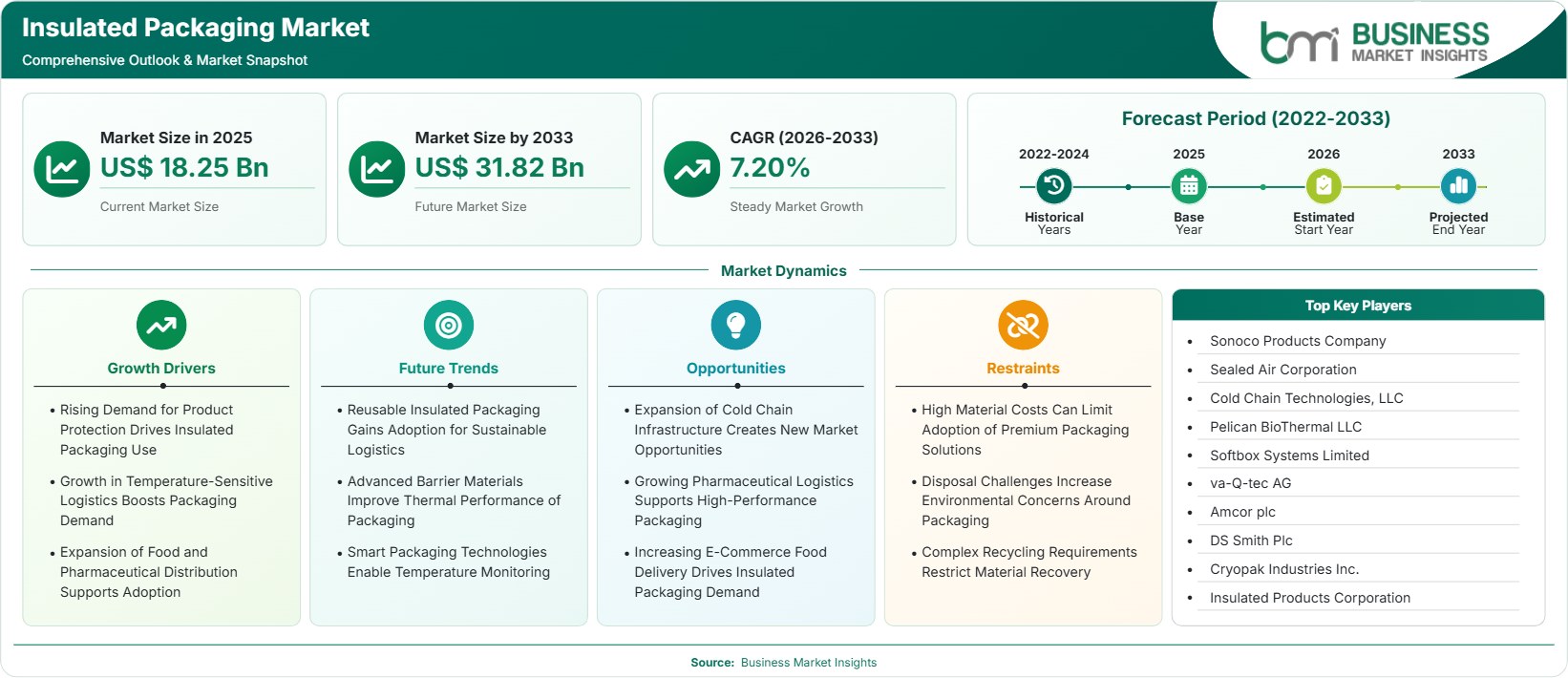
The Insulated Packaging Market size was valued at US$ 18.25 Billion in 2025 and is projected to reach US$ 31.82 Billion by 2033, growing at a CAGR of 7.20% during 2026–2033, driven by cold-chain expansion, pharmaceutical distribution, and demand for recyclable packaging solutions.

Report Coverage
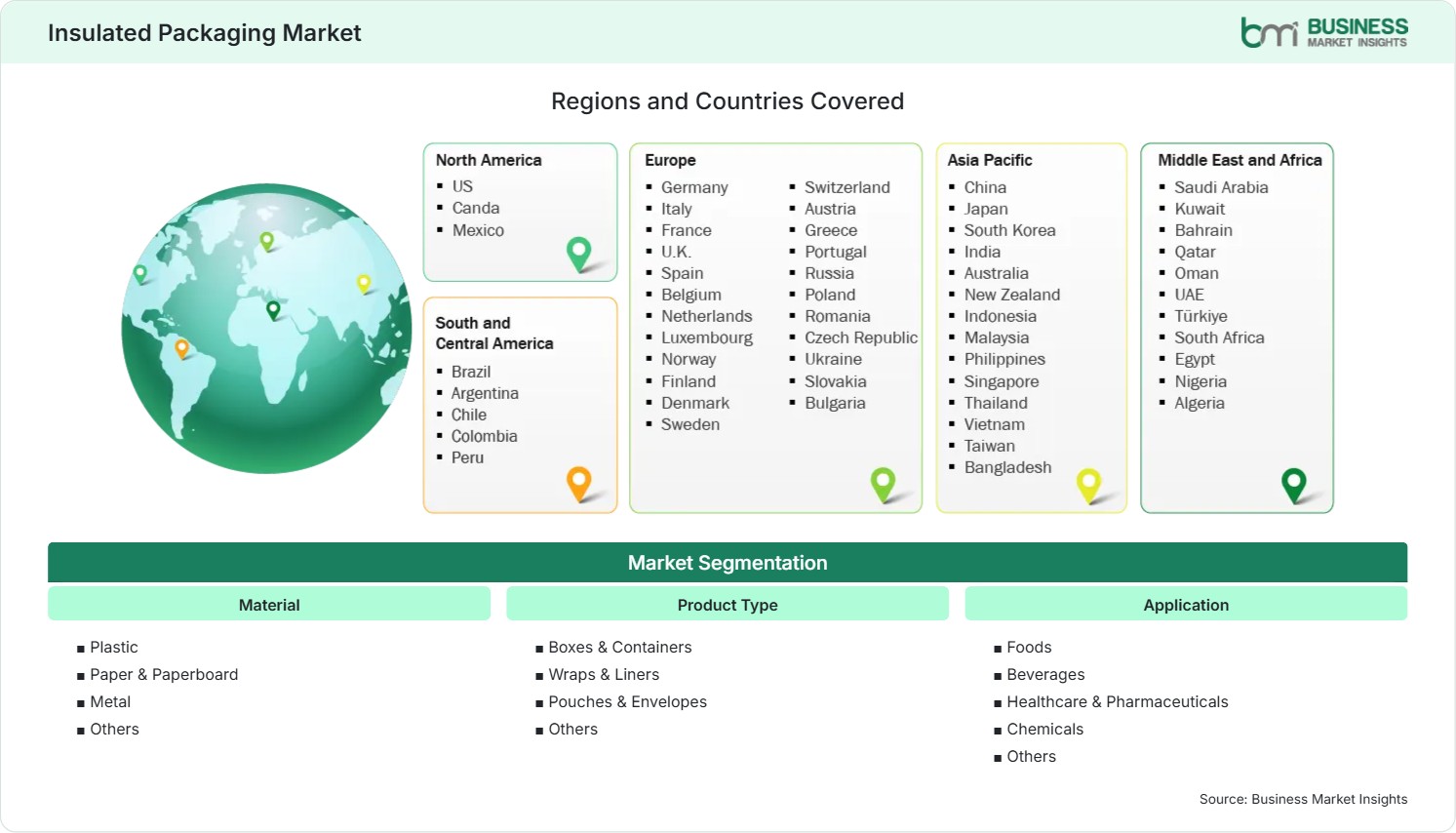
  • Material: Plastic, Paper & Paperboard, Metal, Others
  • Product Type: Boxes & Containers, Wraps & Liners, Pouches & Envelopes, Others
  • Application: Foods, Beverages, Healthcare & Pharmaceuticals, Chemicals, Others
US$ 18.25 Bn Market size in 2025
US$ 31.82 Bn Market Size by 2033
7.20% CAGR, 2026 - 2033
2026-2033 Forecast Period

AI Overview

Insulated Packaging Market Summary

  • North America: held 31%–34% Insulated Packaging Market share in 2025 and is projected to grow at 6.4%–6.9% CAGR through 2033, supported by pharmaceutical distribution, and demand for validated temperature-control solutions. The US represents 82%–85% of regional demand, expanding at 6.5%–7.0% CAGR through 2033, supported by pharmaceutical logistics and food distribution.
  • Fastest Growing Region: Asia Pacific held 25%–28% share in 2025 and is projected to expand at 8.1%–8.7% CAGR through 2033, supported by pharmaceutical manufacturing, organized food distribution, e-commerce grocery, urbanization, and expanding temperature-controlled logistics networks.
  • Leading Segment: Plastic held 44%–48% share in 2025 and is projected to grow at 6.8%–7.3% CAGR through 2033, supported by lightweight construction, thermal performance, moisture resistance, scalable manufacturing, and broad suitability for food and healthcare shipments.
  • High Growth Segment: Healthcare & Pharmaceuticals held 25%–29% share in 2025 and is projected to expand at 8.2%–8.8% CAGR through 2033, supported by biologics, vaccines, temperature-sensitive therapies, clinical materials, and stricter cold-chain handling requirements.
  • Key Market Opportunity: Expansion of cold-chain infrastructure creates demand for reusable containers, high-performance insulation, validated temperature control, recyclable materials, and packaging designed for longer transit durations across pharmaceutical and food distribution networks.
  • Major Market Players: Sonoco Products Company, Sealed Air Corporation, Cold Chain Technologies, LLC, Pelican BioThermal LLC, Softbox Systems Limited, va-Q-tec AG, Amcor plc, DS Smith Plc, Cryopak Industries Inc., Insulated Products Corporation.
Strategic Insights

Insulated Packaging Market: Strategic Insights

Insulated Packaging Market Strategic Framework
FREE PDF
Request your free sample
Request free sample
Stakeholder View

Key Takeaways

  • Value chain is moving away from insulated boxes and towards thermal management system that integrates insulation, coolants, monitoring, verification, and reverse logistics.
  • Pharmaceutical shipments offer the best opportunity for premiumization since biologicals and other sensitive items demand thermal performance management as well as package qualification.
  • Material development efforts are directed at making materials lighter, more efficient, more recyclable, and compatible with existing recyclers.
  • Asia Pacific provides the strongest regional expansion opportunity as pharmaceutical manufacturing, food distribution, organized retail, and temperature-controlled logistics develop concurrently.
  • Investment priorities are moving toward reusable systems and network-based logistics models that can reduce recurring packaging expenditure while improving asset utilization and supporting sustainability targets.
  • Packaging suppliers that demonstrate measurable reductions in product loss, shipment failure, packaging weight, and total logistics cost can strengthen customer retention and command higher-value contracts.
Geographic Outlook

Insulated Packaging Market Regional Highlights

North America Insulated Packaging Market

North America Insulated Packaging Market held 31%–34% share in 2025 and is projected to expand at 6.4%–6.9% CAGR through 2033. Demand is supported by established pharmaceutical distribution, advanced food logistics, meal delivery, and temperature-sensitive healthcare shipments. The US remains the dominant market, while Canada contributes through food, biotechnology, and healthcare distribution.

  • Pharmaceutical logistics is another significant demand driver due to the requirement of reliable temperature management in the transportation and temporary storage of biologicals, specialty medicines, vaccines, and clinical supplies.
  • Food logistics is also emerging as a demand driver, especially with respect to the need for efficient temperature protection in last-mile deliveries of perishable food products.
  • Reusable thermal systems are becoming relevant in situations where the volume of shipments makes their usage economically feasible despite high initial costs.
  • Sustainability requirements are encouraging material reduction, recyclable components, reusable designs, and improved package recovery while customers continue demanding reliable thermal performance.

US Insulated Packaging Market

The US Insulated Packaging Market represented 82%–85% of North American demand in 2025 and is forecast to grow at 6.5%–7.0% CAGR through 2033. Pharmaceutical distribution, specialty healthcare products, meal delivery, seafood, fresh foods, and temperature-sensitive laboratory materials support consumption. The market is characterized by sophisticated logistics networks and greater adoption of validated thermal packaging.

  • There are growing opportunities within pharmaceutical use due to increasing specialty and biologic medicines, leading to higher requirements for packages able to provide control conditions through parcels, air, and ground shipments.
  • Food delivery within e-commerce requires packages with high levels of insulation to ensure thermal control while being small enough to provide efficiency in shipment costs and handling.
  • Reusable packages are becoming more popular with shipment volumes where reverse logistics and refurbishment operations can be implemented.

Europe Insulated Packaging Market

Europe held 21%–24% share in 2025 and Europe Insulated Packaging Market forecast to grow at 6.0%–6.5% CAGR through 2033. Germany, the UK, France, and Italy remain leading markets, while Poland and Spain provide stronger expansion opportunities. Regulatory pressure is accelerating packaging redesign around recyclability, material reduction, reuse, and waste prevention.

  • Germany remains a leading market because of its pharmaceutical manufacturing base, advanced logistics infrastructure, food-processing capacity, and strong emphasis on packaging efficiency.
  • Poland is among the faster-growing markets as pharmaceutical manufacturing, food processing, exports, and modern distribution networks expand temperature-sensitive shipment requirements.
  • Regulatory requirements are encouraging packaging designs that improve recyclability and reduce virgin material use without weakening insulation, structural strength, or product protection.
  • Reusable thermal packaging provides opportunities where established distribution loops can lower packaging waste and improve lifecycle economics across repeated temperature-controlled shipments.

Asia Pacific Insulated Packaging Market

Asia Pacific Insulated Packaging Market represented 25%–28% share in 2025 and is projected to grow at 8.1%–8.7% CAGR through 2033, making it the fastest-growing regional market. China, Japan, South Korea, and India are important demand markets, whereas India, Indonesia, Vietnam, and Southeast Asia provide attractive expansion opportunities. Temperature-controlled logistics needs for pharmaceuticals manufacturing, food processing, organized retailing, e-commerce groceries, and healthcare infrastructure are on the rise.

  • China continues to be an important demand market owing to pharmaceuticals manufacturing, food distribution, e-commerce activities, and extensive logistics chains that need thermal protection.
  • India is one of the fastest-growing country markets because of the growth in exports, distribution of healthcare products, food deliveries, organized retail, and cold chain infrastructures.
  • Japan and South Korea support demand for technically advanced packaging because of sophisticated pharmaceutical, food, electronics, and healthcare supply chains requiring reliable logistics performance.
  • Southeast Asian markets offer emerging opportunities as urbanization, food delivery, pharmaceutical manufacturing, and modern retail expand, increasing demand for affordable and efficient thermal packaging.

Rest of World Insulated Packaging Market

South and Central America represented 9%–12% of global demand in 2025, with Brazil and Mexico serving as important markets. The Insulated Packaging Market trend is supported by pharmaceutical distribution, food exports, seafood, fresh produce, and organized retail. Expanding cold-chain infrastructure creates demand for insulated containers and flexible packaging formats, although logistics fragmentation and cost sensitivity can constrain adoption.

The Middle East and Africa represented the remaining 8%–11% share and are projected to grow at 6.0%–6.6% CAGR through 2033. Saudi Arabia, the United Arab Emirates, South Africa, and selected Gulf markets provide stronger opportunities because of food imports, healthcare investment, pharmaceutical distribution, and controlled-temperature logistics.

  • Brazil gains from food exports, distribution of pharmaceuticals, seafood transport, and growing organized retailing, which requires packaging that can protect temperature-sensitive products.
  • Mexico benefits from integrated supply chains across North America, food processing, pharmaceutical manufacturing, and cross-border transportation, which needs thermal protection to be reliable.
  • Saudi Arabia and the United Arab Emirates present high-value opportunities through import of food, investment in healthcare, distribution of pharmaceuticals, and developing temperature-sensitive logistics infrastructure.
  • South Africa provides an important African demand center, while wider regional adoption depends on logistics infrastructure, electricity reliability, affordability, and access to specialized thermal packaging.
Global Market Geography
FREE PDF
Request your free sample
Request free sample
Segment Analysis

Insulated Packaging Market Segmentation

Material

Plastic held 44%–48% Insulated Packaging Market share in 2025 and is projected to grow at 6.8%–7.3% CAGR through 2033. Its position reflects lightweight construction, moisture resistance, scalable conversion, and strong insulation performance. Paper and paperboard are gaining attention because of recyclability objectives, while metal remains relevant for durable, high-performance applications.

  • Plastic: Provides lightweight insulation, moisture resistance, structural flexibility, and scalable production, making it suitable for food, pharmaceutical, beverage, and temperature-sensitive distribution applications.
  • Paper & Paperboard: Supports recyclable packaging objectives while offering structural strength and printability. Fiber-based insulation is gaining attention where material reduction and recovery are priorities.
  • Metal: Provides high durability and dimensional stability for specialized thermal systems requiring repeated use, strong protection, and resistance to demanding handling environments.

Product Type

Boxes & Containers held 46%–50% share in 2025 and are projected to grow at 6.6%–7.1% CAGR through 2033. Wraps & Liners provide flexible thermal protection for irregular products and palletized shipments. Pouches & Envelopes support smaller shipments and last-mile distribution, particularly where low weight and compact dimensions are important.

  • Boxes & Containers: Provide structured thermal protection for food, pharmaceutical, healthcare, and beverage shipments, supporting coolant integration, stacking, handling efficiency, and extended transportation requirements.
  • Wraps & Liners: Offer flexible insulation for pallets, containers, totes, and individual products. Their adaptability supports temperature protection where rigid packaging would add unnecessary volume.
  • Pouches & Envelopes: Provide lightweight thermal protection for parcel shipments, samples, medicines, meal kits, and other smaller loads requiring compact and convenient packaging.

Application

Healthcare & Pharmaceuticals held 25%–29% share in 2025 and is projected to grow at 8.2%–8.8% CAGR through 2033. Foods remain a major application because perishables require protection against temperature fluctuations during transportation. Beverages, chemicals, and other applications broaden demand where product quality or safety can be affected by thermal exposure.

  • Foods: Requires thermal protection for meat, seafood, dairy, fresh produce, prepared foods, and meal deliveries where temperature stability supports quality, shelf life, and food safety.
  • Beverages: Uses insulated packaging for temperature-sensitive products, premium beverages, delivery formats, and distribution channels where thermal exposure can affect product quality or consumer experience.
  • Healthcare & Pharmaceuticals: Requires validated thermal protection for medicines, biologics, vaccines, diagnostics, clinical materials, and specialty therapies with defined temperature-control requirements.
  • Chemicals: Uses thermal packaging for temperature-sensitive chemicals and specialty materials where exposure to excessive heat or cold can affect stability, performance, or safe handling.
Market Forces

Insulated Packaging Market Dynamics

Key Market Drivers

Rising Demand for Product Protection Drives Insulated Packaging Use

Variations in temperatures during storage, handling, and transport may affect the quality of the item, reduce its shelf-life, and even result in lost shipments. Shippers increasingly have been using insulated shipping containers to establish a controlled thermal environment for sensitive products. There is a greater demand for insulated packaging where the financial impact of product loss is higher than the cost of extra packaging. In complex supply chains and increasing delivery distances, thermal protection forms part of the product integrity process.

Growth in Temperature-Sensitive Logistics Boosts Packaging Demand

The pharmaceutical, healthcare, food and specialty product industries are demanding increased temperature control over longer periods of transportation and handling. The increase in demand for insulated packaging is due to the fact that there is a need for logistics providers to have passive temperature control systems that work efficiently even during transit, short-term storage and last mile delivery. According to FAO, continuous temperature control is necessary in the logistics of refrigerated foods, and packaging is key in minimizing temperature increases during handling outside of refrigeration conditions.

Expansion of Food and Pharmaceutical Distribution Supports Adoption

Geographical and operational complexity of the food and pharmaceutical distribution chains is increasing. Insulated packaging is becoming necessary to fill the gaps between the cool storage facility, transportation modes, distribution centers, and last mile delivery points. Controlled environment is equally important in the case of pharmaceutical distribution. In the process, packaging becomes complementary to the cold chain system, and not a substitute for it. This makes packaging materials in demand which would provide protection for cargo while loading and unloading.

Key Market Opportunities

Expansion of Cold Chain Infrastructure Creates New Market Opportunities

Cold-chain infrastructure expansion creates an opportunity for packaging suppliers to address gaps between refrigerated storage and final delivery. Emerging markets with developing cold-chain networks can adopt insulated packaging alongside refrigerated transport, enabling thermal protection during loading, transfers, and delivery. Reusable containers can provide additional value where distribution routes are predictable and return logistics are available. Suppliers can also target infrastructure projects by offering standardized packaging platforms for food, healthcare, and pharmaceutical applications.

Growing Pharmaceutical Logistics Supports High-Performance Packaging

Pharmaceutical logistics provides a high-value opportunity because product integrity can depend on maintaining defined temperature ranges throughout transportation. Demand is moving toward validated thermal packaging capable of supporting longer routes, international shipments, and variable ambient conditions. This environment supports premium packaging solutions with documented thermal performance, reliable closure systems, and compatibility with temperature monitoring. These capabilities can increase switching costs and strengthen relationships with pharmaceutical manufacturers, distributors, healthcare organizations, and logistics providers.

Increasing E-Commerce Food Delivery Drives Insulated Packaging Demand

Online grocery, prepared-food delivery, and direct-to-consumer food distribution are increasing the importance of thermal protection during last-mile transportation. The opportunity is particularly strong for compact formats that combine insulation, low weight, easy handling, and controlled material use. FAO emphasizes that temperature management and suitable packaging are important for reducing food loss during transport and handling. E-commerce creates a different packaging requirement from palletized distribution because individual orders experience more handling events and less predictable delivery timing.

Market Restraints and Challenges

High Material Costs Can Limit Adoption of Premium Packaging Solutions

Factor: High-performance insulation, phase-changing material, durable reusable components, special linings, and proven thermal technology will lead to high-cost packaging. Impact: Food and pharmaceutical logistics companies that are cost-conscious may not adopt new packaging technology or opt for cheaper versions. High-quality insulated packaging has to provide measurable value in the form of reduced losses, extended transportation time, reduced coolant usage, or multi-use capabilities.

Disposal Challenges Increase Environmental Concerns Around Packaging

Factor: Multilayer materials, polymer foams, liners, adhesives, and mixed-material assemblies can complicate collection and recycling after use. Impact: Disposal challenges can restrict adoption where customers face strict sustainability targets or limited waste-management infrastructure. Balancing environmental performance with thermal reliability remains a major product-development challenge.

Company Analysis

Competitive Landscape

The Insulated Packaging Market analysis indicates competition across thermal packaging specialists, diversified packaging manufacturers, cold-chain technology providers, and material-focused suppliers. Competitive positioning depends on insulation efficiency, temperature-control duration, material selection, product customization, regulatory suitability, reuse capability, and distribution reach.

Company Name

Overview

Products and Services relevant to this market

Sonoco Products Company

Diversified packaging manufacturer with broad protective and temperature-sensitive packaging capabilities.

Insulated containers, protective packaging, temperature-control solutions, and packaging systems for food and healthcare logistics.

Sealed Air Corporation

Global packaging company focused on food protection, logistics, and performance-oriented packaging systems.

Insulated packaging, protective packaging, food packaging, thermal solutions, and logistics-oriented packaging technologies.

Cold Chain Technologies, LLC

Specialized provider focused on temperature-sensitive healthcare and pharmaceutical distribution.

Thermal shippers, reusable systems, passive temperature-control packaging, and pharmaceutical cold-chain solutions.

Pelican BioThermal LLC

Temperature-controlled packaging specialist serving healthcare and life-science logistics.

Reusable and single-use thermal shippers, passive cooling systems, thermal testing, and lifecycle services.

Softbox Systems Limited

Provider of temperature-controlled packaging and cold-chain solutions for healthcare logistics.

Passive thermal packaging, reusable systems, insulated containers, and temperature-control solutions.

va-Q-tec AG

Thermal technology company specializing in high-performance insulation and temperature-controlled packaging.

Vacuum insulation panels, thermal packaging systems, passive containers, and temperature-control technologies.

Amcor plc

Global packaging company with broad food, healthcare, and flexible packaging capabilities.

Flexible packaging, protective formats, healthcare packaging, barrier materials, and temperature-sensitive packaging solutions.

DS Smith Plc

Packaging manufacturer focused on fiber-based packaging and circular packaging solutions.

Corrugated packaging, paper-based protective systems, sustainable packaging structures, and temperature-control packaging formats.

Cryopak Industries Inc.

Temperature-control packaging specialist serving healthcare, food, and logistics applications.

Gel packs, phase-change materials, insulated shippers, temperature-control products, and thermal management solutions.

Insulated Products Corporation

Manufacturer focused on insulated shipping and temperature-control packaging.

Insulated containers, shipping systems, thermal liners, and protective packaging for temperature-sensitive products.

Trust & Transparency

Research Methodology

The market analysis combines proprietary research with secondary data from government agencies, company disclosures, regulatory filings, industry databases and expert interviews. Market estimates are validated through data triangulation, cross-market benchmarking and analyst review.

View Full Research Methodology

Questions Answered

Frequently Asked Questions

How does insulated packaging complement refrigerated transportation?

Insulated packaging provides an additional thermal-control layer during loading, unloading, transfers, temporary storage, and last-mile delivery.

Which application offers the strongest long-term growth potential in Insulated Packaging Market report?

Healthcare and pharmaceuticals offer strong premium growth potential because temperature-sensitive medicines, biologics, vaccines, and specialty therapies require reliable thermal protection.

Why are reusable insulated packaging systems gaining attention?

Reusable systems can distribute packaging costs across multiple shipments while reducing disposable material consumption.

How is sustainability changing insulated packaging design?

Manufacturers are reducing material use, increasing reusable formats, improving recyclability, and developing fiber-based or recyclable polymer structures.

What is driving demand for insulated packaging across healthcare and food logistics?

Demand is being driven by longer distribution routes, temperature-sensitive products, expansion of cold-chain networks, and greater emphasis on reducing product loss caused by thermal exposure.

Access the Full Insulated Packaging Market Report

Get segment-level forecasts, regional estimates, competitive benchmarking, company profiles and downloadable Excel datasets.

Access the full Insulated Packaging Market Report
350 pages PDF & Excel | 2026-08-24