
Inspection Repair and Maintenance Market Outlook: Size, Share, Trends, Growth Analysis, Competitive Landscape & Forecast, 2026-2033

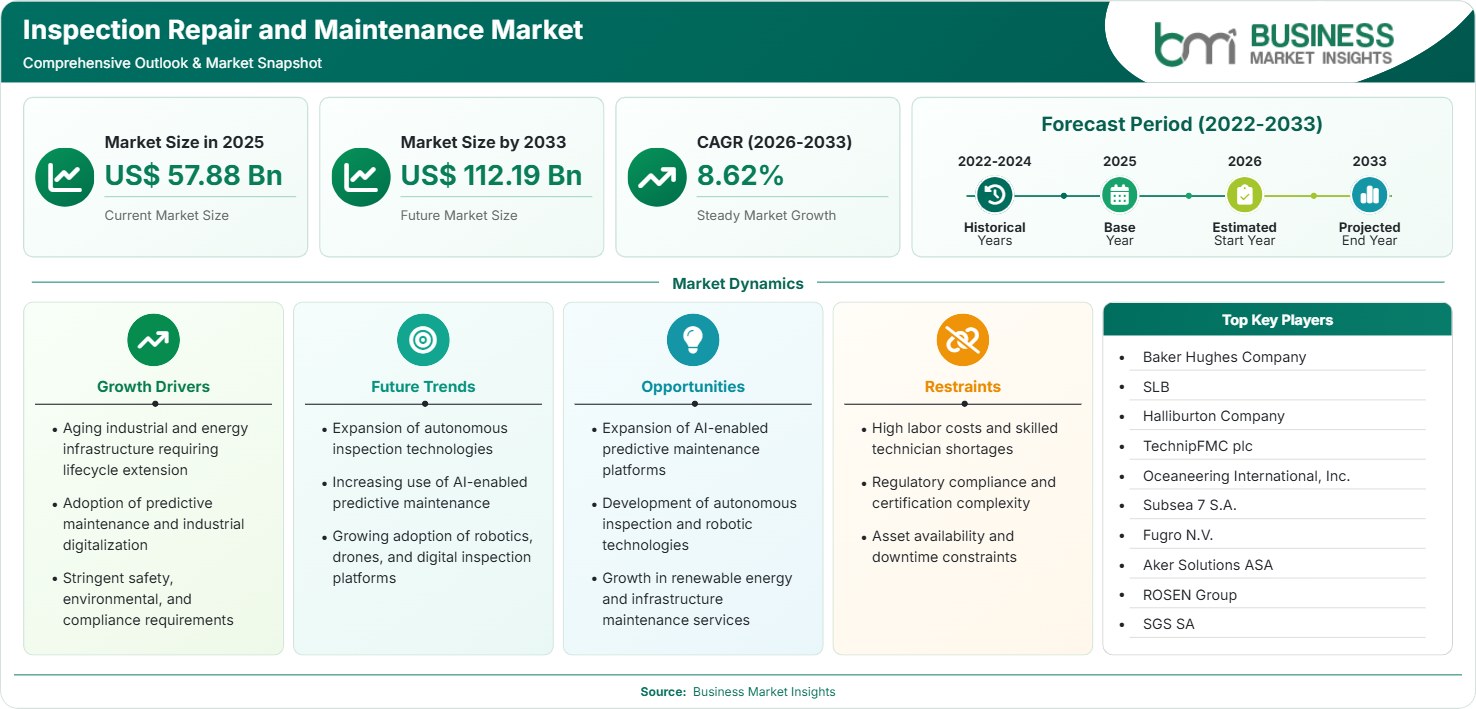
The Inspection Repair and Maintenance Market size was valued at US$ 57.88 Billion in 2025 and is projected to reach US$ 112.19 Billion by 2033, growing at a CAGR of 8.62% during 2026–2033. Growth is supported by aging industrial assets, stricter safety compliance requirements, predictive maintenance adoption, offshore infrastructure expansion, and increasing investments in asset integrity management across energy, manufacturing, marine, and infrastructure sectors.

Report Coverage
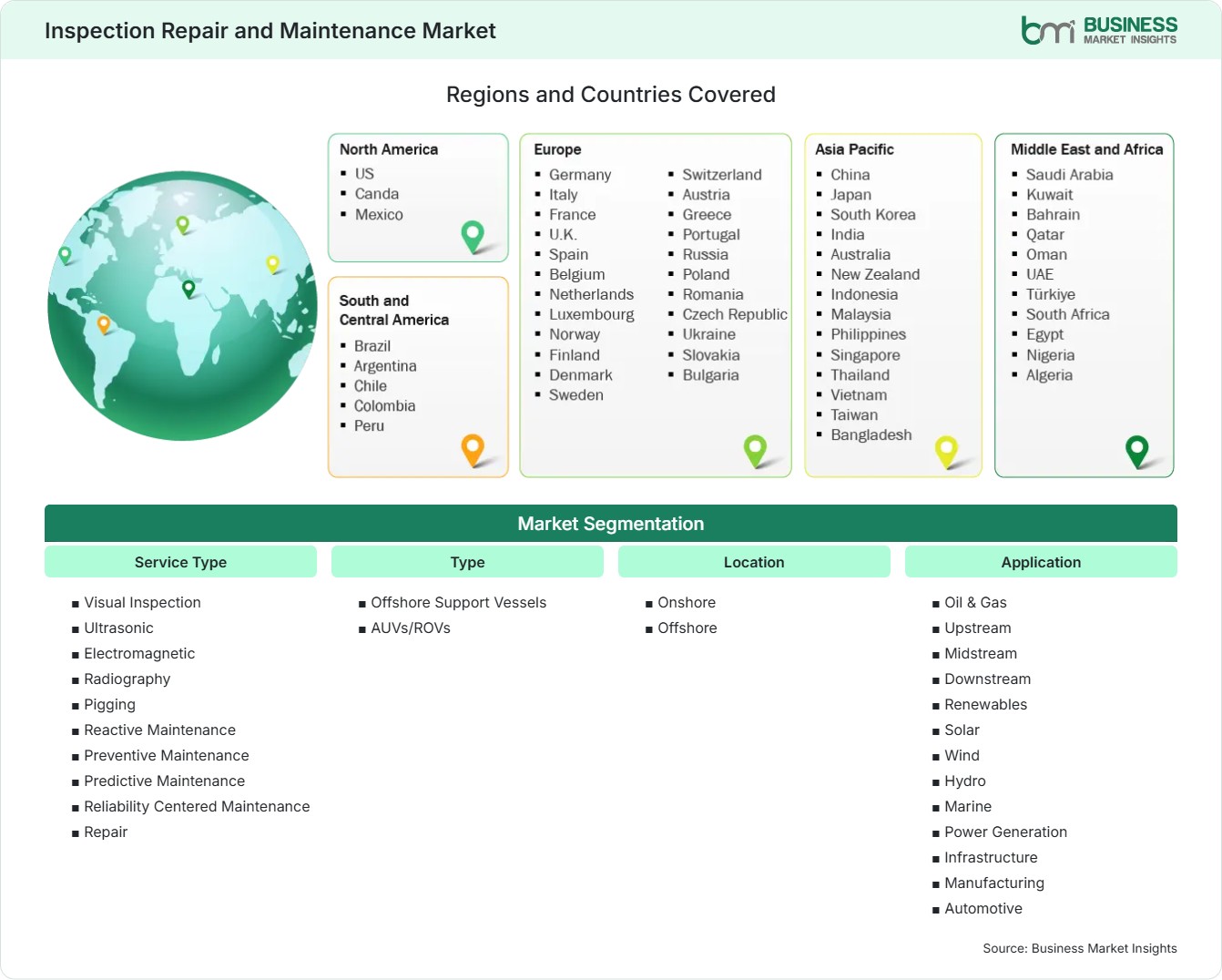
  • Service Type: Visual Inspection, Ultrasonic, Electromagnetic, Radiography, Pigging, Reactive Maintenance, Preventive Maintenance, Predictive Maintenance, Reliability Centered Maintenance, Repair
  • Type: Offshore Support Vessels, AUVs/ROVs
  • Location: Onshore, Offshore
  • Application: Oil & Gas, Upstream, Midstream, Downstream, Renewables, Solar, Wind, Hydro, Marine, Power Generation, Infrastructure, Manufacturing, Automotive
US$ 57.88 Bn Market size in 2025
US$ 112.19 Bn Market Size by 2033
8.62% CAGR, 2026 - 2033
2026-2033 Forecast Period

AI Overview

Inspection Repair and Maintenance Market Summary

  • North America Region: North America holds a market share of 34%–37% in 2025, expanding at a CAGR of 7.8%–8.4% through 2033. Growth is supported by aging pipeline infrastructure, offshore asset upgrades, digital inspection technologies, regulatory compliance, and predictive maintenance investments across energy and industrial facilities. The U.S. benefits from extensive energy infrastructure modernization and is expected to grow at 8.0%–8.6% CAGR.
  • Fastest Growing Region: Asia Pacific accounts for 25%–28% share in 2025 and is projected to expand at 9.8%–10.6% CAGR. Industrialization, renewable energy deployment, manufacturing expansion, infrastructure upgrades, and offshore exploration activities continue creating strong service demand across regional economies.
  • Leading Segment: Oil & Gas application represents 38%–42% share in 2025 and is forecast to grow at 8.0%–8.8% CAGR. Asset integrity requirements, pipeline monitoring programs, corrosion management initiatives, offshore field maintenance, and stringent operational safety regulations support sustained demand.
  • High Growth Segment: Predictive Maintenance holds 18%–22% share in 2025 and advances at 10.5%–11.5% CAGR. AI-enabled diagnostics, sensor deployment, digital twins, remote monitoring capabilities, downtime reduction objectives, and lifecycle optimization strategies are accelerating enterprise adoption.
  • Key Market Opportunity: Expanding integration of AI, robotics, drones, autonomous inspection systems, and digital asset management platforms creates significant opportunities for service providers delivering efficiency, safety, data-driven maintenance, and operational excellence.
  • Major Market Players: Baker Hughes Company, SLB, Halliburton Company, TechnipFMC plc, Oceaneering International, Inc., Subsea 7 S.A., Fugro N.V., Aker Solutions ASA, ROSEN Group, SGS SA.
Strategic Insights

Inspection Repair and Maintenance Market: Strategic Insights

Inspection Repair and Maintenance Market Strategic Framework
FREE PDF
Request your free sample
Request free sample
Stakeholder View

Key Takeaways

  • The value chain is becoming increasingly data-centric, with inspection activities feeding predictive maintenance platforms, creating recurring service revenues and stronger client retention.
  • Renewable energy facilities, offshore wind installations, and industrial infrastructure refurbishment programs offer some of the strongest medium-term growth opportunities.
  • AI-enabled diagnostics, autonomous vehicles, robotics, and digital twins are transforming traditional field-service models into technology-driven asset management solutions.
  • Asia Pacific offers the strongest investment potential as industrial capacity additions, energy demand growth, and infrastructure spending continue to accelerate.
  • Strategic acquisitions are expanding capabilities in robotics, condition monitoring, and digital asset integrity management, reflecting industry consolidation trends.
  • Sustainability objectives are increasing demand for proactive maintenance programs that reduce emissions, extend asset life, and improve energy efficiency.
Geographic Outlook

Inspection Repair and Maintenance Market Regional Highlights

North America Inspection Repair and Maintenance Market

North America accounted for approximately 34%–37% share in 2025 and is expected to grow at 7.8%–8.4% CAGR through 2033. The region benefits from extensive oil and gas infrastructure, mature industrial facilities, and advanced adoption of digital inspection technologies. Inspection Repair and Maintenance Market share remains supported by stringent safety regulations, asset-integrity programs, and increasing investments in predictive maintenance. Demand continues growing across refining facilities, power generation assets, and transportation infrastructure requiring lifecycle extension and operational reliability improvements.

  • Aging pipeline networks require frequent integrity assessments and corrosion management programs.
  • Advanced adoption of drones, robotics, and digital inspection software supports productivity improvements.
  • Offshore Gulf operations continue generating substantial inspection and maintenance spending.
  • Manufacturing modernization initiatives increase demand for predictive maintenance services.

US Inspection Repair and Maintenance Market

The United States represents roughly 76%–80% of North American revenue and expands at 8.0%–8.6% CAGR. Industrial automation, refinery upgrades, offshore energy assets, and transportation infrastructure modernization underpin sustained demand. Asset owners increasingly leverage predictive analytics and remote monitoring to reduce downtime and improve operational efficiency. Inspection Repair and Maintenance Market growth remains influenced by federal safety standards and ongoing investment into critical infrastructure rehabilitation.

  • Large energy infrastructure base supports recurring service demand.
  • Predictive maintenance platforms are being implemented across industrial sectors.
  • Renewable energy projects generate additional inspection requirements.
  • Infrastructure rehabilitation programs boost long-term market potential.

Europe Inspection Repair and Maintenance Market

Europe holds 27%–30% Inspection Repair and Maintenance Market share in 2025 and is projected to record 7.4%–8.1% CAGR. Demand is supported by offshore wind expansion, industrial decarbonization programs, and stringent regulatory oversight. The United Kingdom remains a leading market, while Norway and Germany demonstrate strong growth prospects. Digital asset management, advanced non-destructive testing technologies, and lifecycle extension initiatives support adoption throughout critical infrastructure and energy assets.

  • Offshore wind maintenance activities continue expanding rapidly.
  • Germany leads manufacturing-related service demand.
  • Norway benefits from offshore energy asset management requirements.
  • Asset life-extension programs support recurring revenue streams.

Asia Pacific Inspection Repair and Maintenance Market

Asia Pacific accounts for 25%–28% Inspection Repair and Maintenance Market share in 2025 and records the highest regional CAGR of 9.8%–10.6%. Rapid industrialization, energy infrastructure expansion, and manufacturing investments support strong demand. China remains the leading market, while India demonstrates the fastest growth trajectory. Public infrastructure projects, renewable energy deployment, and modernization of industrial facilities continue strengthening service opportunities across the region.

  • China leads revenue generation through extensive industrial capacity.
  • India benefits from expanding infrastructure and energy investments.
  • Smart manufacturing initiatives support predictive maintenance adoption.
  • Offshore exploration and renewable developments expand addressable demand.

Rest of World Inspection Repair and Maintenance Market

Rest of World accounts for 10%–13% Inspection Repair and Maintenance Market share and is expected to grow at 8.5%–9.3% CAGR. The Middle East benefits from large-scale oil and gas infrastructure requiring continuous asset integrity management. South and Central America are supported by energy and mining investments. Saudi Arabia leads regional demand, while the UAE and Brazil continue exhibiting strong growth supported by modernization and industrial expansion programs.

  • Middle Eastern energy infrastructure drives recurring maintenance requirements.
  • Brazil benefits from offshore resource development activities.
  • Mining and industrial investments generate rising inspection demand.
  • Asset modernization initiatives strengthen long-term service adoption.
Global Market Geography
FREE PDF
Request your free sample
Request free sample
Segment Analysis

Inspection Repair and Maintenance Market Segmentation

Service Type

Service Type accounted for approximately 48%–52% market share in 2025 and is projected to expand at a CAGR of 8.7%–9.3% through 2033. Growing emphasis on asset integrity, regulatory compliance, downtime reduction, and lifecycle optimization continues driving demand. The Inspection Repair and Maintenance Market scope within this segment has widened due to increasing adoption of predictive technologies, advanced non-destructive testing, and digital maintenance platforms across industrial and infrastructure assets.

  • Visual Inspection: Widely adopted for routine asset assessments across industrial plants, pipelines, marine structures, and infrastructure projects. Growing drone deployment and digital imaging systems improve inspection efficiency and coverage.
  • Ultrasonic: Used extensively for thickness measurement, corrosion monitoring, and weld integrity evaluation. Demand is increasing due to stricter safety requirements and expanding adoption across energy and manufacturing facilities.
  • Electromagnetic: Supports defect detection in pipelines, storage vessels, and metallic structures. Adoption is driven by its capability to identify anomalies without requiring extensive operational disruption.
  • Radiography: Preferred for critical weld inspections and structural assessments in high-risk environments. Growth is supported by stringent quality assurance requirements in energy, power generation, and industrial sectors.
  • Pigging: Essential for pipeline integrity management and operational efficiency. Increasing pipeline expansion projects worldwide continue supporting demand for intelligent pigging technologies and services.
  • Reactive Maintenance: Remains necessary for unplanned equipment failures and emergency interventions. Organizations increasingly combine reactive approaches with predictive systems to reduce operational risks.
  • Preventive Maintenance: Utilized to minimize asset failures through scheduled servicing and inspections. Industrial operators favor this approach for improving reliability and reducing maintenance-related expenditures.
  • Predictive Maintenance: Gaining traction through AI analytics, sensors, and connected monitoring systems. Advanced diagnostics help organizations optimize maintenance schedules and minimize unexpected downtime.
  • Reliability Centered Maintenance: Focuses on critical asset functions and operational reliability. Adoption is increasing among asset-intensive industries seeking long-term performance optimization.
  • Repair: Includes structural restoration, equipment refurbishment, component replacement, and integrity recovery activities. Demand is supported by aging infrastructure and asset life-extension strategies.

Type

Type represented nearly 22%–26% share in 2025 and is expected to register a CAGR of 9.2%–10.1%. Technological advancement in subsea inspection systems, automation, robotics, and remote operations is expanding deployment across offshore infrastructure, renewable energy facilities, and marine environments requiring frequent integrity assessments and maintenance interventions.

  • Offshore Support Vessels: Serve as essential platforms for conducting inspection, maintenance, repair, logistics, and intervention operations. Demand is supported by offshore energy development and marine asset expansion.
  • AUVs/ROVs: Autonomous and remotely operated vehicles enhance subsea inspection accuracy while reducing human exposure. Increased deployment reflects growing preference for cost-efficient offshore asset management solutions.

Location

Location-based services remain fundamental to market growth, accounting for approximately 100% service deployment coverage, with onshore operations dominating revenue contribution. The segment is projected to expand at a CAGR of 8.4%–9.2% due to infrastructure upgrades, offshore energy developments, and increasing regulatory oversight across industrial operations.

  • Onshore: Driven by manufacturing facilities, transportation infrastructure, power generation plants, and processing facilities requiring continuous inspection and maintenance support for operational reliability.
  • Offshore: Supported by oil and gas platforms, subsea assets, offshore wind farms, and marine infrastructure that require advanced inspection technologies and specialized maintenance expertise.

Application

Application demand is led by energy-related industries, with this segment accounting for approximately 55%–60% market share in 2025 and projected to expand at 8.8%–9.6% CAGR. Increasing infrastructure complexity, sustainability initiatives, and asset performance optimization programs continue driving adoption across multiple sectors.

  • Oil & Gas: The largest application area due to asset integrity requirements across upstream, midstream, and downstream operations. Regulatory compliance and operational safety remain primary demand drivers.
  • Upstream: Requires continuous monitoring of drilling, production, offshore platforms, and associated infrastructure to ensure safety, reliability, and production continuity.
  • Midstream: Focuses on pipelines, storage facilities, and transportation networks where integrity management and leak prevention programs are critical priorities.
  • Downstream: Includes refineries and processing facilities requiring regular inspections, maintenance programs, and repair activities to maximize efficiency and compliance.
  • Renewables: Growing rapidly as solar, wind, and hydro assets require lifecycle management, condition monitoring, and preventive maintenance programs.
  • Solar: Inspection services support panel efficiency, fault detection, electrical system reliability, and performance optimization across utility-scale installations.
  • Wind: Requires blade inspections, turbine maintenance, structural assessments, and offshore support activities to ensure operational performance and energy output.
  • Hydro: Involves monitoring dams, turbines, generators, and associated infrastructure to maintain safety, efficiency, and long-term asset reliability.
  • Marine: Demand is supported by vessel maintenance, port infrastructure inspections, subsea asset management, and maritime safety compliance requirements.
  • Power Generation: Relies on ongoing inspection and maintenance activities to ensure equipment reliability, grid stability, and operational continuity.
  • Infrastructure: Includes bridges, tunnels, rail networks, water systems, and public facilities requiring regular assessments and rehabilitation programs.
  • Manufacturing: Increasingly leverages predictive maintenance platforms to reduce downtime, improve productivity, and optimize equipment performance.
  • Automotive: Utilizes inspection and maintenance services throughout production facilities to ensure quality, operational efficiency, and regulatory compliance.
Market Forces

Inspection Repair and Maintenance Market Dynamics

Key Market Drivers

Aging Industrial and Energy Infrastructure Requires Lifecycle Extension

A significant proportion of pipelines, refineries, offshore platforms, power generation facilities, and transportation infrastructure worldwide are operating beyond their original design life. Owners of assets are increasingly focused on adopting life-extension approaches due to the capital required for infrastructure replacement. The inspection, maintenance, and repair activities can assist in ensuring compliance with the regulations, enhancing reliability, and minimizing risks related to safety. More investment in integrity management of the pipelines, structural health monitoring, corrosion prevention, and asset rehabilitation is creating recurring demand.

Adoption of Predictive Maintenance and Industrial Digitalization

Industrial organizations are accelerating investment in predictive maintenance technologies that combine sensors, AI analytics, cloud platforms, and digital twins. These systems detect performance problems before breakdowns, enabling operators to reduce maintenance costs and enhance their assets' efficiency. Maintenance approaches driven by digitalization allow for monitoring of crucial pieces of equipment in manufacturing plants, energy companies, and transportation networks. Widespread use of Industrial IoT solutions makes it possible to collect data continuously and address the conditions of equipment.

Stringent Safety, Environmental, and Compliance Requirements

Governments and regulatory agencies are strengthening requirements related to operational safety, environmental protection, and infrastructure integrity. Inspections, asset verification, and maintenance are essential for compliance and risk mitigation for industrial companies. Operational reliability and environmental impacts are becoming key factors for energy plants, transport infrastructure, and other public assets. Compliance-focused investments still provide substantial opportunities for demand for non-destructive testing, remote inspections, and repairs. Businesses are realizing that preventive maintenance helps them mitigate regulatory risks and increase safety and efficiency.

Key Market Opportunities

Expansion of Offshore Wind and Renewable Energy Infrastructure

Deployment of offshore wind farms, solar power plants, and hydropower facilities at a rapid pace is opening up new service avenues. Inspection, predictive maintenance, structural health checks, and asset management are among the needs of renewable energy companies. As their reach expands to tough locations, the need for robotics and remote monitoring systems rises. Inspection Repair and Maintenance Market Forecasts indicate growing involvement of service providers capable of supporting complex renewable infrastructure. Investors increasingly target companies offering integrated maintenance solutions designed specifically for renewable energy applications.

Growth of Autonomous Inspection Technologies

AUVs, ROVs, drones, and robotic inspection systems are transforming traditional service delivery models. These advancements ensure safety, speed up data-gathering processes, and reduce operational costs in dangerous situations. More and more companies opt for using automated inspections to reach the hard-to-reach places without stopping the production process. Progress in machine vision, defect recognition with the help of artificial intelligence, and cloud computing provides additional value. Those who implement autonomous inspection systems can distinguish themselves due to increased efficiency and data accuracy.

Smart Infrastructure Monitoring Programs

Governments worldwide are increasing funding for transportation, utility, and public infrastructure modernization. Inspection and maintenance services are crucial for bridges, tunnels, water systems, railways, and power lines. Intelligent monitoring systems utilizing sensors and diagnostics will result in ongoing service needs. Predictive asset management of infrastructure is becoming a priority among infrastructure owners due to the need to maximize lifespan and avoid failures. This approach, together with monitoring, is expected to generate ongoing service demand.

Market Restraints and Challenges

High Technology Deployment Costs and Capital Requirements

Factor: Advanced inspection systems, including robotics, AI analytics platforms, digital twins, AUVs, and ROVs, require substantial investment in hardware, software, training, and integration. Impact: Small service providers and operators find themselves limited by financial considerations due to the high initial expense of advanced technology, which delays the ROI period and presents challenges for implementation. While the eventual gains in terms of efficiency are certainly compelling, the capital requirements have continued to hamper adoption rates.

Shortage of Skilled Technical Workforce

Factor: Many inspection, maintenance, and repair activities require highly trained personnel with expertise in non-destructive testing, robotics operation, data analytics, and asset integrity management. Impact: Worker shortages can raise labor expenses, prolong project times, and diminish service delivery. As technological advancement continues to enhance industrial equipment, the need for skilled workers keeps growing at a rate that is faster than their training. Service providers are now experiencing increasing difficulties in ensuring service delivery within the stipulated operational capacity.

Company Analysis

Competitive Landscape

The competitive environment is characterized by integrated service providers, technology specialists, inspection experts, and asset integrity companies. The Inspection Repair and Maintenance Market analysis highlights rising investments in robotics, digital monitoring, and predictive maintenance capabilities.

Company Name

Overview

Products and Services relevant to this market

Baker Hughes Company

Global energy technology company with strong asset integrity capabilities.

Inspection services, non-destructive testing, asset monitoring, maintenance solutions.

SLB

Major oilfield technology provider supporting industrial asset reliability.

Digital inspection, predictive maintenance, integrity management solutions.

Halliburton Company

Energy services leader with extensive infrastructure expertise.

Inspection technologies, maintenance support, operational optimization services.

TechnipFMC plc

Offshore engineering and energy infrastructure specialist.

Subsea inspection, repair programs, intervention services.

Oceaneering International, Inc.

Leading offshore robotics and inspection provider.

ROV services, subsea inspections, maintenance and repair solutions.

Subsea 7 S.A.

Offshore engineering contractor with global operations.

Asset integrity, subsea maintenance, inspection solutions.

Fugro N.V.

Geo-data and infrastructure inspection specialist.

Remote inspections, digital monitoring, asset assessment services.

Aker Solutions ASA

Engineering company supporting offshore lifecycle operations.

Maintenance engineering, repair solutions, integrity management.

ROSEN Group

Asset integrity and inspection technology provider.

Pipeline inspection, diagnostics, condition assessment systems.

SGS SA

Global testing, inspection, and certification company.

Inspection, verification, compliance, industrial maintenance support.

Trust & Transparency

Research Methodology

The market analysis combines proprietary research with secondary data from government agencies, company disclosures, regulatory filings, industry databases and expert interviews. Market estimates are validated through data triangulation, cross-market benchmarking and analyst review.

View Full Research Methodology

Questions Answered

Frequently Asked Questions

What does the Inspection Repair and Maintenance Market Report help stakeholders evaluate?

The Inspection Repair and Maintenance Market Report helps stakeholders assess growth prospects, competitive positioning, technology trends, investment priorities, regional opportunities, and evolving end-user requirements.

How are autonomous technologies influencing service delivery?

AUVs, ROVs, drones, and robotic inspection platforms enhance safety, reduce human exposure in hazardous environments, improve data quality, and lower operational costs.

Which region offers the strongest growth potential?

Asia Pacific presents the strongest growth outlook due to infrastructure development, industrial expansion, renewable energy investments, and increasing deployment of advanced maintenance technologies.

What factors are accelerating predictive maintenance adoption?

Industrial digitization, AI-powered analytics, connected sensors, remote monitoring systems, and downtime reduction objectives are encouraging organizations to transition from reactive to predictive maintenance models.

Which application segment generates the highest revenue?

Oil & Gas remains the largest application segment because operators require continuous inspection, integrity management, maintenance, and repair activities across upstream, midstream, and downstream assets.

Access the Full Inspection Repair and Maintenance Market Report

Get segment-level forecasts, regional estimates, competitive benchmarking, company profiles and downloadable Excel datasets.

Access the full Inspection Repair and Maintenance Market Report
350 pages PDF & Excel | 2026-08-27