Market Summary
Executive Summary and Global Market Analysis
Aircraft line maintenance refers to the routine inspection, troubleshooting, repair, and servicing activities performed on aircraft between flights or during short ground intervals to ensure operational readiness and regulatory compliance. These services include component replacement, defect rectification, engine and auxiliary power unit (APU) checks, and aircraft-on-ground (AOG) support. Aircraft line maintenance plays a critical role in minimizing operational disruptions, maintaining safety standards, and supporting airline fleet availability. The market is expanding as global air traffic continues to recover, airlines focus on improving fleet utilization, and airport operators invest in efficient ground support infrastructure. Growing adoption of predictive maintenance technologies, digital inspection tools, and real-time aircraft monitoring systems is further supporting demand for advanced line maintenance services across commercial aviation networks.
Several factors may limit market growth. The aviation industry faces an ongoing shortage of licensed maintenance technicians and skilled engineers, creating workforce challenges for maintenance providers. Increasing aircraft system complexity requires continuous technician training and investment in specialized equipment. Airlines also face pressure to reduce maintenance costs while maintaining strict safety and regulatory requirements. In addition, maintenance operations can be affected by supply chain disruptions for spare parts and components, leading to longer turnaround times. Expanding maintenance capabilities at congested airports can also be challenging due to space limitations and infrastructure constraints. These factors may increase operational costs and affect service efficiency for maintenance organizations.
Despite these challenges, the Aircraft Line Maintenance market continues to present significant growth opportunities. Digital transformation initiatives are enabling more efficient maintenance planning, fault diagnostics, and documentation processes. An increase in the number of narrow-body planes in service, growth in low-cost airlines, and the rising need for quick turnaround operations have created opportunities in the field of dedicated line maintenance solutions. Technological advancements like diagnostics powered by artificial intelligence, mobile maintenance services, and predictive analytics have enhanced the efficiency of line maintenance solutions. There are various other factors driving the demand for line maintenance services in the current scenario.
Segment Analysis
Aircraft Line Maintenance Market Segmentation
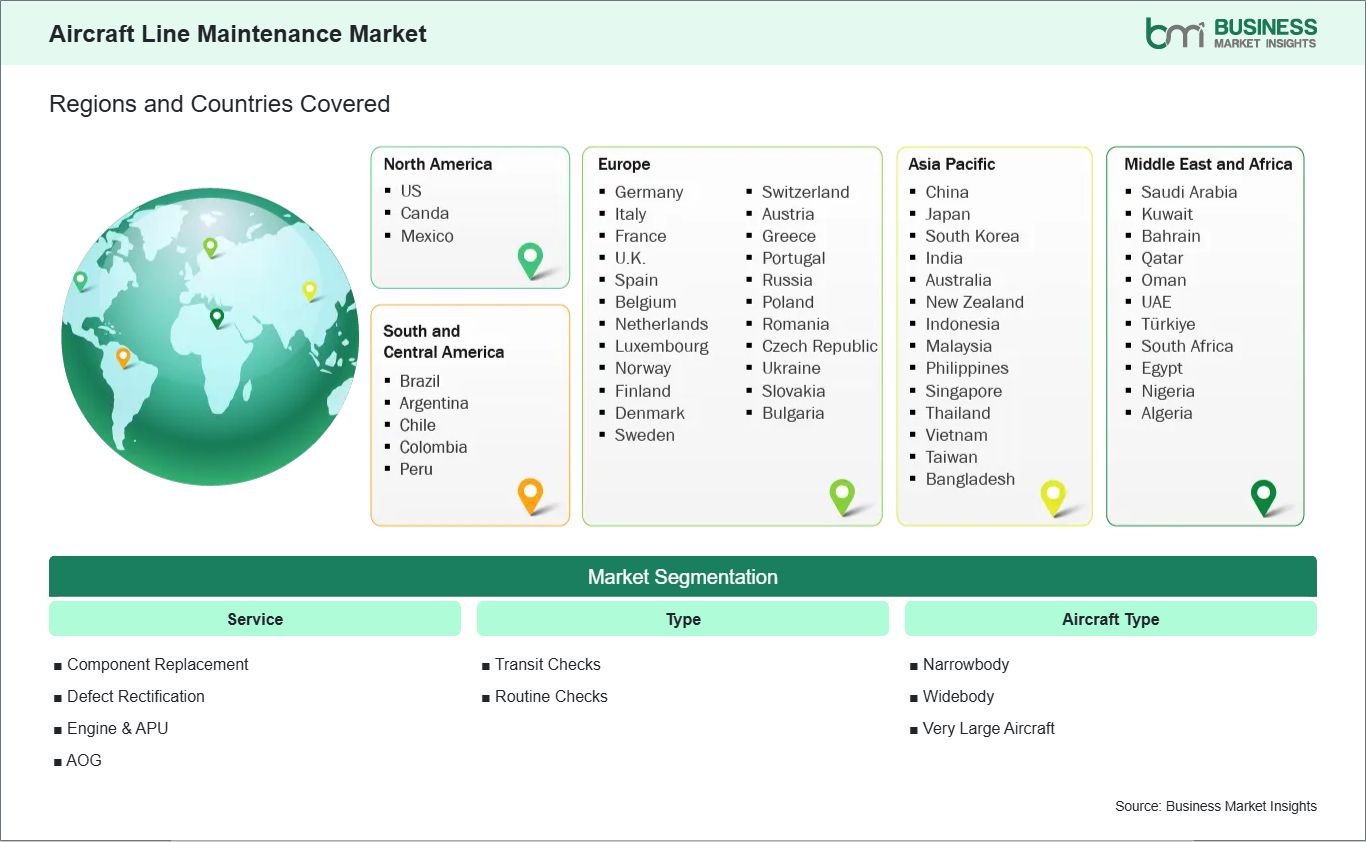
The Aircraft Line Maintenance market is segmented based on service, type, and aircraft type. These segments help address varying maintenance requirements across airline operations and fleet categories.
By Service
- Component Replacement: Covers replacement of worn or damaged aircraft components to maintain operational reliability.
- Defect Rectification: Focuses on identifying and correcting technical issues detected during inspections or operations.
- Engine & APU: Includes inspection, troubleshooting, and maintenance of engines and auxiliary power units.
- AOG: Provides urgent maintenance support to return grounded aircraft to service as quickly as possible.
By Type
- Transit Checks: Routine inspections conducted between flights to verify aircraft readiness.
- Routine Checks: Scheduled maintenance activities performed at predefined operational intervals.
By Aircraft Type
- Narrowbody: Represents maintenance demand from single-aisle commercial aircraft operating high-frequency routes.
- Widebody: Includes maintenance services for long-haul and high-capacity aircraft fleets.
- Very Large Aircraft: Covers specialized maintenance requirements for large passenger and cargo aircraft.
Market Forces
Aircraft Line Maintenance Market Drivers and Opportunities
Expanding Global Airline Operations Driving Maintenance Demand
The growth of commercial aviation and increasing aircraft utilization are major factors driving the Aircraft Line Maintenance market. Airlines are operating larger fleets and increasing flight frequencies to meet rising passenger and cargo transportation demand. As aircraft spend more time in operation, the need for regular inspections, repairs, and technical support becomes increasingly important. Regulatory authorities require strict compliance with safety and airworthiness standards, making line maintenance an essential operational function.
The aviation industry is also adopting advanced aircraft technologies, which require specialized maintenance expertise and equipment. Maintenance providers are investing in technician training, digital maintenance tools, and efficient service workflows to support modern aircraft fleets. The expansion of airport infrastructure and growth of airline networks across emerging economies are creating additional demand for maintenance services. As operators seek to minimize delays and maximize aircraft availability, reliable line maintenance capabilities become increasingly valuable. These factors collectively support sustained growth in the Aircraft Line Maintenance market.
Digital Maintenance Technologies Creating New Service Opportunities
The integration of digital technologies into aircraft maintenance operations is creating significant opportunities for the Aircraft Line Maintenance market. Airlines and maintenance providers are increasingly using predictive analytics, condition-based monitoring, and real-time aircraft health data to identify potential issues before they affect operations. These technologies improve maintenance planning and reduce unexpected aircraft downtime.
Mobile maintenance applications and digital inspection platforms are streamlining communication between technicians, operators, and maintenance control centers. Artificial intelligence and machine learning tools are improving fault diagnosis and helping maintenance teams make faster decisions. Growing investments in connected aircraft technologies are further supporting advanced maintenance capabilities. Emerging aviation markets are also expanding airport and maintenance infrastructure to support fleet growth. As airlines focus on operational efficiency and cost optimization, technology-driven maintenance services are expected to gain greater importance. These developments create long-term opportunities for service providers offering innovative and responsive line maintenance solutions.
Size and Share Analysis
Aircraft Line Maintenance Market Size and Share Analysis
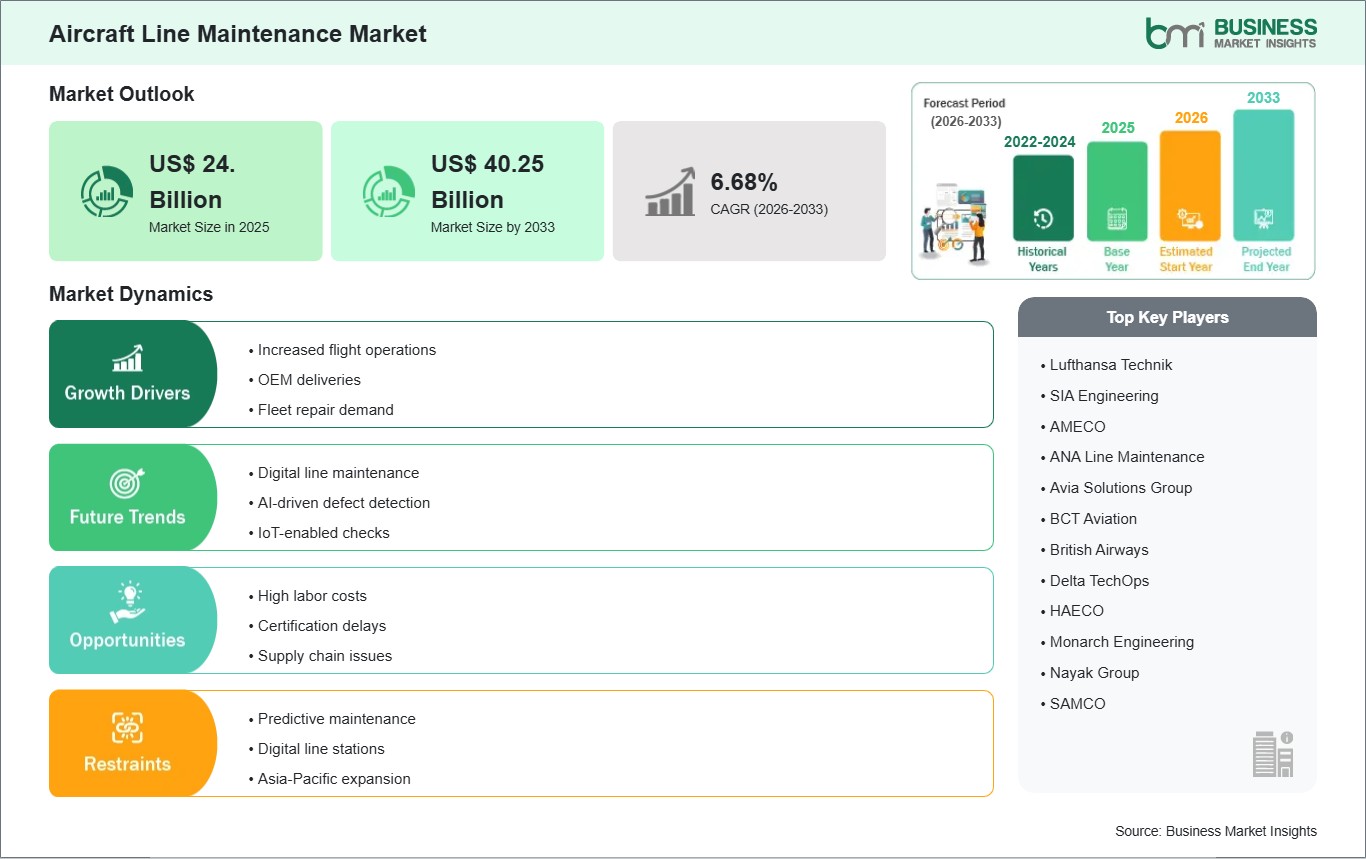
The Aircraft Line Maintenance Market is projected to grow from US$ 24. Billion in 2025 to US$ 40.25 Billion by 2033 , registering a CAGR of 6.68% from 2026 to 2033.
By service, component replacement accounts for a significant share of the market due to the continuous need to replace worn, damaged, or life-limited aircraft parts during daily operations. Defect rectification remains an important segment as airlines focus on maintaining aircraft reliability and regulatory compliance. Engine & APU services contribute substantially because of their critical role in aircraft performance, while AOG services continue to grow as operators seek rapid solutions to minimize aircraft downtime.
By type, transit checks hold a major share owing to their frequent execution between scheduled flights. Routine checks remain essential for maintaining airworthiness and ensuring operational safety. By aircraft type, narrowbody aircraft dominate the market due to their extensive deployment in domestic and regional airline networks. Widebody aircraft generate steady maintenance demand from international operations, while very large aircraft require specialized maintenance support because of their complex systems and operational requirements.
Report Coverage
Aircraft Line Maintenance Market Report Coverage and Deliverables
The "Aircraft Line Maintenance Size and Forecast (2022-2033)" report provides a detailed analysis of the market covering below areas:
- Aircraft Line Maintenance market size and forecast at global, regional, and country levels for all the key market segments covered under the scope
- Aircraft Line Maintenance market trends, as well as market dynamics such as drivers, restraints, and key opportunities
- Aircraft Line Maintenance market analysis covering key market trends, global and regional framework, major players, regulations, and recent market developments
- Industry landscape and competition analysis covering market concentration, heat map analysis, prominent players, and recent developments for the market
- Detailed company profiles, including SWOT analysis
Geographic Insights
Aircraft Line Maintenance Market Geographic Insights
The Aircraft Line Maintenance Market shows diverse regional adoption patterns influenced by airline fleet expansion, airport infrastructure development, regulatory compliance requirements, and increasing demand for operational efficiency.
North America, being a developed region, has a well-established aviation sector and a mature aircraft maintenance ecosystem. The region comprises the United States and Canada, where major commercial airlines, airport operators, and maintenance service providers continuously invest in advanced maintenance technologies and workforce development. The region focuses on maintaining high aircraft availability, improving operational safety, and complying with stringent aviation regulations. It has extensive airport infrastructure and established maintenance facilities, enabling efficient line maintenance operations across domestic and international airline networks. The growing adoption of predictive maintenance solutions and digital inspection technologies further supports market development across the region.
Asia Pacific is growing significantly, driven by rapid expansion of commercial aviation, increasing passenger traffic, and continuous fleet additions. The region comprises countries such as China, India, Japan, and Southeast Asian nations, where airline operators are expanding their route networks and investing in maintenance capabilities. The region focuses on strengthening airport infrastructure, enhancing maintenance efficiency, and supporting growing aircraft operations. Rising investments in aviation training programs, digital maintenance systems, and airport modernization projects are creating favorable conditions for market growth. The expansion of low-cost carriers and increasing aircraft utilization rates are also contributing to the growth of the Aircraft Line Maintenance Market across the region.
Both regions are contributing significantly to the growth of the Aircraft Line Maintenance Market, focusing on aviation infrastructure development, fleet expansion, maintenance efficiency improvements, and increasing adoption of advanced maintenance technologies.
Industry Activity
Recent Developments
The Aircraft Line Maintenance Market is analyzed using a mix of primary and secondary research sources, including corporate publications, industry associations, and verified databases. This approach ensures accurate tracking of innovation trends and strategic developments influencing the market.
- In February 2024, ST Engineering announced enhancements to its aircraft maintenance capabilities, including expanded support services and digital maintenance solutions designed to improve operational efficiency. The development strengthens the company's ability to provide comprehensive line maintenance services for commercial airline operators and supports increasing fleet maintenance requirements.
- In July 2024, Lufthansa Technik expanded its line maintenance network by adding new international service locations and strengthening support capabilities for airline customers. The initiative was aimed at improving aircraft availability and providing faster maintenance assistance at key aviation hubs. The expansion reflects growing demand for responsive line maintenance services across global airline networks.
Trust & Transparency
Research Methodology
The market analysis combines proprietary research with secondary data from government agencies, company disclosures, regulatory filings, industry databases and expert interviews. Market estimates are validated through data triangulation, cross-market benchmarking and analyst
review.
View Full Research Methodology
Key Sources Referred:
World Bank - Global Trade Indicators
World Trade Organization (WTO)
International Monetary Fund (IMF)
International Trade Administration (ITA)
Company Websites
Company Annual Reports
Company Investor Presentations