
Industry 4.0 in Aerospace and Defense Market Outlook: Size, Share, Trends, Growth Analysis, Competitive Landscape & Forecast, 2026-2033

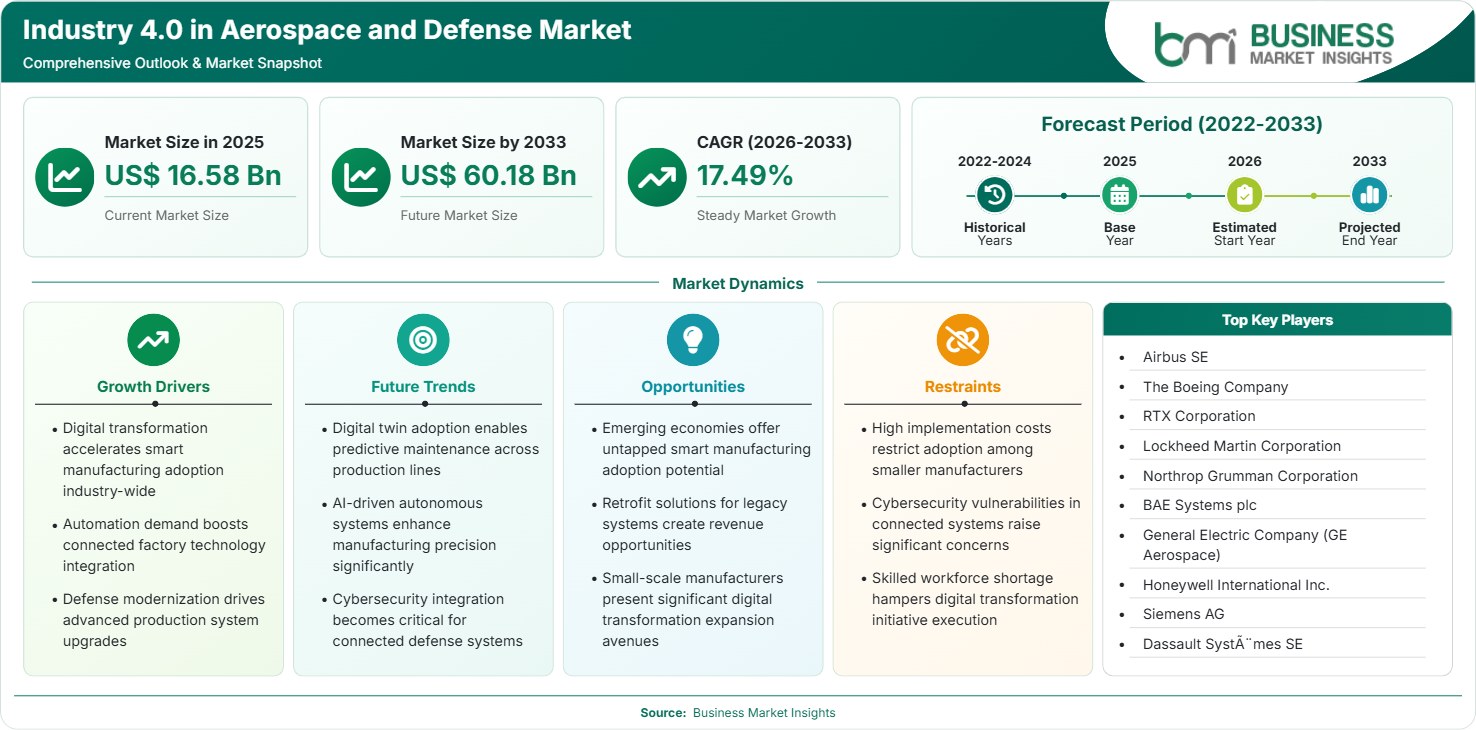
The Industry 4.0 in Aerospace and Defense Market size was valued at US$ 16.58 Billion in 2025 and is projected to reach US$ 60.18 Billion by 2033, growing at a CAGR of 17.49% during 2026–2033. Key drivers include smart factory deployment, digital twins, AI-enabled maintenance, defense modernization programs, and connected production ecosystems, while opportunities emerge from autonomous manufacturing, resilient supply chains, and lifecycle digitalization.

Report Coverage
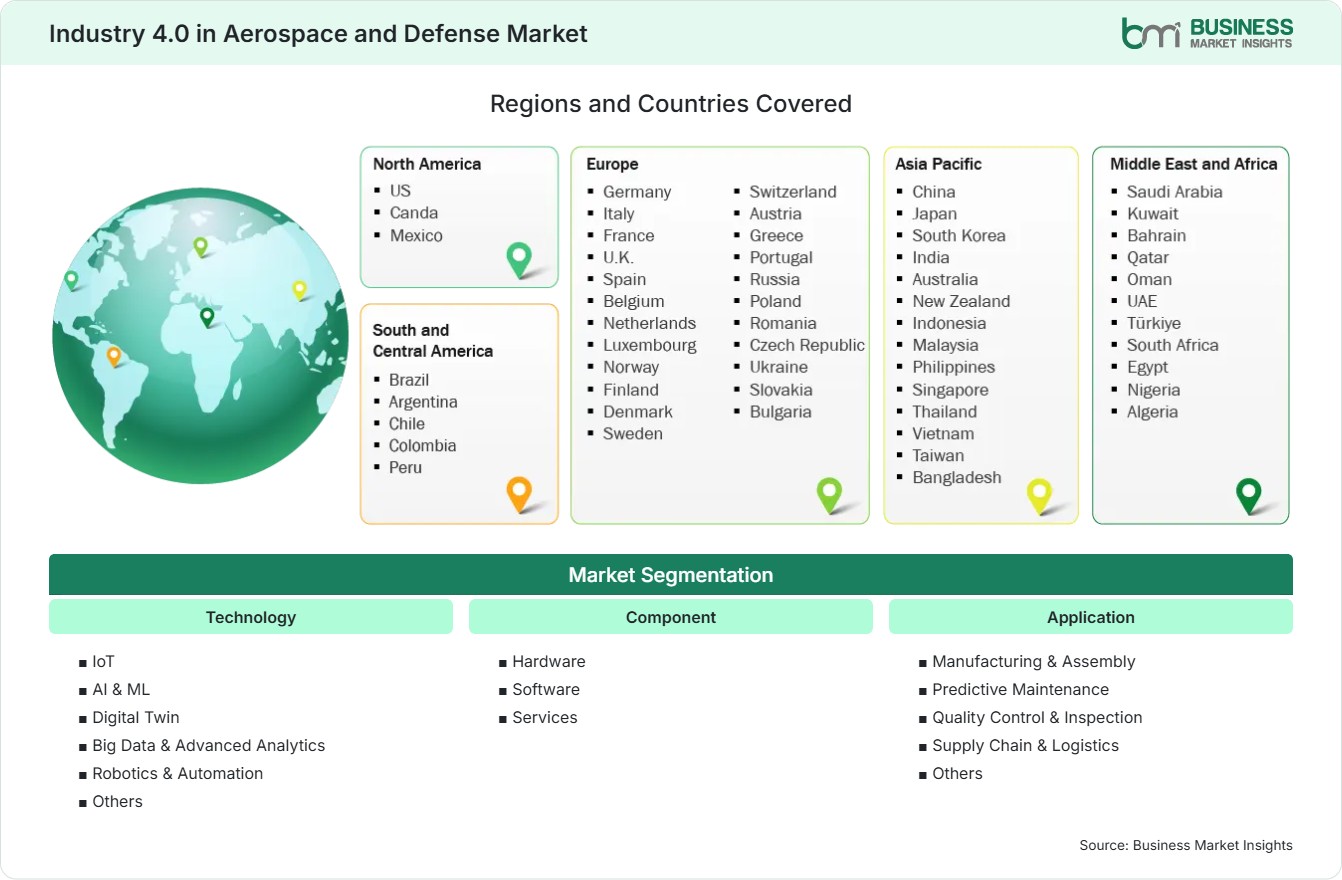
  • Technology: IoT, AI & ML, Digital Twin, Big Data & Advanced Analytics, Robotics & Automation, Others
  • Component: Hardware, Software, Services
  • Application: Manufacturing & Assembly, Predictive Maintenance, Quality Control & Inspection, Supply Chain & Logistics, Others
US$ 16.58 Bn Market size in 2025
US$ 60.18 Bn Market Size by 2033
17.49% CAGR, 2026 - 2033
2026-2033 Forecast Period

AI Overview

Industry 4.0 in Aerospace and Defense Market Summary

  • North America Region: North America holds a market share of 37%–40% in 2025, growing at a CAGR of 16.5%–18.0% during 2026–2033. Growth is supported by defense digitization, advanced aerospace manufacturing, AI-enabled maintenance platforms, digital engineering adoption, industrial IoT integration, supply-chain modernization initiatives, cybersecure automation frameworks, and government-backed innovation investments. The US accounts for 75%–78% of regional demand and is expected to record a CAGR of 16.8%–18.2% through 2033.
  • Fastest Growing Region: Asia Pacific holds 24%–27% share in 2025 and expands at a CAGR of 19.0%–21.0%. Drivers include aerospace production capacity expansion, indigenous defense programs, smart manufacturing investments, robotics deployment, digital twin adoption, AI-driven quality systems, industrial modernization agendas, and increasing regional aircraft demand.
  • Leading Segment: Manufacturing & Assembly accounts for 31%–34% share in 2025 and advances at 17.0%–18.5% CAGR. Adoption is accelerated by automated production lines, connected machinery, digital workflows, real-time analytics, reduced assembly errors, labor optimization, enhanced traceability, production scalability, and operational efficiency gains.
  • High Growth Segment: AI & ML represents 15%–18% share in 2025 and grows at 20.0%–22.5% CAGR. Expansion is driven by predictive maintenance, anomaly detection, autonomous inspections, process intelligence, mission planning support, quality forecasting, manufacturing optimization, engineering analytics, and decision automation capabilities.
  • Key Market Opportunity: Expanding digital thread implementation across aircraft design, manufacturing, maintenance, and sustainment phases creates opportunities for lifecycle visibility, reduced downtime, improved compliance, stronger collaboration, and accelerated innovation.
  • Major Market Players: Airbus SE, The Boeing Company, RTX Corporation, Lockheed Martin Corporation, Northrop Grumman Corporation, BAE Systems plc, General Electric Company (GE Aerospace), Honeywell International Inc., Siemens AG, Dassault Systèmes SE.
Strategic Insights

Industry 4.0 in Aerospace and Defense Market: Strategic Insights

Industry 4.0 in Aerospace and Defense Market Strategic Framework
FREE PDF
Request your free sample
Request free sample
Stakeholder View

Key Takeaways

  • Increasingly, the original equipment manufacturers in the aerospace sector are incorporating their suppliers into digitally linked value chains, which enhances visibility, traceability, and the coordination of production within complex global ecosystems.
  • Predictive maintenance and the use of digital twins offer significant potential by reducing downtime costs and enhancing aircraft availability across both commercial and defense fleets.
  • AI-powered inspection systems are being used to replace certain manual quality-control processes, which results in quicker identification of defects and an improvement in manufacturing consistency.
  • The Asia Pacific region offers a strong case for investment because of the expansion in aircraft manufacturing, the adoption of defense localization strategies, and the high level of spending on industrial automation.
  • The formation of strategic partnerships among aerospace manufacturers, software vendors, and providers of industrial automation is speeding up digital transformation and leading to greater market consolidation.
  • As the number of connected production environments increases in the aerospace and defence sectors, cybersecurity-focused industrial platforms are becoming a key factor in distinguishing one offering from another.
Geographic Outlook

Industry 4.0 in Aerospace and Defense Market Regional Highlights

North America Industry 4.0 in Aerospace and Defense Market

North America captured 37%–40% market share during 2025 and is expected to expand at a 16.5%–18.0% CAGR through 2033. The region benefits from strong aerospace manufacturing capabilities, substantial defense spending, digital engineering programs, and advanced smart-factory deployments. Major OEMs and defense contractors continue integrating predictive analytics, digital twins, and industrial IoT platforms. The region also represents the largest Industry 4.0 in Aerospace and Defense Market share, supported by mature technology infrastructures and continuous innovation investments.

  • The defense digital transformation programs promote the adoption of connected production platforms and ensure that industrial networks are secured.
  • The strong involvement of aerospace original equipment manufacturers is responsible for the widespread adoption of digital engineering technologies.
  • Maintenance solutions powered by AI help operators to improve fleet availability and cut down on lifecycle costs.
  • Investing in automation helps to deal with workforce limitations and boosts assembly-line productivity.

US Industry 4.0 in Aerospace and Defense Market

The US contributes 75%–78% of North American Industry 4.0 in Aerospace and Defense Market revenue and records a projected 16.8%–18.2% CAGR. Strong government funding, defense modernization, aerospace innovation programs, model-based systems engineering initiatives, and smart manufacturing investments continue driving technology deployment across commercial and military sectors.

  • Digital thread architectures are now being used more by defense contractors in both the development and sustainment phases.
  • Smart factories enhance the scalability of production for aircraft, engines, and defence platforms.
  • Predictive maintenance technologies help to achieve the aims of readiness and mission availability.
  • The use of industrial AI is speeding up operational intelligence and manufacturing optimization.

Europe Industry 4.0 in Aerospace and Defense Market

Europe accounts for 27%–30% Industry 4.0 in Aerospace and Defense Market share in 2025 and grows at a 16.0%–17.8% CAGR. Germany, France, and the UK lead adoption through advanced aerospace manufacturing ecosystems. Spain and Italy demonstrate accelerating investments in industrial automation and defense digitization. Sustainability-focused production strategies and digital manufacturing initiatives further support regional expansion.

  • Germany is still the biggest market in the region, with a strong level of adoption of Industry 4.0 in manufacturing plants.
  • France has the advantage of having aerospace clusters and the widespread use of digital engineering.
  • The United Kingdom achieves significant growth as a result of its defense innovation and smart manufacturing initiatives.
  • Use of digital twin applications is becoming more widespread in the areas of aircraft production and maintenance.

Asia Pacific Industry 4.0 in Aerospace and Defense Market

Asia Pacific holds 24%–27% share and represents the fastest-growing region, expanding at a 19.0%–21.0% CAGR. China, Japan, South Korea, and India are investing heavily in aerospace manufacturing and defense modernization. Rapid industrial automation adoption, expanding aircraft demand, and localization initiatives contribute substantially to regional Industry 4.0 in Aerospace and Defense Market growth.

  • China is leading the region in terms of revenue due to its expansion in manufacturing and its efforts at digitalization.
  • India's growth rate among regions is one of the highest as a result of its own defense initiatives.
  • The integration of robotics and AI leads to an improvement in both production quality and operational efficiency.
  • The government's support promotes the development of smart factories and innovation ecosystems.

Rest of World Industry 4.0 in Aerospace and Defense Market

The Rest of World region accounts for 8%–10% Industry 4.0 in Aerospace and Defense Market share and expands at a 15.0%–17.0% CAGR. The Middle East benefits from defense modernization programs and aerospace maintenance investments. South & Central American growth is supported by aerospace manufacturing upgrades and increasing industrial automation adoption across production facilities.

  • UAE and Saudi Arabia lead the region in spending on digital aerospace technology.
  • Brazil is still a major centre for the manufacturing of aerospace vehicles in South America.
  • Solutions for smart maintenance and supply chain visibility are becoming more popular.
  • The greater the degree of industrial digitalization the better the competitiveness and operational performance will be.
Global Market Geography
FREE PDF
Request your free sample
Request free sample
Segment Analysis

Industry 4.0 in Aerospace and Defense Market Segmentation

Technology

Technology represented approximately 34%–37% share in 2025 and is projected to grow at 18.0%–20.0% CAGR. The segment defines the technological foundation of connected aerospace manufacturing. The growing deployment of industrial IoT, AI platforms, digital twins, and analytics solutions supports productivity, quality improvement, and lifecycle optimization. The Industry 4.0 in Aerospace and Defense Market scope continues expanding as digital engineering becomes central to aerospace competitiveness.

  • IoT: Enables real-time equipment monitoring, asset connectivity, operational visibility, and performance optimization across manufacturing and maintenance environments.
  • AI & ML: Supports predictive insights, maintenance forecasting, defect detection, autonomous analytics, and intelligent production decision-making.
  • Digital Twin: Creates virtual replicas that improve simulation accuracy, lifecycle management, design validation, and operational optimization.
  • Big Data & Advanced Analytics: Enhances process intelligence, operational forecasting, performance benchmarking, and enterprise-wide decision support.
  • Robotics & Automation: Improves production speed, repeatability, safety performance, and manufacturing precision across aerospace facilities.

Component

Component solutions account for 29%–32% share in 2025 and are expected to grow at 16.5%–18.5% CAGR. Enterprises increasingly combine hardware infrastructure with specialized software and service capabilities. Platform integration, cybersecurity requirements, and lifecycle support contracts continue influencing purchasing decisions across aerospace and defense organizations.

  • Hardware: Includes sensors, controllers, communication devices, robotics equipment, and connected manufacturing infrastructure.
  • Software: Provides analytics, digital engineering, simulation, predictive maintenance, and manufacturing execution capabilities.
  • Services: Covers integration, consulting, implementation, training, maintenance, and digital transformation support activities.

Application

Application solutions hold 31%–34% share in 2025 and advance at 17.0%–18.5% CAGR. Rising pressure for quality, productivity, and operational resilience drives implementation across manufacturing, maintenance, and logistics processes. The segment continues benefiting from broader Industry 4.0 in Aerospace and Defense Market trends associated with intelligent operations.

  • Manufacturing & Assembly: Enables connected production, automated workflows, digital traceability, and improved process consistency.
  • Predictive Maintenance: Reduces unexpected failures through condition monitoring, analytics, and failure forecasting techniques.
  • Quality Control & Inspection: Utilizes AI vision systems, sensors, and analytics for more accurate defect identification.
  • Supply Chain & Logistics: Enhances inventory visibility, supplier coordination, operational transparency, and fulfillment performance.
Market Forces

Industry 4.0 in Aerospace and Defense Market Dynamics

Key Market Drivers

Rising Adoption of Smart Manufacturing Programs

There is pressure on aerospace manufacturers to boost their production rates without at the same time compromising the high quality standards. By using smart manufacturing systems that combine sensors, robotics, AI, and analytics, it is possible to increase output and cut down on mistakes. Since industry groups such as IATA have pointed out that demand for aircraft is increasing, the original equipment manufacturers are being prompted to modernize their production facilities. Digital factories allow for real-time monitoring, predictive maintenance, and the optimization of resources. The operational benefits achieved in this way can be applied to faster deployment in both the commercial aviation and defense sectors.

Growing Use of Digital Twins Across Lifecycle Operations

Digital twins are increasingly applied during aircraft design, production, maintenance, and sustainment. These platforms reduce physical prototyping requirements while improving product validation and operational decision-making. Wider digital thread adoption enhances collaboration among engineering, manufacturing, and support teams. Industry 4.0 technologies allow organizations to improve efficiency, increase visibility, and support long-term asset management requirements throughout the aerospace lifecycle.

Defense Modernization and Digital Engineering Investments

Governments are boosting their investment in advanced defense platforms and digital engineering environments. Through the use of connected manufacturing, AI-driven analytics, and model-based systems engineering, development speed and mission readiness improve. Defense agencies are looking for production systems based on technology that can provide greater agility and resilience. These priorities continue to drive the long-term demand for Industry 4.0 technologies within aerospace and defense organizations.

Key Market Opportunities

Expansion of Lifecycle Digital Thread Ecosystems

Digital thread capabilities connecting design, production, maintenance, and sustainment processes create meaningful value opportunities. Organizations can improve traceability, compliance management, collaboration efficiency, and operational intelligence. Investments supporting end-to-end data continuity are expected to accelerate, creating an attractive Industry 4.0 in Aerospace and Defense Market Forecasts for software providers and technology integrators.

AI-Powered Aerospace Maintenance Platforms

Maintenance organizations are now using AI-powered monitoring systems that can predict component degradation before failures occur. Such systems lead to a reduction in aircraft downtime, enhance availability, and allow for better maintenance planning. With fleets growing globally, demand for intelligent support systems is likely to increase significantly, creating new recurring revenue opportunities for providers of digital solutions.

Industrial Cybersecurity Integration

Since connected factories need secure operational technology environments, there is growing demand for cybersecurity platforms that are designed for use in the aerospace and defence sectors. Companies that provide secure connectivity, threat monitoring, and solutions with a focus on compliance are likely to benefit from the rising need for protection in highly connected production systems.

Market Restraints and Challenges

High Implementation Costs and Integration Complexity

The setup of smart-factory infrastructure involves substantial capital outlays covering software, hardware, networking, training, and system integration. As a result, smaller suppliers and mid-sized manufacturers often delay adopting it due to financial constraints and uncertainty about the timing of returns on investment. Additional costs are caused by the difficulties of integrating with older equipment and by the fragmented nature of the data systems. Such obstacles may hinder transformation initiatives and slow the implementation of changes across parts of the aerospace supply chain.

Cybersecurity Risks in Connected Production Networks

The greater the level of connectivity, the higher the exposure to cyber threats aimed at operational technology, manufacturing systems, and mission-critical data. As a result, security events can lead to disruptions in production schedules, result in greater compliance requirements, and cause substantial financial consequences. Aerospace and defense organizations, therefore, have to extend their deployment cycles and make additional security investments before they can implement large-scale, highly connected Industry 4.0 environments.

Company Analysis

Competitive Landscape

The competitive environment reflects ongoing Industry 4.0 in Aerospace and Defense Market analysis, with aerospace OEMs, defense contractors, automation companies, and digital software providers investing heavily in connected manufacturing capabilities.

Company Name

Overview

Products and Services relevant to this market

Airbus SE

Global aerospace leader advancing digital manufacturing and lifecycle connectivity initiatives.

Digital twins, smart manufacturing platforms, data analytics, aerospace production technologies.

The Boeing Company

Major aerospace manufacturer investing in AI, automation, and digital engineering.

Smart factory solutions, digital production systems, advanced manufacturing technologies.

RTX Corporation

Defense and aerospace technology provider pursuing model-based and digital engineering.

Digital design environments, predictive analytics, connected aerospace systems.

Lockheed Martin Corporation

Defense contractor emphasizing digital transformation and advanced production.

Digital engineering, intelligent manufacturing, aerospace sustainment technologies.

Northrop Grumman Corporation

Aerospace and defense innovator focused on connected development ecosystems.

Model-based systems, analytics platforms, manufacturing modernization solutions.

BAE Systems plc

Global defense company deploying smart manufacturing and automation initiatives.

Digital production systems, advanced engineering services, automation technologies.

General Electric Company (GE Aerospace)

Aerospace engine leader leveraging analytics and industrial software.

Predictive maintenance, connected engines, industrial analytics solutions.

Honeywell International Inc.

Industrial technology company supporting aerospace digitalization.

IoT platforms, automation systems, connected aerospace technologies.

Siemens AG

Industrial automation and digital transformation provider.

Digital twins, industrial software, smart manufacturing and automation tools.

Dassault Systèmes SE

Enterprise software leader with strong aerospace engineering presence.

3DEXPERIENCE platform, simulation tools, lifecycle management software.

Trust & Transparency

Research Methodology

The market analysis combines proprietary research with secondary data from government agencies, company disclosures, regulatory filings, industry databases and expert interviews. Market estimates are validated through data triangulation, cross-market benchmarking and analyst review.

View Full Research Methodology

Questions Answered

Frequently Asked Questions

Which technology segment is expected to grow fastest?

AI & ML technologies are projected to record the strongest growth due to increasing demand for predictive analytics, automation, intelligent inspections, and digital decision support.

What does the Industry 4.0 in Aerospace and Defense Market Report cover?

The Industry 4.0 in Aerospace and Defense Market Report evaluates technology adoption, business opportunities, competitive dynamics, regional performance, market trends, and future growth prospects.

Which region dominates the market?

North America leads due to high defense spending, established aerospace manufacturing infrastructure, advanced technology adoption, and strong innovation ecosystems.

How does AI improve aerospace manufacturing?

AI enhances quality inspection, predicts maintenance needs, optimizes production scheduling, identifies anomalies, and improves operational decision-making through advanced analytics.

What is driving adoption of Industry 4.0 technologies in aerospace and defense?

Increasing aircraft production requirements, defense modernization programs, predictive maintenance demand, and digital engineering initiatives are accelerating technology adoption across manufacturing and sustainment operations.

Access the Full Industry 4.0 in Aerospace and Defense Market Report

Get segment-level forecasts, regional estimates, competitive benchmarking, company profiles and downloadable Excel datasets.

Access the full Industry 4.0 in Aerospace and Defense Market Report
350 pages PDF & Excel | 2026-09-23
Similar Research

Related Market Reports