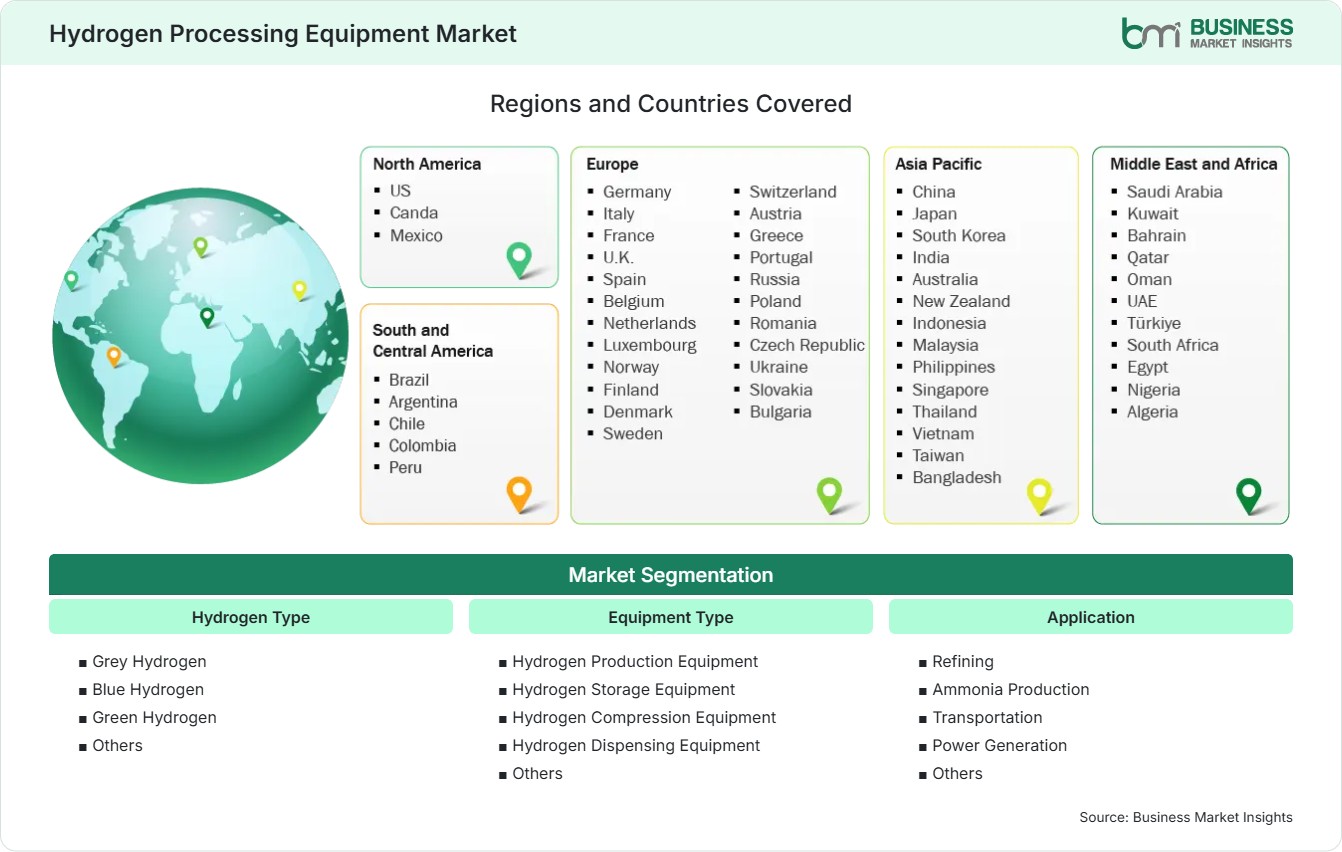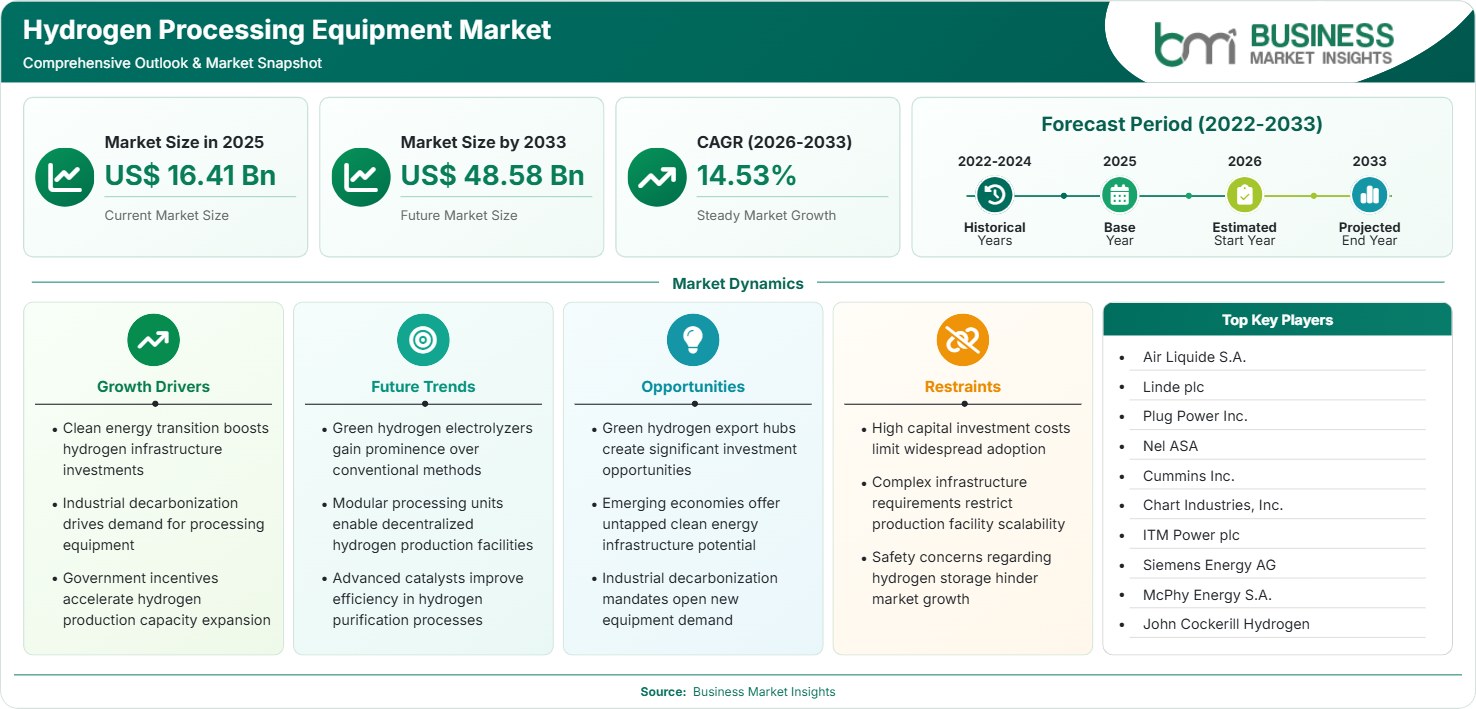
Hydrogen Processing Equipment Market Regional Highlights
North America Hydrogen Processing Equipment Market
North America accounted for approximately 34%–37% of global revenue in 2025 and is projected to grow at a CAGR of 13.5%–14.5% through 2033. The region maintains significant Hydrogen Processing Equipment Market share due to established industrial infrastructure, strong research capabilities, project financing availability, and accelerating commercialization activities across low-carbon hydrogen production and distribution networks.
- The federal hydrogen hub programs are still supporting the development of large-scale projects, which in turn increases the demand for production, storage, and compression equipment and also strengthens the regional manufacturing ecosystems as well as the technology commercialization initiatives.
- The refining and chemical industries continue to be the main users of hydrogen equipment as companies carry out investments aimed at reducing emissions and modernising their operations in existing industrial facilities.
- The incorporation of carbon capture into hydrogen projects is providing more opportunities for suppliers of blue hydrogen equipment to deploy their products in industrial and energy applications across the region.
- The increasing amount of money being invested in heavy-duty transportation infrastructure is leading to the installation of hydrogen dispensing systems to support trucks, buses, and logistics operations in key corridors.
- The involvement of private capital and cooperation between public and private sectors are still speeding up the deployment of technology, the expansion of manufacturing, and commercialisation efforts in the various stages of the hydrogen industry.
US Hydrogen Processing Equipment Market
The United States represents 78%–82% of North American Hydrogen Processing Equipment Market revenue in 2025 and advances at a CAGR of 13.8%–14.8% through 2033. Government incentives, industrial decarbonization initiatives, and expanding hydrogen hubs continue attracting equipment investments. Strong participation from energy companies, utilities, transportation providers, and technology developers supports commercialization.
- Large-scale projects for electrolyzers are helping to improve the nation's domestic supply chains at the same time as they support industrial users who are looking for ways to adopt low-carbon hydrogen.
- Initiatives aimed at integrating renewable energy are increasing the demand for equipment that can be used for flexible hydrogen production and for grid balancing.
- People who are involved in transportation are looking at hydrogen-powered options for heavy-duty fleets and are therefore promoting spending on compression and dispensing infrastructure.
- Advanced project deployments are now experiencing concentrated demand due to industrial clusters in the energy, chemicals, and manufacturing sectors.
Europe Hydrogen Processing Equipment Market
Europe held approximately 25%–28% of global Hydrogen Processing Equipment Market revenue in 2025 and is projected to expand at a CAGR of 14.0%–15.5% during 2026–2033. The region benefits from ambitious decarbonization objectives, extensive renewable energy deployment, and hydrogen infrastructure investments.
- Germany is still the country's biggest market, due to its industrial decarbonisation initiatives and the establishment of large electrolyser installations, and the demand is focused on applications in the chemical, steel, and energy sectors.
- Spain is one of the fastest-growing countries, taking advantage of its plentiful renewable resources and the development of export-oriented hydrogen projects, which in turn creates more opportunities for equipment manufacturers.
- In the Netherlands and Belgium hydrogen infrastructure projects based on ports are facilitating investments in storage, compression, and distribution equipment for use in both the domestic and export markets.
- Demand for fueling and dispensing systems is increasing all over Europe as a result of various transportation projects in the fields of rail, public transit, and heavy-duty logistics.
- The commercialisation and implementation of large-scale hydrogen ecosystems are being speeded up by strategic collaborations between utilities, industrial operators, and technology providers.
Asia Pacific Hydrogen Processing Equipment Market
Asia Pacific accounted for roughly 28%–31% of global Hydrogen Processing Equipment Market revenue during 2025 and is expected to record the fastest CAGR of 16.0%–17.5% through 2033. Rapid industrialization, renewable energy investments, and national hydrogen strategies are strengthening demand throughout the region.
- China is still leading the way in terms of regional adoption due to its large-scale deployment of electrolyzers, its manufacturing advantages, and its increasing investments in industrial uses of hydrogen.
- India is seeing rapid growth as its national hydrogen initiatives promote the development of infrastructure and the domestic manufacturing of key equipment technologies.
- Japan and South Korea are still leading in the field of technology, with a focus on hydrogen mobility, fuel cells, and the use of advanced equipment to support their long-term energy transition objectives.
- The capacity for renewable generation is being expanded, which is leading to production projects in a number of countries combining solar and wind resources with hydrogen facilities.
- Regional export goals are leading to investment in storage, compression, and liquefaction facilities. These will support future hydrogen trade routes.
Rest of World Hydrogen Processing Equipment Market
The Rest of World region represents approximately 9%–12% of global Hydrogen Processing Equipment Market revenue in 2025 and is projected to expand at a CAGR of 15.0%–16.5% through 2033. Middle East and Africa markets are benefiting from large renewable energy resources and export-oriented hydrogen strategies.
- Saudi Arabia is carrying out large-scale projects for the production of hydrogen with the aim of supporting future export markets and achieving its industrial diversification objectives.
- The United Arab Emirates is still making investments in integrated hydrogen facilities, this involving the deployment of advanced equipment for production, storage and transportation.
- Brazil is using its renewable electricity resources to set up competitive green hydrogen projects, which in turn increases the demand for equipment throughout the value chain.
- Chile is drawing in international investors by means of its developments in hydrogen that is powered by renewable energy, with a focus on industrial uses and on export possibilities.
- The level of cooperation between governments and large energy companies is speeding up the implementation of projects and the introduction of new technologies in emerging markets.