
Laser Processing Equipment Market Outlook: Size, Share, Trends, Growth Analysis, Competitive Landscape & Forecast, 2026-2033

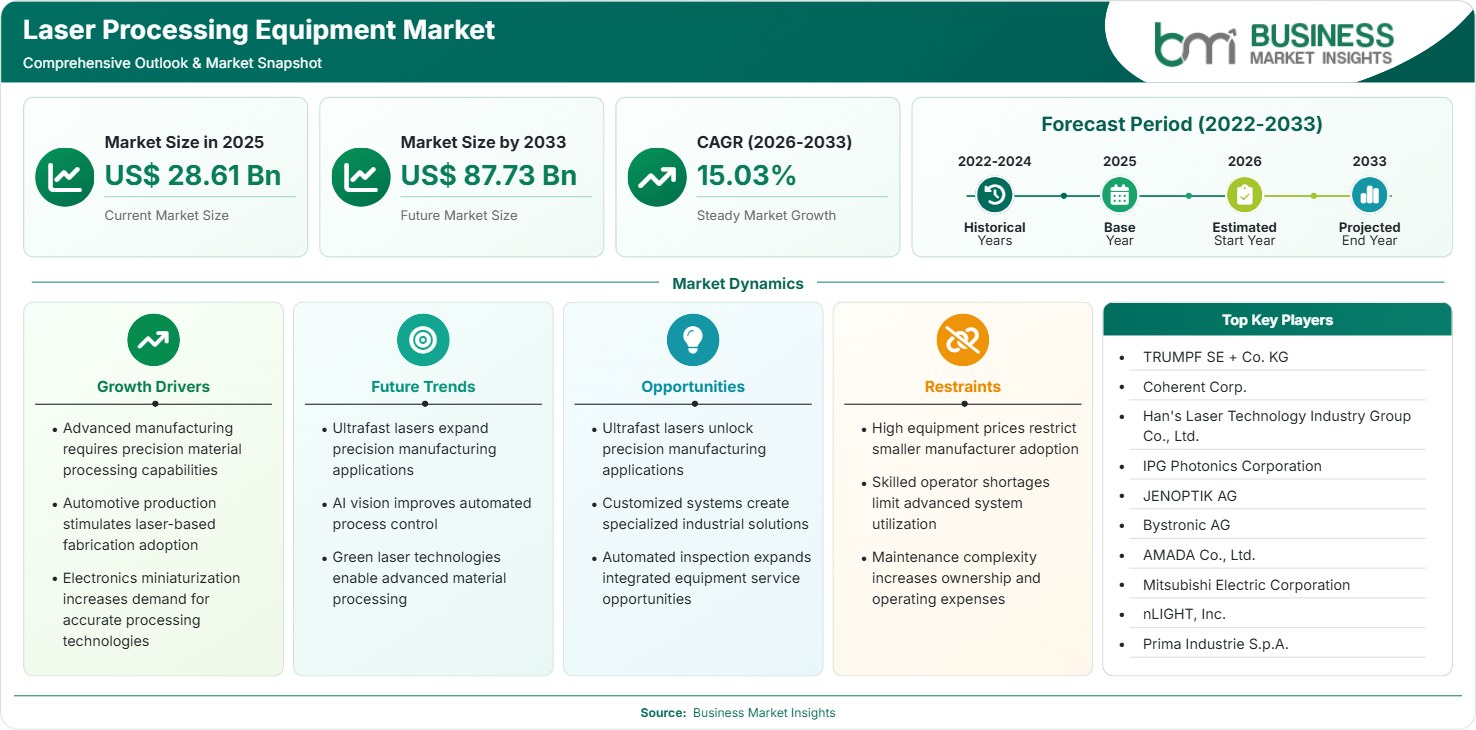
The Laser Processing Equipment Market size was valued at US$ 28.61 Billion in 2025 and is projected to reach US$ 87.73 Billion by 2033, growing at a CAGR of 15.03% during 2026–2033. Rising industrial automation, EV battery manufacturing, precision electronics fabrication, smart factory adoption, and demand for high-speed non-contact machining are accelerating equipment deployment across global manufacturing ecosystems.

Report Coverage
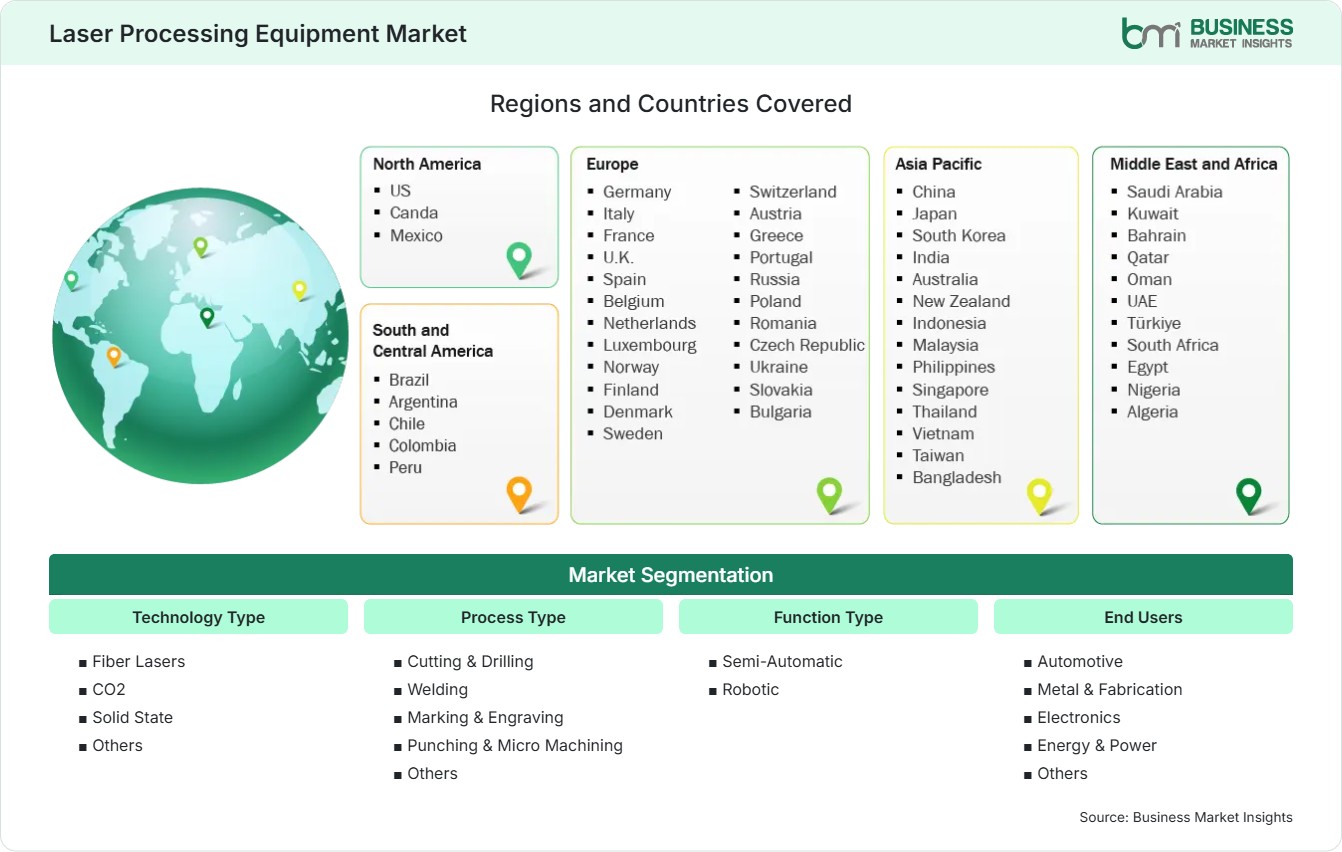
  • Technology Type: Fiber Lasers, CO2, Solid State, Others
  • Process Type: Cutting & Drilling, Welding, Marking & Engraving, Punching & Micro Machining, Others
  • Function Type: Semi-Automatic, Robotic
  • End Users: Automotive, Metal & Fabrication, Electronics, Energy & Power, Others
US$ 28.61 Bn Market size in 2025
US$ 87.73 Bn Market Size by 2033
15.03% CAGR, 2026 - 2033
2026-2033 Forecast Period

AI Overview

Laser Processing Equipment Market Summary

  • North America Region: North America holds a market share of 33%–36% in 2025, growing with a CAGR of 13.2%–14.5% during 2026–2033. Strong aerospace manufacturing, EV investments, reshoring initiatives, automation upgrades, advanced fabrication demand, digital production systems, industrial robotics adoption, high-value component processing, energy transition projects, and semiconductor expansion support growth. US market benefits from aerospace, semiconductor, and EV manufacturing investments, advancing at approximately 13.5%–14.8% CAGR.
  • Fastest Growing Region: Asia Pacific holds a market share of 29%–32% in 2025 and is projected to expand at a CAGR of 16.5%–18.0% during 2026–2033. Expanding electronics manufacturing, battery production capacity, industrial automation programs, export-oriented fabrication industries, rising capital expenditure, precision engineering demand, government incentives, and supply chain localization accelerate equipment deployment.
  • Leading Segment: Cutting & Drilling accounts for 38%–42% of the Laser Processing Equipment Market share in 2025 and is expected to grow at 14.2%–15.5% CAGR. Automotive metal fabrication, industrial machinery production, sheet-metal processing expansion, high throughput requirements, reduced wastage, precision manufacturing, digital workflows, and automated production environments support sustained equipment demand.
  • High Growth Segment: Robotic function systems represent a 32%–36% share in 2025 and advance at 17.0%–18.8% CAGR. Manufacturers increasingly integrate robotics, machine vision, intelligent controls, flexible production lines, labor optimization strategies, automated welding cells, and Industry 4.0 initiatives to enhance productivity.
  • Key Market Opportunity: Expansion of laser-based processing in EV battery manufacturing, semiconductor packaging, advanced medical devices, and lightweight aerospace materials creates opportunities for integrated automation, digital control, and high-precision production systems globally.
  • Major Market Players: TRUMPF SE + Co. KG, Coherent Corp., Han's Laser Technology Industry Group Co., Ltd., IPG Photonics Corporation, JENOPTIK AG, Bystronic AG, AMADA Co., Ltd., Mitsubishi Electric Corporation, nLIGHT, Inc., and Prima Industrie S.p.A.
Strategic Insights

Laser Processing Equipment Market: Strategic Insights

Laser Processing Equipment Market Strategic Framework
FREE PDF
Request your free sample
Request free sample
Stakeholder View

Key Takeaways

  • The value chain increasingly integrates laser sources, motion systems, automation software, optics suppliers, robotics providers, and machine builders, creating opportunities for collaborative solution development and long-term service revenues.
  • EV battery manufacturing, precision electronics, and advanced metal fabrication provide the strongest upside potential because of their demand for micron-level precision, process consistency, and scalable automated production.
  • Fiber laser innovation continues to outperform alternative technologies through higher efficiency, reduced operating costs, advanced beam control, and compatibility with digital manufacturing ecosystems.
  • Asia Pacific offers the most compelling expansion opportunity due to strong manufacturing investments in China, India, Vietnam, and South Korea, particularly for electronics and battery production.
  • Strategic acquisitions increasingly focus on automation software, machine vision, and robotics capabilities as vendors seek broader integrated manufacturing portfolios and recurring revenue streams.
  • Sustainability objectives are encouraging manufacturers to adopt resource-efficient processing technologies that reduce material waste, minimize secondary finishing requirements, and improve factory energy performance.
Geographic Outlook

Laser Processing Equipment Market Regional Highlights

North America Laser Processing Equipment Market

North America accounted for around 33%-36% of worldwide demand in 2025 and is estimated to grow at a CAGR of 13.2%-14.5% through 2033. Major investments in aerospace, defense, semiconductor manufacturing, electric vehicle (EV) manufacturing, and industrial automation have driven equipment adoption. Manufacturers in the region have started using robotic processing cells and smart manufacturing techniques. The Laser Processing Equipment Market share is driven by high capital expenditure, efforts to improve employee productivity, and reshoring operations.

  • Aerospace component manufacturing increasingly utilizes advanced laser cutting and welding systems to process lightweight alloys while meeting stringent quality and traceability requirements.
  • Semiconductor expansion projects are generating demand for precision micromachining technologies capable of supporting next-generation packaging, wafer processing, and electronics manufacturing.
  • Industrial automation spending encourages integration of robotics, machine vision, and digitally connected laser workstations across fabrication environments.
  • Energy transition investments support production of battery systems, electrical components, and renewable infrastructure requiring high-precision material processing.

US Laser Processing Equipment Market

The US accounts for around 76%-80% of regional revenue and is expected to grow at 13.5%-14.8% during 2033. Growth will be attributed to the introduction of advanced manufacturing processes, investments in semiconductors, production of electric vehicles, and aircraft modernization. Manufacturers have been continuously investing in upgrading their existing manufacturing facilities with fiber lasers and robotics technology. Demand will be dominated by the industrial sector, which requires precise manufacturing environments.

  • Federal incentives supporting semiconductor manufacturing capacity encourage adoption of ultra-precise processing technologies for advanced packaging and fabrication applications.
  • Automotive producers increasingly deploy robotic laser welding systems to improve production efficiency and consistency in EV assembly operations.
  • Aerospace suppliers prioritize laser processing for lightweight materials and complex geometries requiring extremely accurate manufacturing tolerances.
  • Smart factory implementation accelerates data-driven production management and integration of digitally controlled fabrication equipment.

Europe Laser Processing Equipment Market

The Europe Laser Processing Equipment Market holds a 26%-29% market share in 2025 and is anticipated to grow at a CAGR of 13.8%-15.0% through 2033. The German market is the largest country market, whereas Eastern European manufacturing hubs show faster growth at around 15%-17% CAGR. Factors driving demand include automotive engineering, industrial machinery manufacturing, and manufacturing process improvements for sustainability. Increasing investments by regional firms in energy-efficient processing systems, digitalization, and automation of fabrication processes boost their production efficiency.

  • Germany leads regional adoption due to strong machine-tool manufacturing capabilities and widespread implementation of Industry 4.0 technologies.
  • Poland and the Czech Republic emerge as high-growth production centers benefiting from manufacturing relocations and investment inflows.
  • Automotive electrification supports demand for battery production equipment and precision welding applications.
  • Sustainability regulations encourage replacement of older equipment with more efficient laser-based manufacturing technologies.

Asia Pacific Laser Processing Equipment Market

The Asia Pacific region accounts for 29% to 32% of total revenues in 2025 and experiences the highest growth rate, with a CAGR of 16.5% to 18.0% through 2033. China remains the largest market, while India and Southeast Asia register robust growth. The electronics industry, battery manufacturing, industrial machinery, and export-based fabrication industries drive high demand for products. The growing government support for advanced manufacturing and industrial automation will continue to attract investment.

  • China leads equipment consumption through extensive electronics, automotive, and industrial production capabilities.
  • India demonstrates rapid adoption supported by industrial development programs, local manufacturing expansion, and infrastructure investment.
  • South Korea and Japan maintain strong demand for high-precision processing within advanced electronics and semiconductor industries.
  • Southeast Asian economies benefit from supply-chain diversification and foreign direct investment in manufacturing infrastructure.

Rest of World Laser Processing Equipment Market

The Rest of World region accounts for 8%–11% market share in 2025 and is expected to expand at 14.5%–16.3% CAGR through 2033. South and Central America benefit from automotive and industrial manufacturing activity, while Middle East and Africa markets increasingly invest in industrial diversification and production modernization.

Brazil represents the leading market across Latin America, while Saudi Arabia and the United Arab Emirates show stronger growth momentum due to industrial transformation programs, infrastructure investment, and advanced manufacturing initiatives.

  • Brazilian fabrication industries adopt automated processing technologies to improve productivity and international competitiveness.
  • Gulf countries are investing in industrial diversification programs supporting demand for advanced manufacturing equipment.
  • Mining and energy sectors generate specialized requirements for fabrication, repair, and precision processing applications.
  • Expanding industrial parks and manufacturing clusters encourage long-term equipment deployment throughout developing economies.
Global Market Geography
FREE PDF
Request your free sample
Request free sample
Segment Analysis

Laser Processing Equipment Market Segmentation

Technology Type

Technology Type accounted for about 34%-38% of industry revenue in 2025 and is predicted to grow at a 15.1%-16.2% CAGR. The scope of the Laser Processing Equipment Market will continue to expand as manufacturers incorporate application-specific laser technology, with efficiency, precision, material suitability, and operating costs in mind.

  • Fiber Lasers: Widely adopted for metal processing applications due to superior efficiency, high beam quality, lower maintenance requirements, and compatibility with automated manufacturing environments.
  • CO2: Remains relevant across non-metal and thick-material applications where processing versatility and established industrial integration continue supporting utilization.
  • Solid State: Supports precision processing tasks requiring controlled energy delivery, particularly in electronics manufacturing and specialized industrial applications.

Process Type

Process Type contributed 40%-43% market share in 2025 and is expected to grow at 14.8%-15.7% CAGR. The Laser Processing Equipment Market trends are reflected in increased usage across various production stages to achieve precision, flexibility, efficiency, and higher final product quality.

  • Cutting & Drilling: Dominates demand through extensive utilization in sheet metal processing, industrial machinery manufacturing, automotive production, and precision engineering operations.
  • Welding: Experiences strong adoption owing to growing EV battery manufacturing, lightweight materials processing, and automated assembly requirements.
  • Marking & Engraving: Supports traceability, branding, identification, and compliance requirements across electronics, automotive, medical, and industrial sectors.
  • Punching & Micro Machining: Expands through semiconductor, electronics, and micro-component fabrication applications demanding exceptional accuracy and minimal material distortion.

Function Type

Function Type contributes approximately 21%–25% market share in 2025 and is forecast to achieve 16.0%–17.5% CAGR. Automation priorities continue shifting investment toward intelligent manufacturing systems capable of integrating laser technologies with robotics, sensors, analytics, and digital production workflows.

  • Semi-Automatic: Preferred by small and medium manufacturers balancing productivity improvements with controlled capital investment strategies.
  • Robotic: Gains momentum through smart factory initiatives, labor optimization targets, and demand for highly repeatable manufacturing performance.

End Users

End Users contributed about 37%–41% of the market share in 2025 and are expected to expand at a 15.4%–16.8% CAGR. Adoption trends depend on the complexity of the manufacturing process, the regulatory framework, the nature of the materials, and the level of automation.

  • Automotive: Leverages laser technologies extensively for body construction, battery manufacturing, lightweight materials processing, and automated production.
  • Metal & Fabrication: Remains a foundational customer segment owing to continuous demand for cutting, drilling, and welding applications.
  • Electronics: Expands through miniaturization trends, semiconductor investments, and precision component production requirements.
  • Energy & Power: Utilizes equipment for manufacturing electrical components, renewable-energy systems, and industrial infrastructure.
Market Forces

Laser Processing Equipment Market Dynamics

Key Market Drivers

Acceleration of Industrial Automation and Smart Manufacturing

Productivity gains, repetition, and quality control are key focuses in manufacturing industries as they move towards automation technologies. The International Federation of Robotics publishes reports indicating strong industrial robot installations in the manufacturing industry, thereby emphasizing the need for integrated laser technology. Laser processing technology is now being incorporated with robots, machine vision, and computer control to form smart manufacturing cells. The Laser Processing Equipment Market growth is driven by these innovations, as automated processes help eliminate errors, increase efficiency, and enhance quality management. Companies in the automotive, aerospace, metalworking, and electronics industries are investing in better-performing production facilities.

Rapid Expansion of Electric Vehicle and Battery Manufacturing

The production of electric vehicles is creating a strong need for accurate welding, cutting, and micro-machining processes. Producing battery cells requires precise thermal management and consistent process characteristics, which are difficult to achieve with traditional methods. Laser technology currently available today is useful in ensuring that processes such as electrode manufacturing, cell fabrication, and battery pack assembly are conducted successfully. Investment in factory construction across Asia, North America, and Europe is expected to increase demand for equipment. Further, developments in battery chemistry have necessitated design innovations and the adoption of flexible manufacturing technologies.

Growing Demand for Precision Electronics and Semiconductor Production

Miniaturization in electronics is leading to more stringent demands on the manufacturing processes for components and semiconductors. Lasers offer high accuracy for drilling, marking, structuring, and micro-machining applications. The growing use of hardware for artificial intelligence, high-performance computing, consumer electronics, and semiconductor manufacturing requires sophisticated processing equipment. The Laser Processing Equipment Market trends are characterized by the growing demand for micrometer-level accuracy, minimal material damage, and high-speed processing capability. There has been an increase in the use of advanced lasers to meet future challenges in electronics manufacturing.

Key Market Opportunities

Advanced Battery Manufacturing Ecosystems

The large investments in battery manufacturing plants have created many opportunities for equipment manufacturers offering integrated automation, inspection, and processing capabilities. Modern manufacturers tend to look for turnkey production systems integrating robotic, electronic, and laser processing technologies. Any changes in battery technology can call for different battery manufacturing methods, opening up more opportunities for suppliers. The Laser Processing Equipment Market forecasts suggest there will be significant investment in the battery manufacturing industry. The opportunity extends beyond equipment sales into software, maintenance services, process optimization, and lifecycle support offerings.

Semiconductor Reshoring and Regional Supply Chain Expansion

Government-sponsored investments in semiconductor capacity are driving demand for high-end production technology. The fab, package, and electronics manufacturing plants now have a growing need for laser processing technologies. Diversification of regional supply chains further helps ensure long-term investments. Suppliers of micromachining, marking, and wafer processing technologies can capitalize on growing market demand. In addition, there is great potential for applications such as process engineering, digital integration, predictive maintenance, and quality assurance.

Medical Device and Precision Healthcare Manufacturing

Laser processing technologies have become widely adopted by medical deviceto manufacturer the manufacture implants, surgical tools, diagnostic equipment, and micro-machines. Accuracy demands, tracking, and compliance requirements favor laser manufacturing techniques. The increasing cost of healthcare worldwide and the need for minimally invasive technology create a good environment. Suppliers of equipment that can provide reliable, precise, and clean manufacturing techniques can take advantage of this situation. Opportunities are especially attractive in micro-manufacturing, implants, and high-end diagnostic device manufacturing, where performance consistency is critical to product quality and regulatory compliance.

Market Restraints and Challenges

High Capital Investment and Integration Complexity

Factor: Deployment of advanced laser technology generally entails substantial expenditures on automation, software, robotics, security measures, and staff training. Impact: Overly high implementation costs can delay purchase decisions, particularly for SMEs operating on a shoestring budget. In addition, implementation difficulties can cause further delays. While the advantages that accrue from the productivity boost far outweigh the expenses incurred, economic factors have to be considered in some developing countries. In general, before any significant modernization is implemented, return-on-investment calculations are performed.

Technical Skills Gap and Operational Expertise Requirements

Factor: Efficient use of highly developed processing systems demands knowledge and experience in such areas as optics, programming, automation, process control, and maintenance. Impact: A shortage of skilled personnel can reduce efficiency and hinder the full exploitation of available machinery. Increased training costs, implementation delays, and production difficulties may arise from a lack of a competent labor force. Rapid technological change adds to the complexity of workforce development. Application support and services are increasingly offered by vendors, but talent remains an essential consideration.

Company Analysis

Competitive Landscape

Laser Processing Equipment Market analysis indicates competition is shaped by technological innovation, automation integration, application expertise, and global service capabilities.

Company Name

Overview

Products and Services relevant to this market

TRUMPF SE + Co. KG

German industrial technology leader specializing in machine tools, laser systems, automation, and smart manufacturing solutions.

Laser cutting systems, welding solutions, automation platforms, software integration, and industrial laser sources.

Coherent Corp.

Global photonics company serving industrial, electronics, communications, and scientific markets with advanced laser technologies.

Fiber lasers, industrial processing systems, welding platforms, micromachining equipment, and optics solutions.

Han's Laser Technology Industry Group Co., Ltd.

Major Chinese provider of industrial laser processing equipment with extensive manufacturing capabilities.

Laser cutting, marking, welding, automation systems, and precision industrial manufacturing solutions.

IPG Photonics Corporation

Leading fiber laser innovator focused on high-performance industrial laser technologies.

Fiber laser sources, welding systems, cutting solutions, and advanced manufacturing platforms.

JENOPTIK AG

German technology company delivering photonics and precision manufacturing solutions globally.

Laser processing equipment, micromachining technologies, automation tools, and industrial optics.

Bystronic AG

Provider of advanced sheet-metal processing technologies and automation systems.

Laser cutting machines, bending technologies, software systems, and production automation solutions.

AMADA Co., Ltd.

Industrial machinery manufacturer with strong expertise in precision fabrication equipment.

Laser processing machines, sheet-metal fabrication systems, automation cells, and production software.

Mitsubishi Electric Corporation

Diversified technology company active in industrial automation and laser-based manufacturing solutions.

Laser cutting equipment, factory automation systems, control technologies, and manufacturing software.

nLIGHT, Inc.

Developer of high-performance laser and photonics technologies for industrial applications.

Fiber lasers, beam delivery systems, industrial processing solutions, and precision manufacturing technologies.

Prima Industrie S.p.A.

Italian manufacturer providing advanced industrial machinery and automation offerings.

Laser cutting, welding systems, integrated manufacturing platforms, and digital production technologies.

Trust & Transparency

Research Methodology

The market analysis combines proprietary research with secondary data from government agencies, company disclosures, regulatory filings, industry databases and expert interviews. Market estimates are validated through data triangulation, cross-market benchmarking and analyst review.

View Full Research Methodology

Questions Answered

Frequently Asked Questions

What does a Laser Processing Equipment Market Report typically evaluate?

A Market Report generally assesses technology adoption, competitive positioning, regional demand trends, investment activity, end-user dynamics, regulatory influences, and future growth prospects.

What factors determine long-term supplier competitiveness?

Application expertise, installed service networks, software integration, automation capabilities, processing accuracy, lifecycle support quality, and energy efficiency increasingly influence supplier selection.

How does automation influence purchasing decisions?

Manufacturers increasingly prioritize systems that integrate robotics, machine vision, analytics, and digital controls because these capabilities improve productivity, quality consistency, and operational flexibility.

What technology category is gaining the fastest adoption?

Fiber laser systems are experiencing the strongest adoption due to superior efficiency, lower maintenance needs, high beam quality, and compatibility with modern automated production environments.

Which industries generate the strongest demand for laser processing equipment?

Automotive, electronics, semiconductor manufacturing, aerospace, metal fabrication, energy systems, and medical device production collectively account for the largest demand because of precision, productivity, and automation requirements.

Access the Full Laser Processing Equipment Market Report

Get segment-level forecasts, regional estimates, competitive benchmarking, company profiles and downloadable Excel datasets.

Access the full Laser Processing Equipment Market Report
350 pages PDF & Excel | 2026-09-16
Similar Research

Related Market Reports