
Health Insurance Market Outlook: Size, Share, Trends, Growth Analysis, Competitive Landscape & Forecast, 2026-2033

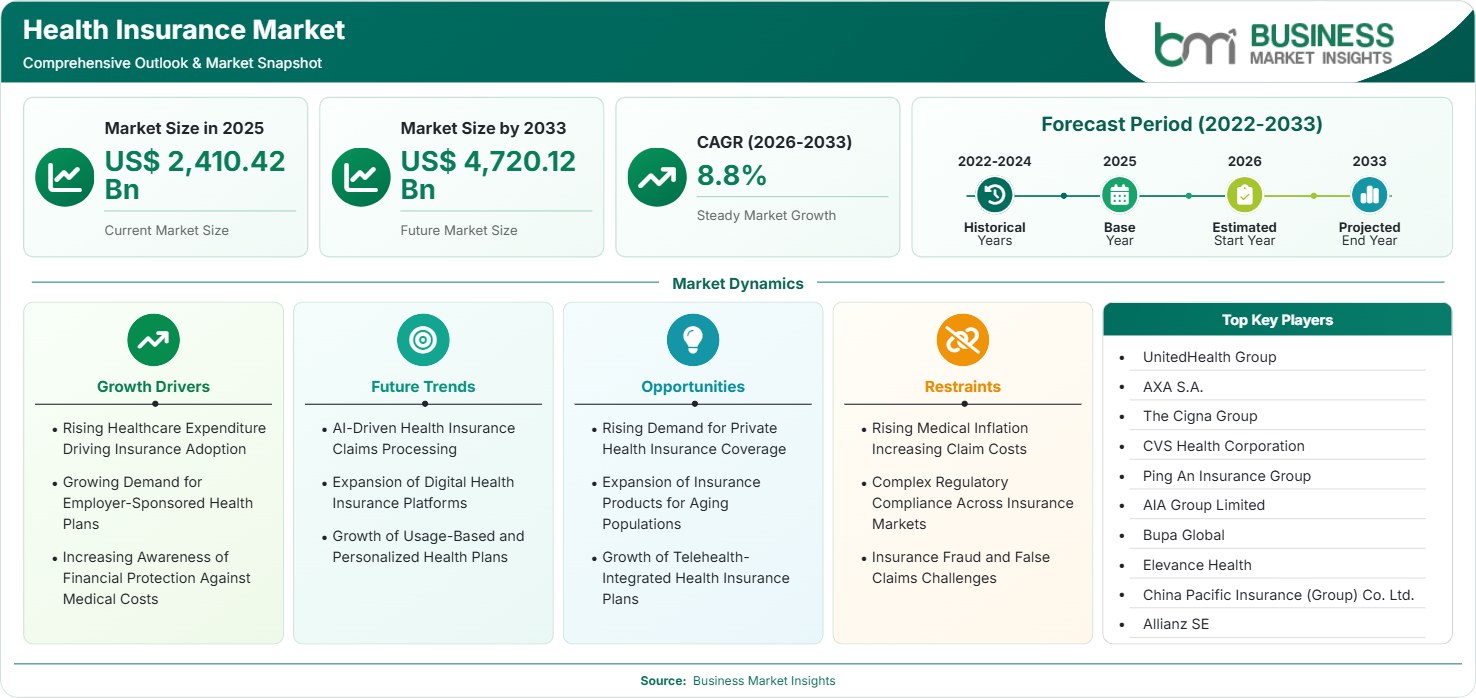
The Health Insurance Market size was valued at US$ 2,410.42 Billion in 2025 and is projected to reach US$ 4,720.12 Billion by 2033, growing at a CAGR of 8.8% during 2026–2033. Growth is driven by rising healthcare expenditures, increasing prevalence of chronic diseases, expanding health coverage programs, growing awareness regarding financial protection against medical costs, and increasing digitalization of insurance services.

Report Coverage
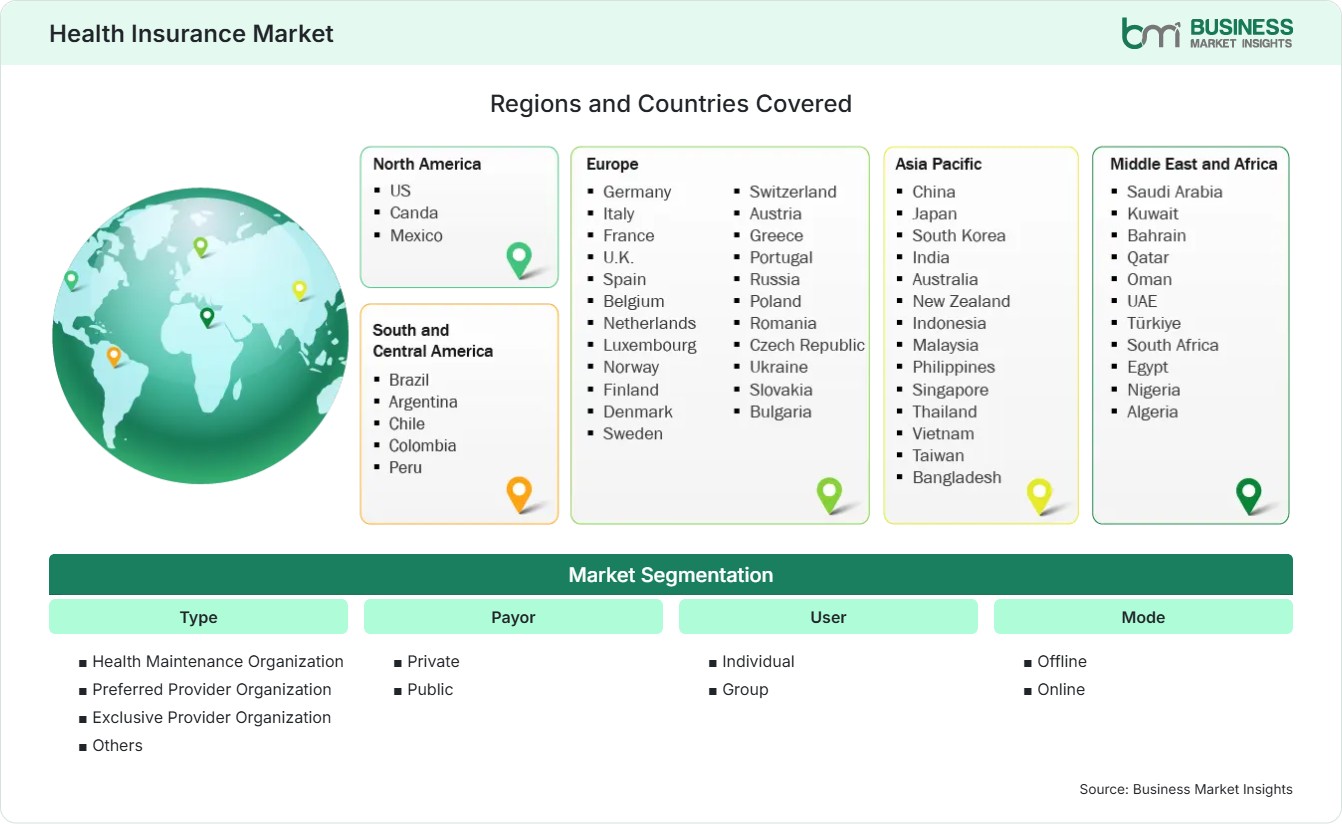
  • Type: Health Maintenance Organization, Preferred Provider Organization, Exclusive Provider Organization, Others
  • Payor: Private, Public
  • User: Individual, Group
  • Mode: Offline, Online
  • Distribution Channel: Direct Sales, Agents, Brokers, Banks, Others
US$ 2,410.42 Bn Market size in 2025
US$ 4,720.12 Bn Market Size by 2033
8.8% CAGR, 2026 - 2033
2026-2033 Forecast Period

01 AI Overview

Health Insurance Market Summary

  • North America Region: North America holds a market share of 39%–42% in 2025, growing at a CAGR of 8.1%–8.7% during 2026–2033. Demand is supported by high healthcare spending, established insurance ecosystems, and increasing adoption of private health coverage. The U.S. remains the dominant market, advancing at a CAGR of 8.2%–8.8%.
  • Fastest Growing Region: Asia Pacific accounts for 23%–26% of revenue in 2025 and is projected to register a CAGR of 10.1%–10.8% through 2033. Rising healthcare awareness, expanding middle-class populations, and increasing insurance penetration continue supporting market development.
  • Leading Segment: Preferred Provider Organization (PPO) plans hold a Health Insurance Market share of 34%–38% in 2025 and are expected to grow at a CAGR of 8.7%–9.3%. Demand is driven by provider flexibility, broad network coverage, and growing consumer preference for healthcare choice.
  • High Growth Segment: Online mode accounts for 26%–30% of market revenue in 2025 and is projected to register a CAGR of 10.5%–11.2% during the forecast period. Increasing digital adoption, online policy comparison tools, and simplified enrollment processes continue supporting expansion.
  • Key Market Opportunity: Growing demand for personalized insurance plans, digital healthcare ecosystems, and preventive healthcare coverage is creating significant opportunities for insurers and healthcare service providers.
  • Major Market Players: UnitedHealth Group, AXA S.A., The Cigna Group, CVS Health Corporation, Ping An Insurance Group, AIA Group Limited, Bupa Global, Elevance Health, China Pacific Insurance (Group) Co. Ltd., and Allianz SE.
02 Strategic Insights

Health Insurance Market: Strategic Insights

health-insurance-market-market-strategic-framework
FREE PDF
Request your free sample
Request free sample
03 Stakeholder View

Key Takeaways

  • The market ecosystem includes insurance providers, healthcare organizations, third-party administrators, brokers, employers, government agencies, and policyholders.
  • PPO plans remain among the most attractive opportunities due to flexibility in provider selection and broad consumer preference.
  • Product innovation increasingly focuses on digital enrollment, wellness incentives, personalized policies, and preventive healthcare coverage.
  • Asia Pacific provides the strongest growth potential supported by rising insurance awareness, healthcare investments, and expanding healthcare access.
  • The health insurance market forecast suggests that digital insurance platforms continue transforming market dynamics by improving policy accessibility, claims processing, and customer engagement.
  • Individual plans, employer-sponsored coverage, and digital distribution channels are increasingly becoming key revenue generators across global insurance markets.
04 Geographic Outlook

Health Insurance Market Regional Highlights

North America Health Insurance Market

North America accounted for 39%–42% of global revenue in 2025 and is projected to expand at a CAGR of 8.1%–8.7% through 2033. Growth is supported by high healthcare expenditure, increasing enrollment in private health plans, and growing awareness regarding medical financial protection. The Health Insurance Market share in the region continues benefiting from strong employer-sponsored coverage and ongoing digitalization of insurance services.

  • Private insurance providers continue expanding coverage options to meet evolving consumer healthcare needs.
  • Employer-sponsored health plans remain a major contributor to overall insurance enrollment.
  • Digital healthcare ecosystems are improving customer engagement and claims management efficiency.
  • Rising chronic disease prevalence continues to increase demand for comprehensive health coverage.
  • Insurers are increasingly integrating wellness and preventive care benefits into policy offerings.

US Health Insurance Market

The United States represented 34%–37% of global revenue in 2025 and is anticipated to register a CAGR of 8.2%–8.8% during the forecast period. Demand is driven by rising healthcare costs, growing insurance participation, and expansion of private health plans. Increasing adoption of digital insurance platforms continues supporting Health Insurance Market growth.

  • Consumers are increasingly seeking broader coverage and preventive healthcare benefits.
  • Employer-sponsored insurance remains one of the largest health coverage channels.
  • Insurers continue investing in digital enrollment, claims processing, and telehealth integration.
  • Value-based care models are influencing insurance product development strategies.

Europe Health Insurance Market

Europe held 27%–30% of global revenue in 2025 and is projected to grow at a CAGR of 8.3%–8.9% through 2033. Growing healthcare expenditures, increasing private insurance participation, and rising demand for supplementary health coverage continue supporting market expansion. Germany remains the leading market with a CAGR of 8.4%–9.0%, while Poland is the fastest-growing country, expanding at a CAGR of 9.0%–9.6%.

  • Consumers increasingly utilize supplementary insurance to access broader healthcare services.
  • Growing aging populations continue increasing healthcare utilization and insurance demand.
  • Germany maintains leadership through a well-established healthcare and insurance infrastructure.
  • Poland is witnessing accelerated growth due to rising healthcare awareness and insurance penetration.
  • Digital insurance services continue improving customer accessibility and engagement.

Asia Pacific Health Insurance Market

Asia Pacific accounted for 23%–26% of global revenue in 2025 and is expected to remain the fastest-growing region, registering a CAGR of 10.1%–10.8% through 2033. Rising healthcare awareness, increasing disposable incomes, and expanding insurance penetration continue driving market growth. China remains the largest regional market with a CAGR of 9.9%–10.6%, while India records the highest growth at 10.8%–11.5%.

  • Growing middle-class populations continue to increase demand for private health insurance products.
  • China benefits from healthcare reforms and expanding insurance coverage programs.
  • India is witnessing rapid growth in health insurance adoption across urban and semi-urban populations.
  • Digital distribution platforms are improving policy accessibility and customer reach.
  • Rising healthcare expenditure is encouraging consumers to seek financial protection through insurance.

Rest of World Health Insurance Market

The Rest of World region accounted for 6%–9% of global revenue in 2025 and is expected to register a CAGR of 8.2%–8.8% through 2033. Market growth is supported by increasing healthcare awareness, expanding insurance infrastructure, and growing government initiatives promoting healthcare coverage. Demand remains particularly strong for private and employer-sponsored insurance products.

Brazil is the leading market in South & Central America and is forecast to grow at a CAGR of 8.4%–9.0%. In the Middle East & Africa, the United Arab Emirates is expected to be the fastest-growing country with a CAGR of 8.7%–9.3%.

  • Brazil continues benefiting from expanding private health insurance participation and healthcare investments.
  • The United Arab Emirates is witnessing growing demand for comprehensive and premium insurance plans.
  • Governments continue promoting healthcare accessibility and insurance enrollment initiatives.
  • Digital platforms are improving policy management and customer service capabilities.
  • Rising healthcare costs continue supporting long-term demand for health insurance products.
global-market-geography
FREE PDF
Request your free sample
Request free sample
05 Segment Analysis

Health Insurance Market Segmentation

Type

Type-based segmentation continues evolving as consumers seek healthcare plans that balance affordability, provider access, and coverage flexibility. Preferred Provider Organization (PPO) plans lead the segment with a 34%–38% share in 2025 and are projected to grow at a CAGR of 8.7%–9.3% through 2033. The market scope continues expanding as policyholders increasingly prioritize provider choice and access to broad healthcare networks.

  • Health Maintenance Organization (HMO): Widely utilized due to lower premium costs and coordinated healthcare management through designated provider networks.
  • Preferred Provider Organization (PPO): Dominates market demand owing to flexibility in provider selection, broad network access, and reduced referral requirements.
  • Exclusive Provider Organization (EPO): Gains traction through relatively lower costs and focused provider networks offering streamlined healthcare services.
  • Others: Include specialized and customized health coverage plans tailored to specific consumer and organizational requirements.

Payor

Payor structures continue shaping insurance accessibility and market participation across regions. Private insurers maintain a significant presence through diversified product offerings, while public programs continue supporting healthcare access for broader populations. Health Insurance Market trends indicate increasing collaboration between public and private stakeholders to improve healthcare coverage and affordability.

  • Private: Leads market demand through comprehensive policy offerings, employer-sponsored plans, and customized health coverage solutions.
  • Public: Continues supporting healthcare accessibility through government-sponsored programs and public insurance initiatives.

User

User segmentation reflects varying healthcare needs among individuals and organizations. Group coverage remains a major contributor due to employer-sponsored insurance programs. Health Insurance Market share continues benefiting from increasing enrollment across both individual and group policy categories.

  • Individual: Demand is driven by growing awareness regarding healthcare protection and increasing accessibility of digital insurance platforms.
  • Group: Benefits from employer-sponsored insurance programs, broader coverage options, and large-scale enrollment initiatives.

Mode

Mode of policy purchase continues evolving as digital technologies transform customer engagement and insurance accessibility. Online mode accounts for 26%–30% market share in 2025 and is projected to register the fastest growth at a CAGR of 10.5%–11.2% through 2033. Increasing digital adoption and consumer preference for convenient policy management continue supporting segment expansion.

  • Offline: Remains relevant through in-person consultations, agent-assisted policy selection, and traditional distribution networks.
  • Online: Expanding rapidly through digital enrollment platforms, policy comparison tools, and streamlined claims management services.

Distribution Channel

Distribution channels play a crucial role in policy awareness, customer acquisition, and service delivery. Insurers continue strengthening omnichannel strategies to improve market reach and customer engagement across multiple touchpoints.

  • Direct Sales: Enables insurers to build direct customer relationships and improve service personalization.
  • Agents: Continue serving as important intermediaries providing policy guidance and customer support.
  • Brokers: Facilitate policy comparisons and customized coverage solutions based on consumer requirements.
  • Banks: Benefit from bancassurance partnerships that expand insurance accessibility through existing banking networks.
  • Others: Include digital platforms, employer channels, and specialized insurance distributors.
06 Market Forces

Health Insurance Market Dynamics

Key Market Drivers

Rising Healthcare Expenditure Driving Insurance Adoption

Increasing healthcare costs across both developed and emerging economies are encouraging individuals and businesses to seek financial protection through health insurance coverage. Rising expenses associated with hospitalization, diagnostics, specialist consultations, and chronic disease management continue to increase the importance of comprehensive insurance solutions. Consumers increasingly recognize the value of insurance in reducing out-of-pocket medical expenditures and ensuring access to quality healthcare services. Governments and private insurers are expanding coverage options to address growing healthcare affordability concerns. As healthcare spending continues to rise globally, demand for health insurance products is expected to remain strong throughout the forecast period.

Growing Demand for Employer-Sponsored Health Plans

Employer-sponsored health insurance remains a key component of healthcare coverage in many countries. Organizations increasingly provide health benefits to attract and retain skilled employees while supporting workforce well-being. Employees continue viewing health coverage as one of the most valuable workplace benefits, contributing to higher enrollment rates in group insurance programs. Insurers are developing flexible group plans that incorporate wellness programs, preventive healthcare services, and digital healthcare features. Growing adoption of employee health benefits continues supporting expansion of the health insurance market.

Increasing Awareness of Financial Protection Against Medical Costs

Consumers are becoming increasingly aware of the financial risks associated with unexpected medical expenses and long-term healthcare needs. Educational campaigns, healthcare reforms, and broader access to insurance information are improving understanding of insurance benefits. Rising prevalence of chronic diseases and increasing healthcare utilization are further encouraging consumers to secure adequate health coverage. Insurers continue investing in customer education and awareness programs to improve penetration rates. This growing focus on financial preparedness continues supporting long-term market growth.

Key Market Opportunities

Rising Demand for Private Health Insurance Coverage

Demand for private health insurance is increasing as individuals seek quicker access to medical services, shorter waiting times, broader hospital networks, and comprehensive healthcare coverage. Rising disposable incomes, greater health awareness, and growing expectations for high-quality medical care are encouraging consumers to invest in private insurance plans. Employers are also expanding health benefits to attract and retain skilled employees, further supporting market growth. Insurance providers are introducing flexible policy options, wellness programs, preventive care benefits, and customized coverage to meet diverse consumer needs. As public healthcare systems continue experiencing capacity constraints and rising patient volumes, private health insurance is expected to remain an increasingly attractive solution across both developed and emerging healthcare markets.

Expansion of Insurance Products for Aging Populations

The rapidly growing elderly population worldwide is creating significant opportunities for health insurance providers to develop specialized products tailored to senior healthcare needs. Older adults generally require more frequent medical consultations, long-term care services, prescription medications, and chronic disease management, increasing demand for comprehensive insurance coverage. Insurers are expanding their product portfolios with policies that include preventive healthcare, home care assistance, rehabilitation services, and wellness programs designed to promote healthy aging. Rising life expectancy and improvements in medical care are also encouraging consumers to seek long-term financial protection against future healthcare expenses. This demographic transition is expected to generate sustained demand for innovative and senior-focused health insurance solutions.

Growth of Telehealth-Integrated Health Insurance Plans

The increasing adoption of telehealth services is encouraging health insurers to integrate virtual healthcare benefits into their insurance offerings. Telehealth-enabled plans provide policyholders with convenient access to medical consultations, specialist advice, mental health services, and follow-up care through digital platforms. These services improve healthcare accessibility for individuals living in remote or underserved regions while reducing travel time and overall treatment costs. Insurance providers are collaborating with telehealth companies to enhance customer experience, improve care coordination, and support preventive healthcare initiatives. Growing consumer acceptance of digital healthcare, combined with ongoing technological advancements and expanding digital health ecosystems, is expected to drive innovation and create long-term growth opportunities for telehealth-integrated insurance products.

Market Restraints and Challenges

Rising Medical Inflation Increasing Claim Costs

Factor: Healthcare service costs continue increasing due to advancements in medical technology, rising treatment expenses, increasing demand for healthcare services, and growing prevalence of chronic conditions.

Impact: Rising claim costs place pressure on insurer profitability and often result in higher premium prices for policyholders. Increasing healthcare expenditures can affect affordability and limit insurance adoption within certain consumer segments. Insurers must continuously balance pricing strategies, risk management, and coverage quality to maintain competitiveness and profitability.

Complex Regulatory Compliance Across Insurance Markets

Factor: Health insurance providers operate within highly regulated environments characterized by varying compliance requirements related to consumer protection, data privacy, healthcare coverage standards, and financial reporting.

Impact: Compliance obligations increase operational complexity, administrative costs, and product development timelines. Insurers must invest significantly in governance frameworks, regulatory expertise, and compliance management systems. Regulatory variations across jurisdictions can also complicate market expansion strategies and increase operational challenges for multinational insurance providers.

07 Company Analysis

Competitive Landscape

The market remains highly competitive with the presence of multinational insurance providers, healthcare service organizations, diversified financial institutions, and digital insurance platforms. Companies are focusing on digital policy management, personalized health plans, wellness-based coverage models, telehealth integration, and customer experience enhancement. Rising healthcare expenditures and expanding insurance penetration continue shaping Health Insurance Market analysis and competitive strategies across the global healthcare financing ecosystem.

Company Name

Overview

Products and Services Relevant to this Market

UnitedHealth Group

Global healthcare and insurance company with extensive health coverage and healthcare services operations.

Health insurance plans, employer-sponsored coverage, healthcare benefits management.

AXA S.A.

International insurance provider serving individual and corporate customers globally.

Health insurance policies, medical coverage solutions, wellness programs.

The Cigna Group

Healthcare services and insurance company focused on health benefits and care management.

Health insurance, employer health plans, healthcare management services.

CVS Health Corporation

Healthcare company integrating insurance, pharmacy, and care delivery services.

Health insurance products, healthcare benefits, integrated care solutions.

Ping An Insurance Group

Major financial and insurance services provider with diversified healthcare offerings.

Health insurance plans, digital insurance services, healthcare solutions.

AIA Group Limited

Asia-focused life and health insurance provider with broad regional presence.

Individual health insurance, group coverage, wellness programs.

Bupa Global

International healthcare and insurance company serving individuals and corporate clients.

Private health insurance, international medical coverage, healthcare plans.

Elevance Health

Health benefits company offering a wide range of medical insurance products.

Individual coverage, employer-sponsored insurance, healthcare services.

China Pacific Insurance (Group) Co. Ltd.

Comprehensive insurance provider serving health, life, and property insurance markets.

Health insurance products, medical coverage plans, healthcare protection solutions.

Allianz SE

Global insurance and financial services company with extensive healthcare coverage offerings.

Private health insurance, corporate health plans, medical protection solutions.

08 Industry Activity

Recent Developments

May 2026

Aditya Birla Health Insurance launched Activ Yuva, a wellness-focused health insurance plan that rewards healthy habits across nutrition, fitness, and sleep through its HealthReturns program, enabling users to earn benefits and premium-linked rewards.

May 2026

Bajaj General Insurance launched MHCP EDGE+, a customizable health indemnity plan offering coverage from ₹5 lakh to ₹5 crore, with unlimited reinstatement, global treatment options, wellness-focused features, and flexible riders for enhanced protection.

March 2026

UnitedHealth Group launched Avery, an advanced AI companion built to enhance member engagement platforms by providing 24/7 natural language navigation, personal coverage insights, and automated care management solutions.

October 2025

Allianz SE scaled its digital health insurance services by introducing new regional Insurtech platforms designed to optimize mobile policy accessibility, automate claims processing, and enhance customer onboarding.

10 Trust & Transparency

Research Methodology

The market analysis combines proprietary research with secondary data from government agencies, company disclosures, regulatory filings, industry databases and expert interviews. Market estimates are validated through data triangulation, cross-market benchmarking and analyst review.

View Full Research Methodology

11 Questions Answered

Frequently Asked Questions

What challenge has the greatest long-term impact on the industry?

Rising medical inflation remains a major challenge because increasing treatment and healthcare service costs directly affect claim expenses, premiums, and insurer profitability.

How is online insurance distribution influencing market growth?

Online platforms improve policy accessibility, simplify enrollment processes, enhance customer engagement, and support efficient policy comparison and management.

Why is Asia Pacific the fastest-growing region?

The region benefits from rising healthcare awareness, increasing disposable incomes, expanding insurance penetration, and growing healthcare investments.

Which type segment leads the market?

Preferred Provider Organization (PPO) plans lead the market due to broad provider networks, flexibility in healthcare access, and strong consumer preference.

What is driving growth in the health insurance market report?

Rising healthcare expenditures, increasing employer-sponsored health plans, growing awareness of financial protection against medical expenses, and expanding insurance penetration are the primary growth drivers.

Access the Full Health Insurance Market Report

Get segment-level forecasts, regional estimates, competitive benchmarking, company profiles and downloadable Excel datasets.

Access the full Health Insurance Market Report
350 pages PDF & Excel | 2026-07-31