Halogen‑Free Flame Retardant BOPET Films Market Outlook (2022-2033)

Historic Data: 2022-2024   |   Base Year: 2025   |   Forecast Period: 2026-2033
Report Content: Market Scope, Market Segmentation, Market Dynamics, and Competitive Analysis

Report Coverage:
  • End-Use Industry (Electrical Insulation, Transportation, Building & Construction, Other End-Use Industries)

No. of Pages: 388
Report Code: BMIPUB00033963
Category: Chemicals and Materials
Halogen‑Free Flame Retardant BOPET Films Market

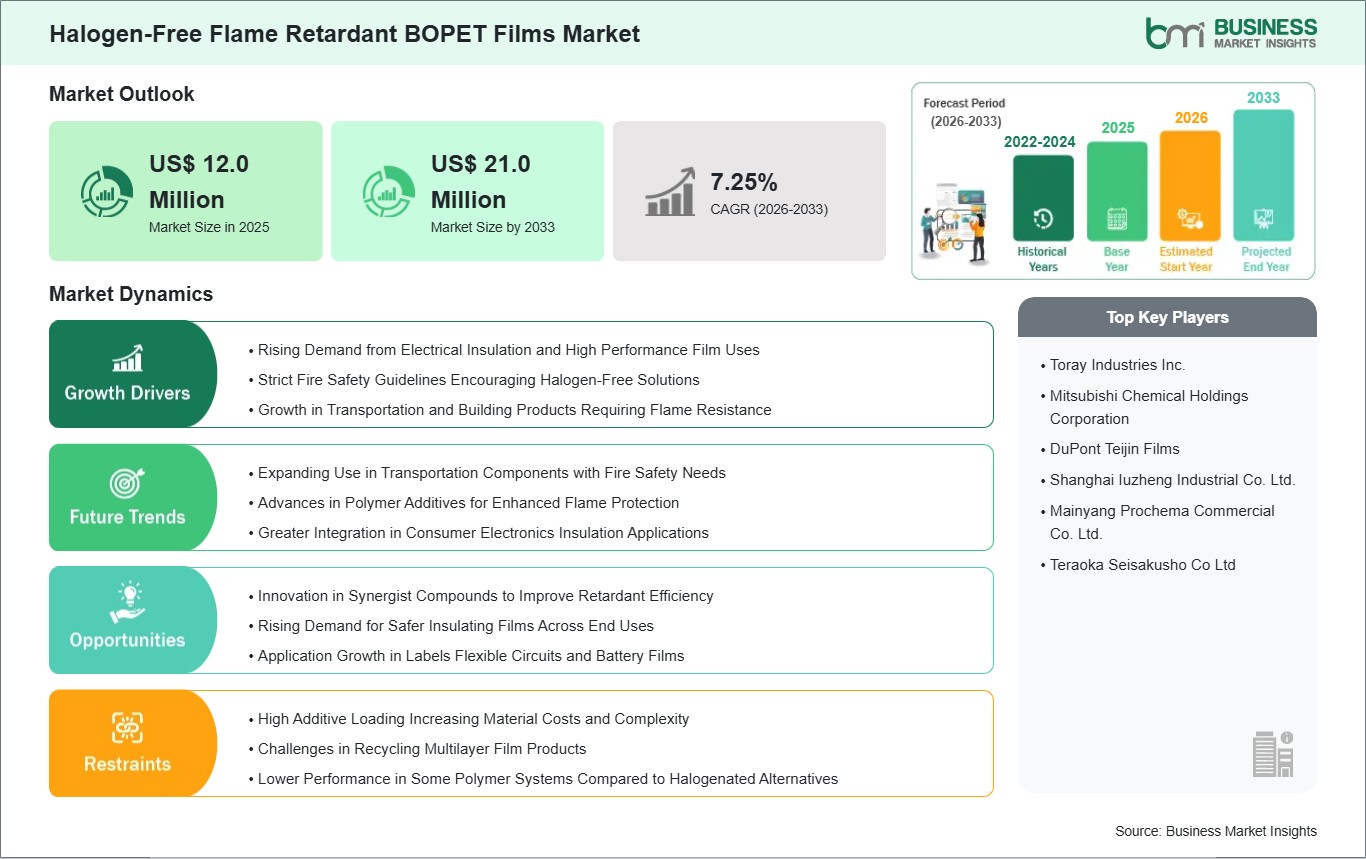
The Halogen-Free Flame Retardant BOPET Films Market size is expected to reach US$ 21.0 Million by 2033 from US$ 12.0 Million in 2025. The market is estimated to record a CAGR of 7.25% from 2026 to 2033.

Executive Summary and Global Market Analysis:

The global halogen-free flame retardant (HFFR) BOPET films market has developed into a vital segment of the advanced materials field. This growth can be attributed to the increasing need for safety, regulatory, and sustainability requirements across various end-use markets. HFFR BOPET films are advanced PE films that are developed with flame-retardant properties without using halogens. This film type provides improved fire safety and minimizes toxic emissions during the burning process. HFFR BOPET films are used in electrical insulation, flexible electronics, automobile parts, and industrial packaging, where fire resistance, mechanical properties, and thermal stability are crucial. Market growth is being driven by a more rigorous regulatory environment, which is limiting the use of halogenated flame retardants due to environmental and health concerns, as well as the growing interest in safe and green materials.

There is a growing interest among manufacturers in materials that can provide a balance of performance, quality, and environmental acceptability, especially for applications in the electronics and automotive sectors, where fire performance and regulatory compliance are critical. Furthermore, the versatility of HFFR BOPET films enables the design of lightweight, flexible, and rugged solutions, which align with the miniaturization, flexible circuit, and smart packages trends. Despite these advantages, there exist some challenges in this market. The cost of production of halogen-free variants is generally high in comparison to conventional BOPET films. Also, it is technically challenging to attain uniform flame retardancy without affecting mechanical and optical properties. Further, there might exist a need to modify processing methods according to the needs of end-users. However, as sustainability and flame retardancy continue to influence material selection, HFFR BOPET films are likely to find increased usage in various applications.

Halogen‑Free Flame Retardant BOPET Films Market - Strategic Insights:

global-market-strategic-framework
Get more information on this report

Halogen‑Free Flame Retardant BOPET Films Market Segmentation Analysis:

Key segments that contributed to the derivation of the halogen‑free flame retardant BOPET films  market analysis are end‑use industry.

  • By end‑use industry, the halogen‑free flame retardant BOPET film market is classified into electrical insulation, transportation, building & construction, and other end‑use industries. The electrical insulation subsegment dominated the market in 2025.

Halogen‑Free Flame Retardant BOPET Films Market Drivers and Opportunities:

Rising Demand from Electrical Insulation and High-Performance Film Uses

The demand for halogen-free flame retardant BOPET films has been increasing gradually over time, driven by the need for materials that can provide high electrical insulation properties and fire safety. These films are commonly used for wiring insulation, flexible printed circuits, transformers, and other high voltage applications where dielectric strength retention and flame retardation are important. The need for halogen-free flame retardant films has emerged due to safety considerations and the need to reduce environmental and health hazards. The films have become indispensable due to their reliability under high temperature and high stress conditions.

Besides electrical insulation, high-performance films have applications that are pushing up demand for halogen-free flame retardant BOPET films. For instance, halogen-free flame retardant BOPET films are used in battery encapsulation and for protective layers of sensitive components. High-performance films are used for high-end packaging solutions. This is because high-performance films can withstand extreme conditions without compromising functionality. Besides that, high-performance films can be used in different ways because of their ability to be coated and laminated with different materials. This makes them preferred for use in different engineering and manufacturing applications.

The trend toward high-performance applications continues to expand as industries prioritize materials that support durability, reliability, and fire safety in demanding environments. These films offer dimensional stability, resistance to thermal stress, and consistent performance across a wide range of operating conditions. Their adoption is further supported by the growing emphasis on sustainability and regulatory compliance, encouraging manufacturers to integrate halogen‑free flame retardant films into products where both performance and safety are critical considerations.

Innovation in Synergist Compounds to Improve Retardant Efficiency

Innovation in synergist compound formulations has the potential to transform halogen-free flame retardant BOPET films, with significant improvements in the performance of the flame retardancy, while the mechanical and optical properties of the films are maintained. The synergists, such as phosphorus-based additives, nanoparticles, and intumescent synergists, enhance the performance of the flame retardants, thus reducing the amount of the synergist used, while the transparency, flexibility, and tensile strength of the films are retained. The innovation has the potential to improve the films’ performance to meet increasingly demanding fire safety standards, thus expanding the scope of the films to cover application areas where performance and safety are key concerns.

Advancements in reactive and chemically bonded synergist technologies have further strengthened the functionality of these films. By integrating flame retardants directly into the polymer matrix, films achieve long-lasting resistance to heat and flame without compromising surface quality or dimensional stability. This approach ensures that the materials maintain their protective properties under prolonged thermal and mechanical stress, making them ideal for critical applications where durability and safety are essential. Additionally, these innovations support the creation of multifunctional films that combine electrical insulation, flame retardancy, and mechanical reinforcement in a single solution.

The continued study of hybrid and multi-mechanism synergist blends is also opening new possibilities for halogen-free flame retardant BOPET films. This is done by using a blend of different compounds that can provide films with improved thermal properties, reduced flammability, and increased environmental acceptability, without sacrificing important properties like transparency, flexibility, and strength. These new technologies not only improve the performance of these films but also increase the number of applications that these films can be used for, thereby ensuring their continued position as a trusted, high-performance film for modern designs that are safety-conscious.

Halogen‑Free Flame Retardant BOPET Films Market Size and Share Analysis:

The halogen‑free flame retardant BOPET films  market is experiencing steady growth, with market size and share analysis reflecting evolving treatment preferences and competitive dynamics among key players. The report evaluates important subsegments categorized within end‑use industry, highlighting their respective contributions to overall market performance.

By end‑use industry, the electrical insulation subsegment dominated the halogen‑free flame retardant BOPET film market in 2025. Electrical insulation applications demand materials with superior thermal stability, dielectric properties, and flame-retardant performance, which drives the strong adoption of BOPET films in this segment.

Halogen‑Free Flame Retardant BOPET Films Market Report Highlights:

Report Attribute Details
Market size in 2025 US$ 12.0 Million
Market Size by 2033 US$ 21.0 Million
Global CAGR (2026 - 2033)7.25%
Historical Data 2022-2024
Forecast period 2026-2033
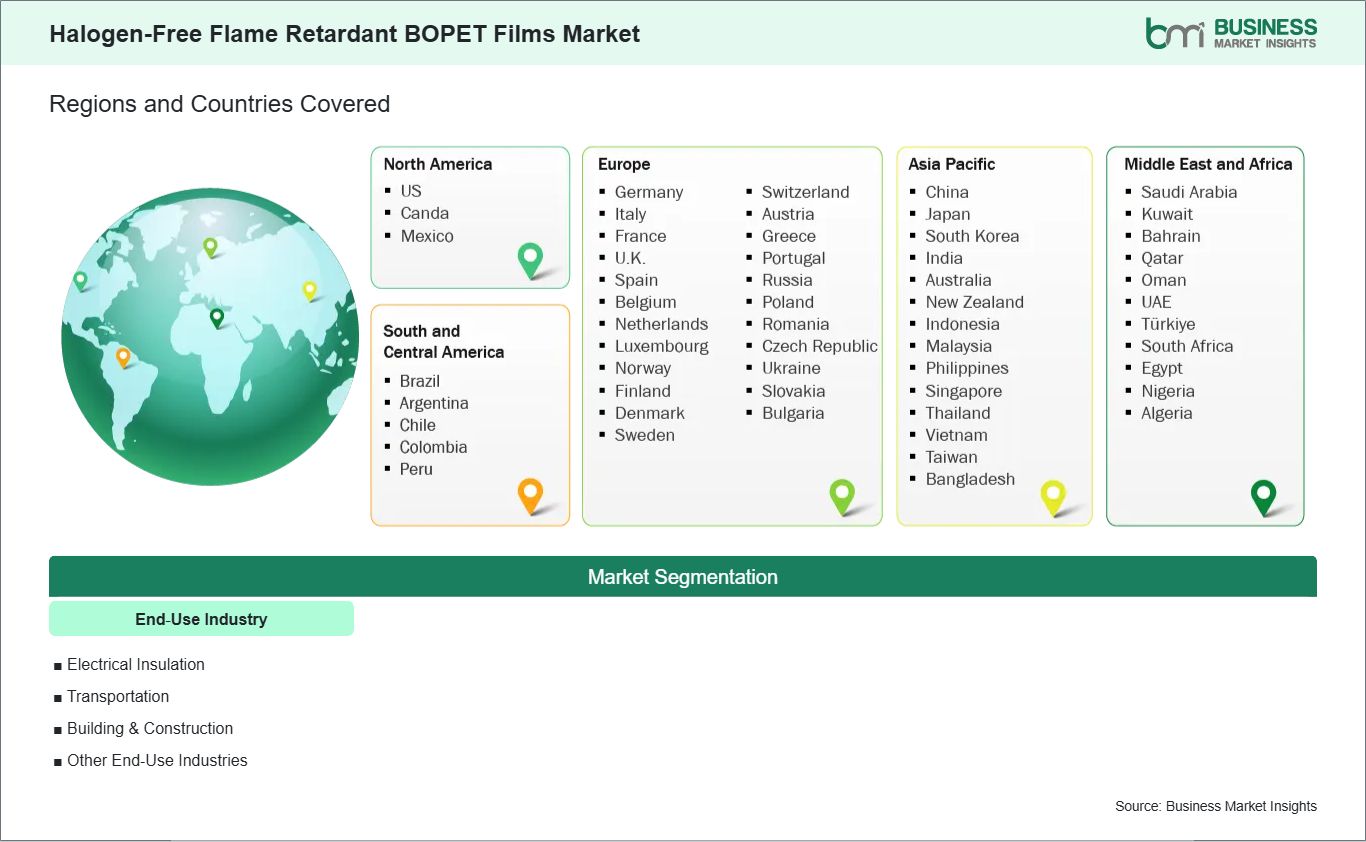
Segments Covered By End-Use Industry
  • Electrical Insulation
  • Transportation
  • Building & Construction
  • Other End-Use Industries
Regions and Countries Covered
North America US, Canada, Mexico
Europe Belgium, Austria, Finland, Denmark, Greece, Poland, Romania, Russia, Ukraine, Czech Republic, Slovakia, Bulgaria, Italy, Luxembourg, Germany, Switzerland, France, Netherlands, Norway, Portugal, Spain, Sweden, United Kingdom
Asia-Pacific Australia, China, India, Japan, South Korea, Indonesia, Malaysia, Philippines, Singapore, Thailand, Vietnam, Bangladesh, New Zealand, Taiwan
South and Central America Brazil, Argentina, Peru, Chile, Colombia
Middle East and Africa Bahrain, Kuwait, Oman, Qatar, Saudi Arabia, United Arab Emirates, Turkiye, South Africa, Egypt, Algeria, Nigeria
Market leaders and key company profiles
  • Toray Industries Inc.
  • Mitsubishi Chemical Holdings Corporation
  • DuPont Teijin Films
  • Shanghai Iuzheng Industrial Co. Ltd.
  • Mainyang Prochema Commercial Co. Ltd.
  • Teraoka Seisakusho Co Ltd
Get more information on this report

Halogen‑Free Flame Retardant BOPET Films Market Report Coverage and Deliverables:

The "Halogen‑Free Flame Retardant BOPET Films Market Size and Forecast (2022 - 2033)" report provides a detailed analysis of the market covering below areas:

  • Halogen‑Free Flame Retardant BOPET Films market size and forecast at global, regional, and country levels for all the key market segments covered under the scope
  • Halogen‑Free Flame Retardant BOPET Films market trends, as well as drivers, restraints, and opportunities
  • Halogen‑Free Flame Retardant BOPET Films market analysis covering key trends, regional framework, major players, regulations, and recent developments
  • Industry landscape and competition analysis covering market concentration, heat map analysis, prominent players, and recent developments for the Halogen‑Free Flame Retardant BOPET Films market
  • Detailed company profiles, including SWOT analysis

Halogen‑Free Flame Retardant BOPET Films Market Geographic Insights:

The geographical scope of the Halogen‑Free Flame Retardant BOPET Films market report is divided into five regions: North America, Asia Pacific, Europe, Middle East & Africa, and South & Central America. The Halogen‑Free Flame Retardant BOPET Films market in North America is expected to grow during the forecast period.

The region of North America holds the highest global market share for HFFR BOPET films, which can be attributed to the fact that the region has a high level of safety regulations, as well as the maturity of the manufacturing infrastructure and the adoption of the product for high-performance industrial applications. In the United States and Canada, the product is utilized for applications like electrical insulation, flexible printed circuits, and automotive parts, wherein the level of compliance to fire safety regulations and environmental norms is of critical importance.

The strong position of North America is further supported by strong research and development activities. Manufacturers and material producers in North America are putting efforts into the development of films with improved flame retardancy, mechanical properties, and optical properties, thus expanding the scope of the material in flexible electronics, smart devices, and insulation materials. Although the production cost and process of halogen-free films are on the higher side in comparison to conventional BOPET films, the focus of the North American market on safety, environmental concerns, and the development of high-performance materials continues to drive the market for the material. The strong regulatory environment and the industrial infrastructure of the region have set benchmarks for the world, thus placing the North American market at the forefront in the adoption and development of halogen-free flame retardant BOPET films.

global-market-geography
Get more information on this report

Halogen‑Free Flame Retardant BOPET Films Market Research Report Guidance:

  • The report includes qualitative and quantitative data in the Halogen‑Free Flame Retardant BOPET Films market across type, application, and geography.
  • The report starts with the key takeaways (chapter 2), highlighting the key trends and outlook of the Halogen‑Free Flame Retardant BOPET Films market.
  • Chapter 3 focuses on the research methodology of the study.
  • Chapter 4 includes ecosystem analysis.
  • Chapter 5 highlights the major industry dynamics in the Halogen‑Free Flame Retardant BOPET Films market, including factors that are driving the market, prevailing deterrents, potential opportunities, as well as future trends. Impact analysis of these drivers and restraints is also covered in this section.
  • Chapter 6 discusses the Halogen‑Free Flame Retardant BOPET Films market scenario, in terms of historical market revenues, and forecast till the year 2033.
  • Chapters 7 to 8 cover the Halogen‑Free Flame Retardant BOPET Films market segments by end‑use industry, and geography across North America, Europe, Asia Pacific, Middle East and Africa, and South and Central America. They cover the market volume, revenue forecast, and factors driving the market.
  • Chapter 9 describes the competitive analysis with the heat map analysis for the key players operating in the market.
  • Chapter 10 describes the industry landscape analysis. It provides detailed descriptions of business activities such as market initiatives, new developments, mergers, and joint ventures globally, along with a competitive landscape.
  • Chapter 11 provides detailed profiles of the major companies operating in the Halogen‑Free Flame Retardant BOPET Films market. Companies have been profiled on the basis of their key facts, business descriptions, products, financial overview, SWOT analysis, and key developments.
  • Chapter 12, i.e., the appendix, is inclusive of a brief overview of the company, list of abbreviations, and disclaimer.

Halogen‑Free Flame Retardant BOPET Films Market News and Key Development:

The halogen‑free flame retardant BOPET films  market is evaluated by gathering qualitative and quantitative data post primary and secondary research, which includes important corporate publications, association data, and databases. A few of the key developments in the halogen‑free flame retardant BOPET films  market are:

  • In April 2024, Toray Industries Inc. highlighted its participation in NPE 2024, where the company showcased advanced material solutions (including high‑performance films and engineering plastics), signaling continued focus on innovative film products for electronics and automotive sectors.
  • In December 2022, Toray Industries Inc. announced that it developed a new PET film with excellent applicability and adhesion for advanced coating use, part of ongoing innovation in polyester film materials that can support high‑performance applications.

Key Sources Referred:

  • International Organization for Standardization (ISO)
  • American Society for Testing and Materials (ASTM International)
  • Bureau of Indian Standards (BIS)
  • Environmental Protection Agency (EPA), USA
  • European Chemicals Agency (ECHA)
  • Central Pollution Control Board (CPCB), India
  • Ministry of Chemicals and Fertilizers, India
  • American Chemistry Council (ACC)
  • Indian Chemical Council (ICC)
  • European Chemical Industry Council (Cefic)
  • Specialty Chemical Association of India (SCAI)
  • Company Websites
  • Company Annual Reports
  • Company Investor Presentations
The List of Companies - Halogen‑Free Flame Retardant BOPET Films Market
  • Toray Industries Inc.
  • Mitsubishi Chemical Holdings Corporation
  • DuPont Teijin Films
  • Shanghai Iuzheng Industrial Co. Ltd.
  • Mainyang Prochema Commercial Co. Ltd.
  • Teraoka Seisakusho Co Ltd
Frequently Asked Questions
How big is the Halogen‑Free Flame Retardant BOPET Films Market?

The Halogen‑Free Flame Retardant BOPET Films Market is valued at US$ 12.0 Million in 2025, it is projected to reach US$ 21.0 Million by 2033.

What is the CAGR for Halogen‑Free Flame Retardant BOPET Films Market by (2026 - 2033)?

As per our report Halogen‑Free Flame Retardant BOPET Films Market, the market size is valued at US$ 12.0 Million in 2025, projecting it to reach US$ 21.0 Million by 2033. This translates to a CAGR of approximately 7.25% during the forecast period.

What segments are covered in this report?

The Halogen‑Free Flame Retardant BOPET Films Market report typically cover these key segments-

  • End-Use Industry (Electrical Insulation, Transportation, Building & Construction, Other End-Use Industries)

What is the historic period, base year, and forecast period taken for Halogen‑Free Flame Retardant BOPET Films Market?

The historic period, base year, and forecast period can vary slightly depending on the specific market research report. However, for the Halogen‑Free Flame Retardant BOPET Films Market report:

  • Historic Period : 2022-2024
  • Base Year : 2025
  • Forecast Period : 2026-2033
  • Who are the major players in Halogen‑Free Flame Retardant BOPET Films Market?

    The Halogen‑Free Flame Retardant BOPET Films Market is populated by several key players, each contributing to its growth and innovation. Some of the major players include:

  • Toray Industries Inc.
  • Mitsubishi Chemical Holdings Corporation
  • DuPont Teijin Films
  • Shanghai Iuzheng Industrial Co. Ltd.
  • Mainyang Prochema Commercial Co. Ltd.
  • Teraoka Seisakusho Co Ltd
  • Who should buy this report?

    The Halogen‑Free Flame Retardant BOPET Films Market report is valuable for diverse stakeholders, including:

    • Investors: Provides insights for investment decisions pertaining to market growth, companies, or industry insights. Helps assess market attractiveness and potential returns.
    • Industry Players: Offers competitive intelligence, market sizing, and trend analysis to inform strategic planning, product development, and sales strategies.
    • Suppliers and Manufacturers: Helps understand market demand for components, materials, and services related to concerned industry.
    • Researchers and Consultants: Provides data and analysis for academic research, consulting projects, and market studies.
    • Financial Institutions: Helps assess risks and opportunities associated with financing or investing in the concerned market.

    Essentially, anyone involved in or considering involvement in the Halogen‑Free Flame Retardant BOPET Films Market value chain can benefit from the information contained in a comprehensive market report.

    Available Report Formats

    pdf-format excel-format pptx-format
    Buy Now
    Sales Assistance
    +1 646 791 7070 (US & UK)
    Customization Form

    Please tell us your area of interest
    (Market Segments/ Regions and Countries/ Companies)