
Flame Retardants Market Outlook: Size, Share, Trends, Growth Analysis, Competitive Landscape & Forecast, 2026-2033

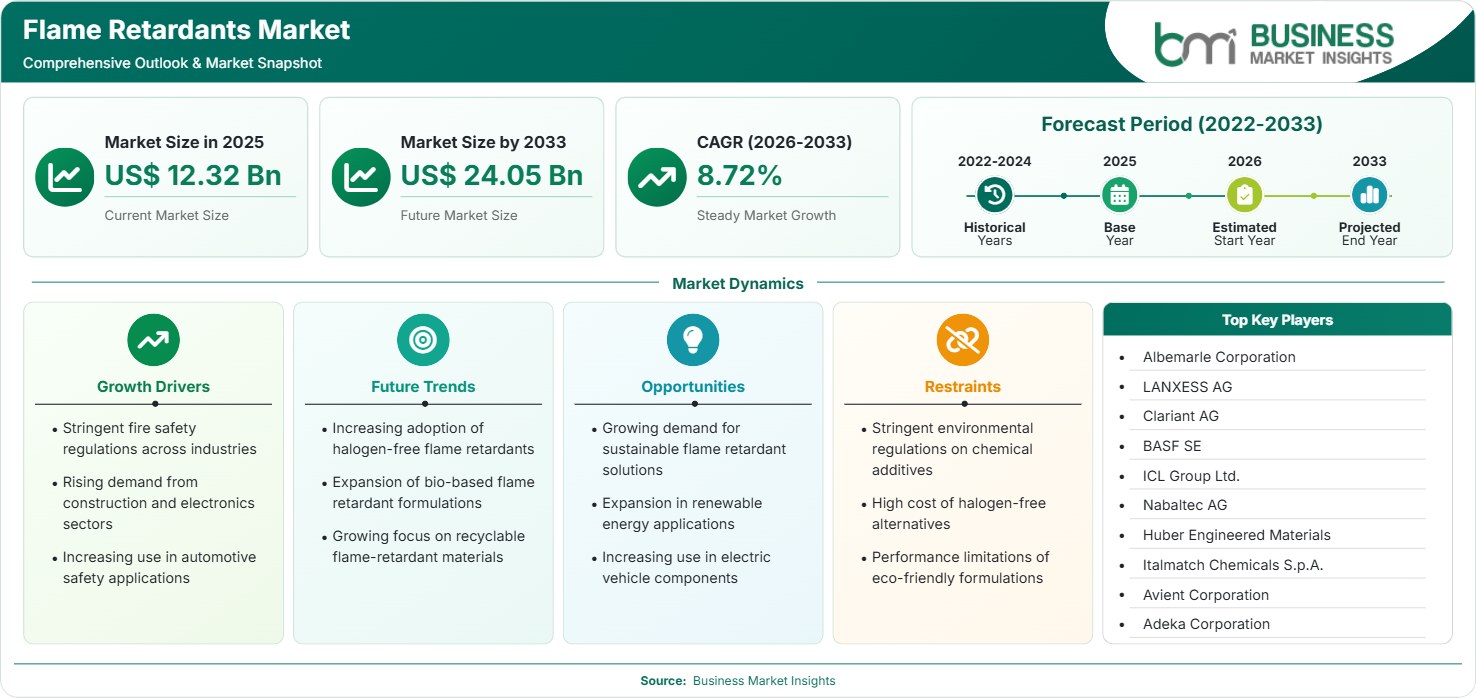
The Flame Retardants Market size was valued at US$ 12.32 Billion in 2025 and is projected to reach US$ 24.05 Billion by 2033, growing at a CAGR of 8.72% from 2026 to 2033, driven by fire safety standards, construction demand, electronics growth, electric vehicle adoption, and sustainable material innovation.

Report Coverage
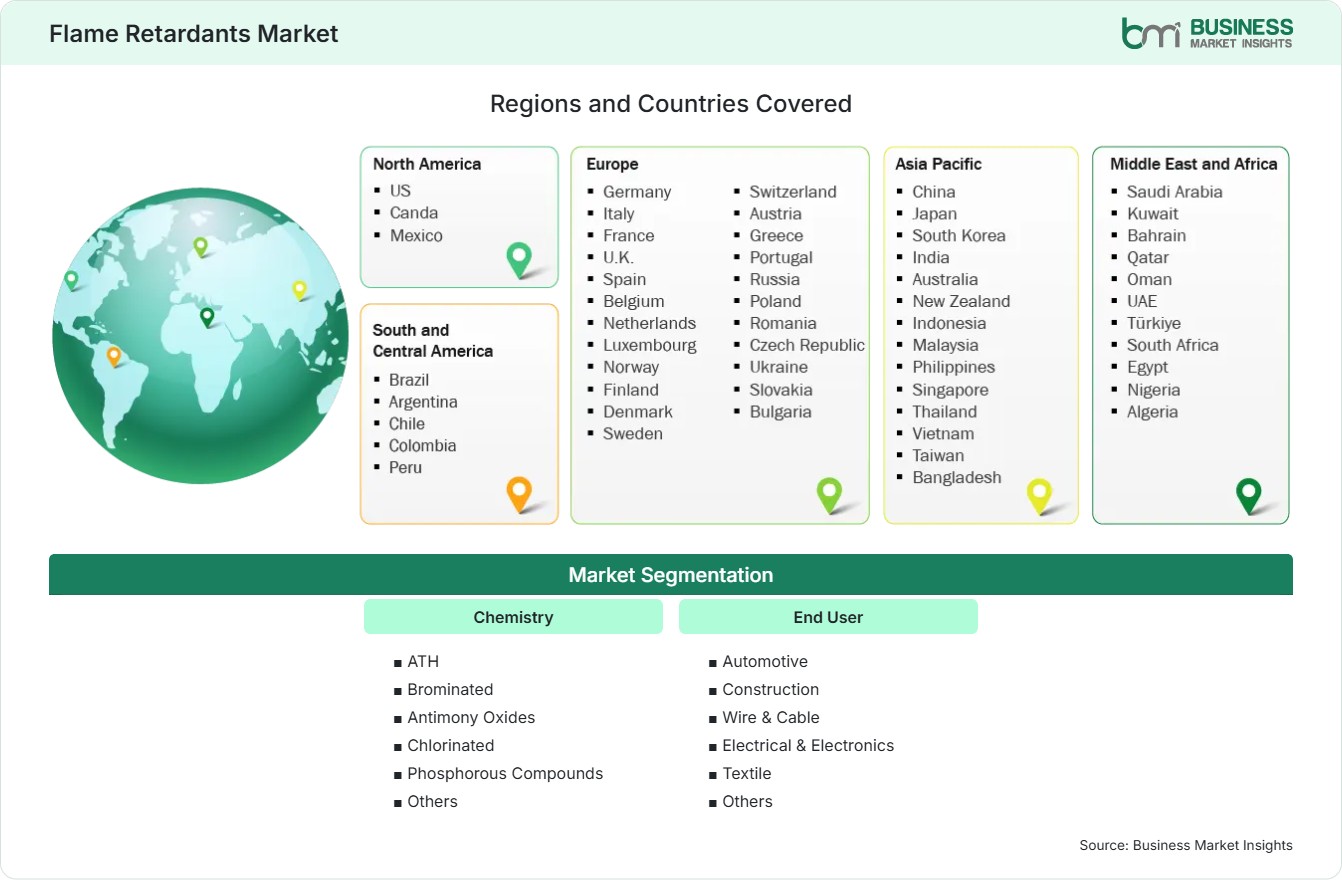
  • Chemistry: ATH, Brominated, Antimony Oxides, Chlorinated, Phosphorous Compounds, Others
  • End User: Automotive, Construction, Wire & Cable, Electrical & Electronics, Textile, Others
US$ 12.32 Bn Market size in 2025
US$ 24.05 Bn Market Size by 2033
8.72% CAGR, 2026 - 2033
2026-2033 Forecast Period

01 AI Overview

Flame Retardants Market Summary

  • North America Region: North America holds a market share of 28%–32% in 2025, growing with a CAGR of 8.10%–8.60% influenced by strict fire regulations, infrastructure development, electronics manufacturing, and automotive safety requirements. The U.S. market analysis indicates a CAGR of 8.20%–8.70% from 2026–2033, supported by building codes, electric vehicle production, and advanced material adoption.
  • Fastest Growing Region: Asia Pacific holds a market share of 34%–38% in 2025, growing with a CAGR of 9.00%–9.50% influenced by industrial expansion, construction activities, electronics production, automotive manufacturing, and increasing regulatory focus on fire protection.
  • Leading Segment: Phosphorous Compounds hold a market share of 24%–28% in 2025, growing with a CAGR of 8.70%–9.20% influenced by demand for halogen-free solutions, electrical applications, and advanced polymer protection technologies.
  • High Growth Segment: ATH holds a market share of 20%–24% in 2025, growing with a CAGR of 9.10%–9.60% influenced by sustainable material demand, construction applications, and preference for low-toxicity flame retardant systems.
  • Key Market Opportunity: Sustainable formulations, renewable energy equipment, and electric vehicle components are creating opportunities for advanced flame retardant technologies with improved safety and environmental performance.
  • Major Market Players: Albemarle Corporation, LANXESS AG, Clariant AG, BASF SE, ICL Group Ltd., Nabaltec AG, Huber Engineered Materials, Italmatch Chemicals S.p.A., Avient Corporation, Adeka Corporation.
02 Strategic Insights

Flame Retardants Market: Strategic Insights

Flame Retardants Market Strategic Framework
FREE PDF
Request your free sample
Request free sample
03 Stakeholder View

Key Takeaways

  • The market ecosystem is shifting toward specialized flame-retardant chemistries that balance fire protection performance, regulatory compliance, and environmental considerations across industrial applications.
  • Phosphorous compounds, ATH, and other halogen-free solutions are gaining importance due to increasing demand for safer and more sustainable material technologies.
  • Material manufacturers are accelerating innovation in low-emission formulations designed for electric vehicles, electronics, renewable energy systems, and advanced polymer applications.
  • Asia Pacific provides strong investment potential due to expanding construction activity, electronics manufacturing capacity, and automotive production growth across emerging economies.
  • Strategic collaborations and portfolio diversification are shaping competition as chemical companies strengthen sustainable additive capabilities and application-specific solutions.
  • Increasing adoption of electric mobility and renewable energy infrastructure is creating new demand channels for high-performance flame-resistant materials.
04 Geographic Outlook

Flame Retardants Market Regional Highlights

North America Flame Retardants Market

North America accounted for 28%–32% share in 2025 and is projected to expand at a CAGR of 8.10%–8.60% during 2026–2033. The region maintains a strong position due to strict fire safety regulations, advanced manufacturing industries, and increasing demand from construction, automotive, and electronics sectors. The Flame Retardants Market share in North America is supported by regulatory compliance requirements, infrastructure modernization, and electric vehicle component production. The United States represents the largest regional contributor due to strong chemical industry capabilities, established end-user industries, and increasing adoption of advanced polymer solutions.

  • The United States leads regional demand through strict building codes, automotive safety standards, and expanding electronics manufacturing activities.
  • Canada is increasing adoption of flame-retardant materials through infrastructure upgrades and growing demand for safer construction products.
  • Manufacturers are developing low-emission flame retardant solutions to address evolving environmental requirements and industry standards.
  • Automotive companies are incorporating fire-resistant materials into electric vehicle systems, batteries, and lightweight components.

US Flame Retardants Market

The United States represented 22%–26% share within North America in 2025 and is expected to grow at a CAGR of 8.20%–8.70% between 2026–2033. The country remains a major market due to advanced industrial infrastructure, high construction activity, and strong demand from electronics and automotive sectors. Federal and state-level safety regulations are encouraging adoption of compliant flame-retardant materials. The Flame Retardants Market analysis highlights opportunities from electric vehicle production, renewable energy equipment, and advanced polymer applications requiring improved fire resistance.

  • Construction companies are increasing use of flame-resistant materials to meet commercial and residential safety requirements.
  • Electronics manufacturers are adopting advanced polymer solutions for improved protection in electrical components and devices.
  • Electric vehicle producers are expanding demand for fire-resistant materials in battery systems and vehicle components.

Europe Flame Retardants Market

Europe accounted for 24%–28% share in 2025 and is forecast to grow at a CAGR of 8.00%–8.50% from 2026–2033. Germany, France, the United Kingdom, Italy, and the Netherlands represent key markets due to advanced automotive production, strict environmental standards, and developed construction industries. Germany and France are among high-growth countries supported by electric vehicle manufacturing, renewable energy investments, and demand for sustainable materials in Flame Retardants Market. European regulations focused on chemical safety are encouraging development of halogen-free flame-retardant technologies and improved material performance.

  • Germany maintains strong demand through automotive manufacturing, industrial production, and advanced polymer applications.
  • France is expanding adoption through construction safety requirements and renewable energy infrastructure development.
  • The United Kingdom is increasing usage in electrical systems, transportation applications, and building materials.
  • Italy is supporting market growth through automotive components, manufacturing activities, and construction sector demand.

Asia Pacific Flame Retardants Market

Asia Pacific represented 34%–38% share in 2025 and is expected to grow at a CAGR of 9.00%–9.50% during 2026–2033. The region is experiencing rapid expansion due to industrial development, infrastructure investment, electronics production, and automotive manufacturing growth. China, India, Japan, South Korea, and Southeast Asian economies represent major markets supported by increasing material consumption and manufacturing expansion. The Flame Retardants Market trends in Asia Pacific are influenced by demand for safer construction materials, expanding electronics industries, and rising adoption of electric vehicles requiring improved thermal and fire protection.

  • China dominates regional demand through large electronics manufacturing, automotive production, and construction activities.
  • India is experiencing increasing adoption due to infrastructure development, manufacturing expansion, and rising safety standards.
  • Japan continues investing in advanced flame-retardant materials for electronics, automotive, and industrial applications.
  • South Korea is strengthening demand through semiconductor manufacturing and electric vehicle component production.

Rest of World Flame Retardants Market

Rest of World accounted for 8%–12% share in 2025 and is projected to grow at a CAGR of 8.30%–8.80% during 2026–2033. South America and Middle East and Africa markets are gradually expanding in Flame Retardants Market due to infrastructure development, industrial investments, and increasing awareness regarding fire safety. Brazil, Mexico, Saudi Arabia, and South Africa represent emerging opportunities supported by construction projects, energy infrastructure, and manufacturing growth.

  • Brazil is increasing demand through construction growth, automotive manufacturing, and industrial applications requiring fire protection.
  • Mexico is expanding adoption through electronics production, automotive facilities, and manufacturing investments.
  • Saudi Arabia is supporting growth through infrastructure projects and energy sector development initiatives.
  • South Africa is developing opportunities through construction activities and industrial modernization programs.
Global Market Geography
FREE PDF
Request your free sample
Request free sample
05 Segment Analysis

Flame Retardants Market Segmentation

Chemistry

The chemistry segment is driven by increasing demand for effective fire protection materials across polymers, coatings, textiles, and industrial applications. Phosphorous Compounds represented the leading category with 24%–28% share in 2025 and are projected to grow at a CAGR of 8.70%–9.20% during 2026–2033. Growing preference for halogen-free technologies and regulatory pressure on traditional chemistries are supporting Flame Retardants Market adoption. Manufacturers are developing advanced formulations that provide fire resistance while meeting sustainability requirements across multiple end-use industries.

  • ATH: ATH is widely adopted due to low toxicity, smoke suppression properties, and applications in construction materials, cables, and polymer systems.
  • Brominated: Brominated flame retardants provide high efficiency and are used in specialized applications requiring strong fire protection performance.
  • Antimony Oxides: Antimony oxides are used as synergistic additives with other flame retardants to improve fire resistance in polymer applications.
  • Chlorinated: Chlorinated flame retardants are utilized in selected industrial applications due to effective fire suppression properties and compatibility with specific polymer systems.
  • Phosphorous Compounds: Phosphorous compounds are gaining adoption due to halogen-free positioning, lower environmental concerns, and suitability for electronics, textiles, and automotive applications.

End User

The end-user segment is expanding due to increasing safety requirements across automotive, construction, electronics, and industrial applications. Electrical & Electronics represented the leading category with 26%–30% share in 2025 and are expected to grow at a CAGR of 8.80%–9.30% during 2026–2033. Rising electronic device production, electric mobility development, and demand for safer electrical systems are supporting adoption. Manufacturers are focusing on flame retardant materials that improve component reliability, thermal management, and compliance with industry safety standards.

  • Automotive: Automotive manufacturers are increasing adoption of flame-retardant materials for vehicle interiors, electrical systems, and electric vehicle components requiring enhanced fire protection.
  • Construction: Construction industries utilize flame retardants in insulation, cables, coatings, and building materials to meet safety standards and improve structural protection.
  • Wire & Cable: Wire and cable producers use flame retardant solutions to reduce fire risks in electrical infrastructure and industrial installations.
  • Electrical & Electronics: Electronics manufacturers require flame retardant materials for circuit components, housings, and devices to improve safety and regulatory compliance.
  • Textile: Textile producers adopt flame retardant treatments for protective clothing, industrial fabrics, and specialized applications requiring fire-resistant performance.
06 Market Forces

Flame Retardants Market Dynamics

Key Market Drivers

Stringent fire safety regulations across industries

The implementation of stringent fire safety regulations across industries is driving demand for advanced flame-retardant materials in construction, electronics, automotive, and industrial applications. Governments and regulatory organizations are strengthening safety standards for buildings, electrical systems, transportation equipment, and consumer products. Manufacturers are required to improve fire resistance performance while meeting environmental compliance requirements. The growth is supported by increasing adoption of certified materials and safer product designs. The Flame Retardants Market trends indicate a shift toward halogen-free and low-emission solutions as companies balance performance with sustainability expectations. Growing enforcement of fire protection standards is encouraging material innovation and investment in advanced additive technologies.

Rising demand from construction and electronics sectors

The rising demand from construction and electronics sectors is increasing adoption of flame-retardant materials due to expanding infrastructure development and growing electronic product manufacturing. Construction companies require fire-resistant insulation, cables, coatings, and polymer materials to improve building safety. Fire safety has become a key concern among electronics producers who use flame retardants in housing, connections, and electronic components. The rapid growth in digitalization, along with increased manufacturing of electronic equipment, is driving demand for special compounds. Chemical manufacturers are offering products tailored to specific applications that deliver better results and comply with regulations. The development of smart infrastructure and renewables also drives demand.

Increasing use in automotive safety applications

Growing usage in automobile safety applications is driving demand for flame retardant materials as automotive companies are trying to provide better protection and reliability of passenger components. Electric automobiles are driving the trend because of the need for increased fire resistance in batteries, electronics, and polymer components used in such cars. Flame retardant materials are being utilized by automotive component suppliers in car interior and electrical systems applications, as well as under-the-hood applications. The transition toward to electric vehicles is promoting the development of special materials that can handle thermal risks. Companies are investing in R&D to improve the properties of their products.

Key Market Opportunities

Growing demand for sustainable flame-retardant solutions

Growing demand for sustainable flame retardants is creating new opportunities for producers designing green flame retardants. Industries are looking for products that have reduced ecological footprint and at the same time can provide the necessary level of fire protection. Halogen-free technologies, phosphorus compounds, and mineral solutions are becoming more popular because of regulation demands and sustainable development goals. The chemical industry has been investing heavily in research programs aimed at increasing efficiency, reducing pollution, and better compatibility with modern polymers. Sustainable flame retardants are expected to become popular in construction, electronics, automotive, and renewable energy industries. Companies able to produce highly efficient products with better environmental characteristics are expected to benefit from these trends.

Expansion in renewable energy applications

The expansion in renewable energy applications is creating new opportunities for flame retardant manufacturers as solar, wind, and energy storage systems require enhanced fire protection materials. Renewable energy equipment includes electrical components, cables, battery systems, and polymer structures where thermal safety is critical. The increasing expenditure on clean energy infrastructure is driving high demand for flame-resistant materials with excellent longevity and reliability. Increasing effort is being put into developing solutions that can operate in harsh conditions while maintaining safety. The increasing number of energy transition programs around the world will create the demand for advanced flame-retardant technology.

Increasing use in electric vehicle components

The increasing use in electric vehicle components is creating significant opportunities as automotive manufacturers require advanced materials for batteries, charging systems, power electronics, and lightweight structures. The emergence of electric vehicles brings about new thermal management challenges and, consequently, an increased requirement for flame retardants to improve safety and durability. Companies in the chemicals sector are developing formulations which can be applied in polymers employed in the construction of battery modules, connectors, and other automobile parts. Collaboration between chemical companies and automobile manufacturers is gaining momentum owing to the expansion of electric mobility programs worldwide. This trend is expected to continue in next-gen electric vehicles.

Market Restraints and Challenges

Stringent environmental regulations on chemical additives

Factor: Stringent environmental regulations on chemical additives create challenges because governments are increasing restrictions on certain flame-retardant chemistries due to concerns related to toxicity, persistence, and environmental impact. Impact: These regulations can increase compliance costs, limit usage of specific formulations, and require manufacturers to invest heavily in alternative technologies. Companies must continuously modify product portfolios to meet evolving chemical safety requirements across different regions. Regulatory changes may increase research and development expenses while extending product approval timelines. Manufacturers are focusing on sustainable formulations, improved testing procedures, and regulatory alignment strategies to maintain market competitiveness and support long-term adoption.

High cost of halogen-free alternatives

Factor: High cost of halogen-free alternatives creates challenges because advanced sustainable flame retardant technologies often require expensive raw materials, specialized processing, and additional formulation development. Impact: Higher production costs can limit adoption among price-sensitive end users and affect competitiveness against traditional solutions. Industries transitioning toward environmentally preferred materials may face increased manufacturing expenses during the replacement process. Companies are investing in production optimization and technology improvements to reduce cost differences. Increasing demand for sustainable solutions is encouraging innovation, but affordability remains an important factor influencing adoption across developing markets and cost-conscious industries.

07 Company Analysis

Competitive Landscape

The Flame Retardants Market analysis highlights a competitive environment shaped by chemical innovation, regulatory compliance, sustainable formulation development, and expanding applications across construction, automotive, electronics, and industrial sectors. Leading companies are focusing on advanced additive technologies, portfolio expansion, and environmentally responsible solutions to address evolving industry requirements.

Company Name

Overview

Products and Services relevant to this market

Albemarle Corporation

Global specialty chemicals company focused on advanced material solutions and performance additives.

Provides brominated flame retardants, specialty chemicals, and fire safety solutions for industrial applications.

LANXESS AG

Chemical company developing specialty materials and additives for multiple industrial sectors.

Offers phosphorus-based flame retardants, polymer additives, and sustainable material solutions.

Clariant AG

Specialty chemical manufacturer providing innovative additives and sustainable solutions.

Develops flame retardant additives, polymer solutions, and fire protection technologies.

BASF SE

Global chemical company offering advanced materials and performance solutions.

Provides flame retardant systems, engineering plastics, and polymer modification solutions.

ICL Group Ltd.

Specialty minerals and chemicals producer serving industrial and advanced material markets.

Supplies phosphorus-based flame retardants and specialty chemical solutions.

Nabaltec AG

Manufacturer specializing in mineral-based specialty products and additives.

Provides aluminum hydroxide flame retardants and mineral-based fire protection materials.

Huber Engineered Materials

Specialty materials company focused on mineral-based functional solutions.

Offers ATH flame retardants, magnesium hydroxide products, and engineered material solutions.

Italmatch Chemicals S.p.A.

Specialty chemical producer developing additives for industrial applications.

Provides phosphorus-based flame retardants and performance additives for polymers.

Avient Corporation

Global materials company providing polymer solutions and specialty additives.

Offers flame retardant compounds, polymer formulations, and engineered material technologies.

Adeka Corporation

Chemical manufacturer focused on additives and specialty materials.

Develops flame retardant additives, polymer stabilizers, and advanced material solutions.

10 Trust & Transparency

Research Methodology

The market analysis combines proprietary research with secondary data from government agencies, company disclosures, regulatory filings, industry databases and expert interviews. Market estimates are validated through data triangulation, cross-market benchmarking and analyst review.

View Full Research Methodology

11 Questions Answered

Frequently Asked Questions

What does the Flame Retardants Market Report provide?

The report provides insights into market size, regional performance, segmentation trends, competitive analysis, growth factors, challenges, and opportunities influencing global flame protection material adoption.

Which flame retardant chemistry is experiencing strong adoption?

Phosphorus compounds are experiencing strong adoption due to demand for halogen-free solutions, regulatory compliance, and suitability across electronics, automotive, textile, and industrial applications requiring improved fire resistance.

Why are electric vehicles increasing demand for flame retardants?

Electric vehicles require enhanced thermal and fire protection due to battery systems, power electronics, and lightweight polymer components. Flame retardant materials help improve safety, reliability, and performance in next-generation vehicle designs.

How are sustainable solutions changing the Flame Retardants Market forecasts?

Sustainable flame-retardant solutions are gaining attention through increased adoption of halogen-free formulations, mineral-based additives, and phosphorus compounds. Manufacturers are focusing on reducing environmental impact while maintaining required fire protection performance across industrial applications.

What industries are driving demand for flame retardant materials?

Construction, automotive, electrical and electronics, wire and cable, and renewable energy industries are driving demand due to increasing safety requirements. These sectors require materials that improve fire resistance, reduce risks, and support compliance with evolving safety standards.

Access the Full Flame Retardants Market Report

Get segment-level forecasts, regional estimates, competitive benchmarking, company profiles and downloadable Excel datasets.

Access the full Flame Retardants Market Report
350 pages PDF & Excel | 2026-08-12