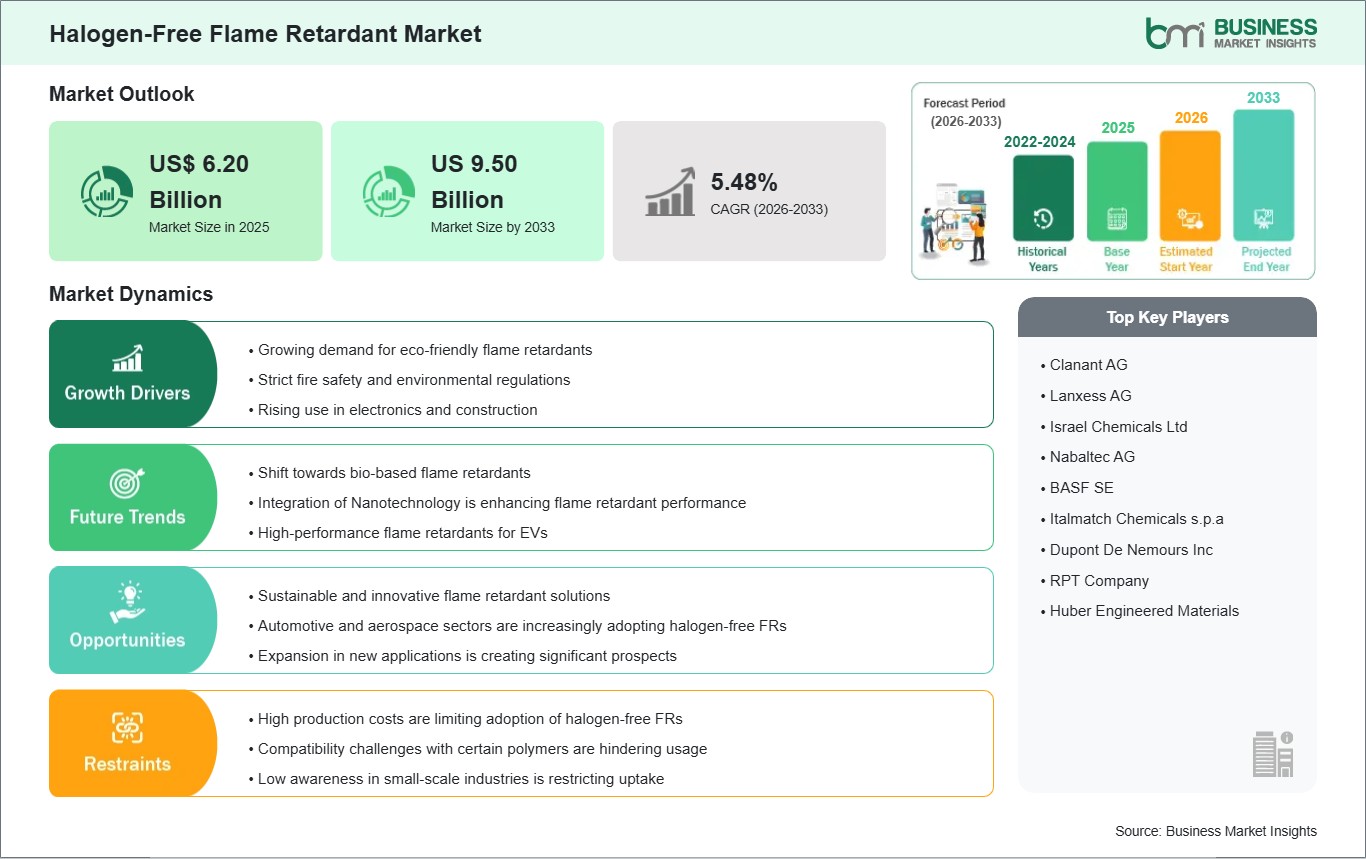
The Halogen-Free Flame Retardant Market size is expected to reach US$ 9.50 Billion by 2033 from US$ 6.20 Billion in 2025. The market is estimated to record a CAGR of 5.48% from 2026 to 2033.
The global halogen‑free flame retardant market is witnessing significant interest as industries worldwide increasingly prioritize safety, sustainability, and compliance with environmental standards. Halogen‑free flame retardants (HFFRs) are designed to provide effective fire protection without the harmful environmental and health impacts associated with halogenated alternatives, which can release toxic gases and corrosive residues during combustion. The growing awareness of ecological concerns, coupled with stricter fire safety regulations across multiple industries, has propelled the adoption of these safer alternatives. The applications of HFFRs are varied and widespread and include fields such as electronics, automotive, construction, transportation, and textiles.
For instance, in the field of electronics, there is a need to protect sensitive components from fire hazards. In construction and building materials, there is an emerging need for materials that are not only fire-resistant but also meet the needs of green building initiatives. Automotive and transportation industries are increasingly adopting HFFRs in materials that are not only fire-resistant but also lightweight and high-performance materials that meet the needs for automotive and transportation applications. Formulation of halogen-free materials that offer similar performance to that of halogenated flame retardants can be technically challenging for some applications that need to be tested for safety compliance. However, with emerging innovative products and formulations for synergistic materials, HFFRs are becoming increasingly useful and are likely to be the cornerstone for future development of fire-safe and environmentally friendly materials.

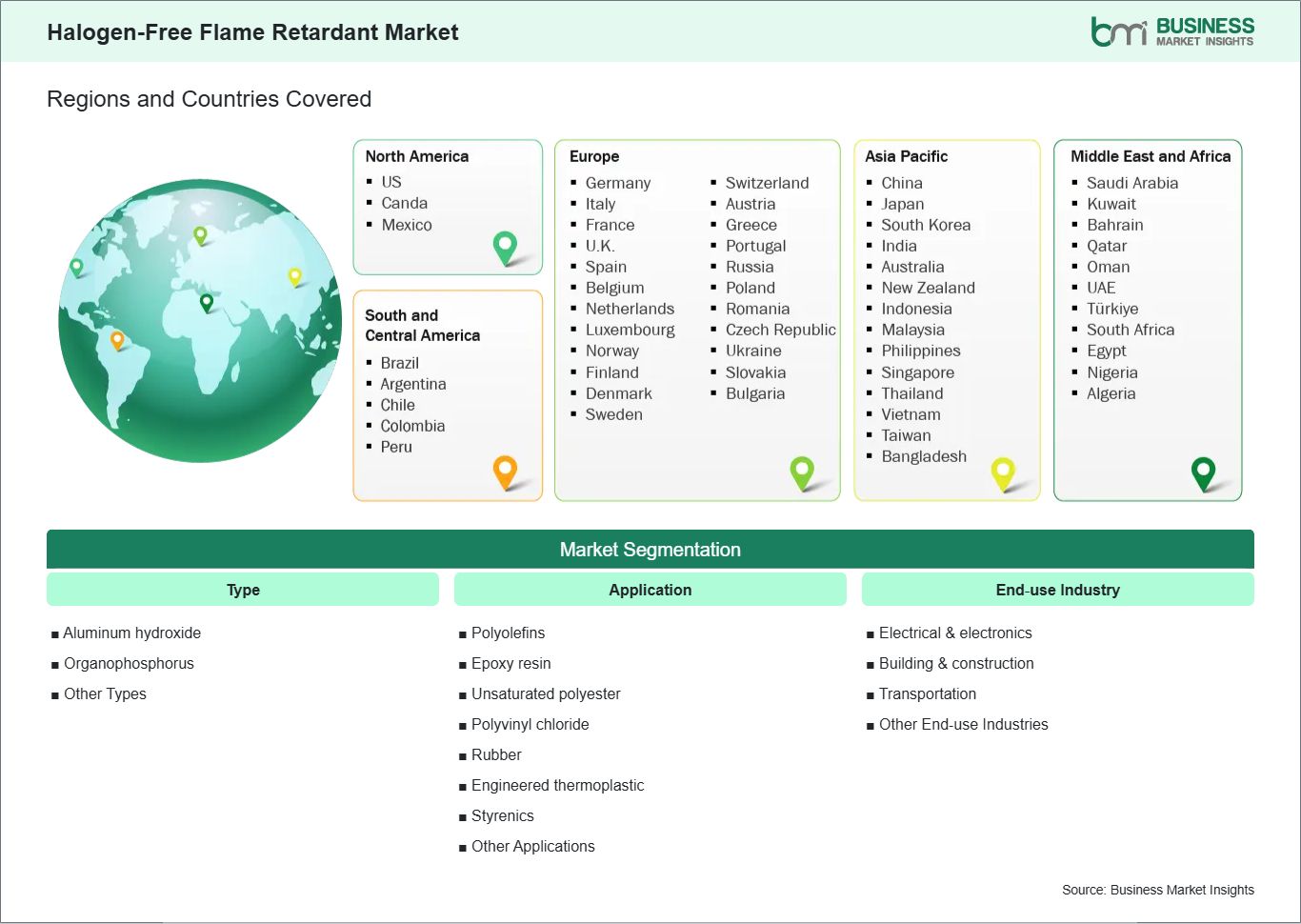
Key segments that contributed to the derivation of the halogen‑free flame retardant market analysis are type, application, and end‑use industry.
The global demand for eco-friendly halogen-free flame retardants is experiencing significant growth as industries increasingly prioritize environmental safety alongside fire protection. Manufacturers and product designers are moving away from halogenated compounds due to their potential to release toxic and corrosive gases during combustion, which can pose risks to both human health and the environment. Halogen-free alternatives provide comparable flame-retardant performance while reducing harmful emissions, making them a preferred choice for modern applications. These flame retardants are now widely used in insulation materials, cables, polymers, foams, and electronics, combining effective fire safety with environmentally responsible production.
The drive for eco-friendly flame retardants is further fueled by the need to comply with evolving fire safety and environmental regulations across various industries. Companies are increasingly incorporating halogen-free flame retardants to meet strict standards without compromising product quality, reliability, or performance. In addition, manufacturers are leveraging these environmentally safe alternatives as a way to differentiate their products, aligning with broader sustainability initiatives and consumer expectations for greener materials. This growing emphasis on safety, compliance, and ecological responsibility has created a strong global pull for halogen-free solutions across multiple sectors.
In parallel, the need for high-performance and environment-friendly flame retardants has led to the development of innovative chemical formulations. Industries are looking for materials that are thermally stable, have mechanical strength, are efficient in flame retardancy, even in challenging conditions, and are also environment-friendly. Flame retardants that are halogen-free are being integrated into high-performance materials like polymers, textiles, coatings, and composites, thus offering versatility in the application of these materials in all fields that require flame retardancy and strength. The need for flame retardancy, environmental concerns, and regulatory needs are thus leading the global market to adopt environment-friendly and halogen-free flame retardants.
Innovation in the halogen-free flame retardant market is focused on creating sustainable solutions that balance environmental responsibility with high performance. Modern formulations combine phosphorus-based compounds, nitrogen-containing agents, and inorganic fillers to enhance flame retardancy while minimizing ecological impact. These advanced systems are compatible with a wide range of materials, including polymers, coatings, adhesives, and composites, allowing manufacturers to deliver durable, safe, and sustainable products without compromising mechanical or aesthetic properties. The ability to maintain both performance and environmental compliance is a key factor driving adoption across diverse industrial applications.
Moreover, sustainable flame retardants are also changing to deliver co-benefits in multiple functionalities. Synergistic flame retardants enhance thermal stability, mechanical reinforcement, and smoke and toxic gas suppression, thereby becoming applicable in demanding applications. This helps the materials function optimally in challenging conditions and also meet environmental safety standards. By using these newer and efficient, environment-friendly alternatives to conventional and less efficient halogenated flame retardants, it is possible to obtain improved performance of the materials and extend their service life in applications like automotive parts, building composites, and electrical devices.
The global movement towards sustainability and the development and practice of sustainable and circular economy concepts is further fueling the development and production of recyclable and biodegradable flame retardant materials. By using sustainable and eco-friendly additive products, organizations and companies are not only contributing to the global movement towards sustainability and sustainable economy concepts but also ensuring that they comply with flame retardant requirements and regulations. The ongoing movement towards research and development in this sector is allowing for the development and production of next-generation halogen-free flame retardant products that not only perform and function at optimum levels but also comply with sustainability and sustainable economy concepts.

The halogen‑free flame retardant market is experiencing steady growth, with market size and share analysis reflecting evolving treatment preferences and competitive dynamics among key players. The report evaluates important subsegments categorized within type, application, and end‑use industry, highlighting their respective contributions to overall market performance.
By type, the aluminum hydroxide subsegment dominated the halogen‑free flame retardants market in 2025. Aluminum hydroxide provides excellent flame-retardant properties, thermal stability, and smoke suppression, making it highly suitable for diverse applications, which drives its widespread adoption.
Based on application, the polyolefins subsegment dominated the halogen‑free flame retardants market in 2025. Polyolefins benefit from improved fire safety, chemical resistance, and mechanical performance, making them ideal for demanding industries, supporting strong demand for halogen‑free flame retardant technologies.
In terms of end-use industry, the electrical & electronics subsegment dominated the halogen‑free flame retardants market in 2025. Electrical & electronics applications require high-performance materials with superior flame retardancy and insulation properties, reinforcing the dominance of this segment.
| Report Attribute | Details |
|---|---|
| Market size in 2025 | US$ 6.20 Billion |
| Market Size by 2033 | US 9.50 Billion |
| Global CAGR (2026 - 2033) | 5.48% |
| Historical Data | 2022-2024 |
| Forecast period | 2026-2033 |
| Segments Covered | By Type
|
|
Regions and Countries Covered
| |
| North America | US, Canada, Mexico |
| Europe | Belgium, Austria, Finland, Denmark, Greece, Poland, Romania, Russia, Ukraine, Czech Republic, Slovakia, Bulgaria, Italy, Luxembourg, Germany, Switzerland, France, Netherlands, Norway, Portugal, Spain, Sweden, United Kingdom |
| Asia-Pacific | Australia, China, India, Japan, South Korea, Indonesia, Malaysia, Philippines, Singapore, Thailand, Vietnam, Bangladesh, New Zealand, Taiwan |
| South and Central America | Brazil, Argentina, Peru, Chile, Colombia |
| Middle East and Africa | Bahrain, Kuwait, Oman, Qatar, Saudi Arabia, United Arab Emirates, Turkiye, South Africa, Egypt, Algeria, Nigeria |
| Market leaders and key company profiles |
|
The "Halogen‑Free Flame Retardant Market Size and Forecast (2022 - 2033)" report provides a detailed analysis of the market covering below areas:
The geographical scope of the Halogen‑Free Flame Retardant market report is divided into five regions: North America, Asia Pacific, Europe, Middle East & Africa, and South & Central America. The Halogen‑Free Flame Retardant market in North America is expected to grow during the forecast period.
North America leads the global halogen‑free flame retardant market, primarily due to a combination of stringent safety regulations, environmental awareness, and a strong presence of end-use industries that demand high-performance flame retardant solutions. Regulatory bodies and fire safety standards in the region have encouraged manufacturers to transition away from traditional halogenated compounds, promoting safer alternatives that reduce toxic emissions during fires. This has established North America as a testing ground and trendsetter for halogen‑free technologies globally.
The electronics and electrical equipment industry is also one of the key drivers of the market, as there is a need for the usage of halogen-free materials in insulating wires and circuit boards. In addition to this, the construction and building industry is also using more and more HFFRs for fire-resistant insulation and coatings. This can be attributed to the growing trend towards green building initiatives.
The automotive and transportation industry also contributes significantly to the market by using halogen-free flame retardants in its products. Innovation is a key feature of the North American market, and companies are investing in the R&D of high-performance formulations that provide improved fire protection while maintaining high environmental compatibility.
However, the high cost of the advanced materials and the presence of existing halogen-based materials are still key drivers of the adoption rate of halogen-free flame retardants. Despite the challenges, the North American region, with its high level of regulation, technological advancements, and industrial capabilities, remains the leading region, which dictates the trends and the adoption rate of halogen-free flame retardants worldwide.

The halogen‑free flame retardant market is evaluated by gathering qualitative and quantitative data post primary and secondary research, which includes important corporate publications, association data, and databases. A few of the key developments in the halogen‑free flame retardant market are:
The Halogen‑Free Flame Retardant Market is valued at US$ 6.20 Billion in 2025, it is projected to reach US 9.50 Billion by 2033.
As per our report Halogen‑Free Flame Retardant Market, the market size is valued at US$ 6.20 Billion in 2025, projecting it to reach US 9.50 Billion by 2033. This translates to a CAGR of approximately 5.48% during the forecast period.
The Halogen‑Free Flame Retardant Market report typically cover these key segments-
The historic period, base year, and forecast period can vary slightly depending on the specific market research report. However, for the Halogen‑Free Flame Retardant Market report:
The Halogen‑Free Flame Retardant Market is populated by several key players, each contributing to its growth and innovation. Some of the major players include:
The Halogen‑Free Flame Retardant Market report is valuable for diverse stakeholders, including:
Essentially, anyone involved in or considering involvement in the Halogen‑Free Flame Retardant Market value chain can benefit from the information contained in a comprehensive market report.
Please tell us your area of interest
(Market Segments/ Regions and Countries/ Companies)