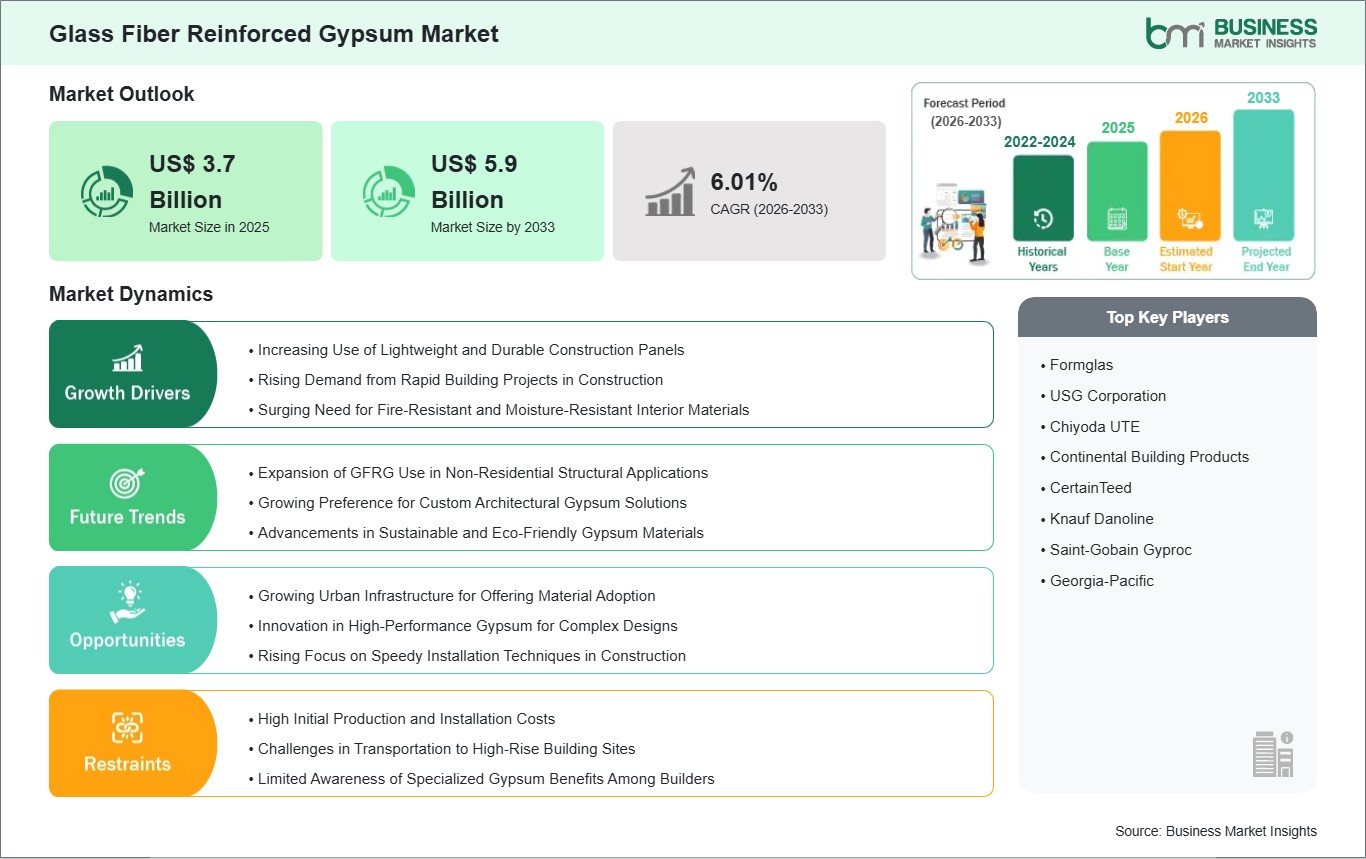
The Glass Fiber Reinforced Gypsum Market size is expected to reach US$ 5.9 Billion by 2033 from US$ 3.7 Billion in 2025. The market is estimated to record a CAGR of 6.01% from 2026 to 2033.
The global glass fiber reinforced gypsum (GFRG) market has gained significant attention as architects, developers, and contractors increasingly seek materials that combine strength, durability, and design flexibility. GFRG, which blends traditional gypsum with glass fibers, delivers enhanced tensile strength, impact resistance, and dimensional stability, making it far more resilient than conventional gypsum. Its lightweight composition and ability to be molded into intricate shapes give designers freedom to create visually striking ceilings, partitions, wall panels, and decorative features, all while reducing structural load, a key advantage in modern urban construction and interior design projects.
The market is driven by increasing demand for materials that are not only aesthetically diverse but also fire-resistant and require minimal maintenance during their life cycle. Construction companies and developers are looking for materials that can simplify installation and maintenance cycles, and ensure consistent performance during the life cycle of buildings. The quality of prefabricated and panelized products has improved, making GFRG an attractive choice for large-scale construction and renovation projects. However, there are also drawbacks.
The installation of GFRG requires trained labor, which is often difficult in regions where trained labor is not easily available. The cost of using GFRG is also higher than traditional gypsum, which might act as a hindrance for projects looking for cost-effectiveness. However, as sustainability, aesthetics, and performance are becoming key considerations, GFRG is now being regarded as a preferred choice for futuristic construction projects across the globe.

Key segments that contributed to the derivation of the glass fiber reinforced gypsum market analysis are type, application, and end user.
The need for lightweight yet robust construction materials is fueling the demand for glass fiber reinforced gypsum (GFRG) construction panels. These construction panels are gaining popularity as they provide the fire resistance, dimensional stability, and easy installation benefits of traditional gypsum products along with improved mechanical strength through the addition of glass fibers. These construction panels are being increasingly used by builders and construction contractors to ensure the performance requirements of construction projects while providing a lightweight structure to the buildings.
Glass fiber reinforced gypsum construction panels are gaining popularity as they provide several operational benefits in modern construction projects. The lightweight nature of the construction panel ensures easy handling and transport of the construction material, making it ideal for modern construction projects. The construction panel ensures a smooth and quality surface, along with the benefits of being lightweight, thus allowing architects and builders to design creative and aesthetically appealing interior and exterior designs of modern structures.
Durability is another factor contributing to the popularity of GFRG panels. Unlike standard gypsum, GFRG exhibits improved resistance to cracking, warping, and moisture-related damage, which enhances lifecycle performance and reduces maintenance requirements. As developers prioritize efficiency, cost-effectiveness, and long-term reliability in construction materials, GFRG panels are emerging as a preferred choice for projects seeking lightweight, high-performance solutions that meet modern building standards and architectural requirements.
Rapid urbanization and infrastructure development are fueling the use of glass fiber-reinforced gypsum in building projects worldwide. Cities expanding with residential complexes, commercial towers, and institutional facilities require materials that are both efficient to install and capable of maintaining structural and aesthetic integrity over time. GFRG panels are increasingly adopted in these contexts because they provide an optimal combination of lightweight construction, fire safety, and dimensional stability, which aligns with the demands of modern urban development.
In urban infrastructure construction projects, GFRG panels are commonly applied for the construction of interior walls, partitions, ceilings, and façade cladding. This is mainly attributed to the fact that the panels can be molded to achieve complex designs and geometries while reducing construction periods and the impact on the surrounding environment. In public buildings, offices, and high-rise residential buildings, the application of GFRG panels can provide an effective balance between functionality, safety, and aesthetics. This makes the panels a preferred option for modern urban infrastructure construction.
Moreover, the application of GFRG panels can be attributed to their contribution to the sustainability and efficiency of urban infrastructure construction. The panels are designed to be lightweight, reducing the cost of transportation and installation. In addition, the panels are designed for long-lasting performance, reducing the need for constant repairs and replacements. In urban infrastructure construction projects where the need for efficient and appealing construction products is increasing, the application of GFRG panels can play a crucial role in the construction of modern urban infrastructure.

The glass fiber reinforced gypsum market is experiencing steady growth, with market size and share analysis reflecting evolving treatment preferences and competitive dynamics among key players. The report evaluates important subsegments categorized within type, application, and end user, highlighting their respective contributions to overall market performance.
By type, the Type X subsegment dominated the glass fiber reinforced gypsum market in 2025. Type X offers enhanced fire resistance and structural integrity, making it highly suitable for safety-critical construction applications, which drives its widespread adoption.
Based on application, the interior subsegment dominated the glass fiber reinforced gypsum market in 2025. Interior applications require lightweight, durable, and easy-to-install materials for walls and ceilings, making this segment highly suitable for modern building designs, which drives its widespread adoption.
In terms of end user, the non-residential subsegment dominated the glass fiber reinforced gypsum market in 2025. Non-residential buildings demand high-performance materials that ensure safety, durability, and aesthetic appeal, making this segment highly suitable for commercial and institutional construction projects, which drives its widespread adoption.
| Report Attribute | Details |
|---|---|
| Market size in 2025 | US$ 3.7 Billion |
| Market Size by 2033 | US$ 5.9 Billion |
| Global CAGR (2026 - 2033) | 6.01% |
| Historical Data | 2022-2024 |
| Forecast period | 2026-2033 |
| Segments Covered | By Type
|
|
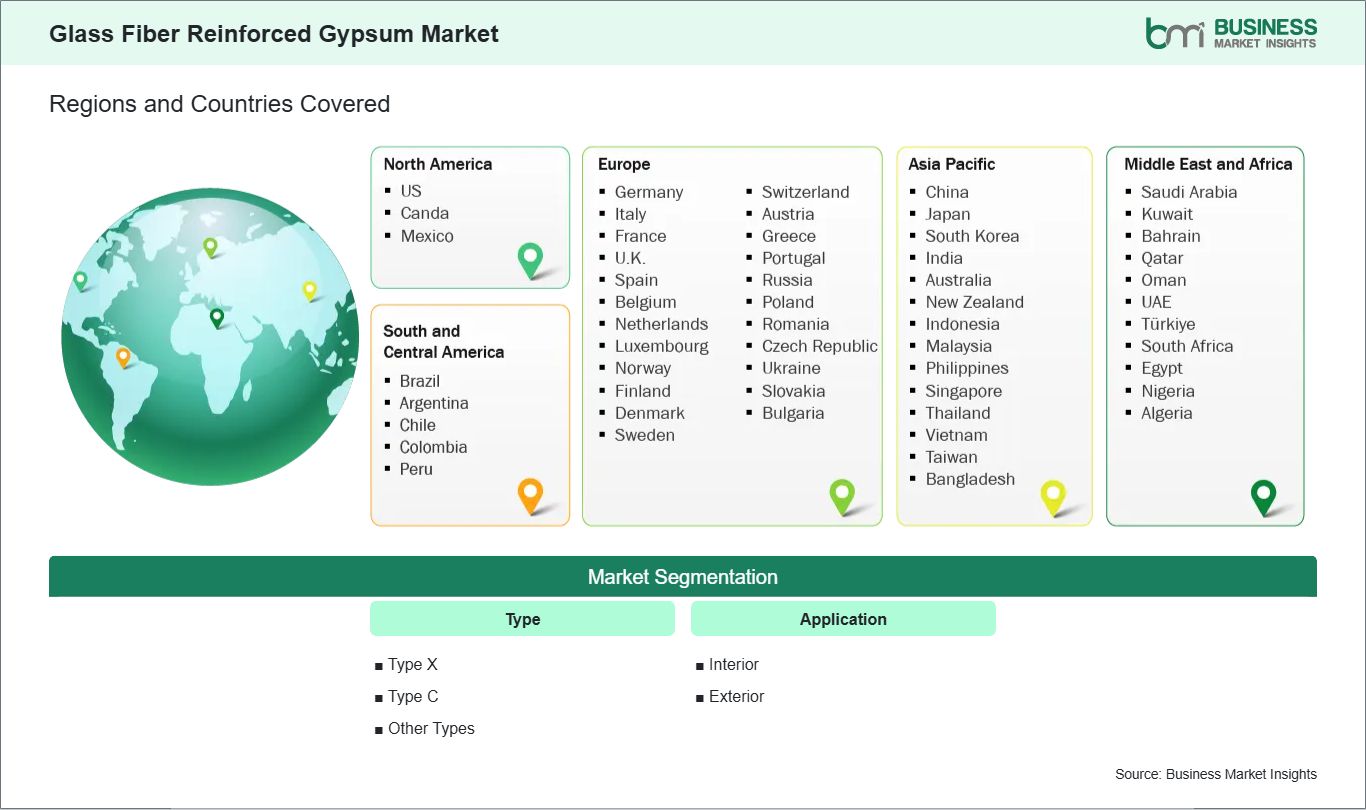
Regions and Countries Covered
| |
| North America | US, Canada, Mexico |
| Europe | Belgium, Austria, Finland, Denmark, Greece, Poland, Romania, Russia, Ukraine, Czech Republic, Slovakia, Bulgaria, Italy, Luxembourg, Germany, Switzerland, France, Netherlands, Norway, Portugal, Spain, Sweden, United Kingdom |
| Asia-Pacific | Australia, China, India, Japan, South Korea, Indonesia, Malaysia, Philippines, Singapore, Thailand, Vietnam, Bangladesh, New Zealand, Taiwan |
| South and Central America | Brazil, Argentina, Peru, Chile, Colombia |
| Middle East and Africa | Bahrain, Kuwait, Oman, Qatar, Saudi Arabia, United Arab Emirates, Turkiye, South Africa, Egypt, Algeria, Nigeria |
| Market leaders and key company profiles |
|
The "Glass Fiber Reinforced Gypsum Market Size and Forecast (2022 - 2033)" report provides a detailed analysis of the market covering below areas:
The geographical scope of the Glass Fiber Reinforced Gypsum market report is divided into five regions: North America, Asia Pacific, Europe, Middle East & Africa, and South & Central America. The Glass Fiber Reinforced Gypsum market in North America is expected to grow during the forecast period.
North America leads the global GFRG market, driven by a mature construction industry, high architectural standards, and a strong appetite for innovative building materials. In the United States and Canada, GFRG is widely used in commercial buildings, institutional facilities, and upscale residential developments where aesthetics, fire resistance, and durability are equally important. Architects and developers increasingly turn to GFRG panels for ceilings, partitions, and decorative applications that require both visual appeal and structural reliability. The region also benefits from a robust prefabrication and supply system, which ensures manufacturers can produce quality panels efficiently and deliver them in larger numbers, thus reducing labor requirements and project completion time.
The region of North America also focuses on sustainability and efficiency, which is perfectly in line with the characteristics of GFRG, which is lightweight and also environment-friendly. The presence of qualified contractors and a robust material supply system ensures that the panels are installed correctly, thus increasing confidence levels among developers. Though cost and installation issues are also areas of concern, North America's emphasis on innovative, high-performance, and design-centric building is going to ensure that GFRG continues to maintain a strong footprint. The region is also setting an example for global adoption, emphasizing how advanced building techniques, durability, and aesthetics can also ensure increased uptake of next-generation building materials.

The glass fiber reinforced gypsum market is evaluated by gathering qualitative and quantitative data post primary and secondary research, which includes important corporate publications, association data, and databases. A few of the key developments in the glass fiber reinforced gypsum market are:
The Glass Fiber Reinforced Gypsum Market is valued at US$ 3.7 Billion in 2025, it is projected to reach US$ 5.9 Billion by 2033.
As per our report Glass Fiber Reinforced Gypsum Market, the market size is valued at US$ 3.7 Billion in 2025, projecting it to reach US$ 5.9 Billion by 2033. This translates to a CAGR of approximately 6.01% during the forecast period.
The Glass Fiber Reinforced Gypsum Market report typically cover these key segments-
The historic period, base year, and forecast period can vary slightly depending on the specific market research report. However, for the Glass Fiber Reinforced Gypsum Market report:
The Glass Fiber Reinforced Gypsum Market is populated by several key players, each contributing to its growth and innovation. Some of the major players include:
The Glass Fiber Reinforced Gypsum Market report is valuable for diverse stakeholders, including:
Essentially, anyone involved in or considering involvement in the Glass Fiber Reinforced Gypsum Market value chain can benefit from the information contained in a comprehensive market report.
Please tell us your area of interest
(Market Segments/ Regions and Countries/ Companies)