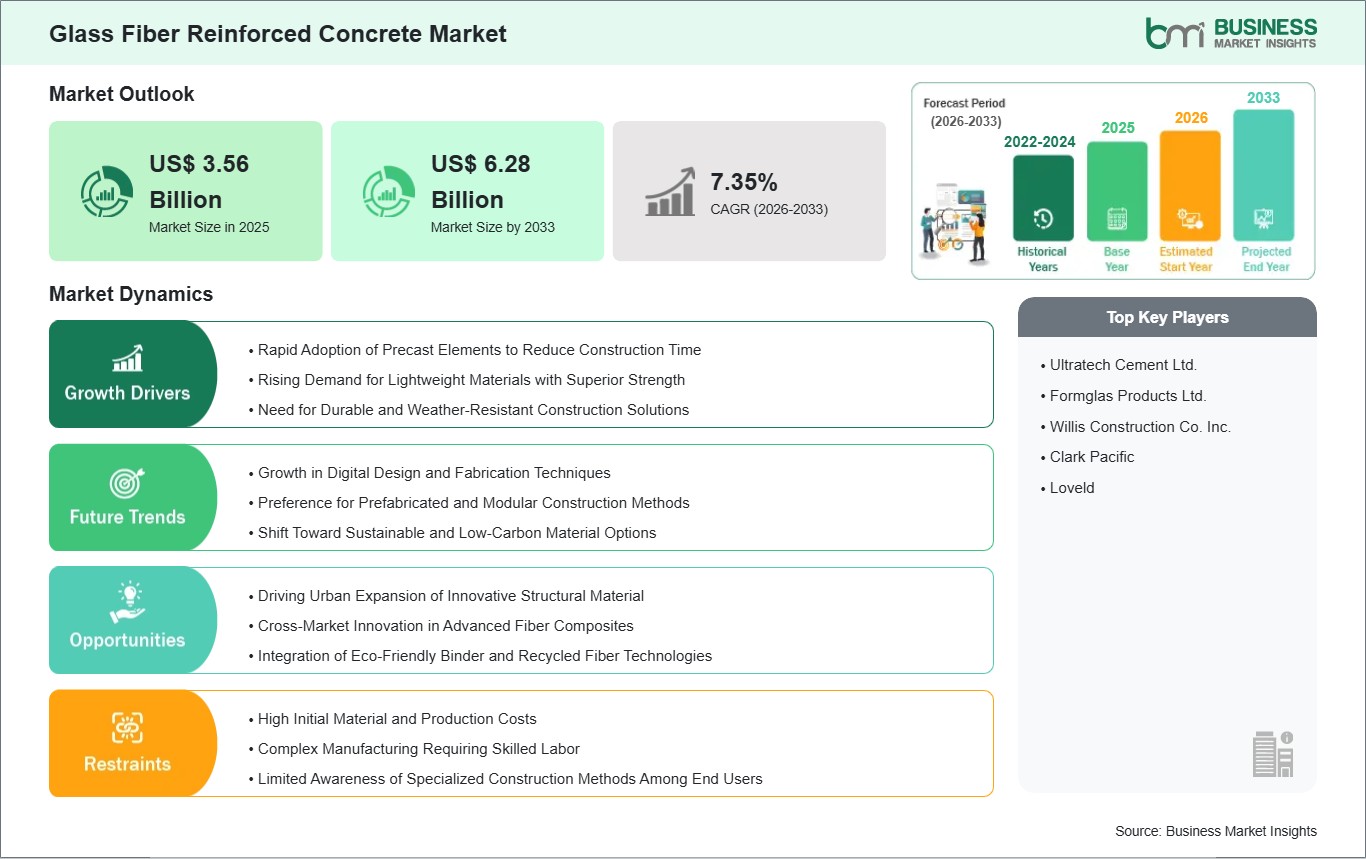
The Glass Fiber Reinforced Concrete Market size is expected to reach US$ 6.28 Billion by 2033 from US$ 3.56 Billion in 2025. The market is estimated to record a CAGR of 7.35% from 2026 to 2033.
The global glass fiber reinforced concrete (GFRC) market is gaining traction as architects and construction professionals increasingly demand materials that combine durability, design flexibility, and lightweight performance. GFRC, composed of a concrete matrix reinforced with alkali-resistant glass fibers, offers superior tensile strength, crack resistance, and long-term durability compared with traditional concrete. Its versatility allows it to be molded into intricate shapes, making it ideal for façade panels, wall cladding, decorative elements, and even structural accents.
As urban development accelerates, particularly in commercial and residential construction, the appeal of materials that can reduce structural loads while providing aesthetic freedom has strengthened GFRC`s position in modern construction. GFRC`s lightweight nature reduces material use and transportation costs while enabling faster installation, aligning with the push for eco-friendly building solutions. The advancement of technology in mixing, spraying, and casting techniques also plays a critical role in improving the quality, uniformity, and flexibility of the product, thus allowing architects to deliver more complex designs. Although there are several challenges associated with GFRC, it is also important to note that, like other building materials, it is also going to grow in terms of significance and usage as all countries’ construction industries are embracing new technologies.

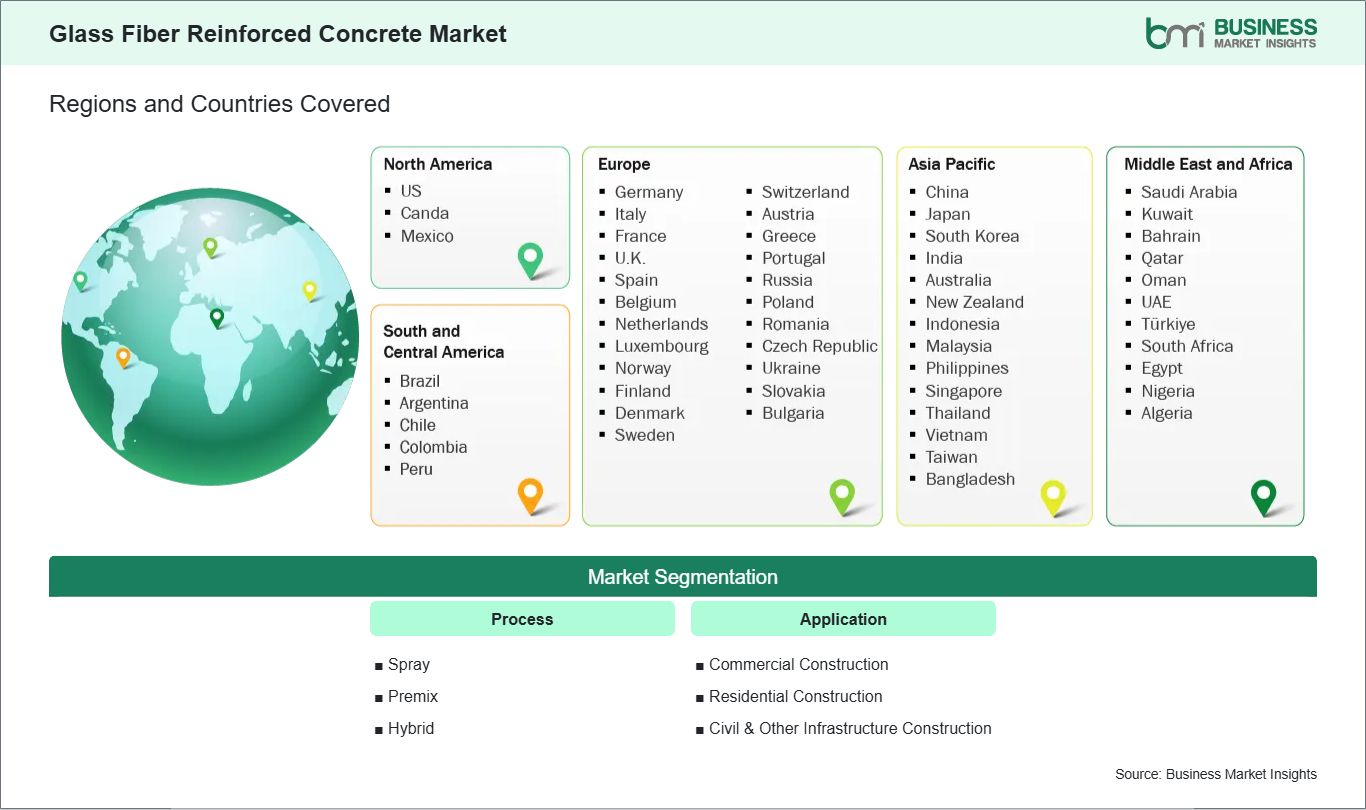
Key segments that contributed to the derivation of the glass fiber reinforced concrete market analysis are process and application.
The adoption of precast glass fiber reinforced concrete (GFRC) elements has accelerated as construction companies seek to reduce project timelines while maintaining quality. Off-site manufacturing of panels, façade components, and structural beams allows construction sites to run multiple tasks simultaneously, significantly shortening the overall schedule. Precast GFRC elements also provide consistent strength and finish quality, helping contractors meet tight deadlines and avoid delays due to weather or site constraints. This efficiency is particularly valuable for large-scale commercial and high-rise residential projects where project schedules are critical.
In addition to time efficiency, precast GFRC offers flexibility in both design and construction. This is due to its light and durable construction, which makes handling easier and reduces the need for heavy machinery. This is particularly important in urban construction situations where machinery is a constraint. This flexibility in construction and design is attracting architects and engineers to precast GFRC. It allows for complex designs on building facades and offers options for curved and textured surfaces. This makes precast GFRC an attractive solution for modern construction projects that require efficiency and aesthetic appeal.
The sustainability of precast GFRC is also an important factor in its adoption. Its manufacture involves less waste and environmental damage compared to traditional methods of construction. This makes precast GFRC an attractive solution for construction projects. As construction projects become increasingly complex and require consideration of speed, sustainability, and aesthetics, precast GFRC is becoming an important solution. It offers an opportunity for fast and efficient construction while meeting sustainability requirements.
Rapid urbanization is increasing demand for innovative construction materials such as GFRC that combine structural strength with design flexibility. Its tensile strength and durability allow for high-rise façades, modular components, and architectural cladding that meet both aesthetic and functional requirements. Developers and urban planners are leveraging GFRC to create visually striking buildings that can withstand the challenges of modern urban environments, including higher load demands and long-term environmental exposure.
This is a major advantage, particularly in urban areas where space is a constraint. This is due to the low weight of the material, which reduces the load on the foundations. This, in turn, enables the construction of higher buildings without compromising safety. GFRC is also advantageous in that it is flexible enough for use in renovation and retrofitting. This has helped in the upgrade of old urban structures without disrupting services. It has become a popular material for mixed-use buildings, which feature GFRC for its design flexibility.
GFRC has also shown potential for use in sustainable urban structures. It has low maintenance needs, is resistant to environmental factors, and has a long lifespan. This has a direct impact on the overall cost of urban structures, which is a major factor in urban planning. GFRC has also shown potential for efficient urban expansion, given its production and installation process. It has become a popular material for urban structures, given its flexibility and potential for the design of efficient urban spaces.

The glass fiber reinforced concrete market is experiencing steady growth, with market size and share analysis reflecting evolving treatment preferences and competitive dynamics among key players. The report evaluates important subsegments categorized within process and application, highlighting their respective contributions to overall market performance.
By process, the spray subsegment dominated the glass fiber reinforced concrete market in 2025. Spray processes enable uniform fiber distribution and faster application, making them highly suitable for large-scale construction projects, which drives their widespread adoption.
Based on application, the commercial construction subsegment dominated the glass fiber reinforced concrete market in 2025. Commercial construction projects demand durable and high-performance materials for structural and architectural applications, making this segment highly suitable for modern building requirements, which drives its widespread adoption.
| Report Attribute | Details |
|---|---|
| Market size in 2025 | US$ 3.56 Billion |
| Market Size by 2033 | US$ 6.28 Billion |
| Global CAGR (2026 - 2033) | 7.35% |
| Historical Data | 2022-2024 |
| Forecast period | 2026-2033 |
| Segments Covered | By Process
|
|
Regions and Countries Covered
| |
| North America | US, Canada, Mexico |
| Europe | Belgium, Austria, Finland, Denmark, Greece, Poland, Romania, Russia, Ukraine, Czech Republic, Slovakia, Bulgaria, Italy, Luxembourg, Germany, Switzerland, France, Netherlands, Norway, Portugal, Spain, Sweden, United Kingdom |
| Asia-Pacific | Australia, China, India, Japan, South Korea, Indonesia, Malaysia, Philippines, Singapore, Thailand, Vietnam, Bangladesh, New Zealand, Taiwan |
| South and Central America | Brazil, Argentina, Peru, Chile, Colombia |
| Middle East and Africa | Bahrain, Kuwait, Oman, Qatar, Saudi Arabia, United Arab Emirates, Turkiye, South Africa, Egypt, Algeria, Nigeria |
| Market leaders and key company profiles |
|
The "Glass Fiber Reinforced Concrete Market Size and Forecast (2022 - 2033)" report provides a detailed analysis of the market covering below areas:
The geographical scope of the Glass Fiber Reinforced Concrete market report is divided into five regions: North America, Asia Pacific, Europe, Middle East & Africa, and South & Central America. The Glass Fiber Reinforced Concrete market in North America is expected to grow during the forecast period.
North America leads the global GFRC market, driven by its mature construction industry, high architectural standards, and strong emphasis on sustainability and innovation. The United States, in particular, has seen widespread adoption of GFRC in commercial buildings, institutional projects, and high-end residential developments. Developers and architects favor GFRC for its combination of strength, lightweight characteristics, and ability to create complex designs that are difficult to achieve with traditional concrete. Façade panels, decorative cladding, and modular architectural elements are among the most common applications in this region, reflecting both aesthetic ambitions and practical construction needs.
Furthermore, the presence of well-established leadership in the region is complemented by the well-established precast concrete industry and the culture of using advanced materials to enhance project schedules and performance. The focus on sustainability by North American builders also makes the case for GFRC, as it offers the advantage of reduced material usage and structural weights. The established supplier network and the ongoing advancement of the production process, including the integration of fibers and finishing, also work in favor of GFRC adoption. Although the cost and technological barriers of GFRC may be seen as drawbacks, the premium focus of the North American construction industry on quality, modularization, and aesthetics makes GFRC a dominant player in the world market.

The glass fiber reinforced concrete market is evaluated by gathering qualitative and quantitative data post primary and secondary research, which includes important corporate publications, association data, and databases. A few of the key developments in the glass fiber reinforced concrete market are:
The Glass Fiber Reinforced Concrete Market is valued at US$ 3.56 Billion in 2025, it is projected to reach US$ 6.28 Billion by 2033.
As per our report Glass Fiber Reinforced Concrete Market, the market size is valued at US$ 3.56 Billion in 2025, projecting it to reach US$ 6.28 Billion by 2033. This translates to a CAGR of approximately 7.35% during the forecast period.
The Glass Fiber Reinforced Concrete Market report typically cover these key segments-
The historic period, base year, and forecast period can vary slightly depending on the specific market research report. However, for the Glass Fiber Reinforced Concrete Market report:
The Glass Fiber Reinforced Concrete Market is populated by several key players, each contributing to its growth and innovation. Some of the major players include:
The Glass Fiber Reinforced Concrete Market report is valuable for diverse stakeholders, including:
Essentially, anyone involved in or considering involvement in the Glass Fiber Reinforced Concrete Market value chain can benefit from the information contained in a comprehensive market report.
Please tell us your area of interest
(Market Segments/ Regions and Countries/ Companies)