Glass & Specialty Synthetic Fiber Market Outlook (2022-2033)

Historic Data: 2022-2024   |   Base Year: 2025   |   Forecast Period: 2026-2033
Report Content: Market Scope, Market Segmentation, Market Dynamics, and Competitive Analysis

Report Coverage:
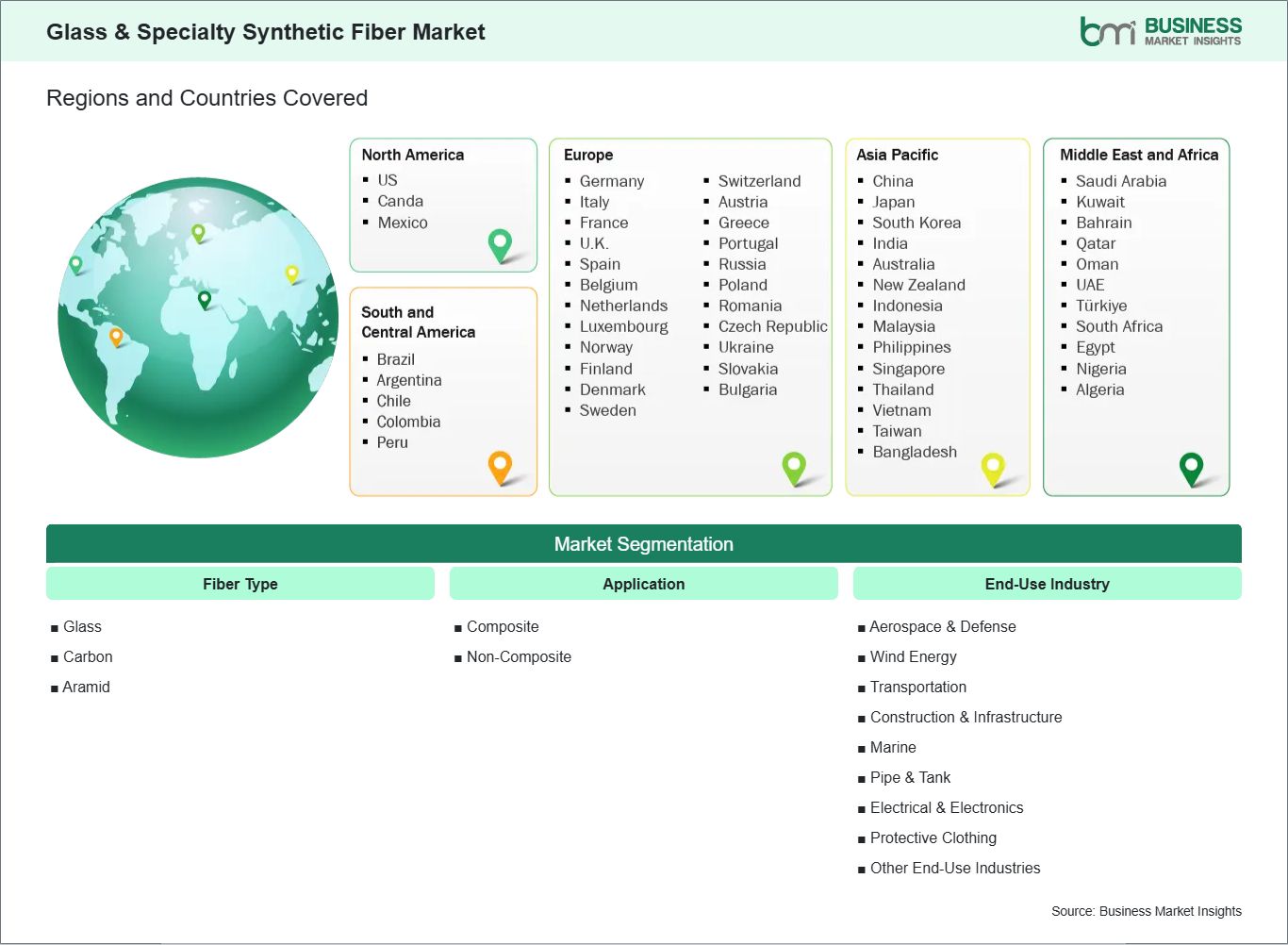
  • Fiber Type (Glass, Carbon, Aramid)
  • Application (Composite, Non-Composite)
  • End-Use Industry (Aerospace & Defense, Wind Energy, Transportation, Construction & Infrastructure, Marine, Pipe & Tank, Electrical & Electronics, Protective Clothing, Other End-Use Industries)

No. of Pages: 386
Report Code: BMIPUB00033956
Category: Chemicals and Materials
Glass & Specialty Synthetic Fiber Market

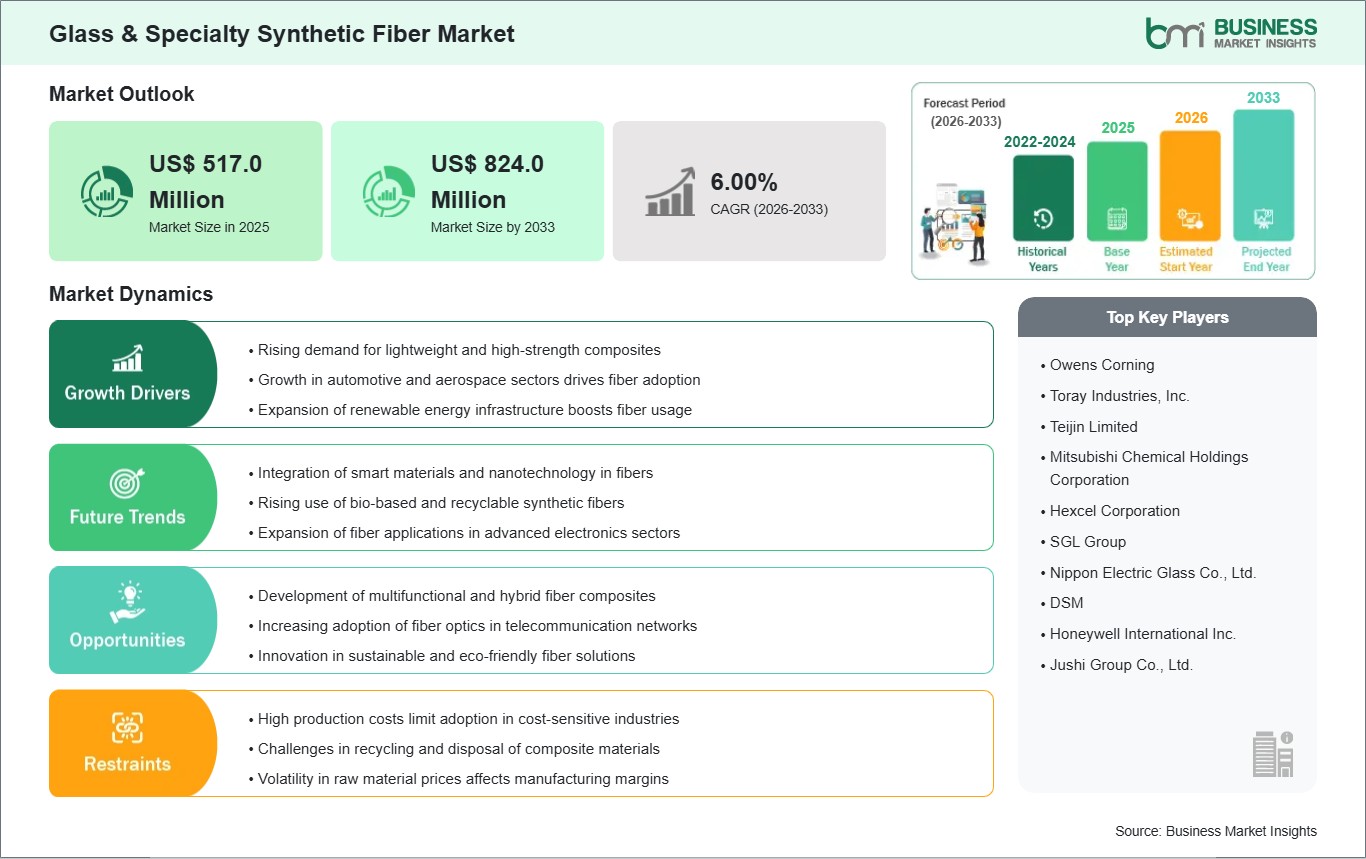
The Glass & Specialty Synthetic Fiber Market size is expected to reach US$ 824.0 Million by 2033 from US$ 517.0 Million in 2025. The market is estimated to record a CAGR of 6.00% from 2026 to 2033.

Executive Summary and Global Market Analysis:

The global glass and specialty synthetic fiber market operates through its multiple application fields and technological advancements, and its changing market needs, which serve different industrial sectors. Glass fibers — including E‑glass, S‑glass, and specialty variants — together with engineered synthetic fibers such as carbon, aramid, and specialty polymer‑based fibers, illustrate a diverse materials ecosystem. Modern engineering solutions require these fiber materials because they meet vital performance standards that demand high tensile strength, low weight, thermal stability, corrosion resistance and dimensional accuracy.

The military sector adopts these products across multiple fields, which include traditional manufacturing, aerospace and defense, automotive and transportation, renewable energy infrastructure, industrial composites, protective textiles, telecommunications, and advanced filtration systems. The market maintains its worldwide growth through this widespread applicability, which drives its permanent business operations. The global market depends on the primary driver, which involves customers who seek lightweight materials with high performance capabilities to create products that improve operational efficiency while achieving sustainable results. Composite structures that use specialty fibers for reinforcement have become standard components in aerospace and defense applications, which require new airframe, fuel structure, and ballistic protection system designs.

As the automotive industry moves towards electrification and lightweight design, the demand for glass and synthetic engineered fibers has increased because these materials help decrease vehicle weight while maintaining structural integrity and enhancing energy efficiency. Renewable energy applications that use wind turbine blades and offshore structures require materials that can handle changing loads while providing extended service life to support market expansion. Current telecommunications technology and high-speed data networks create increased requirements for specialty optical fibers, which serve essential digital infrastructure needs. The global market encounters significant limitations that occur despite high market demand. The production of high-performance fibers requires substantial energy resources, which result in elevated production expenses compared to standard materials.

The industry faces sustainability challenges because of fiber recycling issues, composite materials end-of-life disposal problems and hazardous substance issues that exist in some synthetic fibers, which have led to regulatory examination and industry development of environmentally friendly solutions. The solution requires companies to make financial commitments toward recycling technology development, new material discovery and supply chain improvements. The glass and specialty synthetic fiber market keeps growing because industries choose materials that provide high performance and long-lasting quality, and resource-efficient solutions. The global market will change because of industrial needs and environmental demands through continuous product development and greater focus on environmentally sustainable operations.

Glass & Specialty Synthetic Fiber Market - Strategic Insights:

global-market-strategic-framework
Get more information on this report

Glass & Specialty Synthetic Fiber Market Segmentation Analysis:

Key segments that contributed to the derivation of the glass & specialty synthetic fiber market analysis are fiber type, application and end-use industry.

  • By fiber type, the glass & specialty synthetic fiber market is segmented into glass, carbon, aramid. The glass segment dominated the market in 2025.
  • Based on application, the glass & specialty synthetic fiber market is categorized into composite, non-composite. The composite segment dominated the market in 2025.
  • In terms of end-use industry, the glass & specialty synthetic fiber market is categorized into aerospace & defense, wind energy, transportation, construction & infrastructure, marine, pipe & tank, electrical & electronics, protective clothing, other end-use industries. The aerospace & defense segment dominated the market in 2025.

Glass & Specialty Synthetic Fiber Market Drivers and Opportunities:

Rising demand for lightweight and high-strength composites

The global market for glass and specialty synthetic fibers is growing because multiple industries require materials that are both lightweight and high-strength. The aerospace industry uses fibers as metal replacements to create lighter aircraft structures, which leads to better fuel efficiency, while the automotive industry uses fiber-reinforced composites to improve performance and range in electric and hybrid vehicles. Asia Pacific and North America are leading regions for this adoption, reflecting both industrial growth and technological sophistication.

Construction and infrastructure projects generate demand because fiber composites are used in bridges, facades and industrial panels, which provide durability and corrosion resistance and maintenance cost savings. Wind turbine blades and offshore platforms constitute renewable energy projects that serve as new applications for glass fibers.

Specialty synthetic fibers find increasing use in high-performance electronics, filtration systems and protective equipment because they possess better thermal, chemical and mechanical capabilities. The material has achieved widespread industrial acceptance because glass and specialty synthetic fibers serve as vital components needed for modern engineering projects throughout the world.

Development of multifunctional and hybrid fiber composites

Opportunities in the global market are driven by the development of multifunctional and hybrid fiber composites that combine performance, durability, and functionality. These advanced fibers allow manufacturers to meet increasingly stringent requirements for strength, heat resistance, and flexibility in sectors such as aerospace, automotive, and defense. Hybrid composites, which integrate glass fibers with carbon, aramid, or natural fibers, provide tailored solutions for applications requiring both weight reduction and mechanical reinforcement.

The electronics and telecommunication sectors are also benefiting from multifunctional fibers, as these materials are adapted for fiber-optic cables, heat-resistant insulation, and EMI shielding. Emerging markets, particularly in Asia and Latin America, are investing in such technologies to enhance industrial competitiveness while maintaining cost efficiency.

Moreover, sustainability trends are encouraging the development of bio-based or recyclable hybrid fibers, aligning with global initiatives to reduce carbon footprints and resource usage. This innovation not only opens new markets but also strengthens the strategic positioning of glass and specialty synthetic fibers as adaptable, high-value materials for diverse industrial and technological applications worldwide.

Glass & Specialty Synthetic Fiber Market Size and Share Analysis:

The glass & specialty synthetic fiber market demonstrates steady growth, with size and share analysis highlighting evolving trends and competitive dynamics among key players. The report examines subsegments categorized within fiber type, application and end-use industry, offering insights into their contribution to overall market performance.

By fiber type, the glass subsegment dominated the market in 2025, driven by its low cost, high strength, and widespread industrial applications.

Based on application, the composite subsegment dominated the market in 2025, driven by superior mechanical performance and extensive use in multiple industries.

In terms of end-use industry, the aerospace & defense subsegment dominated the market in 2025, driven by the need for lightweight, high-strength materials for aircraft efficiency..

Glass & Specialty Synthetic Fiber Market Report Highlights:

Report Attribute Details
Market size in 2025 US$ 517.0 Million
Market Size by 2033 US$ 824.0 Million
Global CAGR (2026 - 2033)6.00%
Historical Data 2022-2024
Forecast period 2026-2033
Segments Covered By Fiber Type
  • Glass
  • Carbon
  • Aramid
By Application
  • Composite
  • Non-Composite
By End-Use Industry
  • Aerospace & Defense
  • Wind Energy
  • Transportation
  • Construction & Infrastructure
  • Marine
  • Pipe & Tank
  • Electrical & Electronics
  • Protective Clothing
  • Other End-Use Industries
Regions and Countries Covered
North America US, Canada, Mexico
Europe Belgium, Austria, Finland, Denmark, Greece, Poland, Romania, Russia, Ukraine, Czech Republic, Slovakia, Bulgaria, Italy, Luxembourg, Germany, Switzerland, France, Netherlands, Norway, Portugal, Spain, Sweden, United Kingdom
Asia-Pacific Australia, China, India, Japan, South Korea, Indonesia, Malaysia, Philippines, Singapore, Thailand, Vietnam, Bangladesh, New Zealand, Taiwan
South and Central America Brazil, Argentina, Peru, Chile, Colombia
Middle East and Africa Bahrain, Kuwait, Oman, Qatar, Saudi Arabia, United Arab Emirates, Turkiye, South Africa, Egypt, Algeria, Nigeria
Market leaders and key company profiles
  • Owens Corning
  • Toray Industries, Inc.
  • Teijin Limited
  • Mitsubishi Chemical Holdings Corporation
  • Hexcel Corporation
  • SGL Group
  • Nippon Electric Glass Co., Ltd.
  • DSM
  • Honeywell International Inc.
  • Jushi Group Co., Ltd.
Get more information on this report

Glass & Specialty Synthetic Fiber Market Report Coverage and Deliverables:

The "Glass & Specialty Synthetic Fiber Market Size and Forecast (2022 - 2033)" report provides a detailed analysis of the market covering below areas:

  • Glass & Specialty Synthetic Fiber Market size and forecast at global, regional, and country levels for all the key market segments covered under the scope
  • Glass & Specialty Synthetic Fiber Market trends, as well as drivers, restraints, and opportunities
  • Glass & Specialty Synthetic Fiber Market analysis covering key trends, global and regional framework, major players, regulations, and recent developments
  • Industry landscape and competition analysis covering market concentration, heat map analysis, prominent players, and recent developments for the Glass & Specialty Synthetic Fiber Market
  • Detailed company profiles, including SWOT analysis

Glass & Specialty Synthetic Fiber Market Geographic Insights:

The geographical scope of the Glass & Specialty Synthetic Fiber Market report is divided into North America, Asia Pacific, Europe, Middle East & Africa, and South & Central America. North America held the largest share in 2025.

North America maintains its leadership position in the global glass and specialty synthetic fiber market because of its well-developed industrial base technological edge and high demand from the aerospace and defense, automotive and renewable energy industries. The United States, in particular, leads the region due to its innovation-centric manufacturing environment and early adoption of advanced composite materials, while Canada supports growth through infrastructure projects and energy-related applications. The region excels at developing high-performance fibers that possess improved mechanical properties, thermal resistance and chemical resistance together with multifunctional composites used in essential structural and telecommunications functions.

The market in the Asia Pacific displays rapid growth because the automotive and construction sectors expand, urban areas develop and industrial output increases in China, Japan and India. The region requires manufacturers to create fiber-reinforced materials that enhance fuel efficiency and decrease structural weight, and enable large-scale infrastructure and renewable energy initiatives while they work on producing cost-effective products to fulfill local needs.

Europe functions as a developed market that prioritizes environmentally sustainable fiber materials because of strict regulations and growing usage in automotive, wind energy and industrial applications, which require high performance. The region advances through the development of advanced composite applications and its continuous investment in fiber innovation, which includes bio-based and recyclable fiber alternatives.

The Middle East and Africa market experiences growth through infrastructure development and construction activities and oil and gas initiatives, which use glass and specialty synthetic fibers for their corrosion-resistant and high-durability properties, while governments implement modernization efforts and industrial diversification strategies.

The South and Central American market develops through multiple construction, automotive and renewable energy initiatives which operate across Brazil, Mexico and Argentina. The region needs to increase its manufacturing capacity through local fiber-reinforced composite production because industrialization and urbanization needs are growing.

The North American market maintains its lead through advanced technology and multiple application options, while each geographic area develops distinct market patterns, which result from industrial development, regulatory conditions and infrastructure progress and particular industry adoption patterns that work together to expand the global market for glass and specialty synthetic fibers.

global-market-geography
Get more information on this report

Glass & Specialty Synthetic Fiber Market Research Report Guidance:

  • The report includes qualitative and quantitative data in the Glass & Specialty Synthetic Fiber Market across fiber type, application, end-use industry and geography.
  • The report starts with the key takeaways (chapter 2), highlighting key trends and outlook of the Glass & Specialty Synthetic Fiber Market.
  • Chapter 3 focuses on the research methodology of the study.
  • Chapter 4 includes ecosystem analysis.
  • Chapter 5 highlights the major industry dynamics in the Glass & Specialty Synthetic Fiber Market, including factors that are driving the market, prevailing deterrents, potential opportunities, as well as future trends. Impact analysis of these drivers and restraints is also covered in this section.
  • Chapter 6 discusses the Glass & Specialty Synthetic Fiber Market scenario, in terms of historical market revenues, and forecast till the year 2033.
  • Chapters 7 to 10 cover Glass & Specialty Synthetic Fiber Market segments by fiber type, application, end-use industry and geography across North America, Asia Pacific, Europe, Middle East & Africa, and South & Central America. They cover the market revenue forecast and factors driving the market.
  • Chapter 11 describes the competitive analysis along with the heat map analysis for the key players operating in the market.
  • Chapter 12 describes the industry landscape analysis. It provides detailed descriptions of business activities such as market initiatives, new developments, mergers, and joint ventures globally, along with a competitive landscape.
  • Chapter 13 provides detailed profiles of the major companies operating in the Glass & Specialty Synthetic Fiber Market. Companies have been profiled on the basis of their key facts, business descriptions, products, financial overview, SWOT analysis, and key developments.
  • Chapter 14, i.e., the appendix, is inclusive of a brief overview of the company, a list of abbreviations, and a disclaimer.

Glass & Specialty Synthetic Fiber Market News and Key Development:

The Glass & Specialty Synthetic Fiber Market is evaluated by gathering qualitative and quantitative data post primary and secondary research, which includes important corporate publications, association data, and databases. A few of the key developments in the glass & specialty synthetic fiber market are:

  • In February 2025, China Jushi Co., Ltd announced the launch of construction for the second phase of its Huai’an carbon‑neutral intelligent manufacturing base, featuring a large new electronic glass fiber production line. This development underscores Jushi’s strategy to expand advanced glass fiber manufacturing with digital and green production capabilities aimed at enhancing performance, competitiveness, and carbon neutrality.
  • In March 2025, Corning Incorporated announced that it would showcase new AI‑focused fiber and cable solutions at the 2025 Optical Fiber Communication Conference and Exposition, highlighting innovations in high‑density optical fiber and connectivity products to support generative AI network growth. This development demonstrates Corning’s strategic focus on next‑generation optical fiber technologies tailored to data center and network demands.

Key Sources Referred:

  • World Health Organization (WHO)
  • Organisation for Economic Cooperation and Development (OECD)
  • The World Bank Group
  • Worldometer
  • The Lancet
  • International Bar Association
  • International Trade Administration
The List of Companies - Glass & Specialty Synthetic Fiber Market
  • Owens Corning
  • Toray Industries, Inc.
  • Teijin Limited
  • Mitsubishi Chemical Holdings Corporation
  • Hexcel Corporation
  • SGL Group
  • Nippon Electric Glass Co., Ltd.
  • DSM
  • Honeywell International Inc.
  • Jushi Group Co., Ltd.
Frequently Asked Questions
How big is the Glass & Specialty Synthetic Fiber Market?

The Glass & Specialty Synthetic Fiber Market is valued at US$ 517.0 Million in 2025, it is projected to reach US$ 824.0 Million by 2033.

What is the CAGR for Glass & Specialty Synthetic Fiber Market by (2026 - 2033)?

As per our report Glass & Specialty Synthetic Fiber Market, the market size is valued at US$ 517.0 Million in 2025, projecting it to reach US$ 824.0 Million by 2033. This translates to a CAGR of approximately 6.00% during the forecast period.

What segments are covered in this report?

The Glass & Specialty Synthetic Fiber Market report typically cover these key segments-

  • Fiber Type (Glass, Carbon, Aramid)
  • Application (Composite, Non-Composite)
  • End-Use Industry (Aerospace & Defense, Wind Energy, Transportation, Construction & Infrastructure, Marine, Pipe & Tank, Electrical & Electronics, Protective Clothing, Other End-Use Industries)

What is the historic period, base year, and forecast period taken for Glass & Specialty Synthetic Fiber Market?

The historic period, base year, and forecast period can vary slightly depending on the specific market research report. However, for the Glass & Specialty Synthetic Fiber Market report:

  • Historic Period : 2022-2024
  • Base Year : 2025
  • Forecast Period : 2026-2033
  • Who are the major players in Glass & Specialty Synthetic Fiber Market?

    The Glass & Specialty Synthetic Fiber Market is populated by several key players, each contributing to its growth and innovation. Some of the major players include:

  • Owens Corning
  • Toray Industries, Inc.
  • Teijin Limited
  • Mitsubishi Chemical Holdings Corporation
  • Hexcel Corporation
  • SGL Group
  • Nippon Electric Glass Co., Ltd.
  • DSM
  • Honeywell International Inc.
  • Jushi Group Co., Ltd.
  • Who should buy this report?

    The Glass & Specialty Synthetic Fiber Market report is valuable for diverse stakeholders, including:

    • Investors: Provides insights for investment decisions pertaining to market growth, companies, or industry insights. Helps assess market attractiveness and potential returns.
    • Industry Players: Offers competitive intelligence, market sizing, and trend analysis to inform strategic planning, product development, and sales strategies.
    • Suppliers and Manufacturers: Helps understand market demand for components, materials, and services related to concerned industry.
    • Researchers and Consultants: Provides data and analysis for academic research, consulting projects, and market studies.
    • Financial Institutions: Helps assess risks and opportunities associated with financing or investing in the concerned market.

    Essentially, anyone involved in or considering involvement in the Glass & Specialty Synthetic Fiber Market value chain can benefit from the information contained in a comprehensive market report.

    Available Report Formats

    pdf-format excel-format pptx-format
    Buy Now
    Sales Assistance
    +1 646 791 7070 (US & UK)
    Customization Form

    Please tell us your area of interest
    (Market Segments/ Regions and Countries/ Companies)