
French Fries Market Outlook: Size, Share, Trends, Growth Analysis, Competitive Landscape & Forecast, 2026–2033

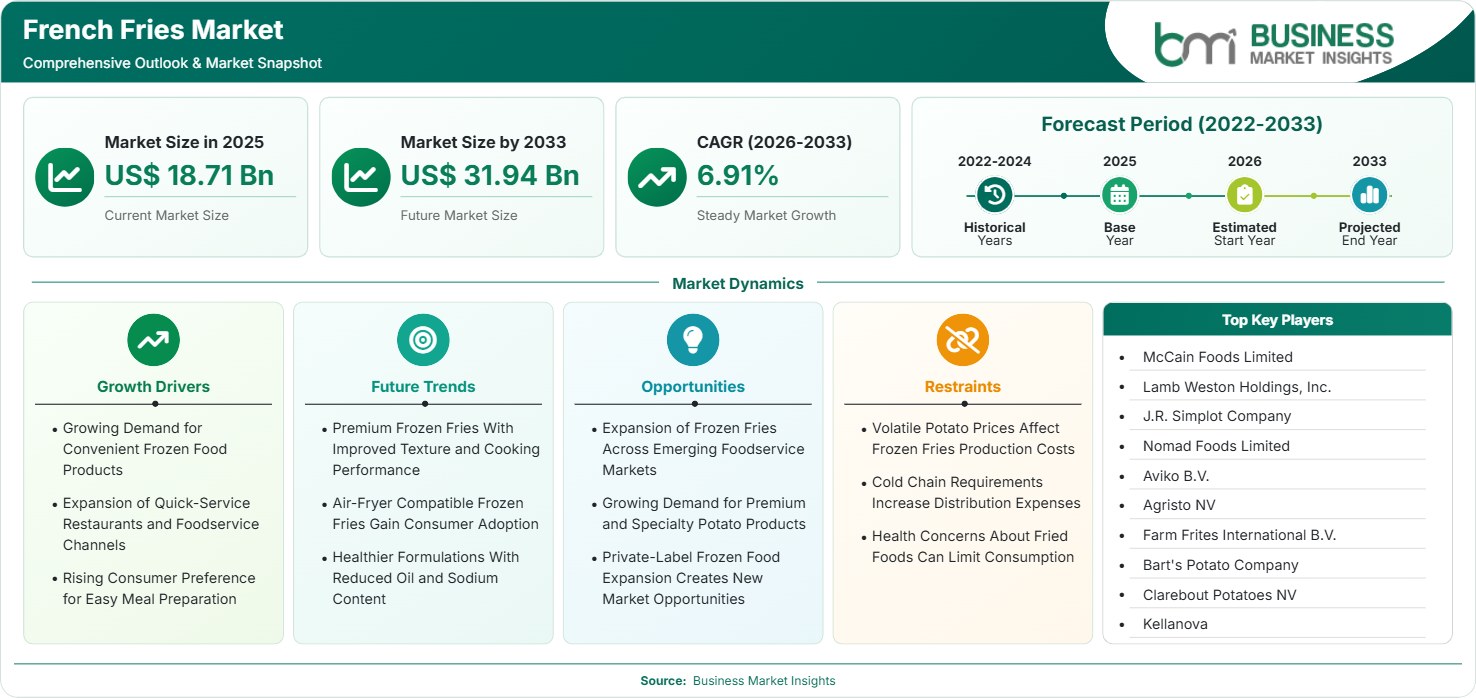
The French Fries Market size was valued at US$ 18.71 Billion in 2025 and is projected to reach US$ 31.94 Billion by 2033, growing at a CAGR of 6.91% during 2026–2033, driven by convenience food demand, expanding foodservice networks, premiumization, private-label growth, and wider frozen-food distribution.

Report Coverage
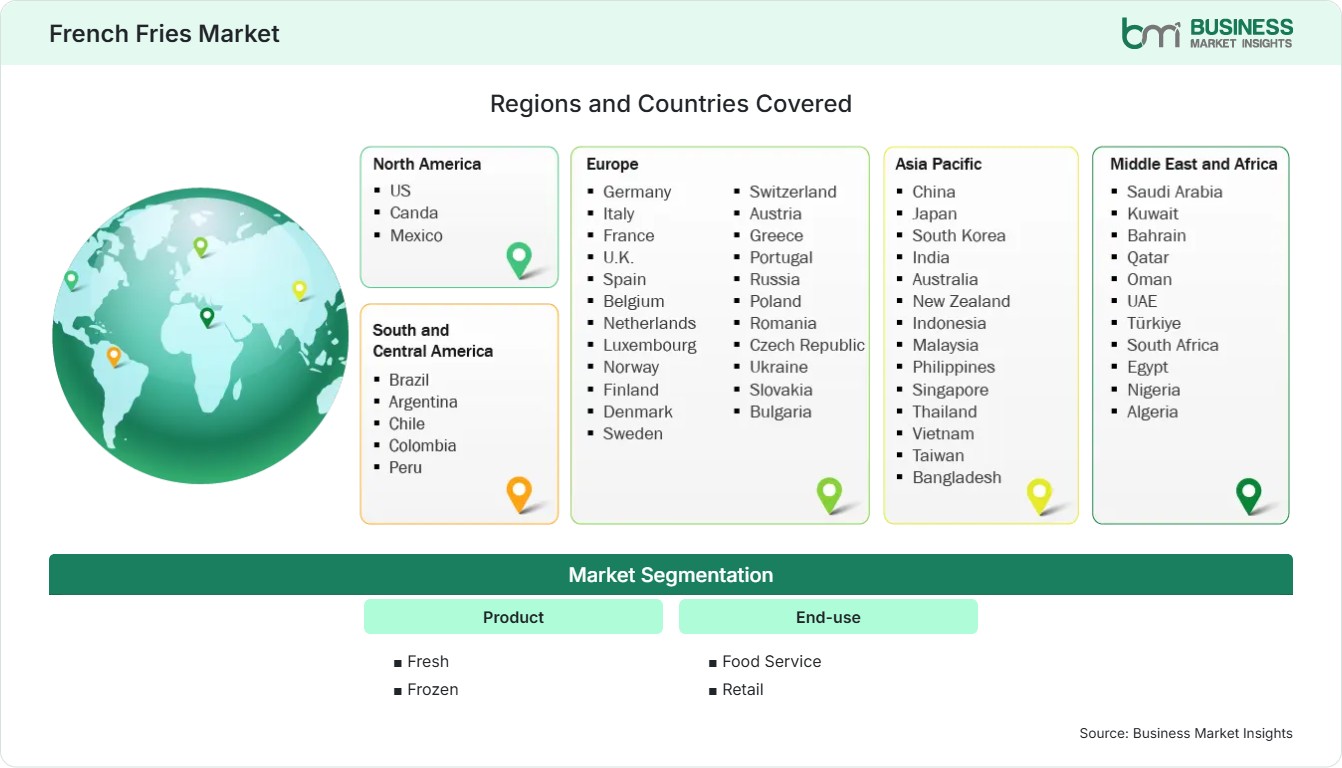
  • Product: Fresh, Frozen
  • End-use: Food Service, Retail
US$ 18.71 Bn Market size in 2025
US$ 31.94 Bn Market Size by 2033
6.91% CAGR, 2026 - 2033
2026-2033 Forecast Period

AI Overview

French Fries Market Summary

  • North America Region: North America holds a 29%–33% share in 2025 and grows at a 6.2%–6.9% CAGR during 2026–2033, supported by established quick-service restaurants, convenient meal preferences, and product innovation across foodservice and household channels. The US remains the region’s largest market, supported by restaurant chains, retail frozen foods, private-label products, and established cold-chain infrastructure, with a 6.3%–7.0% CAGR during 2026–2033.
  • Fastest Growing Region: Asia Pacific holds a 22%–26% share in 2025 and grows at a 7.8%–8.6% CAGR during 2026–2033, supported by urbanization, expanding quick-service restaurants, modern retail development, changing food preferences, rising disposable incomes, and increasing availability of frozen potato products.
  • Leading Segment: Frozen holds a 72%–76% share in 2025 and grows at a 7.0%–7.7% CAGR during 2026–2033, supported by longer shelf life, standardized preparation, foodservice convenience, retail availability, consistent quality, and growing household adoption of frozen convenience foods.
  • High Growth Segment: Food Service holds a 61%–65% share in 2025 and grows at a 7.2%–7.9% CAGR during 2026–2033, supported by quick-service restaurants, casual dining, delivery formats, institutional catering, standardized preparation, and rising demand for ready-to-cook side dishes.
  • Key Market Opportunity: Premium fries, specialty cuts, seasoned products, private-label ranges, emerging foodservice markets, and improved frozen distribution provide manufacturers with opportunities to broaden product portfolios and strengthen customer relationships.
  • Major Market Players: McCain Foods Limited, Lamb Weston Holdings, Inc., J.R. Simplot Company, Nomad Foods Limited, Aviko B.V., Agristo NV, Farm Frites International B.V., Bart's Potato Company, Clarebout Potatoes NV, Kellanova.
Strategic Insights

French Fries Market: Strategic Insights

French Fries Market Strategic Framework
FREE PDF
Request your free sample
Request free sample
Stakeholder View

Key Takeaways

  • The industry relies on a synchronized value chain that includes potato farming, seed varieties, processing, freezing, packing, refrigerated storage, shipping, food service distribution, retail sales, and final preparation. Thus, reliability of supply is important for gaining competitive advantage.
  • Frozen items present the greatest commercial potential since restaurants and retailers appreciate consistency, portion control, increased shelf life, and reduced preparation efforts.
  • Product development is moving beyond conventional cuts toward seasoned, coated, crispier, air-fryer-friendly, and differentiated formats. Processing technology is increasingly focused on texture retention, cooking consistency, and reduced preparation complexity.
  • Asia Pacific provides an attractive expansion opportunity as foodservice networks, modern grocery channels, and frozen-food distribution develop. Localized products and partnerships with restaurant operators can support faster market penetration.
  • Procurement and processing investments remain strategically important because potato quality directly affects yield, appearance, texture, and processing performance. Strong grower relationships can provide an advantage during raw material supply fluctuations.
  • Private-label expansion is creating additional competition across retail channels. Producers that combine efficient manufacturing, and dependable cold-chain distribution can capture retailer relationships while defending margins.
Geographic Outlook

French Fries Market Regional Highlights

North America French Fries Market

North America holds a 29%–33% share in 2025 and grows at a 6.2%–6.9% CAGR through 2033. The US represents the largest regional demand base, supported by quick-service restaurants, frozen retail products, foodservice distributors, and established cold-chain infrastructure. Canada also contributes through foodservice and retail consumption. The French Fries Market share reflects a mature consumption environment where product innovation and premiumization complement established demand.

  • Quick-service restaurants remain major purchasers because fries provide standardized preparation, predictable portioning, and broad consumer acceptance across different menu formats and price points.
  • Frozen retail products benefit from household demand for convenient side dishes, particularly where consumers prefer products requiring limited preparation and offering dependable cooking results.
  • Premiumization is creating space for thicker cuts, specialty varieties, seasoned products, and differentiated textures that allow operators and retailers to move beyond conventional offerings.

US French Fries Market

The US accounts for 83%–87% of North American demand in 2025 and grows at a 6.3%–7.0% CAGR through 2033. Demand is supported by quick-service restaurants, foodservice distributors, retail frozen-food channels, and household consumption. The Market growth is increasingly influenced by product differentiation, restaurant menu development, premium frozen offerings, and private-label programs.

  • Restaurant operators continue to favor frozen fries because standardized products simplify preparation, reduce labor requirements, and maintain consistent serving quality across multiple locations.
  • Retail demand supports manufacturers offering different cuts, pack sizes, seasoning profiles, and preparation formats designed for conventional ovens, air fryers, and other household equipment.
  • Foodservice suppliers increasingly emphasize dependable delivery and product consistency as restaurant operators seek to control kitchen complexity and maintain standardized menu execution.

Europe French Fries Market

Europe holds a 25%–29% share in 2025 and grows at a 5.9%–6.7% CAGR through 2033. Belgium, the Netherlands, Germany, France, and the United Kingdom are leading markets, while Poland and selected Eastern European markets provide higher growth potential. The French Fries Market share is supported by established potato-processing capabilities, strong foodservice demand, and extensive frozen distribution.

  • Belgium and the Netherlands remain important processing centers, supported by established potato cultivation, processing expertise, export infrastructure, and strong relationships with international foodservice customers.
  • Germany and France provide substantial demand through retail, restaurants, institutional foodservice, and processed-food distribution, with manufacturers emphasizing product quality and operational efficiency.
  • The United Kingdom maintains strong foodservice demand, while retailers provide additional opportunities for branded, specialty, and private-label frozen potato products.
  • Poland and other Eastern European markets provide growth opportunities as modern retail and organized foodservice expand and frozen convenience foods become more accessible.

Asia Pacific French Fries Market

Asia Pacific holds a 22%–26% share in 2025 and grows at a 7.8%–8.6% CAGR through 2033, making it the fastest-growing region. China, Japan, Australia, South Korea, and India are leading markets, while India and Southeast Asia provide stronger expansion opportunities. The French Fries Market growth is supported by restaurant expansion, urbanization, modern retail, food delivery, changing eating habits, and increasing availability of frozen products.

  • China offers broad foodservice and retail opportunities as restaurant networks expand and consumers gain greater access to processed and frozen potato products.
  • India provides strong potential through quick-service restaurant expansion, organized retail development, urban consumption, and greater acceptance of international-style convenience foods.
  • Japan, South Korea, and Australia have mature foodservice and retail channels where premium formats, specialty cuts, and differentiated potato products can support value growth.
  • Southeast Asia offers opportunities as restaurant chains, food delivery platforms, hotels, and modern grocery retailers expand frozen-food distribution and require dependable foodservice products.

Rest of World French Fries Market

Rest of World holds a 14%–18% share in 2025 and grows at a 6.5%–7.4% CAGR through 2033. South and Central America are led by Brazil, Mexico, Argentina, Chile, and Colombia, with Brazil and Mexico providing stronger growth opportunities. Foodservice development, retail modernization, and urban consumption support demand. The French Fries Market share is also influenced by local potato supply, import requirements, processing capacity, and availability of reliable cold-chain distribution. The Middle East and Africa provide additional opportunities through restaurant development, hospitality, retail modernization, and expanding foodservice networks. Saudi Arabia, the UAE, South Africa, and Türkiye are leading markets, while Gulf countries provide attractive opportunities for imported and locally distributed frozen products.

  • Brazil and Mexico provide foodservice opportunities as restaurant networks, modern retail, and processed-food consumption expand across major urban markets.
  • Gulf markets support demand through hotels, restaurants, catering operators, and modern retail channels that rely heavily on imported or regionally distributed frozen potato products.
  • South Africa provides opportunities across organized retail and foodservice, with local processors and distributors supporting broader access to frozen potato products.
  • Latin American markets offer scope for regional processing and private-label development as retailers and restaurant operators seek dependable alternatives to imported products.
Global Market Geography
FREE PDF
Request your free sample
Request free sample
Segment Analysis

French Fries Market Segmentation

Product

Frozen holds a 72%–76% share in 2025 and grows at a 7.0%–7.7% CAGR through 2033, supported by longer shelf life, consistent preparation, foodservice convenience, and retail availability. Fresh products continue serving foodservice and retail needs where local preparation, texture, and supply conditions favor shorter distribution cycles. The Market scope remains centered on frozen products due to their operational advantages.

  • Fresh: Fresh fries provide shorter supply cycles and preparation flexibility, serving restaurants and retailers that prioritize locally processed products, fresh texture, and direct potato-to-consumer positioning.
  • Frozen: Frozen fries offer consistent quality, extended storage, simplified preparation, and reliable portion control, making them suitable for restaurants, retailers, institutional kitchens, and household consumption.

End-use

Food Service holds a 61%–65% share in 2025 and grows at a 7.2%–7.9% CAGR through 2033, supported by quick-service restaurants, casual dining, hotels, catering, delivery-oriented kitchens, and institutional foodservice. Retail remains important as frozen-food penetration expands and consumers seek convenient home-preparation options. The French Fries Market trends increasingly favor foodservice products designed for speed, consistency, and reliable cooking performance.

  • Food Service: Restaurants and catering operators use fries because they simplify preparation, support consistent portions, complement diverse menus, and reduce kitchen preparation requirements.
  • Retail: Retail channels provide household access to frozen and fresh fries through supermarkets, convenience stores, specialty retailers, and online grocery platforms offering varied pack formats.
Market Forces

French Fries Market Dynamics

Key Market Drivers

Growing Demand for Convenient Frozen Food Products

Convenience continues to be an important demand driver as consumers and food service operations continue to look for products that save on preparation time while keeping predictability. Preparation steps will be minimized in restaurants, and households will be able to store the product to use at another time without handling fresh potatoes. Manufacturers are designing products for various cooking methods and consumption instances. French Fries Market trends are increasingly favouring products that provide convenience together with texture improvement.

Expansion of Quick-Service Restaurants and Foodservice Channels

Quick-service restaurants remain an important demand channel because fries are easy to portion, prepare, pair with multiple menu items, and standardize across restaurant locations. Expansion of organized foodservice increases the number of outlets requiring consistent frozen potato products, while delivery-oriented formats place greater emphasis on maintaining texture after cooking and transportation. Suppliers are therefore developing products suited to restaurant-specific cooking systems and holding conditions. The French Fries Market growth is also supported by menu diversification as operators use different cuts, seasonings, and specialty formats to create product differentiation.

Rising Consumer Preference for Easy Meal Preparation

Consumers have become more interested in products that will make cooking easier without the need to have cooking knowledge or equipment. French fries meet these criteria as they can either be prepared frozen and stored in advance or can be prepared fresh depending on the consumer’s choice. The air fryer and other countertop cookers have also affected the production of French fries as there is a need to develop fries that can give a perfect texture using an alternative way of preparation.

Key Market Opportunities

Expansion of Frozen Fries Across Emerging Foodservice Markets

Emerging foodservice markets offer an opportunity for frozen fries as restaurant chains, hotels, catering services, and organized dining concepts grow. In such markets, the use of frozen foods will enable operators to maintain consistency of preparation and minimize labor input through preparation of potatoes. This will be especially important in places where there is improvement in the cold chain system and where food service companies have become systematic in their procurement process. The French Fries Market Forecasts increasingly point toward opportunities where foodservice modernization and frozen-food distribution develop together.

Growing Demand for Premium and Specialty Potato Products

Premiumization creates opportunities beyond conventional straight-cut fries as restaurants and retailers seek products that support menu differentiation. Specialty cuts, seasoned products, thicker formats, coated fries, and products designed for specific preparation methods can command greater attention from operators seeking distinctive menu offerings. Premium products also allow manufacturers to focus on performance characteristics such as crispness, holding time, appearance, and texture. The opportunity extends to retail, where differentiated packaging and product positioning can help brands compete in crowded frozen-food categories.

Private-Label Frozen Food Expansion Creates New Market Opportunities

Retailers are expanding private-label frozen food programs to strengthen assortment control and offer competitive alternatives to branded products. This creates opportunities for processors capable of producing consistent quality under retailer-specific packaging, specifications, and pricing requirements. Private-label contracts can also support manufacturing utilization by providing stable customer relationships and predictable production requirements. Suppliers with flexible lines can accommodate different pack sizes, product specifications, and regional preferences without developing entirely separate production systems.

Market Restraints and Challenges

Volatile Potato Prices Affect Frozen Fries Production Costs

Factor: Potato prices can fluctuate because of weather conditions, crop yields, planting decisions, input costs, transportation conditions, and regional supply availability. Impact: Higher raw material costs can reduce processor margins or require price adjustments that affect restaurant and retail purchasing decisions. Processors therefore need strong agricultural sourcing relationships, crop planning, quality monitoring, and procurement strategies.

Cold Chain Requirements Increase Distribution Expenses

Factor: The storage and transportation of frozen fries need controlled temperatures in all phases of processing, storage, distribution, and retailing. Impact: The dependency on cold chain raises issues regarding logistics complexity, high energy consumption, storage costs, and investment in distribution channels. Emerging markets could face additional challenges due to fragmented distribution networks, limited refrigerated storage or higher energy costs.

Company Analysis

Competitive Landscape

The French Fries Market analysis reflects competition between large global potato processors, diversified food companies, regional specialists, and private-label suppliers. Competitive positioning depends on potato sourcing, processing scale, product consistency, foodservice relationships, retail reach, cold-chain capability, innovation, and the ability to customize products for different customers and markets.

Company Name

Overview

Products and Services relevant to this market

McCain Foods Limited

Global frozen potato processor with extensive foodservice and retail relationships and a broad potato-product portfolio.

Frozen French fries, specialty potato products, foodservice solutions, retail products, coated formats, and customized potato offerings.

Lamb Weston Holdings, Inc.

Major global producer focused on frozen potato products for restaurant, foodservice, and retail customers.

French fries, specialty fries, potato specialties, foodservice products, retail offerings, coatings, and customized solutions.

J.R. Simplot Company

Diversified agribusiness with established potato processing and foodservice operations across major markets.

Frozen French fries, potato specialties, foodservice products, prepared foods, and customized restaurant solutions.

Nomad Foods Limited

European frozen-food company with established retail brands and broad frozen category expertise.

Frozen potato products, branded frozen foods, retail products, and convenient meal solutions across European markets.

Aviko B.V.

European potato processor serving foodservice and retail customers with a broad range of processed potato products.

French fries, specialty fries, potato specialties, snacks, foodservice products, and retail frozen potato ranges.

Agristo NV

Potato processor specializing in frozen fries and related potato products for international foodservice and retail customers.

French fries, specialty cuts, potato specialties, coated products, private-label solutions, and foodservice ranges.

Farm Frites International B.V.

Global potato processor supplying frozen fries and potato specialties to foodservice and retail channels.

French fries, specialty fries, coated products, potato specialties, foodservice solutions, and retail offerings.

Bart's Potato Company

Potato processor serving professional customers with fresh and processed potato products.

Fresh and processed fries, potato products, foodservice solutions, and customized potato processing.

Clarebout Potatoes NV

European potato processor focused on frozen fries and specialty potato products for international customers.

Frozen French fries, specialty cuts, potato products, foodservice solutions, and private-label production.

Kellanova

Global food company with established packaged-food expertise and broad consumer distribution capabilities.

Packaged food products, snack and convenience categories, branded consumer products, and distribution capabilities relevant to retail channels.

Trust & Transparency

Research Methodology

The market analysis combines proprietary research with secondary data from government agencies, company disclosures, regulatory filings, industry databases and expert interviews. Market estimates are validated through data triangulation, cross-market benchmarking and analyst review.

View Full Research Methodology

Questions Answered

Frequently Asked Questions

How can producers improve competitiveness in emerging French Fries Market reports?

Producers can combine localized products, reliable cold-chain partnerships, regional sourcing, flexible packaging, foodservice relationships, and efficient distribution. These capabilities reduce supply limitations while allowing products to match local consumption and menu preferences.

What role does product customization play in the foodservice channel?

Customization allows processors to adjust cut, coating, seasoning, packaging, cooking performance, and portion specifications for individual restaurant and distributor requirements. This can improve customer retention and reduce direct price-based competition.

Why is potato variety selection important for French fries?

Potato variety affects dry matter, moisture, color, texture, oil absorption, processing yield, and finished-product appearance. Processors therefore select varieties according to processing characteristics rather than relying solely on general potato availability.

How does private-label production affect manufacturers?

Private-label contracts provide processors with access to retailer volumes and long-term relationships, but they also place greater pressure on production efficiency, product consistency, packaging flexibility, and cost management.

What product characteristics are becoming more important for foodservice customers?

Foodservice customers increasingly prioritize consistent cooking performance, crispness retention, portion consistency, dependable supply, and formats that fit existing kitchen equipment. These characteristics can reduce preparation complexity and support standardized menu execution.

Access the Full French Fries Market Report

Get segment-level forecasts, regional estimates, competitive benchmarking, company profiles and downloadable Excel datasets.

Access the full French Fries Market Report
350 pages PDF & Excel | 2026-08-19