
Forage Seed Market Outlook: Size, Share, Trends, Growth Analysis, Competitive Landscape & Forecast, 2026-2033

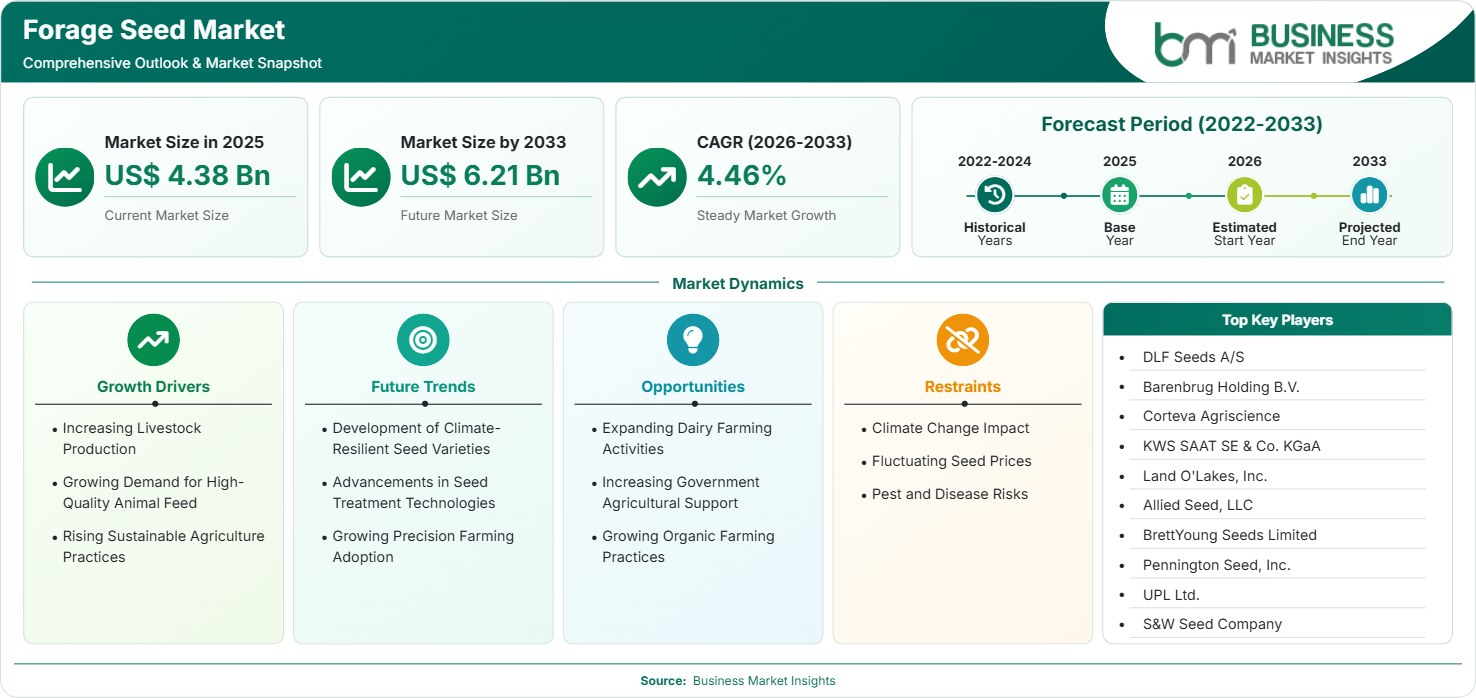
The Forage Seed Market size was valued at US$ 4.38 Billion in 2025 and is projected to reach US$ 6.21 Billion by 2033, growing at a CAGR of 4.46% during 2026–2033. Rising livestock production, demand for nutrient-rich animal feed, sustainable pasture management, improved seed genetics, and government-backed agricultural initiatives continue creating long-term growth opportunities.

Report Coverage
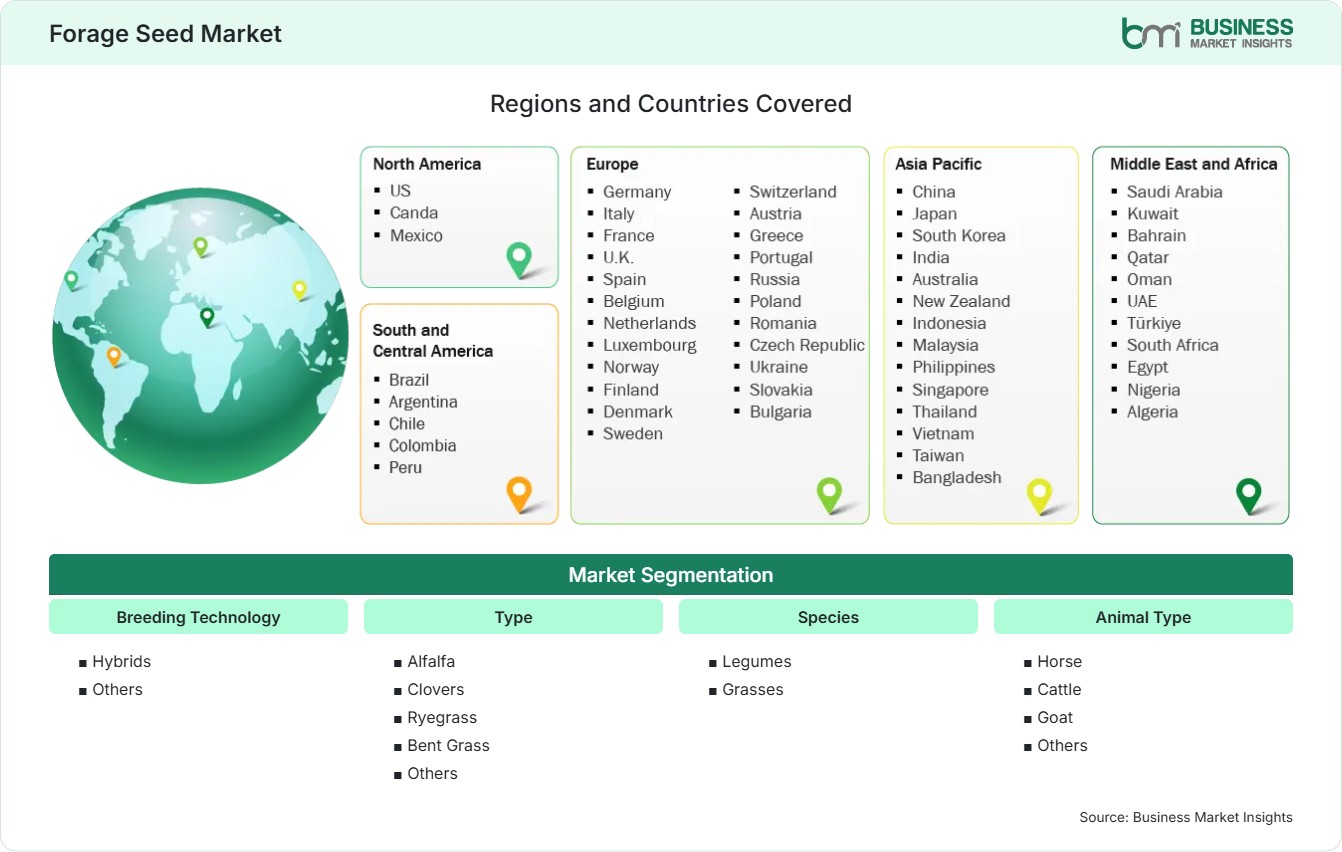
  • Breeding Technology: Hybrids, Others
  • Type: Alfalfa, Clovers, Ryegrass, Bent Grass, Others
  • Species: Legumes, Grasses
  • Animal Type: Horse, Cattle, Goat, Others
US$ 4.38 Bn Market size in 2025
US$ 6.21 Bn Market Size by 2033
4.46% CAGR, 2026 - 2033
2026-2033 Forecast Period

AI Overview

Forage Seed Market Summary

  • North America Region: North America holds a 34%–37% share in 2025 and is projected to expand at a 4.1%–4.4% CAGR during 2026–2033. Strong livestock farming, precision agriculture, certified seed adoption, and pasture improvement initiatives continue supporting commercial cultivation and long-term investments. The U.S. benefits from advanced forage breeding programs, expanding dairy operations, and an estimated 4.2%–4.5% CAGR through 2033.
  • Fastest Growing Region: Asia Pacific accounts for 24%–27% of revenue in 2025 and is forecast to register a 5.2%–5.6% CAGR through 2033. Expanding dairy industries, increasing meat consumption, forage productivity enhancement, and supportive agricultural modernization programs continue accelerating regional demand.
  • Leading Segment: Grasses hold a 56%–59% share in 2025 and are expected to grow at a 4.4%–4.7% CAGR through 2033. Wide adaptability, high biomass production, grazing efficiency, and improved drought tolerance support continuous commercial cultivation across livestock-producing countries.
  • High Growth Segment: Hybrids account for 31%–34% of demand in 2025 and are projected to expand at a 5.3%–5.7% CAGR during 2026–2033. Higher productivity, disease resistance, superior forage quality, and improved climate resilience encourage greater adoption among commercial producers.
  • Key Market Opportunity: Increasing investment in climate-resilient forage varieties, regenerative agriculture, precision livestock farming, and sustainable grazing systems creates significant opportunities for seed developers to commercialize premium, high-yield cultivars across emerging agricultural economies.
  • Major Market Players: DLF Seeds A/S, Barenbrug Holding B.V., Corteva Agriscience, KWS SAAT SE & Co. KGaA, Land O'Lakes, Inc., Allied Seed, LLC, BrettYoung Seeds Limited, Pennington Seed, Inc., UPL Ltd., and S&W Seed Company.
Strategic Insights

Forage Seed Market: Strategic Insights

Forage Seed Market Strategic Framework
FREE PDF
Request your free sample
Request free sample
Stakeholder View

Key Takeaways

  • Value chain involves the incorporation of breeding firms, seed certifying agencies, distribution firms, agronomists, and livestock farmers, resulting in high-quality seeds that increase traceability and productivity of farms as well as resilient forage production systems.
  • There are great opportunities in developing high-quality hybrids, improved grasses, and climate-resistant legumes, as producers are trying to optimize pasture productivity and minimize feed costs.
  • Genetic improvement programs emphasizing drought tolerance, disease resistance, nutritional quality, and faster establishment are reshaping product development priorities across commercial forage breeding portfolios.
  • The Asia Pacific region provides significant potential for investments due to the increase in dairy output, development of agricultural modernization policies, and increasing use of pasture technologies in developing countries.
  • Strategic alliances, increasing regional seed production, licensing deals, and acquisitions further reinforce competitive advantages and enhance distribution potential in growing agricultural markets.
  • Environmental goals for efficient land use, decreased import of feed, increased soil fertility, and less ecological damage will play an increasingly important role in future product developments and investment initiatives.
Geographic Outlook

Forage Seed Market Regional Highlights

North America Forage Seed Market

North America accounted for 34%–37% of the Forage Seed Market share in 2025 and is anticipated to register a 4.1%–4.4% CAGR during 2026–2033. The region benefits from highly commercialized dairy and beef production, widespread adoption of certified forage varieties, and extensive pasture management practices. Seed companies continue investing in drought-tolerant cultivars, digital agronomy, and advanced breeding technologies to improve forage quality. Stable demand from large livestock farms and favorable research infrastructure further support regional expansion.

  • Commercial dairy and beef operations increasingly prefer certified forage seed to improve feed quality, increase milk yield, and reduce dependence on purchased feed while enhancing overall farm profitability and pasture longevity.
  • Public and private breeding programs continue introducing disease-resistant and climate-resilient forage cultivars capable of maintaining productivity under changing environmental conditions and variable rainfall patterns.
  • Precision agriculture technologies, including satellite mapping, soil analytics, and variable-rate seeding, enable producers to optimize pasture establishment while improving resource efficiency and reducing production costs.
  • Sustainability initiatives encouraging soil conservation, carbon sequestration, and regenerative grazing practices continue supporting demand for perennial grasses and legumes across the United States and Canada.

US Forage Seed Market

The United States represents the largest contributor within North America, accounting for 76%–79% of the regional revenue in 2025 and expanding at a 4.2%–4.5% CAGR through 2033. Strong dairy, beef cattle, and equine industries continue supporting consistent forage seed demand. Farmers increasingly adopt improved alfalfa, ryegrass, and clover varieties to maximize forage yield, enhance nutritional value, and strengthen pasture resilience.

  • Major universities and agricultural research institutions continuously develop improved forage genetics that enhance productivity, nutritional value, and disease resistance for commercial livestock producers.
  • Increasing adoption of rotational grazing systems encourages demand for diversified forage mixtures capable of sustaining long-term pasture productivity and animal health.
  • Large commercial livestock operations increasingly utilize certified forage seed to improve feed consistency, operational efficiency, and long-term economic returns.
  • Investments in climate-resilient pasture systems continue supporting adoption of drought-tolerant grass and legume varieties across water-stressed agricultural regions.

Europe Forage Seed Market

Europe held approximately 26%–29% of revenue in 2025 and is forecast to expand at a 4.3%–4.6% CAGR through 2033. Strong environmental regulations, sustainable farming initiatives, and advanced seed breeding capabilities continue supporting demand. Countries including Germany, France, and the Netherlands remain major adopters of premium forage varieties, while Eastern European nations increasingly invest in pasture modernization to improve livestock productivity and agricultural competitiveness.

  • Germany remains a leading market because of advanced livestock production systems, certified seed utilization, and continuous investment in agricultural innovation.
  • France maintains significant demand through extensive dairy farming, productive grassland management, and government support for sustainable agricultural practices.
  • Poland and Romania are among the faster-growing markets as modernization initiatives improve commercial livestock production and encourage adoption of improved forage varieties.
  • Environmental policies promoting biodiversity, soil conservation, and efficient land management continue accelerating demand for premium forage seed throughout Europe.

Asia Pacific Forage Seed Market

Asia Pacific Forage Seed Market accounted for 24%–27% of the market in 2025 and is projected to record the fastest 5.2%–5.6% CAGR during the forecast period. Expanding dairy industries, rising meat consumption, government-backed agricultural modernization, and increasing awareness regarding livestock nutrition continue driving adoption. China, India, Australia, and New Zealand remain important contributors owing to continuous investments in pasture productivity and commercial animal farming.

  • China leads regional demand through expanding dairy farming, large-scale livestock production, and increasing investment in improved forage cultivation technologies.
  • India demonstrates rapid growth as milk production continues rising and government initiatives promote higher-quality livestock feed and sustainable pasture development.
  • Australia remains an important producer owing to extensive grazing systems, strong seed breeding capabilities, and export-oriented livestock industries.
  • New Zealand continues emphasizing premium forage genetics that improve pasture productivity while supporting highly efficient dairy farming operations.

Rest of World Forage Seed Market

The Rest of World region represents 11%–14% of global revenue in 2025 and is expected to expand at a 4.5%–4.9% CAGR through 2033. South America benefits from expanding commercial cattle production, while Middle Eastern and African countries increasingly adopt improved forage species to address feed shortages, climate variability, and sustainable livestock production requirements. Continued investment in agricultural development programs supports gradual regional expansion.

  • Brazil remains the leading South American market owing to extensive cattle ranching, expanding pasture improvement projects, and increasing adoption of certified forage seed.
  • Argentina continues investing in productive grazing systems to improve beef exports and livestock efficiency through better forage quality.
  • Saudi Arabia and the United Arab Emirates increasingly invest in water-efficient forage cultivation technologies to strengthen domestic livestock production.
  • South Africa is emerging as a promising African market through improved pasture management initiatives and growing commercial livestock farming supported by agricultural modernization programs.
Global Market Geography
FREE PDF
Request your free sample
Request free sample
Segment Analysis

Forage Seed Market Segmentation

Breeding Technology

Breeding Technology accounted for a significant share of the market in 2025, with Hybrids representing the fastest-expanding category due to their superior yield potential and resilience. The segment is projected to grow at a 4.8%–5.2% CAGR through 2033 as breeding innovation enhances productivity, climate adaptability, and disease resistance. The expanding Forage Seed Market scope continues encouraging investments in advanced genetic improvement programs and certified seed development.

  • Hybrids: Hybrid forage seeds deliver higher biomass yield, improved nutritional quality, stronger disease resistance, and better tolerance to environmental stress, making them increasingly preferred for commercial livestock production.

Type

The Type segment remains the largest contributor, supported by diverse forage requirements across dairy and meat production systems. It accounted for approximately 38%–41% of market revenue in 2025 and is expected to expand at a 4.4%–4.7% CAGR through 2033. Continuous breeding improvements and regional crop suitability continue influencing adoption patterns across forage species.

  • Alfalfa: This is grown widely due to its high protein composition, good digestion ability, and its suitability in feeding dairy cows.
  • Clovers: Fix nitrogen content in the soil and increase pasture efficiency, thus acting as useful components in sustainable mixed forage farming systems for livestock farmers.
  • Ryegrass: Used for quick establishment, good biomass yield, and effective grazing in intensive dairy farming and beef farming.
  • Bent Grass: Selected primarily for specialized grazing environments requiring dense ground coverage, erosion control, and adaptable pasture performance under varying climatic conditions.

Species

Species segmentation is driven by livestock nutritional requirements, regional climate conditions, and long-term pasture management objectives. The segment represented 55%–58% of market demand in 2025 and is forecast to register a 4.5%–4.8% CAGR through 2033 as producers increasingly adopt high-performance forage varieties.

  • Legumes: Improve forage protein levels, enrich soil fertility through biological nitrogen fixation, and enhance overall pasture quality while reducing dependence on synthetic fertilizers.
  • Grasses: Provide dependable biomass production, broad climatic adaptability, extended grazing periods, and consistent nutritional value, supporting widespread adoption across commercial livestock farms.

Animal Type

Animal Type segmentation reflects varying feed quality requirements among livestock industries. The segment accounted for approximately 32%–35% of revenue in 2025 and is projected to grow at a 4.3%–4.6% CAGR through 2033 as commercial livestock production continues expanding globally.

  • Horse: Premium forage varieties with balanced fiber composition support equine nutrition, digestive health, and performance requirements for breeding, recreation, and competitive activities.
  • Cattle: Represents the largest consuming category because dairy and beef operations require high-quality forage to improve productivity, milk yield, animal health, and feed efficiency.
  • Goat: Demand continues increasing as commercial goat farming expands, requiring nutrient-rich forage capable of supporting meat and milk production under diverse farming conditions.
Market Forces

Forage Seed Market Dynamics

Key Market Drivers

Increasing Livestock Production

Global livestock production keeps growing in order to meet increased needs for milk, meat, and other animal-based products, hence the continuous need for high-quality forage crops. There is an increased demand among commercial dairy farms and beef producers for certified forage seeds that will provide greater yields, good digestibility, and reliable nutrient content. Forage Seed Market trend enhances productivity without being heavily dependent on expensive feed compound.

Growing Demand for High-Quality Animal Feed

Improving feed quality has become a major priority as livestock producers seek higher productivity and healthier animals. Premium forage species containing greater protein levels, digestibility, and mineral content contribute directly to better milk production, improved weight gain, and stronger reproductive performance. Research institutions and seed developers continue introducing enhanced cultivars with superior nutritional characteristics and improved persistence under intensive grazing conditions. The Forage Seed Market growth of commercial livestock production, especially within the realm of dairy farming, is becoming more and more aware of the importance of good quality forages as an economically viable source of feed.

Rising Sustainable Agriculture Practices

Regenerative farming and sustainable land use practices are driving the use of perennial forage crops that aid soil structure, erosion control, and carbon storage. The use of rotational grazing, cultivation of mixed pastures, and effective use of land is encouraged by governments and agricultural associations for improving environmental sustainability. Current forage breeding emphasizes adaptation to drought, disease resistance, and efficient nutrient uptake, allowing forage farmers to achieve productivity despite climatic changes. Such environmental considerations will keep driving investments in developing superior forage seeds.

Key Market Opportunities

Expanding Dairy Farming Activities

The fast expansion of commercial dairy farming in the Asia Pacific region, Latin America, and some parts of Africa offers great prospects for forage seed companies. Increasing consumption of milk, herd size, and construction of improved dairy facilities requires forage materials which can improve feed conversion. The premium forages that provide more nutritious value and enhanced grazing capacity enable the farmers to cut down the cost of purchasing feeds. Long-term Forage Seed Market Forecasts reveal that there will be increased demand for forage breeding technology due to growing dairy modernization.

Increasing Government Agricultural Support

Initiatives by the government on sustainable agriculture, increased productivity through livestock management, and food security are still making it possible for the development of a conducive environment for the growth of forage seeds. Seed subsidy schemes, research funding, agricultural extension, and pasture improvement efforts motivate producers to move towards certified forage seeds that perform well. Public investments in climate smart agriculture have also motivated the development of breeds of crops that are resilient to drought and use of resources efficiently.

Growing Organic Farming Practices

The continued expansion of organic livestock farming increases demand for premium forage varieties produced under certified agricultural systems. Organic producers require nutrient-rich, high-quality pasture capable of supporting animal welfare standards while minimizing synthetic input usage. Seed companies are responding through development of improved organic forage cultivars with greater adaptability, persistence, and productivity. Forage Seed Market growth of consumer preference for sustainably produced dairy and meat products is expected to strengthen commercial opportunities across organic forage production over the coming decade.

Market Restraints and Challenges

Climate Change Impact

Factor: Increasing climate variability, prolonged droughts, floods, and unpredictable weather conditions reduce forage establishment rates and pasture productivity across major agricultural regions.

Impact: Reduced yield of forage results in production risk for seed companies and livestock farmers, making them less likely to adopt high quality seeds. Environmental changes further necessitate continuous breeding efforts aimed at developing seeds that will be productive despite changing climatic conditions.

Fluctuating Seed Prices

Factor: Variations in raw material availability, agricultural input costs, transportation expenses, and global commodity prices create volatility throughout forage seed production and distribution.

Impact: Price fluctuations influence purchase behaviors of livestock growers of small and medium scale in sensitive agriculture markets. Unpredictability in cost of production discourages investment in high-quality certified seeds; hence, some farmers end up using normal planting materials, which hinders income growth for business firms that sell forage seeds commercially.

Company Analysis

Competitive Landscape

The competitive environment remains moderately consolidated, with global seed companies emphasizing advanced breeding technologies, regional production expansion, and strategic partnerships. The Forage Seed Market analysis indicates that product differentiation is increasingly driven by climate resilience, forage quality, seed treatment technologies, and localized cultivar development. Investments in research collaborations and digital agronomy solutions continue strengthening competitive positioning across mature and emerging agricultural markets.

Company Name

Overview

Products and Services Relevant to this Market

DLF Seeds A/S

Global forage and turf seed producer with extensive breeding expertise and international distribution across livestock-producing regions.

Alfalfa, ryegrass, clover, pasture mixtures, certified forage seeds, breeding solutions, and agronomic support services.

Barenbrug Holding B.V.

International seed company specializing in forage grasses, legumes, and sustainable pasture management technologies.

Premium forage grass seeds, legumes, pasture blends, grazing solutions, and seed treatment technologies.

Corteva Agriscience

Global agricultural technology company offering advanced genetics, crop innovation, and seed development capabilities.

Improved forage seed genetics, research-driven breeding, pasture improvement solutions, and agronomic advisory services.

KWS SAAT SE & Co. KGaA

Leading seed developer with strong expertise in breeding technologies and climate-adapted agricultural varieties.

High-performance forage crops, hybrid breeding, seed production, and sustainable agricultural solutions.

Land O'Lakes, Inc.

Agricultural cooperative supporting livestock productivity through feed, seed, and farm management solutions.

Forage seed products, livestock nutrition, pasture management, and integrated agricultural services.

Allied Seed, LLC

North American forage seed supplier serving commercial livestock producers with diversified seed portfolios.

Certified forage grasses, legumes, wildlife mixtures, pasture renovation, and customized seed blends.

BrettYoung Seeds Limited

Canadian seed company focusing on forage, turf, and specialty crop genetics for commercial agriculture.

Alfalfa, forage grasses, legumes, seed research, and certified seed production programs.

Pennington Seed, Inc.

Well-established producer of grass and forage seed serving agricultural and land management applications.

Pasture grasses, forage blends, grazing improvement products, and seed establishment technologies.

UPL Ltd.

Global agricultural solutions provider integrating seed technologies with crop management innovations.

Seed treatment technologies, forage crop solutions, biological products, and integrated farm management services.

S&W Seed Company

International agricultural company specializing in alfalfa and forage genetics with global breeding operations.

Alfalfa seeds, forage sorghum, pasture varieties, breeding technologies, and certified seed production.

Trust & Transparency

Research Methodology

The market analysis combines proprietary research with secondary data from government agencies, company disclosures, regulatory filings, industry databases and expert interviews. Market estimates are validated through data triangulation, cross-market benchmarking and analyst review.

View Full Research Methodology

Questions Answered

Frequently Asked Questions

What does the Forage Seed Market Report typically include?

A comprehensive report generally covers market size, segmentation, competitive landscape, regional performance, technological developments, regulatory trends, growth opportunities, and future strategic outlook for stakeholders.

How is innovation influencing industry competition?

Companies are investing heavily in hybrid breeding, climate-resilient cultivars, digital agronomy, biological seed treatments, and precision agriculture technologies to differentiate product portfolios and improve long-term customer value.

Which application offers the strongest future growth potential?

Commercial dairy and beef farming present the greatest long-term opportunity as producers increasingly prioritize premium forage varieties that improve feed efficiency, animal nutrition, and overall livestock productivity.

Which region dominates the Forage Seed Market?

North America remains the leading regional market because of its advanced livestock industry, widespread use of certified forage varieties, strong agricultural research capabilities, and continuous investment in pasture improvement technologies.

What factors are driving demand for forage seeds?

Growing livestock production, increasing demand for nutrient-rich animal feed, adoption of sustainable grazing systems, improved forage genetics, and government support for agricultural modernization continue driving global demand for high-quality forage seeds.

Access the Full Forage Seed Market Report

Get segment-level forecasts, regional estimates, competitive benchmarking, company profiles and downloadable Excel datasets.

Access the full Forage Seed Market Report
350 pages PDF & Excel | 2026-08-31
Similar Research

Related Market Reports