
Rice Seeds Market Outlook: Size, Share, Trends, Growth Analysis, Competitive Landscape & Forecast, 2026-2033

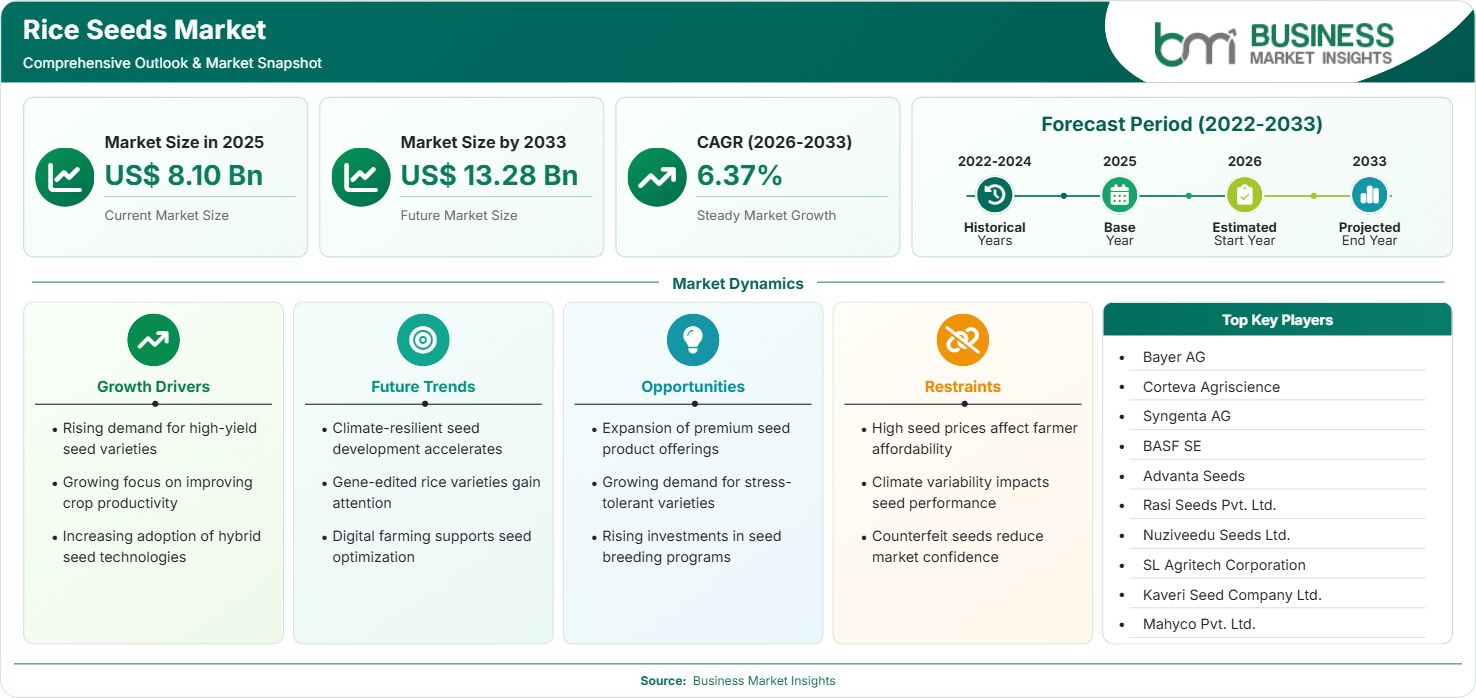
The Rice Seeds Market size was valued at US$ 8.1 billion in 2025 and is projected to reach US$ 13.28 billion by 2033, growing at a CAGR of 6.37% during 2026–2033. Rising demand for high-yield seed varieties, increasing focus on crop productivity, and expanding adoption of hybrid technologies are supporting market expansion, while stress-tolerant varieties and advanced breeding programs create future growth opportunities.

Report Coverage
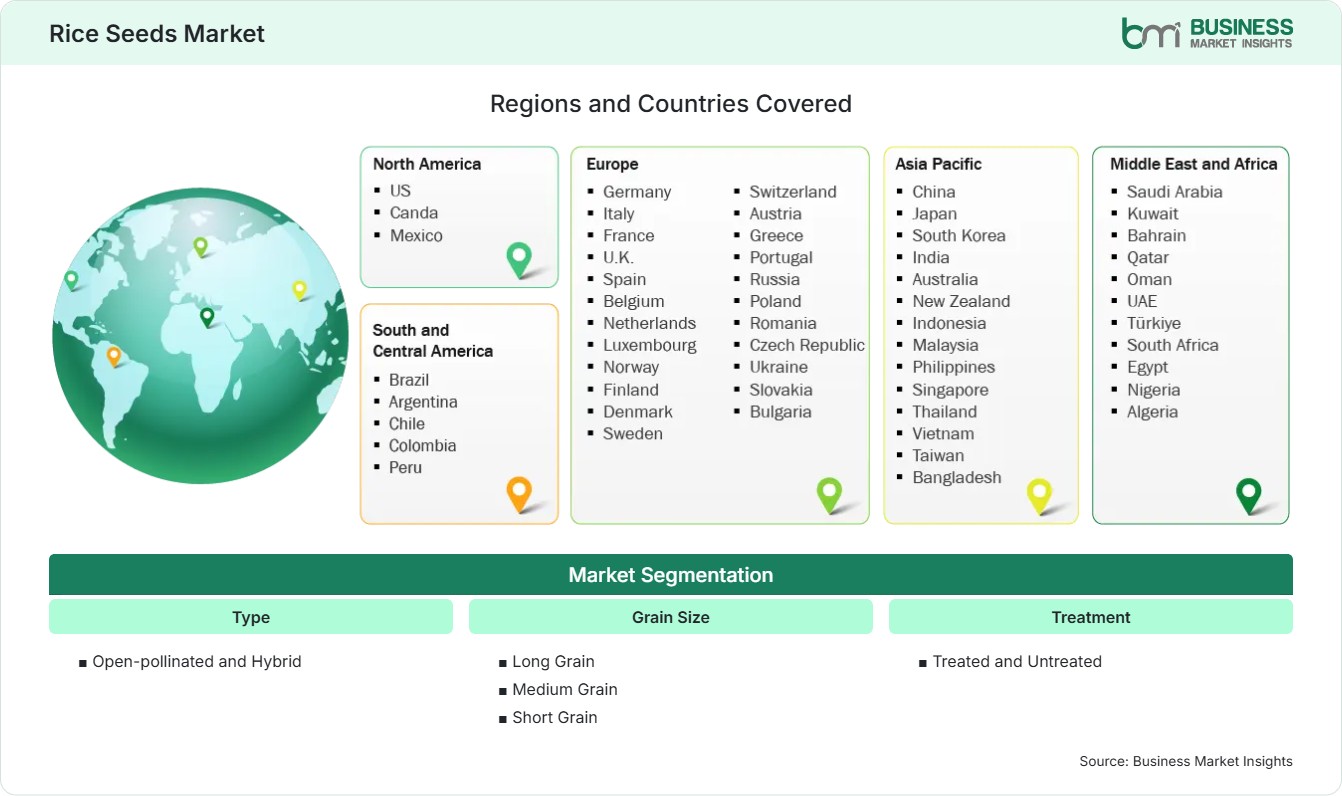
  • Type: Open-pollinated and Hybrid
  • Grain Size: Long Grain, Medium Grain, Short Grain
  • Treatment: Treated and Untreated
US$ 8.10 Bn Market size in 2025
US$ 13.28 Bn Market Size by 2033
6.37% CAGR, 2026 - 2033
2026-2033 Forecast Period

01 AI Overview

Rice Seeds Market Summary

  • North America Region: North America accounts for 8%–10% market share in 2025 and is expected to grow at a CAGR of 5.5%–5.9% during 2026–2033. Increasing use of premium seed varieties, precision farming, and advanced breeding technologies continue supporting regional demand. The U.S. market benefits from mechanized rice farming, improved seed replacement rates, and investments in climate-resilient seed technologies, registering an estimated CAGR of 5.7%–6.1%.
  • Fastest Growing Region: Asia Pacific holds 62%–65% market share in 2025 and is projected to register a CAGR of 6.8%–7.2% during 2026–2033. Rising food demand, increasing hybrid seed adoption, and strong public-private investments in agricultural innovation continue driving regional expansion.
  • Leading Segment: Hybrid seeds represent 54%–57% market share in 2025 and are expected to expand at a CAGR of 6.6%–7.0% owing to higher yields, disease resistance, and improved crop uniformity.
  • High Growth Segment: Treated seeds account for 42%–45% market share in 2025 and are anticipated to grow at a CAGR of 7.1%–7.5% because of increasing focus on seed protection, germination performance, and crop productivity.
  • Key Market Opportunity: Development of premium seed products, climate-resilient rice varieties, and advanced breeding technologies is creating long-term opportunities for seed companies and agricultural research organizations.
  • Major Market Players: Bayer AG, Corteva Agriscience, Syngenta AG, BASF SE, Advanta Seeds, Rasi Seeds Pvt. Ltd., Nuziveedu Seeds Ltd., SL Agritech Corporation, Kaveri Seed Company Ltd., and Mahyco Pvt. Ltd.
02 Strategic Insights

Rice Seeds Market: Strategic Insights

rice-seeds-market-market-strategic-framework
FREE PDF
Request your free sample
Request free sample
03 Stakeholder View

Key Takeaways

  • The industry value chain is increasingly shifting toward certified, hybrid, and high-performance seed varieties that offer superior yields, improved disease resistance, and greater adaptability to changing climatic conditions.
  • Hybrid and treated seed categories present the strongest commercial opportunities as farmers seek solutions that improve productivity, crop uniformity, and farm profitability.
  • Advanced breeding technologies, molecular marker-assisted selection, and precision agriculture tools are accelerating innovation and enabling development of stress-tolerant seed varieties.
  • Asia Pacific remains the most attractive investment region because of its dominant rice cultivation area, rising seed replacement rates, and strong government support for agricultural modernization.
  • Strategic partnerships between seed companies, agricultural research institutions, and public agencies continue strengthening breeding capabilities and supporting commercialization of improved rice seed technologies.
04 Geographic Outlook

Rice Seeds Market Regional Highlights

North America Rice Seeds Market

North America accounted for 8%–10% of the Rice Seeds Market Share in 2025 and is projected to grow at a CAGR of 5.5%–5.9% during 2026–2033. Rising adoption of certified seeds, precision agriculture technologies, and climate-resilient crop varieties continues supporting regional demand. Investments in seed genetics and sustainable farming practices further strengthen long-term market development.

  • Mechanized rice farming continues increasing demand for premium-quality certified seed varieties with improved productivity.
  • Seed companies are investing in breeding technologies that improve disease resistance and climate adaptability.
  • Precision farming practices encourage greater adoption of hybrid and treated rice seeds across commercial farms.
  • Research collaborations between universities and seed developers accelerate commercialization of improved rice varieties.

US Rice Seeds Market

The U.S. represented 82%–85% of the North American market in 2025 and is expected to expand at a CAGR of 5.7%–6.1% through 2033. Modern cultivation practices, high seed replacement rates, and increasing investment in sustainable agriculture continue supporting market expansion.

  • Certified seed adoption improves crop consistency, productivity, and disease management across commercial rice farms.
  • Public and private breeding programs support development of improved rice varieties.
  • Precision irrigation and digital farming technologies strengthen demand for advanced seed products.
  • Climate-smart agricultural practices continue encouraging adoption of stress-tolerant seed varieties.

Europe Rice Seeds Market

Europe held 9%–11% market share in 2025 and is projected to expand at a CAGR of 5.8%–6.2% through 2033. Italy leads regional production, while Spain demonstrates the fastest growth owing to continued investments in sustainable agriculture and improved seed technologies.

  • Government support encourages adoption of certified and environmentally sustainable seed varieties.
  • Seed breeding innovations improve productivity while supporting climate resilience.
  • Increasing research activities strengthen development of disease-resistant rice cultivars.
  • Modern agricultural practices improve seed replacement rates across major producing regions.

Asia Pacific Rice Seeds Market

Asia Pacific accounted for 62%–65% market share in 2025 and is expected to register the strongest Rice Seeds Market Forecasts, expanding at a CAGR of 6.8%–7.2% during 2026–2033. China leads regional consumption, while India records the fastest growth due to expanding hybrid seed adoption and government-backed agricultural modernization initiatives.

  • Hybrid rice seed adoption continues improving productivity across major rice-producing countries.
  • Government food security programs encourage use of certified high-yield seed varieties.
  • Expanding agricultural research strengthens development of climate-resilient rice cultivars.
  • Rising population and food demand support sustained investment in seed technologies.
  • Public-private partnerships accelerate commercialization of advanced breeding innovations.

Rest of World Rice Seeds Market

The Rest of World region represented 13%–16% market share in 2025 and is projected to grow at a CAGR of 6.1%–6.5% during 2026–2033. Brazil leads adoption in South America, while Nigeria demonstrates notable growth across Africa through increasing investments in agricultural productivity and food security initiatives.

  • Government-backed agricultural modernization programs strengthen certified seed adoption.
  • Expanding irrigation projects improve commercial rice cultivation opportunities.
  • Rising investment in local seed production supports greater market accessibility.
  • Climate-resilient seed development enhances productivity across diverse growing conditions.
global-market-geography
FREE PDF
Request your free sample
Request free sample
05 Segment Analysis

Rice Seeds Market Segmentation

Type

The Type segment represents the largest, with Hybrid seeds accounting for 54%–57% market share in 2025 and expanding at a CAGR of 6.6%–7.0%. The Rice Seeds Market Trends indicate increasing farmer preference for hybrid varieties because of their higher productivity, improved resistance to pests and diseases, and better adaptability across different climatic conditions.

  • Open-pollinated: Continue serving traditional farming systems by providing cost-effective seed options that enable farmers to save seeds for future planting while maintaining acceptable productivity.
  • Hybrid: Widely adopted because of higher yield potential, improved crop uniformity, superior disease resistance, and enhanced tolerance to changing environmental conditions.

Grain Size

The Grain Size segment continues expanding as consumer preferences, regional dietary habits, and export demand influence cultivation patterns. Long-grain varieties maintain market leadership, while medium- and short-grain rice remain important for region-specific food applications.

  • Long Grain: Dominates commercial cultivation owing to strong export demand, high productivity, and broad consumer acceptance across global markets.
  • Medium Grain: Maintains steady demand for processed foods and regional cuisines requiring softer texture and moderate starch content.
  • Short Grain: Primarily cultivated for specialty food applications where sticky texture and premium quality characteristics are preferred.

Treatment

The Treatment segment continues gaining importance as growers increasingly prioritize seed protection and higher field performance. Treated seeds demonstrate stronger adoption because they improve germination, protect against early-season diseases, and enhance crop establishment under diverse cultivation conditions.

  • Treated: Increasingly preferred because protective seed coatings improve germination rates, reduce disease pressure, and support stronger crop establishment during early growth stages.
  • Untreated: Continue serving growers preferring conventional cultivation methods or applying customized crop protection strategies after planting.
06 Market Forces

Rice Seeds Market Dynamics

Key Market Drivers

Rising Demand for High-Yield Seed Varieties

The increasing requirement to improve agricultural productivity is a major factor driving the Rice Seeds Market Growth. Farmers are increasingly adopting high-yield seed varieties that offer better germination, enhanced disease resistance, and superior grain quality while maximizing production from limited arable land. The increase in global food consumption and the need to improve the efficiency of the harvesting process continue to motivate farmers to use certified and hybrid rice seeds. Agricultural institutions and seed corporations are utilizing advanced breeding techniques in order to produce varieties that perform better in different climatic environments.

Growing Focus on Improving Crop Productivity

Improving crop productivity has become a strategic priority for governments and agricultural producers as demand for staple food continues rising worldwide. Modern rice seed varieties with enhanced genetic characteristics enable higher yields, improved pest resistance, and better nutrient utilization. The efforts for certificated seeds through the agricultural extension services are fostering sustainable agricultural techniques which will improve the productivity of agriculture in the long run. The growing use of precision agriculture, farm machinery, and scientific methods of cultivating crops is helping in expanding the market. The ongoing research on plant genetics and biotechnology is also helping in developing improved varieties of rice seeds commercially.

Increasing Adoption of Hybrid Seed Technologies

Hybrid seed technologies continue gaining widespread acceptance because they provide higher productivity, improved crop uniformity, and stronger resistance against pests and diseases. Farmers increasingly recognize the economic benefits associated with hybrid rice cultivation, particularly in regions facing rising food demand and declining cultivable land availability. Public-private partnership in hybrid seeds research has resulted in innovative and commercial production of products. Breeding, genetics, and biotechnology are being increasingly used to improve hybrid seeds efficiency and adaptability in varied agroclimatic environments. This is likely to ensure the continued demand for high-performance rice seeds over the forecast period.

Key Market Opportunities

Expansion of Premium Seed Product Offerings

The growing preference for premium-quality seeds provides significant commercial opportunities for seed manufacturers worldwide. Farmers are increasingly investing in certified seed varieties that deliver higher yields, improved grain quality, and better resistance to diseases and environmental stress. The Rice Seeds Market Forecasts indicate continued expansion of premium seed portfolios as agricultural producers focus on maximizing productivity and profitability. Seed companies are introducing value-added products supported by technical advisory services, digital farming solutions, and advanced seed treatment technologies. These developments are expected to strengthen long-term revenue opportunities across commercial agriculture.

Growing Demand for Stress-Tolerant Varieties

Climate variability and increasing environmental pressures are accelerating demand for rice varieties capable of tolerating drought, flooding, salinity, and temperature fluctuations. Seed developers continue investing in advanced breeding technologies to improve crop resilience without compromising productivity or grain quality. Governments and agricultural research organizations are supporting development of climate-smart crop varieties through funding programs and collaborative research initiatives. Expanding commercialization of stress-tolerant seeds is expected to improve food security while creating attractive growth opportunities for leading seed producers operating across global agricultural markets.

Rising Investments in Seed Breeding Programs

Public and private investments in seed breeding programs continue expanding as agricultural stakeholders prioritize sustainable productivity improvements. Advanced genomic selection, marker-assisted breeding, and biotechnology applications are enabling faster development of improved rice varieties with enhanced agronomic performance. Collaboration among research institutions, seed companies, and government agencies is accelerating innovation while strengthening intellectual property portfolios. Increasing investment in breeding infrastructure and research capabilities is expected to support commercialization of next-generation rice seeds with higher yield potential, improved disease resistance, and greater adaptability to changing climatic conditions.

Market Restraints and Challenges

High Seed Prices Affect Farmer Affordability

The relatively high cost of certified and hybrid rice seeds remains a significant barrier for small and medium-scale farmers, particularly in developing agricultural economies where production budgets are limited.

Factor: Premium pricing of certified and hybrid seed varieties.

Impact: High seed prices discourage widespread adoption among cost-sensitive farmers, limiting market penetration despite the long-term productivity benefits offered by improved seed technologies. Lower adoption rates can reduce commercialization opportunities for seed manufacturers and slow overall market expansion.

Climate Variability Impacts Seed Performance

Unpredictable weather patterns, irregular rainfall, prolonged droughts, flooding events, and changing temperatures continue affecting rice cultivation and seed performance across major producing regions.

Factor: Increasing climate variability and extreme weather conditions.

Impact: Environmental uncertainty can reduce germination rates, crop establishment, and yield consistency, making farmers cautious about investing in premium seed varieties. Seed developers must therefore continue investing in resilient breeding technologies to maintain performance under increasingly variable climatic conditions.

07 Company Analysis

Competitive Landscape

The competitive environment of the Market is characterized by multinational seed developers and regional breeding specialists focusing on hybrid seed innovation, climate-resilient genetics, and advanced breeding technologies. The Rice Seeds Market Analysis indicates that companies are strengthening their competitive positions through strategic collaborations, expanded research investments, product portfolio diversification, and regional distribution networks. Increasing emphasis on sustainable agriculture, improved seed replacement rates, and high-performance seed varieties continues encouraging manufacturers to invest in biotechnology, molecular breeding, and digital agriculture solutions to enhance productivity and meet evolving farmer requirements.

Company Name

Overview

Products and Services Relevant to this Market

Bayer AG

Global life sciences company with extensive operations in crop science, seed development, and agricultural biotechnology.

Hybrid rice seeds, crop protection products, seed treatment technologies, digital farming solutions, and agronomic advisory services.

Corteva Agriscience

Global agricultural technology company focused on seed genetics, crop protection, and advanced breeding innovation.

Hybrid rice seeds, biotechnology solutions, seed genetics, biological products, and digital agriculture platforms.

Syngenta AG

International agricultural company specializing in seeds, crop protection, and sustainable farming technologies.

Rice seed varieties, seed treatment products, biological solutions, crop protection chemicals, and precision agriculture technologies.

BASF SE

Global chemical and agricultural solutions provider investing in advanced crop genetics and sustainable farming innovations.

Seed treatment technologies, biological crop solutions, agricultural research, and breeding technologies supporting rice cultivation.

Advanta Seeds

International seed company developing high-performing field crop varieties adapted to diverse climatic conditions.

Hybrid rice seeds, breeding technologies, certified seed production, and agronomic support services.

Rasi Seeds Pvt. Ltd.

Leading Indian seed producer focused on research-driven hybrid seed development across multiple crops.

Hybrid rice seeds, certified seed varieties, breeding programs, and farmer advisory solutions.

Nuziveedu Seeds Ltd.

Agricultural biotechnology company engaged in research, production, and commercialization of improved seed varieties.

Rice hybrid seeds, crop genetics, seed production, and agricultural extension services.

SL Agritech Corporation

Philippine seed company recognized for hybrid rice seed innovation and farmer productivity initiatives.

Hybrid rice seeds, seed breeding programs, research services, and crop productivity technologies.

Kaveri Seed Company Ltd.

Indian seed company with diversified breeding capabilities and extensive agricultural research programs.

Hybrid rice seeds, certified seed production, biotechnology research, and seed distribution services.

Mahyco Pvt. Ltd.

Agricultural research and seed company focused on hybrid crop development and biotechnology innovation.

Rice hybrid seeds, breeding technologies, biotechnology research, seed production, and agronomic solutions.

10 Trust & Transparency

Research Methodology

The market analysis combines proprietary research with secondary data from government agencies, company disclosures, regulatory filings, industry databases and expert interviews. Market estimates are validated through data triangulation, cross-market benchmarking and analyst review.

View Full Research Methodology

11 Questions Answered

Frequently Asked Questions

What does the Rice Seeds Market Report include?

The Market Report provides comprehensive insights into market size, segmentation, competitive landscape, technological developments, regional trends, investment opportunities, recent industry developments, key company profiles, and long-term market outlook through 2033.

Which region offers the strongest growth opportunities?

Asia Pacific offers the greatest growth potential because it accounts for the majority of global rice production, supported by increasing hybrid seed adoption, government food security initiatives, expanding agricultural investments, and continuous improvements in seed replacement rates.

Why are treated rice seeds gaining popularity?

Treated seeds improve germination rates, protect against seed- and soil-borne diseases, enhance early crop establishment, and reduce production risks, making them increasingly attractive for farmers seeking improved productivity and stable harvest outcomes.

Which segment leads the Market?

Hybrid seeds lead the market because they provide higher productivity, improved disease resistance, superior crop uniformity, and stronger adaptability to diverse climatic conditions, making them the preferred choice for commercial rice cultivation.

What is driving the Rice Seeds Market?

The market is driven by rising demand for high-yield seed varieties, increasing hybrid seed adoption, growing emphasis on improving crop productivity, expanding investments in agricultural biotechnology, and continuous innovation in breeding technologies supporting sustainable food production.

Access the Full Rice Seeds Market Report

Get segment-level forecasts, regional estimates, competitive benchmarking, company profiles and downloadable Excel datasets.

Access the full Rice Seeds Market Report
350 pages PDF & Excel | 2026-08-05