
Food Service Coffee Market Size, Share, Trends & Forecast Report, 2026–2033

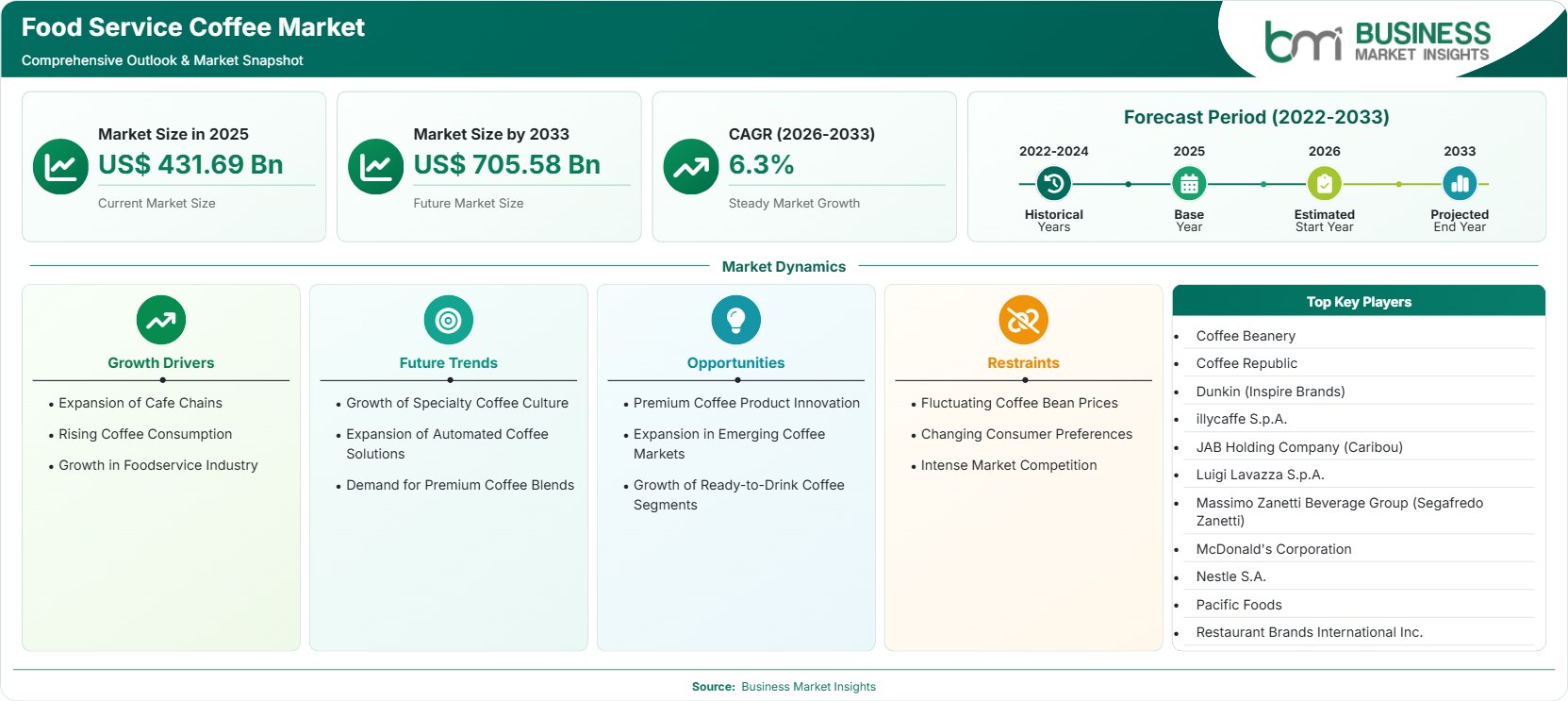
The Food Service Coffee Market size was valued at US$ 431.69 Billion in 2025 and is projected to reach US$ 705.58 Billion by 2033, growing at a CAGR of 6.3% during 2026–2033, driven by expanding café chains, rising coffee consumption, premium beverage innovation, and opportunities in emerging foodservice markets and ready-to-drink coffee adoption.

Report Coverage
  • Type: Take Away/Delivery, Dine-In Coffee
  • End-User: Coffee House & Beverage Shops, Bakery Shops & Restaurants, Others
US$ 431.69 Bn Market size in 2025
US$ 705.58 Bn Market Size by 2033
6.3% CAGR, 2026 - 2033
2026-2033 Forecast Period

01 AI Overview

Food Service Coffee Market Summary

  • North America Region: North America holds a market share of 30%–34% in 2025, growing with a CAGR of 5.8%–6.4% influenced by café chain expansion, specialty coffee adoption, convenience formats, and digital ordering opportunities. The US market shows steady development with a CAGR of 5.9%–6.3% from 2026–2033, supported by established coffeehouse networks, premium beverages, and drive-through consumption models.
  • Fastest Growing Region: Asia Pacific holds market share of 27%–30% in 2025, growing with a CAGR of 7.2%–7.8% influenced by rising urbanization, increasing coffee acceptance, international café investments, and expanding foodservice infrastructure across developing economies.
  • Leading Segment: Dine-In Coffee holds market share of 58%–62% in 2025, growing with a CAGR of 5.9%–6.5% influenced by café culture growth, social consumption occasions, premium beverage experiences, and demand for customized coffee offerings.
  • High Growth Segment: Take Away/Delivery Coffee holds market share of 38%–42% in 2025, growing with a CAGR of 7.0%–7.6% influenced by online ordering platforms, convenience-focused consumers, delivery partnerships, and expansion of quick-service beverage formats.
  • Key Market Opportunity: Premium coffee innovations, ready-to-drink beverage expansion, and emerging market penetration create opportunities through differentiated products, digital ordering ecosystems, and scalable foodservice business models.
  • Major Market Players: Coffee Beanery, Coffee Republic, Dunkin’ (Inspire Brands), illycaffè S.p.A., JAB Holding Company, Luigi Lavazza S.p.A., Massimo Zanetti Beverage Group, McDonald’s Corporation, Nestlé S.A., Pacific Foods, and Restaurant Brands International Inc.
02 Strategic Insights

Food Service Coffee Market: Strategic Insights

Food Service Coffee Market Strategic Framework
FREE PDF
Request your free sample
Request free sample
03 Stakeholder View

Key Takeaways

  • The value chain is evolving from traditional coffee supply models toward integrated ecosystems involving coffee producers, processors, café operators, delivery platforms, and technology providers. Companies are prioritizing supply reliability, quality consistency, and customer engagement.
  • Specialty coffee, premium blends, customized beverages, and experiential café formats represent high-growth opportunities as consumers increasingly seek differentiated products beyond conventional coffee consumption.
  • Technology adoption is becoming a competitive priority, with artificial intelligence-based recommendations, automated equipment, mobile ordering, and digital loyalty programs improving operational efficiency and consumer retention.
  • Asia Pacific presents a strong expansion opportunity due to increasing coffee consumption among younger demographics, rapid urbanization, and growing presence of international café brands in developing markets.
  • Strategic acquisitions, franchising models, and partnerships are shaping competitive positioning as companies seek wider geographic coverage, stronger distribution capabilities, and diversified beverage portfolios.
  • Sustainability and ethical sourcing are becoming important strategic factors, with operators investing in traceable supply chains, responsible coffee procurement, and environmentally conscious packaging solutions.
04 Geographic Outlook

Food Service Coffee Market Regional Highlights

North America Food Service Coffee Market

North America Food Service Coffee Market accounted for a 30%–34% share in 2025 and is projected to expand at a CAGR of 5.8%–6.4% during 2026–2033. The region benefits from mature café ecosystems, strong coffee consumption habits, and widespread presence of organized foodservice operators. The US and Canada remain leading markets, supported by premium coffee demand, convenience-focused formats, and technology-enabled ordering solutions.

  • Established café chains and quick-service restaurants are expanding beverage portfolios through specialty blends, seasonal offerings, and customized coffee experiences.
  • Consumer preference for premium beverages is encouraging operators to introduce high-quality beans, sustainable sourcing, and differentiated preparation methods.
  • Digital ordering platforms, mobile applications, and loyalty programs are improving customer retention and increasing purchase frequency across foodservice outlets.
  • Drive-through coffee formats continue gaining traction by meeting demand for convenience, speed, and accessible beverage consumption.
  • Sustainability initiatives are influencing procurement strategies as companies focus on ethical sourcing and environmentally responsible packaging.

US Food Service Coffee Market

US Food Service Coffee Market share represented a 26%–30% share in 2025 and is estimated to grow at a CAGR of 5.9%–6.3% between 2026–2033. The country remains a major contributor due to strong café culture, high coffee consumption frequency, and extensive presence of multinational and independent coffee operators. Growth is supported by premiumization, convenience formats, and expanding digital food ordering channels.

  • Coffeehouse chains are increasing store networks and menu diversification through specialty beverages, cold coffee options, and seasonal product launches.
  • Restaurant operators are strengthening coffee offerings to increase customer visits, improve margins, and enhance overall dining experiences.
  • Ready-to-drink coffee integration and beverage innovation are supporting expansion across convenience-focused foodservice environments.
  • Consumer interest in sustainability and origin transparency is encouraging responsible sourcing practices among major coffee brands.

Europe Food Service Coffee Market

Europe Food Service Coffee Market held a 22%–26% share in 2025 and is forecast to register a CAGR of 5.5%–6.1% during 2026–2033. The region benefits from established café traditions, strong demand for premium coffee, and widespread adoption of specialty beverage concepts. Italy, Germany, France, and the UK remain major markets, while Poland and Spain show increasing growth potential through expanding café networks and changing consumption patterns.

  • Italy maintains strong influence through traditional coffee culture, premium espresso consumption, and established café business models.
  • Germany and France are experiencing growth through specialty coffee shops, premium blends, and evolving consumer preferences.
  • The UK market is expanding through branded coffee chains, convenience formats, and increased demand for takeaway beverages.
  • European operators are adopting sustainable sourcing practices to align with environmental regulations and consumer expectations.
  • Digital ordering and delivery services are increasing accessibility of coffee products across urban consumer segments.

Asia Pacific Food Service Coffee Market

Asia Pacific Food Service Coffee Market accounted for a 27%–30% share in 2025 and is expected to expand at the fastest CAGR of 7.2%–7.8% between 2026–2033. Rapid urbanization, increasing disposable income, and changing beverage preferences are accelerating adoption across regional markets. China, India, Japan, South Korea, Indonesia, and Vietnam represent important growth centers, with India and Vietnam showing strong expansion potential.

  • International café chains are expanding through franchising and partnerships to capture growing urban coffee consumption.
  • Young consumers are driving demand for specialty coffee, innovative beverages, and modern café experiences across major cities.
  • India and Southeast Asia are attracting investment due to rising café culture and expanding organized foodservice sectors.
  • Technology-driven ordering, delivery platforms, and digital payments are improving accessibility for coffee consumers.
  • Local coffee producers are gaining importance through origin-focused products and regional specialty coffee development.

Rest of World Food Service Coffee Market

Rest of World Food Service Coffee Market represented a 12%–15% share in 2025 and is projected to grow at a CAGR of 6.2%–6.8% from 2026–2033. Latin America benefits from strong coffee production capabilities and growing café consumption, while Middle East and Africa markets are expanding through hospitality investments and premium beverage adoption. Brazil, Mexico, UAE, and Saudi Arabia represent key opportunity markets with increasing organized foodservice development.

  • Latin American markets are benefiting from domestic coffee production advantages, growing café concepts, and increasing premium beverage consumption.
  • Brazil and Mexico are expanding foodservice coffee offerings through branded outlets and specialty coffee experiences.
  • Middle Eastern markets are investing in premium cafés and hospitality-driven coffee concepts targeting younger consumers and tourists.
  • African markets are developing coffee service opportunities through urbanization, local production, and emerging retail infrastructure.
  • International coffee brands are entering developing markets through partnerships, franchises, and localized product strategies.
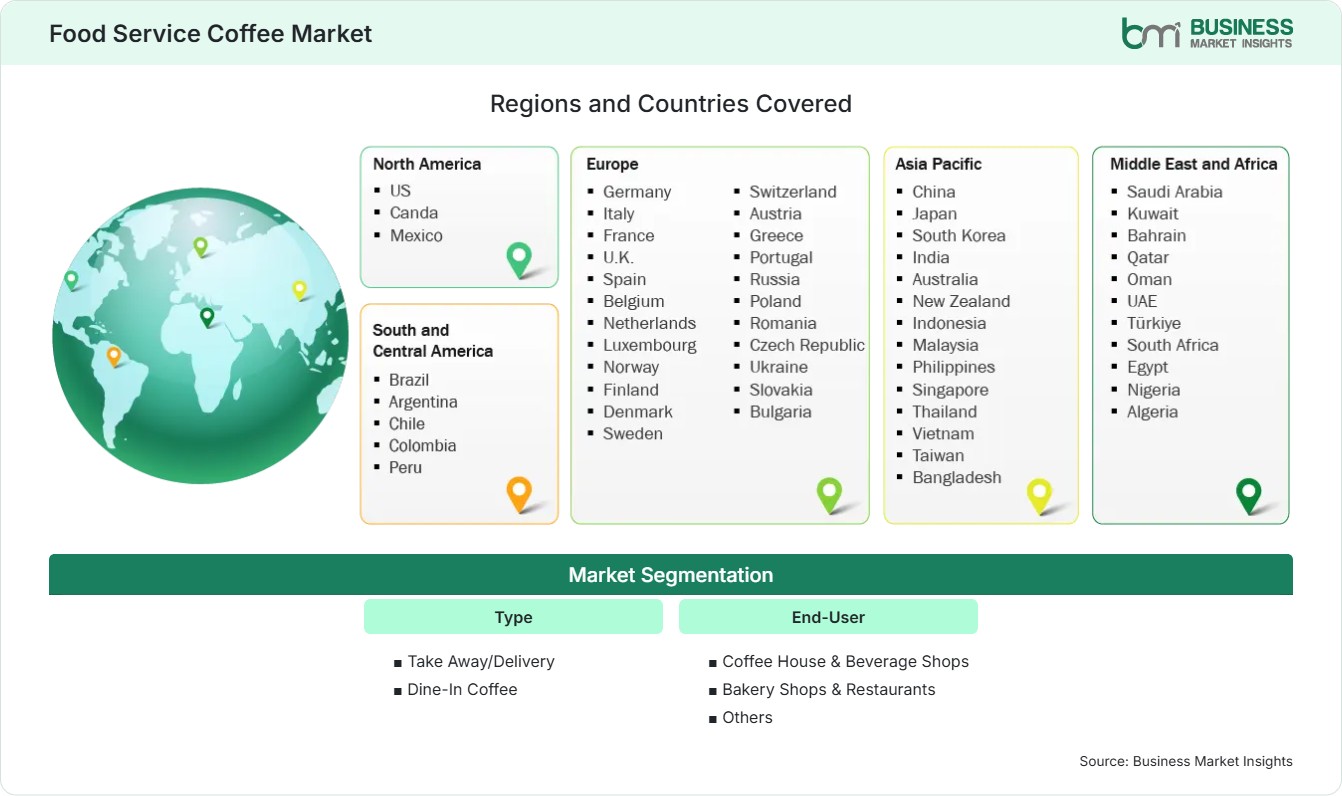
Global Market Geography
FREE PDF
Request your free sample
Request free sample
05 Segment Analysis

Food Service Coffee Market Segmentation

Type

Type segmentation is an important part of the Food Service Coffee Market since dine-in coffee holds the highest position in 2025 on account of café culture and consumers’ preference to consume coffee in a social setting. This segment held a market share of 58%–62% in 2025 and was projected to register a CAGR of 5.9%–6.5% during 2026–2034, supported by café expansion and premium beverage offerings.

  • Take Away/Delivery Coffee: Takeaway and delivery formats are expanding through digital ordering platforms, convenience-focused consumers, and increasing adoption of quick-service beverage models.
  • Dine-In Coffee: Dine-in coffee remains important through café experiences, social interactions, premium beverages, and customized offerings that encourage longer customer engagement.

End-User

The end-user segmentation is a result of varied consumer experiences in the organized food service channels. Coffee shops and drink bars form the highest contribution because of their specialization and customer loyalty. The segment is estimated to register a CAGR of 6.1%-6.7% for the period 2026-2034, owing to location expansions, menu enhancements, and technological service offerings.

  • Coffee House & Beverage Shops: Coffee houses and beverage shops drive demand through specialty beverages, premium experiences, loyalty programs, and personalized customer interactions.
  • Bakery Shops & Restaurants: Bakery shops and restaurants are integrating coffee offerings to increase revenue, improve customer experiences, and complement their food menus.
  • Others: Other end-users include hotels, workplace cafeterias, and institutional foodservice operators adopting coffee solutions to serve diverse consumer groups.
06 Market Forces

Food Service Coffee Market Dynamics

Key Market Drivers

Expansion of Cafe Chains

Chain expansion among coffee stores represents one of the main factors driving changes in worldwide coffee drinking habits due to improved availability, better visibility of the brand name, and uniformity of the beverages offered. Cafe companies organize their expansion efforts using franchises, cooperation agreements, and company-operated coffee houses in both urban and developing areas. The Food Service Coffee Market growth is driven by increased financial investments by multinational and regional coffee companies to expand their consumer base. Trends in the market include increased use of high-end menus, seasonal beverages, ordering systems, and loyalty programs.

Rising Coffee Consumption

The growing coffee-drinking culture is fueling demand in restaurants, beverage stores, and specialty cafes, as coffee is becoming a daily lifestyle product for many consumers. Based on industry analysis by international coffee organizations, global coffee demand is rising owing to factors such as urbanization, changes in working patterns, and acceptance in developing countries. Market development is influenced by young consumers trying out specialty drinks, cold coffee drinks, and customizations. The Food Service Coffee Market trends indicate more interest in quality origins, sustainable sourcing, and novel preparation methods that motivate food service operators to diversify their menu offerings.

Growth in Foodservice Industry

Expansion in the food service industry has led to new possibilities for coffee providers and establishments through increased integration of beverages in restaurants, bakeries, hotels, and convenience stores. The development of food service and online food delivery systems is contributing to better access to coffee by consumers. The market growth receives support from the growing investments in restaurants, higher out-of-home consumption rates, and consumer demands for accompanying beverages. The Food Service Coffee Market Forecast indicates that foodservice companies are developing their coffee offerings to enhance customer satisfaction and add value to their transactions.

Key Market Opportunities

Premium Coffee Product Innovation

Product innovation of high-end coffee has created opportunities through premium coffees, specialty blends, single-origin coffee, functional coffee drinks, and customized brewing. Consumers are becoming more conscious about unique taste, high-quality ingredients, and detailed knowledge regarding where the coffee comes from, and operators should consider widening their product range. There has been significant investment in research and development of new beverage products that will enable companies to differentiate themselves through premium pricing strategies. In addition, innovations like cold-brew coffee, nitro coffee, and sustainable packaging have created numerous market opportunities.

Expansion in Emerging Coffee Markets

Expansion into emerging coffee markets offers many possibilities due to increasing incomes, urbanization, and shifting tastes in beverages in developing countries. Countries in the Asia Pacific, Latin America, and the Middle East have witnessed growing investments in cafés and organized food service businesses. Global firms are establishing themselves in these regions by entering into franchises, collaborations, and product localization. Specialty coffee awareness has been growing among consumers, hence generating more interest in regions where tea is traditionally consumed.

Growth of Ready-to-Drink Coffee Segments

The expansion of ready-to-drink coffee categories presents new opportunities in the form of convenience, coupled with evolving consumer lifestyles. With growing demand for portable drinks, beverages consumed at work, and nutritional beverages on the go, operators in foodservice and beverage companies have been expanding their ready-to-drink portfolios. Innovation in the category with respect to cold coffee, bottled drinks, and functional beverages has helped to engage young customers and professionals alike. Collaborations between coffee brands and foodservice channels could help increase reach and engagement with the consumer base. The category also profits from innovations in packaging technology.

Market Restraints and Challenges

Fluctuating Coffee Bean Prices

Factor: Fluctuating coffee bean prices caused by climate variability, supply disruptions, production changes, and global commodity market movements create cost uncertainty for foodservice operators. Impact: Increases in the cost of raw materials may lead to reduced profit margins, higher pricing pressure on the menu, and changes in sourcing practices for cafes and restaurants. Coffee-growing areas face risks associated with weather factors that have an impact on production. They deal with this problem by diversifying sources, establishing good relations with suppliers, managing inventory, and implementing a pricing policy. Nevertheless, volatility remains a challenge, particularly for businesses with limited purchasing power and smaller independent foodservice establishments.

Changing Consumer Preferences

Factor: Changing consumer preferences toward alternative beverages, health-focused products, sustainability expectations, and evolving consumption occasions create challenges for traditional coffee operators. Impact: Innovation of menu items, product development, and changes in marketing strategy are necessary for businesses to keep up with customer expectations. The younger generations demand a personalized experience, functional beverages, and ethical procurement. Ignoring the demands of the younger generation might result in a loss of brand relevance and customer retention. Food service providers have recognized this issue through innovations such as a wider selection of beverages and technological advancements.

07 Company Analysis

Competitive Landscape

The Food Service Coffee Market analysis highlights competition among global coffee companies, restaurant operators, beverage specialists, and hospitality-focused brands. Companies are strengthening positions through café expansion, premium product development, supply chain improvements, digital ordering capabilities, and strategic partnerships. Competitive differentiation is increasingly influenced by brand recognition, product innovation, sourcing practices, and customer experience management.

Company Name

Overview

Products and Services relevant to this market

Coffee Beanery

US-based specialty coffee company operating retail and café-focused coffee businesses.

Specialty coffee beverages, café services, roasted coffee products, and foodservice coffee solutions.

Coffee Republic

International café brand providing coffee beverages and casual café experiences.

Coffee drinks, café operations, takeaway beverages, and customer-focused beverage services.

Dunkin’ (Inspire Brands)

Global coffee and baked goods chain with extensive quick-service presence.

Coffee beverages, espresso drinks, breakfast products, delivery services, and café solutions.

illycaffe S.p.A.

Italian premium coffee company specializing in high-quality coffee experiences.

Premium coffee blends, espresso products, café solutions, and hospitality coffee services.

JAB Holding Company

Investment group with major coffee and foodservice beverage interests.

Coffee brands, café networks, beverage businesses, and hospitality investments.

Luigi Lavazza S.p.A.

Global coffee company known for premium coffee products and services.

Coffee blends, espresso solutions, foodservice supplies, and café partnerships.

Massimo Zanetti Beverage Group

International coffee producer and beverage company.

Coffee products, roasted beans, foodservice solutions, and beverage distribution.

McDonald’s Corporation

Global restaurant operator with extensive coffee service offerings.

Coffee beverages, breakfast products, restaurant coffee programs, and digital ordering.

Nestlé S.A.

Global food and beverage company with strong coffee portfolio.

Coffee brands, beverage systems, foodservice coffee products, and technology solutions.

Pacific Foods

Food and beverage company offering plant-based beverage products.

Beverage products, foodservice solutions, and complementary café offerings.

Restaurant Brands International Inc.

Global restaurant company operating major quick-service brands.

Coffee beverages, restaurant services, franchising, and foodservice operations.

08 Industry Activity

Recent Developments

May 2026

McDonald’s Corporation refreshed the global McCafe brand identity to strengthen its beverage-focused strategy, introducing a new visual direction and highlighting expanded coffee and beverage offerings across selected markets. The update supports McDonald’s continued focus on coffee as a key foodservice category, including European markets where McCafe operates through McDonald’s restaurants.

January 2026

illycaffe S.p.A. continued strengthening its foodservice positioning by participating in SIGEP World 2026, a major international event for the foodservice and hospitality industry. The company showcased coffee culture, professional coffee solutions, and sustainability initiatives targeted at cafés, restaurants, and hospitality operators across Europe, supporting its premium HoReCa expansion strategy.

November 2025

Luigi Lavazza S.p.A. announced a long-term partnership extension with tennis player Jannik Sinner through 2030, reinforcing the company’s global brand strategy and visibility. The company continues to invest in premium coffee positioning and international growth, including professional coffee solutions for hospitality and foodservice channels in European markets.

June 2025

illycaffe S.p.A. renewed its partnership with The World’s 50 Best Restaurants 2025 as the exclusive coffee partner, reinforcing its positioning as a premium coffee supplier for hospitality, restaurants, and high-end foodservice operators across Europe. The collaboration supports illy’s visibility among global culinary and HoReCa networks relevant to premium coffee consumption.

10 Trust & Transparency

Research Methodology

The market analysis combines proprietary research with secondary data from government agencies, company disclosures, regulatory filings, industry databases and expert interviews. Market estimates are validated through data triangulation, cross-market benchmarking and analyst review.

View Full Research Methodology

11 Questions Answered

Frequently Asked Questions

What does the Food Service Coffee Market Report indicate about future industry development?

The Market Report indicates continued expansion through premium product innovation, emerging market penetration, ready-to-drink coffee growth, and technology-enabled foodservice models supporting changing consumer preferences.

How is sustainability affecting coffee industry strategies?

Sustainability is influencing sourcing practices, packaging decisions, and supply chain management. Companies are focusing on ethical coffee procurement, traceability, responsible farming practices, and environmentally friendly operations to meet consumer expectations.

Which regions offer strong opportunities for coffee service expansion?

Asia Pacific offers significant opportunities due to rising urban populations, increasing disposable income, and expanding café culture. Countries such as India, China, Vietnam, and Indonesia are attracting investments from international and regional coffee brands.

How are café operators improving customer experiences?

Café operators are adopting mobile ordering, loyalty programs, personalized recommendations, automated equipment, and customized beverage menus. These solutions help improve convenience, increase customer engagement, and strengthen brand loyalty.

What factors are driving growth in the Food Service Coffee Market?

Growth is supported by expanding café chains, increasing coffee consumption, foodservice industry development, premium beverage demand, and rising adoption of digital ordering channels. Operators are also benefiting from growing interest in specialty coffee experiences.

Access the Full Food Service Coffee Market Report

Get segment-level forecasts, regional estimates, competitive benchmarking, company profiles and downloadable Excel datasets.

Access the full Food Service Coffee Market Report
350 pages PDF & Excel | 2026-07-31