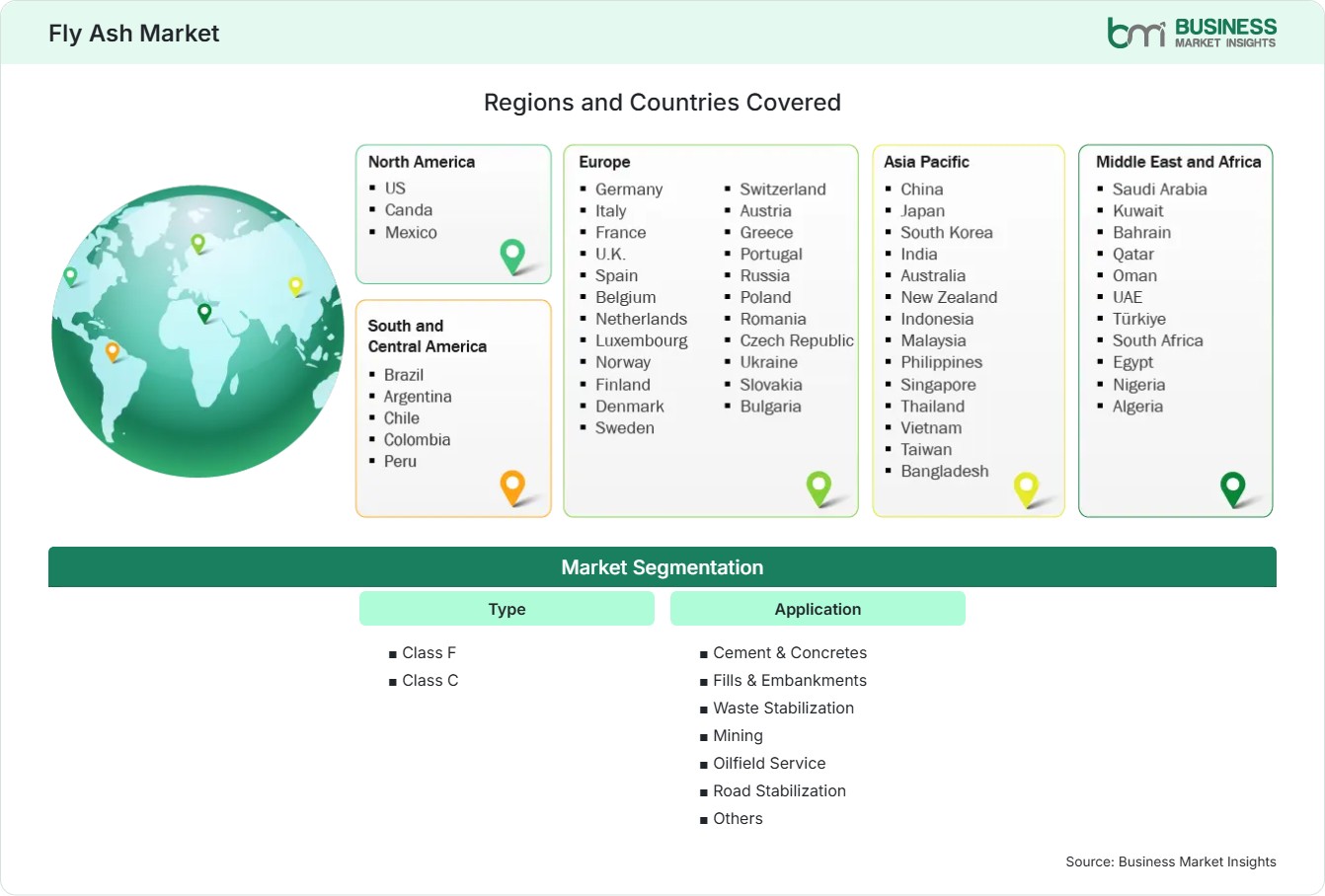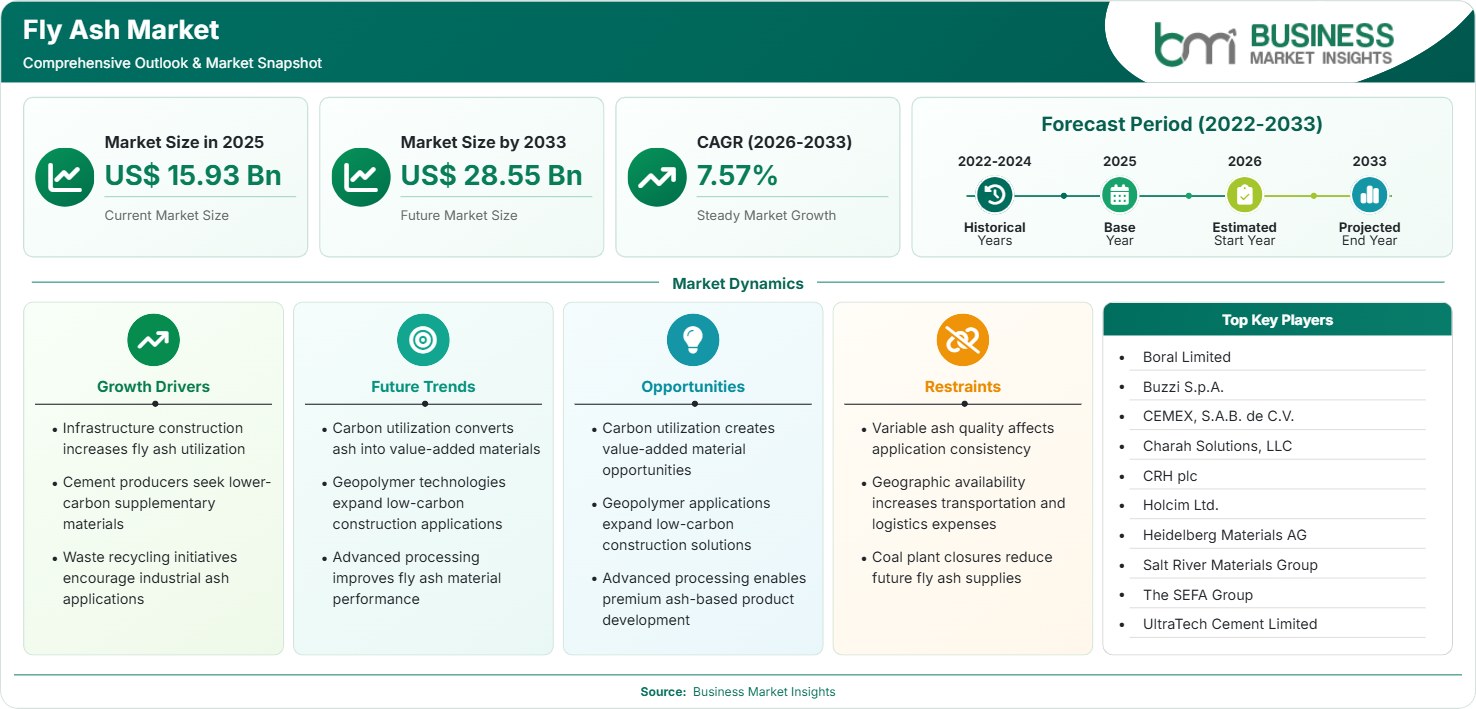
Fly Ash Market Regional Highlights
North America Fly Ash Market
North America held a 27%–30% share in 2025, with a 6.8%–7.5% CAGR through 2033. The region benefits from infrastructure renewal, mature concrete specifications, established ash-processing networks, and rising demand for lower-carbon cementitious materials. The US accounts for most regional demand, while Canada contributes through infrastructure and concrete applications. Supply is increasingly supported by harvested ash and beneficiation as coal generation changes. CRH's acquisition of Eco Material strengthens integrated access to fly ash, pozzolans, and distribution infrastructure.
- Infrastructure rehabilitation is sustaining demand for specification-grade SCMs, particularly where agencies permit performance-based concrete alternatives and contractors seek lower-carbon material combinations.
- US suppliers are investing in harvesting, beneficiation, grinding, and multi-source distribution to offset regional shortages of fresh fly ash and improve supply reliability.
- Canada provides incremental demand through transportation infrastructure, commercial construction, and concrete applications requiring durable and cost-efficient supplementary cementitious materials.
- The region's Fly Ash Market share is supported by established standards, mature logistics, and customer familiarity with Class F material in structural concrete.
US Fly Ash Market
The US represented 23%–26% of global demand in 2025 and is projected to expand at a 6.6%–7.3% CAGR through 2033. Infrastructure renewal, concrete procurement, ash beneficiation, and landfill harvesting support demand despite structural changes in coal generation. Fly ash suppliers increasingly secure multiple utility sources to maintain continuity. EPA beneficial-use frameworks and procurement guidance provide a supportive policy backdrop, although state-level requirements continue to influence project economics and material acceptance.
- The US Fly Ash Market growth increasingly depends on harvested reserves, beneficiation, and logistics because retirement or reduced utilization of coal units can constrain fresh ash availability.
- Infrastructure programs create demand for concrete containing SCMs, particularly where procurement specifications permit alternatives that meet performance and durability requirements.
- Established processors are expanding multi-source networks, enabling ready-mix customers to access Class C and Class F products across geographically dispersed construction markets.
Europe Fly Ash Market
Europe accounted for 14%–17% in 2025 and is projected to record a CAGR of 6.3%–7.1% till 2033. The key countries with construction demand include Germany, the UK, France, Spain, and Poland; however, Poland holds the edge in coal-based ash availability. Countries such as Germany and Poland remain key sources of demand and supply, whereas Spain and France have prospects owing to their lower-carbon cement production methods. Europe suffers a structural drawback in the form of declining coal-fired power generation.
- Germany remains a leading market for performance-oriented concrete materials, with cement producers emphasizing clinker efficiency, resource productivity, and lower embodied carbon.
- Poland provides comparatively strong ash availability because of its power-generation structure, supporting cement and construction-material applications while creating opportunities for quality upgrading.
- France and Spain offer attractive growth avenues as cement manufacturers expand alternative-material portfolios and pursue lower-emission construction solutions.
- Europe's Fly Ash Market trends increasingly favor recovered and processed ash as fresh supply becomes less predictable because of energy-system transformation.
Asia Pacific Fly Ash Market
Asia Pacific region accounted for 40%-44% of global demand in 2025 and is expected to grow at 8.2%-9.0% through 2033, making it the fastest-growing region. It is driven by consumption in China and India, with additional opportunities in Indonesia and Vietnam. The development of infrastructure, cement production, and urbanization, as well as electricity generation from coal plants, is responsible for both supply and demand. India offers excellent commercialization opportunities, as utility companies are seeking profitable uses for ash.
- China remains the largest regional ecosystem for ash generation and utilization, with cement, concrete, bricks, infrastructure, and resource-recovery applications supporting broad demand.
- India combines high infrastructure spending with substantial ash availability, encouraging logistics networks, cement substitution, beneficiation, and long-distance movement from power stations to construction centers.
- Indonesia and Vietnam provide high-growth opportunities as urban development and transport infrastructure increase demand for cementitious materials and construction inputs.
- Asia Pacific Fly Ash Market growth is supported by large cement industries capable of absorbing processed ash at scale and integrating it into blended cement production.
- Japan and South Korea offer more mature, quality-focused markets where advanced processing, specification compliance, and specialized applications provide higher-value opportunities.
Rest of World Fly Ash Market
South and Central America represented 7%–9% of global demand in 2025, while the Middle East and Africa contributed to the remaining regional demand within a combined 10%–12% RoW range. The combined region is projected to grow at 7.0%–8.0% through 2033. Brazil, Mexico, Saudi Arabia, South Africa, and the UAE offer the strongest commercial prospects because infrastructure investment and cement consumption support SCM adoption.
South America benefits from infrastructure and housing requirements, while the Middle East prioritizes large construction programs and lower-carbon building materials. Africa provides longer-term potential as urbanization expands.
- Brazil and Mexico provide leading demand pools through cement manufacturing, infrastructure construction, and industrial development, creating opportunities for local processing and distribution networks.
- Saudi Arabia and the UAE offer attractive opportunities through large-scale infrastructure and real-estate development, where lower-carbon cementitious materials can support project sustainability targets.
- South Africa combines cement demand with established coal-linked material availability, supporting applications in concrete, fills, stabilization, and related construction uses.
- RoW Fly Ash Market trends favor localized processing because transportation can materially affect delivered ash economics when power-generation sites are distant from cement demand centers.