
Surfactants Market Outlook: Size, Share, Trends, Growth Analysis, Competitive Landscape & Forecast, 2026-2033

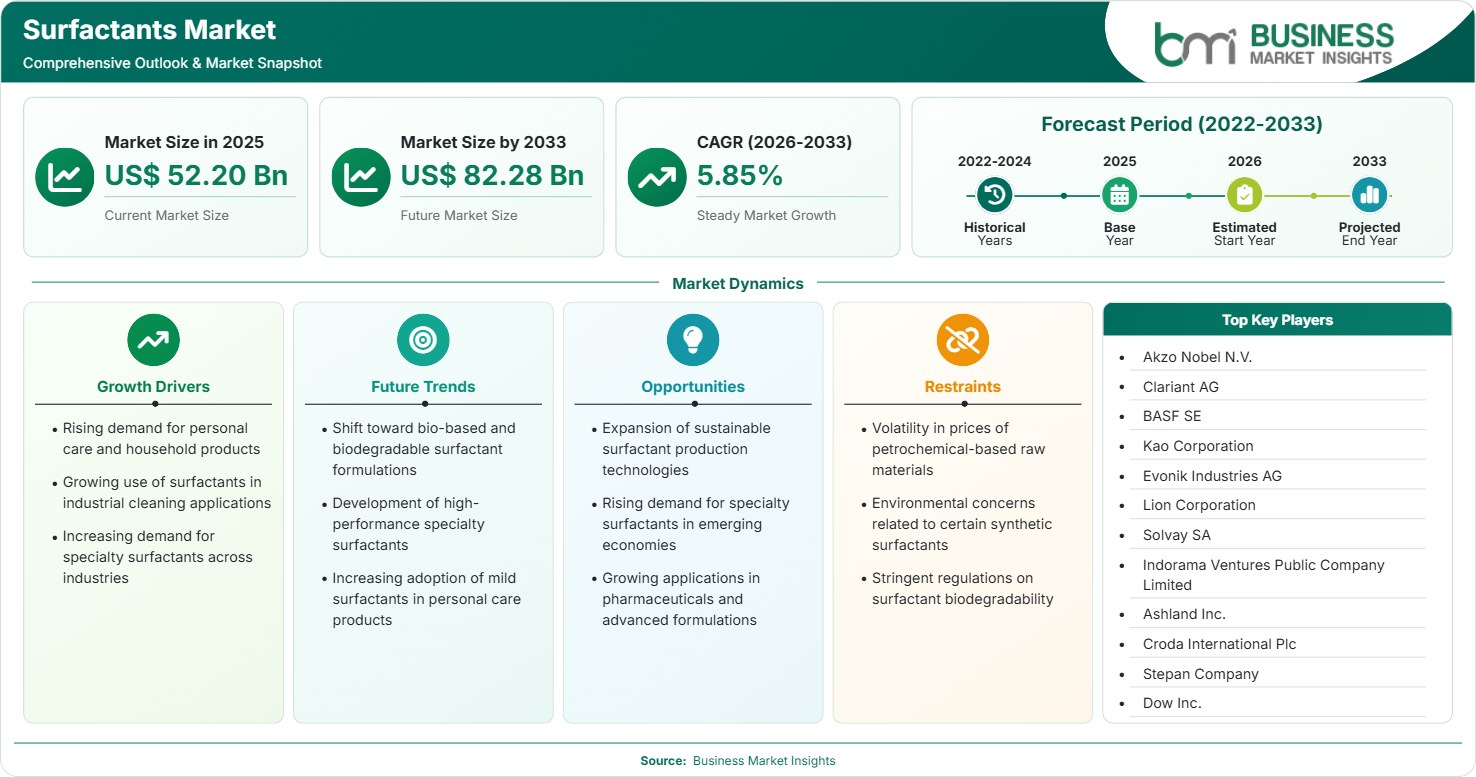
The Surfactants Market size was valued at US$ 52.2 Billion in 2025 and is projected to reach US$ 82.28 Billion by 2033, growing at a CAGR of 5.85% during 2026–2033, driven by sustainable chemistry, specialty formulations, renewable feedstocks, Asian manufacturing expansion, personal care innovation, and industrial applications.

Report Coverage
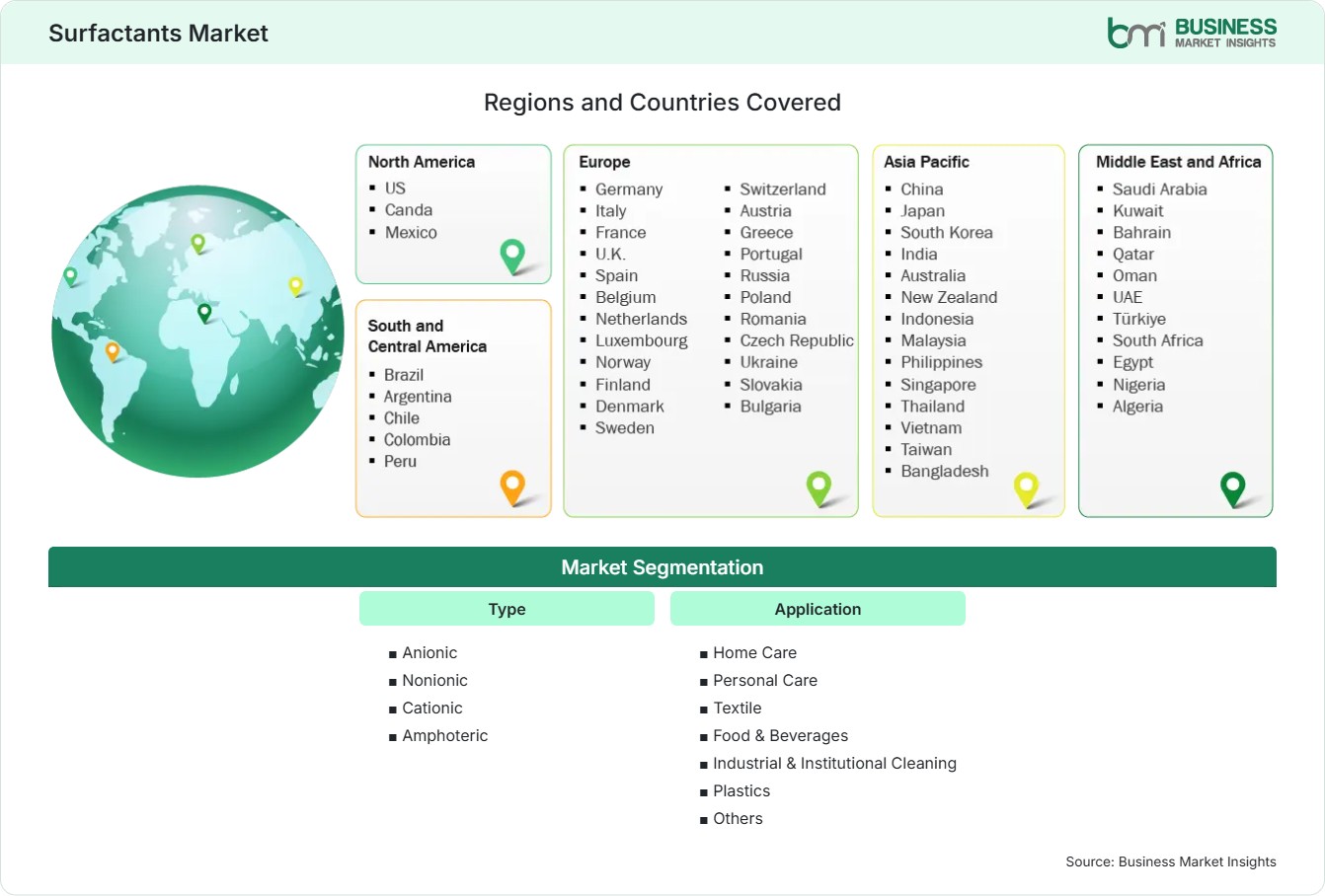
  • Type: Anionic, Nonionic, Cationic, Amphoteric
  • Application: Home Care, Personal Care, Textile, Food & Beverages, Industrial & Institutional Cleaning, Plastics, Others
US$ 52.20 Bn Market size in 2025
US$ 82.28 Bn Market Size by 2033
5.85% CAGR, 2026 - 2033
2026-2033 Forecast Period

AI Overview

Surfactants Market Summary

  • North America Region: North America holds a 20%–23% surfactants market share in 2025, growing with a CAGR of 5.4%–5.8%, influenced by specialty cleaning, personal care, coatings, sustainable reformulation, and renewable chemistry. The US remains the regional anchor, supported by sophisticated formulation industries, institutional cleaning, coatings, and personal care, with CAGR of 5.2%–5.7% during 2026–2033.
  • Fastest Growing Region: Asia Pacific holds a 42%–46% share in 2025, growing with a CAGR of 6.5%–7.0%, influenced by manufacturing expansion, urbanization, detergent consumption, personal care penetration, agricultural formulations, and investment in sustainable production.
  • Leading Segment: Building and Construction holds a 18%–22% share in 2025, growing with a CAGR of 5.5%–6.0%, influenced by coatings, concrete additives, insulation, waterproofing, adhesives, dispersion, and wetting requirements.
  • High Growth Segment: Renewable Energy Infrastructure holds a 9%–12% share in 2025, growing with a CAGR of 7.0%–7.6%, influenced by photovoltaic manufacturing, wind infrastructure, storage technologies, advanced coatings, cleaning, and dispersion requirements.
  • Key Market Opportunity: Sustainable surfactants combining renewable carbon, biodegradability, lower environmental impact, and formulation efficiency create premium opportunities across personal care, cleaning, coatings, agriculture, and industrial applications.
  • Major Market Players: Akzo Nobel N.V., Clariant AG, BASF SE, Kao Corporation, Evonik Industries AG, Lion Corporation, Solvay SA, Indorama Ventures Public Company Limited, Ashland Inc., Croda International Plc, Stepan Company, and Dow Inc.
Strategic Insights

Surfactants Market: Strategic Insights

Surfactants Market Strategic Framework
FREE PDF
Request your free sample
Request free sample
Stakeholder View

Key Takeaways

  • Supply chains for surfactants market are becoming more integrated as producers combine feedstock sourcing, synthesis, formulation support, technical service, and distribution to improve resilience.
  • Specialty uses present the most compelling opportunities due to performance-driven premium pricing especially in personal care, advanced coatings, agriculture, institutional cleaning, and renewable infrastructures.
  • The trend in innovation involves renewable carbon, fermentation-derived materials, mass balance feedstock, sulfate-free systems, low impurity materials, and multi-function chemistries.
  • Good investment opportunities lie in India, China, Southeast Asia, and certain Gulf States since demand and production are both growing.
  • Increasingly, investment strategies involve specialty capacity, product extension, biotech investments, and acquisitions.
Geographic Outlook

Surfactants Market Regional Highlights

North America Surfactants Market

North America holds a 20%–23% surfactants market share in 2025 and grows at a CAGR of 5.4%–5.8% through 2033. Demand is driven by cleaning at homes and institutions, personal care applications, coatings, agriculture, and industry. The United States constitutes the major demand from the region, whereas Canada provides opportunities in mining, energy, agriculture, and specialty manufacturing applications. Mexico will derive its strength from manufacturing linkages and consumer goods production capacity. Buyers will look for biodegradable, sulfate-free, low impurities, and renewable carbon types.

  • Reformulation toward biodegradable, sulfate free, and lower impurity ingredients is increasing demand for specialty alternatives across personal care, cleaning, and institutional applications.
  • Coatings manufacturers increasingly prioritize wetting, dispersion, foam control, and environmental performance, creating opportunities for multifunctional additives that improve formulation efficiency.
  • Mexico offers manufacturing opportunities linked to regional supply chain integration, consumer goods production, automotive activity, and expanding industrial formulation requirements.
  • Technical service is increasingly important as formulators require application support for concentrated cleaners, coatings, agricultural products, and personal care systems.

US Surfactants Market

The United States holds a 75%–79% share of North American demand in 2025 and grows at a CAGR of 5.2%–5.7% through 2033. Surfactants market momentum comes from institutional cleaning, personal care, coatings, agricultural chemicals, and pharmaceutical manufacturing. Buyers increasingly assess environmental profiles alongside price and performance. Suppliers with application laboratories, regulatory expertise, flexible production, and reliable distribution are positioned to capture higher value demand and strengthen customer retention.

  • The regulatory focus on impurity levels and formulation content has been driving higher quality grades, as well as performance consistency in new formulations.
  • Industrial and coatings usage drive demand for low foaming, biodegradable, and advanced wetting systems that can enhance dispersion and surface activity.
  • Agricultural end-use requires emulsifying, spreading, wetting, and dispersion functions, which provides opportunities for specialty chemistries used in highly concentrated agricultural formulations.

Europe Surfactants Market

Europe holds a 22%–25% surfactants market share in 2025 and records a CAGR of 4.9%–5.4% through 2033. Germany, France, Italy, UK and Spain continue to be key markets for consumption and production. France and Poland offer interesting additional growth potential. Focus on sustainable carbon sources, biodegradability, traceability and appropriate feedstocks leads to the substitution of old ingredients with new ones.

  • Germany remains a leading specialty chemistry center, supported by coatings, industrial cleaning, personal care, automotive production, and chemical research.
  • France and Italy offer opportunities in beauty care and household formulations as brands seek biodegradable, naturally derived, and lower impact ingredients.
  • Poland and Central Europe provide manufacturing opportunities as consumer goods production expands and companies diversify supply chains within Europe.
  • Regulatory complexity favors suppliers capable of lifecycle documentation, renewable carbon certification, traceability, and consistent specifications across multinational customer networks.

Asia Pacific Surfactants Market

Asia Pacific holds a 42%–46% share in 2025 and grows at a CAGR of 6.5%–7.0% through 2033, making it the fastest expanding region. With China, Japan, India, South Korea, and Southeast Asia being populated by large consumer bases alongside increasing industrial capacity, China remains at the forefront of production, whereas India and Indonesia provide additional opportunities through growing demand. Laundry detergents, personal care, agriculture, coatings, and industrialization all provide great potential for commodity and specialty surfactants.

  • China enjoys high production capability and high downstream demand to foster commoditized and specialized product development.
  • India provides great growth opportunities given its growing consumer goods demand, personal care products, pharmaceuticals, agriculture, and chemical industry developments.
  • Indonesia and Southeast Asia gain from its growing population, consumer goods manufacturing, oleochemical availability, and increased demand for locally made cleaning products.
  • Japan and South Korea provide high-value markets where purity, consistency, and specialty chemistry is essential.

Rest of World Surfactants Market

South and Central America are led by Brazil, Argentina, Colombia, and Mexico, with demand supported by detergents, personal care, agriculture, food processing, and industrial formulations. Brazil combines oleochemical resources with a large consumer market, creating opportunities for renewable feedstock integration and local specialty production.

The Middle Eastern and African market segments are made up of Saudi Arabia, United Arab Emirates, South Africa, and Egypt. Demand can be attributed to construction, industrial cleaning, personal care, agriculture, and diversification into manufacturing.

  • Brazil remains the leading South American opportunity because renewable feedstocks, consumer scale, agriculture, and chemical capabilities support integrated investment.
  • Saudi Arabia and the United Arab Emirates offer specialty opportunities through industrial diversification, construction, coatings, institutional cleaning, and manufacturing development.
  • South Africa provides a regional gateway for personal care, mining, agriculture, industrial cleaning, and specialty chemical distribution.
  • Egypt and North African economies can benefit from detergent manufacturing, personal care production, import substitution, and improving chemical logistics.
Global Market Geography
FREE PDF
Request your free sample
Request free sample
Segment Analysis

Surfactants Market Segmentation

Production Technology

Production Technology is influenced by energy intensity, process economics, feedstock availability, sustainability requirements, and manufacturing scalability. The Surfactants Market scope increasingly includes concepts emphasizing electrification, renewable energy, and lower carbon intensity. Adoption depends on commercial readiness, product quality, customer qualification, infrastructure, and process reliability. Flexible platforms remain valuable for specialty producers.

  • Renewable Electric Arc Furnace R EAF: This pathway emphasizes electrification and renewable power sourcing, with potential carbon reduction benefits where industrial production requirements accommodate electrically driven systems.
  • Hydrogen Direct Reduced Iron Electric Arc Furnace H2 DRI EAF: Hydrogen based processing emphasizes renewable hydrogen and electrification, although its direct relevance to conventional surfactant manufacturing remains limited within the supplied segmentation.
  • Molten Oxide Electrolysis MOE: MOE represents an emerging electrochemical pathway emphasizing renewable electricity and potential long term carbon reduction for energy intensive industrial production.

By Application

By Application demand depends on construction cycles, manufacturing activity, consumer purchasing, infrastructure investment, and formulation intensity. Building and Construction represents the leading application, while Renewable Energy Infrastructure provides the strongest growth trajectory. The Surfactants Market share across applications is influenced by wetting, emulsification, dispersion, foam control, and surface modification requirements, supporting differentiated specialty chemistry.

  • Building and Construction: Surfactants support concrete additives, coatings, insulation, waterproofing, adhesives, and cleaning systems, with demand linked to construction activity and material performance.
  • Automotive: Automotive applications use surfactants across coatings, cleaners, metal treatment, polymer processing, lubricants, and manufacturing systems, supported by production and surface performance requirements.
  • Renewable Energy Infrastructure: Photovoltaic, wind, storage, and supporting infrastructure applications require wetting, dispersion, cleaning, coating, and process additives, creating opportunities for specialized chemistry.
  • Home Appliances: Appliance manufacturing uses surfactants in cleaning formulations, coatings, plastics processing, surface treatment, and maintenance products, with demand shaped by durability and appearance.
Market Forces

Surfactants Market Dynamics

Key Market Drivers

Expansion of Sustainable and Bio Based Formulations

Sustainability has been a factor considered in procurement considerations, as formulators consider renewable carbon, biodegradation, aquatic toxicity, traceability, and lifecycle considerations in addition to pricing. Manufacturers are developing products based on biosurfactants, plant-based raw material, mass balancing, and lower contamination. Evonik Industries AG has made strides towards commercial scale manufacture of rhamnolipids, and hence demonstrating that there are biosurfactants in commercialization. Lion Corporation has also made strides in developing surfactants from renewable plant sources. Surfactants Market trends therefore favor differentiated sustainable grades, particularly where brands can support premium positioning through documented environmental attributes and stronger regulatory resilience.

Growth of Formulation Intensive Specialty Applications

The strongest commercial opportunities are shifting toward applications where surfactant functionality directly influences product performance or manufacturing efficiency. Personal care customers require control over mildness, viscosity, foam, sensory properties, and ingredient compatibility. Coatings manufacturers prioritize wetting, pigment dispersion, foam control, and stability. Agricultural formulators require emulsification, spreading, penetration, and compatibility with concentrated active ingredients. These requirements favor differentiated chemistry over volume supply. Clariant AG, Stepan Company, Evonik Industries AG, and other producers maintain broad portfolios across anionic, nonionic, amphoteric, and specialty systems. Surfactants Market growth consequently benefits suppliers with application laboratories and technical support because customers increasingly purchase formulation outcomes rather than individual molecules.

Expansion of Asian Manufacturing and Consumption

In Asia Pacific, consumer demand growth and manufacturing expansion in detergents, cosmetics, agriculture, coatings, pharmaceuticals, and industrial chemicals complement each other. In China, chemical manufacturing holds great importance, whereas India is building its capacity for specialty manufacturing and export-oriented supply chain systems. In Southeast Asia, opportunities include population growth, consumer goods manufacturing, oleochemical feedstocks, and industrialization. In terms of quality and sustainability, regional manufacturers are working towards meeting customer requirements due to their demand for specifications and documentation. For global manufacturers, it would be beneficial to manufacture close to customers as well as set up technical centers to facilitate customer qualification.

Key Market Opportunities

Commercial Scale Up of Biosurfactants

Biosurfactants represent an investment strategy based on renewables, biodegradability, functional differentiation, and the possibility of lifecycle benefits. Development efforts are now increasingly concentrating on fermentation efficiency, purification, consistency, economic feasibility, and scaleable process development. Application areas such as premium personal care, household, coatings, and institutions could provide a market entry when environmental and functional features are combined. Collaboration between biotech companies and large chemical companies would mitigate development risk and provide greater access to manufacturing facilities. Opportunities are best suited to those that offer clear functionality, sustainable sourcing, economic scalability, and regulatory acceptance in more than one jurisdiction rather than being product specific. Technical services and customer qualification are critical to translate laboratory discovery into sales.

Renewable Carbon and Mass Balanced Portfolio Expansion

Renewable carbon acts as the middle step between petrochemical chemistry and fully biobased compounds. Products that are mass balanced can use renewable or circular feedstocks in their existing production facilities to deliver low-impact products without having to construct entirely new manufacturing facilities. Some of the companies which have developed such product lines include Clariant AG and Stepan Company. There will be a greater business case when customers want to achieve their carbon reduction targets using similar technical performance products. It will allow producers to penetrate markets in areas including personal care, home care, industrial cleaners, coatings, and agriculture.

Regional Specialty Capacity and Technical Service

Localized specialty capacity can improve delivery reliability, reduce freight exposure, shorten qualification cycles, and strengthen customer relationships. Asia Pacific is particularly attractive because consumption growth and manufacturing expansion occur simultaneously, while Europe and North America provide premium opportunities for regulated applications. Croda International Plc has expanded regional specialty capabilities, illustrating the value of combining manufacturing with technical support. Surfactants Market Forecasts should therefore consider capacity quality, customer access, and application expertise rather than nominal tonnage alone. Attractive projects will integrate flexible reactors, analytical capabilities, application laboratories, and technical service teams. Regional distributors can further accelerate penetration where fragmented customers make direct commercial coverage inefficient.

Market Restraints and Challenges

Feedstock Volatility and Margin Pressure

Factor: Surfactant manufacturing remains exposed to fluctuations in oleochemical feedstocks, petrochemical intermediates, energy, transportation, and packaging costs. Changes in raw material prices can quickly alter production economics because contracts may not immediately pass through cost increases. Impact: Margin compression can discourage capacity investment and make premium sustainable chemistry harder to scale when customers remain price sensitive. Producers therefore require diversified sourcing, flexible procurement, regional manufacturing, and disciplined product segmentation. Renewable raw materials face agricultural and geopolitical supply constraints, adding another layer of procurement risk. Companies without integrated sourcing or differentiated specialty products may experience greater earnings volatility, especially in commodity applications where customers can change suppliers primarily according to delivered cost.

Regulatory Complexity and Reformulation Costs

Factor: Regulations concerning biodegradability, residual impurities, deforestation, fluorinated chemistry, chemical disclosure, aquatic toxicity, and renewable sourcing are becoming more detailed across major markets. Impact: Reformulation creates additional analytical testing, stability assessment, certification, customer approval, and inventory management costs, particularly for multinational brands operating across jurisdictions. Suppliers must maintain extensive regulatory documentation and reliable compositional information throughout global distribution networks. Smaller producers may struggle to finance compliance infrastructure at the same pace as integrated chemical companies. Reformulation can temporarily reduce demand for established ingredients before equivalent replacements reach commercial scale. The challenge creates opportunities for suppliers with regulatory expertise but also raises qualification barriers and commercialization timelines.

Company Analysis

Competitive Landscape

The Surfactants Market analysis indicates competition among diversified chemical companies, specialty ingredient producers, integrated manufacturers, and formulation focused specialists. Competitive advantage increasingly depends on portfolio breadth, sustainable chemistry, manufacturing footprint, technical service, regulatory support, customer qualification, and regional availability.

Company Name

Overview

Products and Services relevant to this market

Akzo Nobel N.V.

Diversified global coatings and specialty chemicals company serving industrial and consumer formulation value chains.

Surface active additives, specialty chemicals, wetting and dispersion solutions, coatings additives, formulation technologies, and technical support.

Clariant AG

Specialty chemicals producer focused on sustainable chemistry, personal care, industrial applications, and differentiated ingredients.

Surfactants, emulsifiers, ethoxylates, wetting agents, dispersants, bio based ingredients, and formulation support.

BASF SE

Global chemical producer with broad infrastructure and downstream formulation capabilities across consumer and industrial markets.

Surfactants, emulsifiers, specialty ingredients, dispersants, cosmetic ingredients, home care solutions, and formulation services.

Kao Corporation

Japanese consumer and chemical products group with strong surfactant expertise and renewable feedstock capabilities.

Anionic, nonionic, amphoteric surfactants, oleochemicals, detergent ingredients, personal care materials, and technical development.

Evonik Industries AG

Specialty chemicals company focused on high performance additives, biosolutions, and sustainable formulation technologies.

Biosurfactants, wetting agents, defoamers, specialty additives, personal care ingredients, and coating additives.

Lion Corporation

Japanese producer with integrated consumer and chemical operations and plant derived surfactant expertise.

Methyl ester sulfonates, detergent surfactants, industrial chemicals, renewable feedstock technologies, and formulation solutions.

Solvay SA

Specialty chemistry company with established capabilities in sustainable surfactants and formulation ingredients.

Biosurfactants, specialty surfactants, emulsifiers, wetting agents, home care ingredients, and personal care solutions.

Indorama Ventures Public Company Limited

Global chemical producer with specialty chemicals and surfactant operations serving multiple downstream industries.

Surfactants, specialty chemicals, oleochemical derivatives, sustainable ingredients, formulation solutions, and technical services.

Ashland Inc.

Specialty ingredients company focused on high performance formulation technologies for consumer and industrial applications.

Specialty surfactants, wetting agents, defoamers, coating additives, personal care ingredients, and formulation support.

Croda International Plc

Specialty chemicals producer emphasizing sustainable ingredients, consumer care, life sciences, and high value formulations.

Surfactants, emulsifiers, specialty ingredients, bio based materials, personal care technologies, and industrial additives.

Stepan Company

Major surfactant producer with broad manufacturing capabilities and technical resources across consumer and industrial markets.

Anionic, cationic, nonionic, amphoteric surfactants, blends, alkoxylates, sulfate systems, and custom formulations.

Dow Inc.

Diversified chemical company supplying performance surfactants and formulation additives across consumer and industrial applications.

Anionic and nonionic surfactants, silicone systems, emulsifiers, wetting agents, dispersants, biodegradable products, and coating additives.

Trust & Transparency

Research Methodology

The market analysis combines proprietary research with secondary data from government agencies, company disclosures, regulatory filings, industry databases and expert interviews. Market estimates are validated through data triangulation, cross-market benchmarking and analyst review.

View Full Research Methodology

Questions Answered

Frequently Asked Questions

What should investors evaluate before funding new capacity?

Investors should evaluate feedstock security, manufacturing flexibility, customer qualification pipelines, regional logistics, regulatory readiness, application expertise, sustainability economics, and capacity utilization. Projects with differentiated technology and contracted demand generally provide stronger strategic protection.

How important is technical service to supplier selection?

Technical service is increasingly important because surfactants influence viscosity, foam, wetting, stability, dispersion, and sensory properties. Suppliers providing application laboratories, testing, regulatory documentation, and troubleshooting can shorten qualification cycles and strengthen customer relationships.

Why are biosurfactants receiving greater investment attention?

Biosurfactants can combine renewable feedstocks, biodegradability, differentiated functionality, and potential lifecycle advantages. Industrial fermentation progress has increased commercial credibility, while premium applications can support pricing that helps offset development and manufacturing costs.

Which applications provide the strongest premium opportunities?

Premium opportunities are concentrated in personal care, advanced coatings, agricultural formulations, pharmaceutical applications, and specialized industrial cleaning. These segments place greater value on purity, formulation efficiency, sensory performance, documentation, and consistent functionality.

What are driving factor in surfactants market report?

Demand is being shaped by renewable carbon targets, biodegradability requirements, environmental disclosure, consumer preference for mild formulations, and brand sustainability commitments. Suppliers are responding with biosurfactants, plant derived chemistry, mass balanced inputs, and lower impurity grades.

Access the Full Surfactants Market Report

Get segment-level forecasts, regional estimates, competitive benchmarking, company profiles and downloadable Excel datasets.

Access the full Surfactants Market Report
350 pages PDF & Excel | 2026-09-15
Similar Research

Related Market Reports