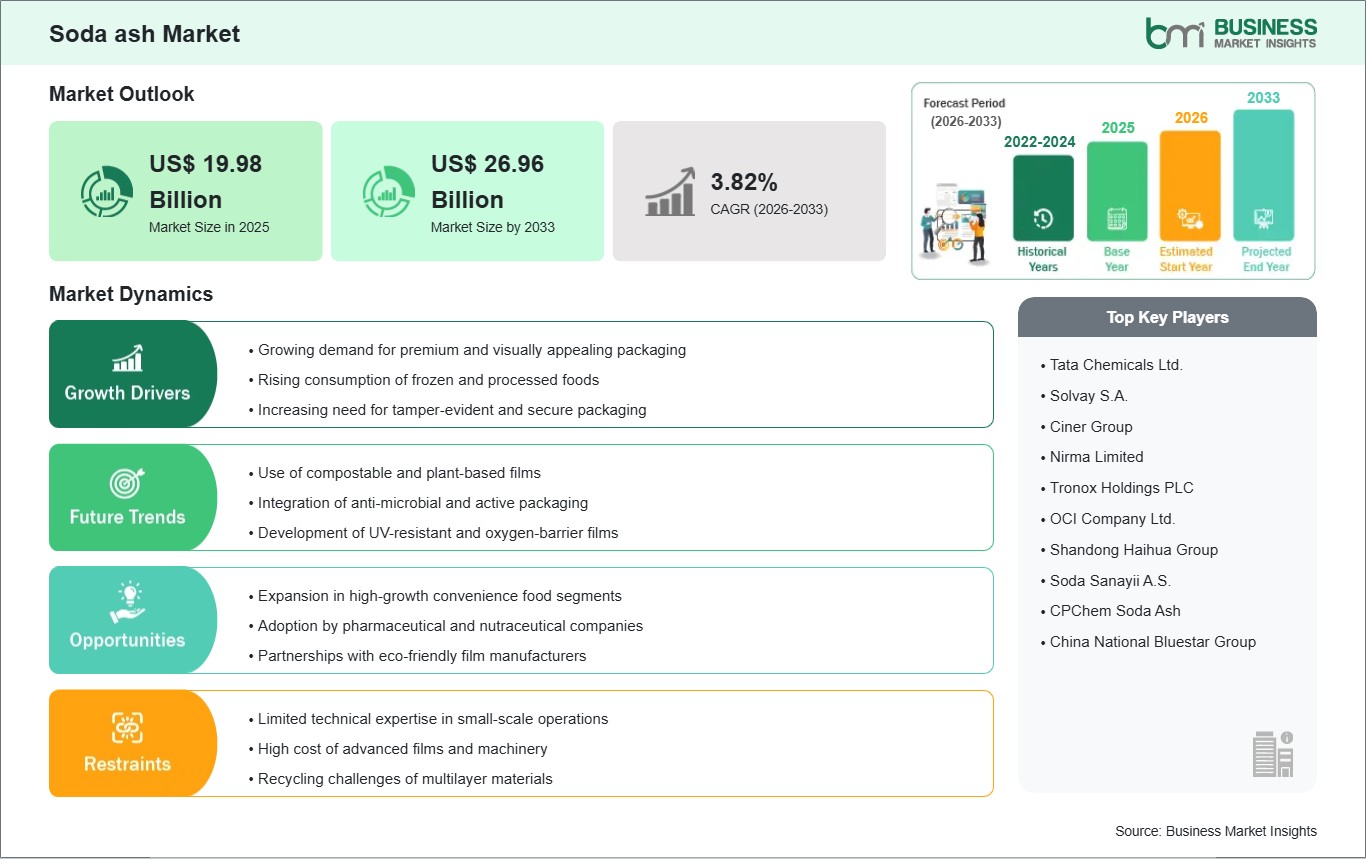
The Soda ash Market size is expected to reach US$ 26.96 billion by 2033 from US$ 19.98 billion in 2025. The market is estimated to record a CAGR of 3.82% from 2026 to 2033.
The global soda ash market is expanding steadily due to its indispensable role in various industrial processes, including glass manufacturing, chemicals, detergents, and water treatment. Soda ash, also known as sodium carbonate, is a key raw material for producing flat glass, container glass, and specialty glass, which drives demand in construction, automotive, and consumer electronics sectors. The increasing urbanization and infrastructure development worldwide are stimulating growth, particularly in emerging economies where demand for construction glass and industrial chemicals is rising. Additionally, the detergent and cleaning products sector contributes to steady consumption, as soda ash improves product efficiency and water softening capabilities. Technological advancements and process innovations, such as the development of high-purity soda ash for specialty applications, are further propelling market growth. Sustainability trends are also influencing production, with manufacturers exploring eco-friendly processes and energy-efficient technologies to minimize carbon footprint.
However, the market faces certain challenges, including fluctuations in raw material availability, energy-intensive production processes, and stringent environmental regulations associated with soda ash manufacturing. Competition from alternative compounds in certain applications, such as baking soda or other chemical substitutes, can also impact demand. Despite these constraints, the global soda ash market remains resilient due to its wide applicability, ongoing industrial growth, and focus on sustainable production methods.

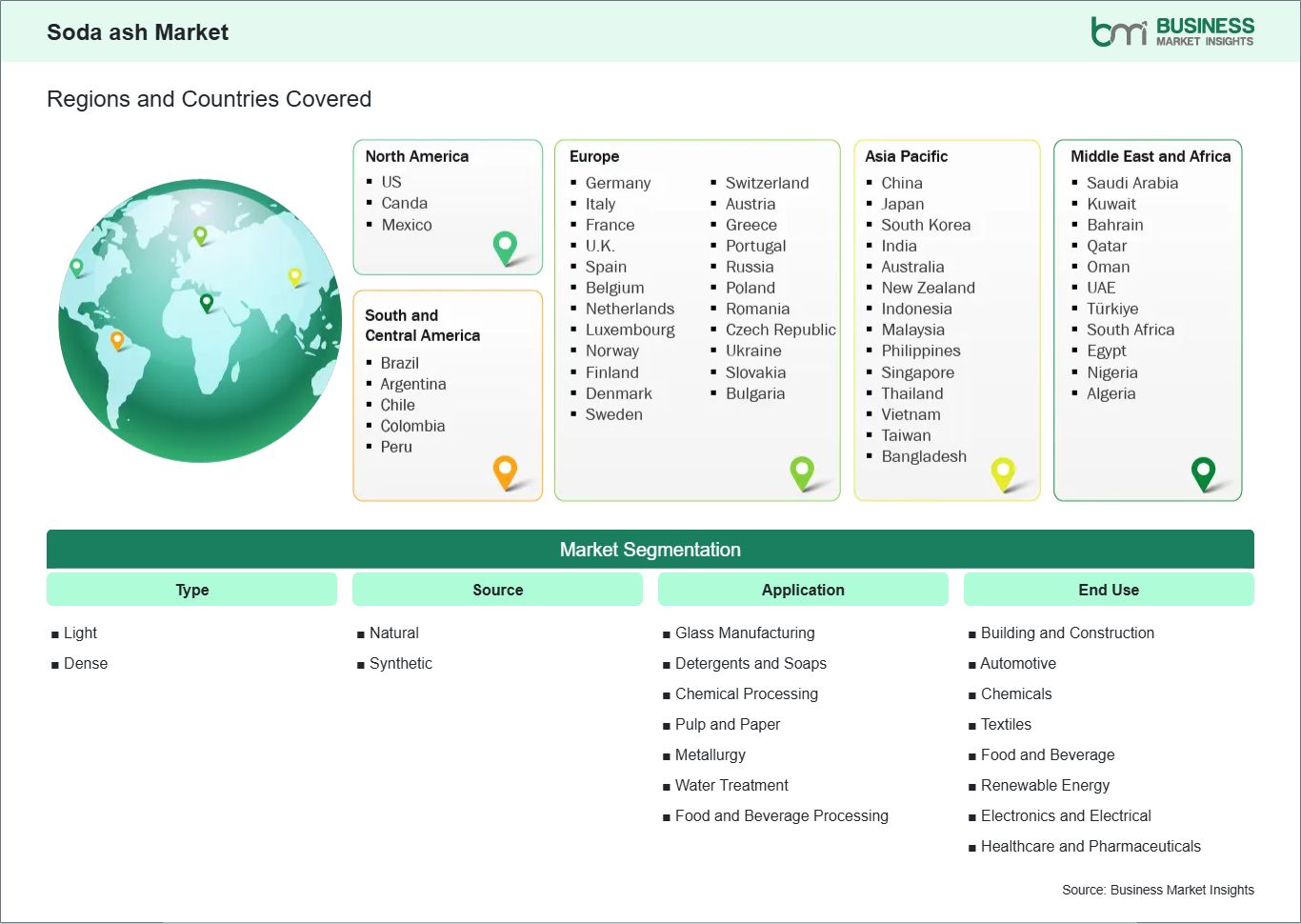
Key segments that contributed to the derivation of the soda ash market analysis are type, source, application, and end use.
The Western Europe soda ash market is witnessing an upward trend due to the increasing demand for premium products, especially those which are visually attractive, in the glass and container industry. Western Europe, including countries like Germany, Belgium, and the Netherlands, are traditional glass manufacturing centers, in which soda ash acts as an essential flux agent, which reduces the melting point of raw materials. Premium glass products, including high-end drinks containers, cosmetics, and other luxury products, need high-grade soda ash to ensure the product has the desired transparency, strength, and color control. For instance, in the country of Belgium, manufacturers of luxury spirits, cosmetics, and other products are increasingly demanding high-grade soda ash feedstock to ensure ultra-clear glass products, which are in line with the branding strategy in the Western Europe region.
In Germany’s Rhineland and Saxony, where there is a high concentration of automotive and specialty glass manufacturing, there has been increasing demand for soda ash with the rising investment in decorative automotive lighting and architectural glazing. These products depend on precise chemical properties of glass, ensuring a steady consumption rate of soda ash despite the economic slowdown. In France’s Grand Est region, specialty glass producers have been using soda ash in sustainable lightweight container glasses, which offer reduced material consumption without compromising product aesthetics—a trend that is now catching up in the food and beverage containers segment.
Apart from traditional uses in specialty glasses, there has been increasing research into using soda ash in innovative packaging materials. Dutch experts in innovative packaging have been working with soda ash-glass coatings, aiming to improve the recyclability and mechanical strength of innovative hybrid containers. Throughout Western Europe, there has been a steady consumption rate of soda ash in innovative packaging materials, given consumers’ desire for products that offer better shelf appeal, along with regional brands’ focus on product design and sustainability.
The pharmaceutical and nutraceutical sectors in Western Europe are increasingly being perceived as important sectors that contribute to the consumption of soda ash, owing to the need for these sectors to use high-purity materials for the manufacturing and formulation processes. The pharmaceutical manufacturing hubs in Western Europe include Switzerland, where the region known as Basel is a major hub for the manufacture of pharmaceutical products, the Golden Triangle region of the UK, and the pharmaceutical hubs of Ireland, where the use of soda ash is required for the intermediate steps of the manufacturing process. The consistent quality requirements of these sectors have led to a high-purity form of soda ash becoming a highly popular product among generic and specialty pharmaceutical manufacturers alike.
For example, in Switzerland, where multinational pharmaceutical companies have established major investments in the manufacture of biologics and specialty pharmaceutical products, suppliers have seen an increased trend for the purchase of pharmaceutical-grade soda ash for controlled crystallization and neutralization processes. Additionally, the regulations imposed by the EU and UK authorities for the manufacture of pharmaceutical products have led to nutraceutical manufacturers in Scandinavia and the Netherlands incorporating soda ash into the manufacture of mineral-based nutraceutical products.
In addition, the increasing nutraceutical market, including products such as effervescent tablets, buffered vitamins, and alkalizing agents, has further improved the position of soda ash in the market. Nutraceutical manufacturers in Denmark and Finland have experienced double-digit growth in the market segments in which soda ash is utilized for the control of effervescence and taste modulation. In conclusion, the market for soda ash in the pharmaceutical and nutraceutical products has the prospect of stable growth in Western Europe, as the region has been at the forefront in the development of product innovations in high-value products in the pharmaceutical and nutraceutical industries.

The soda ash market is experiencing steady growth, with market size and share analysis reflecting evolving treatment preferences and competitive dynamics among key players. The report evaluates important subsegments categorized within type, source, application, and end use highlighting their respective contributions to overall market performance.
By type, the light subsegment dominated the Soda ash market in 2025 because it is the most versatile and widely required grade for a broad range of applications like detergents, glass, and water treatment. Its physical properties make it easier to blend, dissolve, and handle during manufacturing, which increases usage efficiency.
Based on source, the synthetic subsegment dominated the soda ash market in 2025 due to its consistent chemical purity and predictable performance, making it preferred for high‑precision applications such as glass and detergents. Manufacturing plants can scale synthetic production to meet rising demand, especially where natural deposits are limited or logistically challenging.
On a basis of application, the glass manufacturing subsegment dominated the soda ash market in 2025 because soda ash is a primary raw material in glass composition, lowering melting temperatures and improving clarity. This sector spans flat glass for construction, container glass for food & beverages, and specialty glass for electronics, driving massive volume demand.
In terms of end use, the chemical subsegment dominated the soda ash market in 2025 because because soda ash feeds into multiple downstream chemical products from sodium bicarbonate and sodium silicate to catalysts and industrial intermediates. This broad chain of chemical derivatives multiplies soda ash demand compared with end uses that consume soda ash more narrowly.
| Report Attribute | Details |
|---|---|
| Market size in 2025 | US$ 19.98 Billion |
| Market Size by 2033 | US$ 26.96 Billion |
| Global CAGR (2026 - 2033) | 3.82% |
| Historical Data | 2022-2024 |
| Forecast period | 2026-2033 |
| Segments Covered | By Type
|
|
Regions and Countries Covered
| |
| North America | US, Canada, Mexico |
| Europe | Belgium, Austria, Finland, Denmark, Greece, Poland, Romania, Russia, Ukraine, Czech Republic, Slovakia, Bulgaria, Italy, Luxembourg, Germany, Switzerland, France, Netherlands, Norway, Portugal, Spain, Sweden, United Kingdom |
| Asia-Pacific | Australia, China, India, Japan, South Korea, Indonesia, Malaysia, Philippines, Singapore, Thailand, Vietnam, Bangladesh, New Zealand, Taiwan |
| South and Central America | Brazil, Argentina, Peru, Chile, Colombia |
| Middle East and Africa | Bahrain, Kuwait, Oman, Qatar, Saudi Arabia, United Arab Emirates, Turkiye, South Africa, Egypt, Algeria, Nigeria |
| Market leaders and key company profiles |
|
The "Soda Ash Market Size And Forecast (2022 - 2033)" report provides a detailed analysis of the market covering below areas:
The geographical scope of the Soda ash market report is divided into five regions: North America, Asia Pacific, Europe, Middle East & Africa, and South & Central America. The Soda ash market in North America is expected to grow during the forecast period.
The global soda ash market is growing continuously and is an indispensable material for a number of industrial applications, including the manufacture of glass, chemicals, detergents, and water treatment. Soda ash, also known as sodium carbonate, is an important material for the production of flat glass, container glass, and specialty glass, which is fueling the demand for these products in construction, automobiles, and electronic devices. The increasing trend of urbanization and construction activities around the world is also boosting the growth of the soda ash industry, especially in emerging markets where the demand for construction glass and industrial chemicals is increasing.
Moreover, the detergent and cleaning products segment is also contributing to the steady consumption of soda ash, as this material enhances the efficiency and water-softening properties of these products. The growing trend of technology and innovation is also fueling the growth of the global soda ash industry, including the production of high-purity soda ash, a material used for specialty products. Sustainability is also an important factor that is driving the production of this material, as manufacturers are focusing on developing environment-friendly production technologies to reduce the carbon footprint.
However, there exist some challenges facing the market, including fluctuations in raw materials, energy-intensive production, and environmental regulations, especially in manufacturing soda ash. Additionally, competition from other compounds, such as baking soda, may pose some threats. Despite these limitations, the global soda ash market remains stable, considering its wide applications, increasing industrial activities, and environmental concerns.

The soda ash market is evaluated by gathering qualitative and quantitative data post primary and secondary research, which includes important corporate publications, association data, and databases. A few of the key developments in the soda ash market are:
The Soda ash Market is valued at US$ 19.98 Billion in 2025, it is projected to reach US$ 26.96 Billion by 2033.
As per our report Soda ash Market, the market size is valued at US$ 19.98 Billion in 2025, projecting it to reach US$ 26.96 Billion by 2033. This translates to a CAGR of approximately 3.82% during the forecast period.
The Soda ash Market report typically cover these key segments-
The historic period, base year, and forecast period can vary slightly depending on the specific market research report. However, for the Soda ash Market report:
The Soda ash Market is populated by several key players, each contributing to its growth and innovation. Some of the major players include:
The Soda ash Market report is valuable for diverse stakeholders, including:
Essentially, anyone involved in or considering involvement in the Soda ash Market value chain can benefit from the information contained in a comprehensive market report.
Please tell us your area of interest
(Market Segments/ Regions and Countries/ Companies)