Fatty Alcohols Market Outlook (2022-2033)

Historic Data: 2022-2024   |   Base Year: 2025   |   Forecast Period: 2026-2033
Report Content: Market Scope, Market Segmentation, Market Dynamics, and Competitive Analysis

Report Coverage:
  • Type (Short Chain, Pure and Mid Cut, Long Chain, Higher Chain)
  • Application (Industrial & Domestic Cleaning, Personal Care, Plasticizers, Lubricants, Pharmaceutical Formulation, Food & Nutrition, Other Applications)
  • End User (Building & Infrastructure, Mechanical Equipment, Automotive & Other Transport, Other End Users)

No. of Pages: 414
Report Code: BMIPUB00033935
Category: Chemicals and Materials
Fatty Alcohols Market

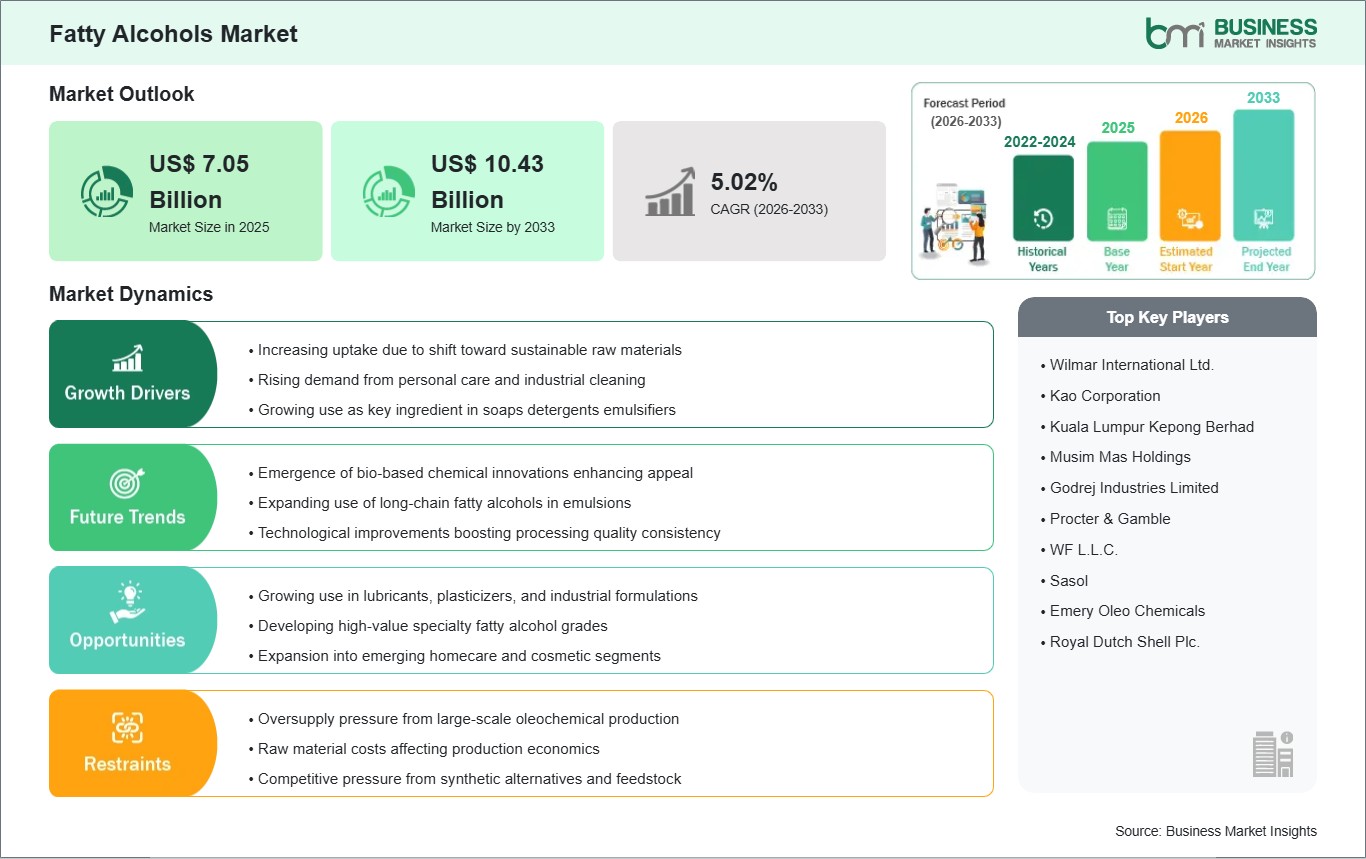
The Fatty Alcohols Market size is expected to reach US$ 10.43 Billion by 2033 from US$ 7.05 Billion in 2025. The market is estimated to record a CAGR of 5.02% from 2026 to 2033.

Executive Summary and Global Market Analysis:

The global fatty alcohol market is driven by the increasing demand for fatty alcohols from the personal care, cosmetics, industrial, and household markets. Fatty alcohols are long-chain alcohol compounds that are derived from natural fat sources, oils, or petrochemicals. They are utilized as important additives for surfactants, emulsifiers, thickeners, and conditioners. Their diverse uses have positioned fatty alcohols as a core component of personal care products such as shampoos, soaps, lotions, detergents, and industrial cleaning agents.

The increased awareness of consumers regarding the performance of these products and their mildness has increased the market for fatty alcohol use in personal care and cosmetics. Another sustainability trend is also affecting the market; in this case, manufacturers are increasingly looking to bio-based sources such as palm oil, coconut oil, or any other plant-based oils to meet the demands of sustainable consumers. However, there is also increased regulatory pressure on sourcing, sustainability, and biodegradability. This presents a challenge to manufacturers in balancing compliance and ethical sourcing. Changes in cost factors, such as plant-based oils or petrochemicals, can also affect the cost of production. However, the inherent characteristics of fatty alcohols in terms of their versatility, compatibility, and gentle skin feel ensure their continued relevance in a wide range of applications. Their appeal to consumers across the globe is also expected to expand with continued innovation in sustainable sourcing.

Fatty Alcohols Market - Strategic Insights:

global-market-strategic-framework
Get more information on this report

Fatty Alcohols Market Segmentation Analysis:

Key segments that contributed to the derivation of the fatty alcohols market analysis are type and application.

  • By type, the fatty alcohol market is segmented into short chain, pure and mid cut, long chain, and higher chain. The pure and mid cut subsegment dominated the market in 2025.
  • Based on application, the fatty alcohol market is classified into industrial & domestic cleaning, personal care, plasticizers, lubricants, pharmaceutical formulation, food & nutrition, and other applications. The industrial & domestic cleaning subsegment dominated the market in 2025.

Fatty Alcohols Market Drivers and Opportunities:

Increasing uptake due to shift toward sustainable raw materials

The growing preference for sustainable raw materials has significantly increased the use of fatty alcohols across a wide range of industries. Derived primarily from natural sources such as plant oils, fatty alcohols are increasingly seen as a more environmentally responsible alternative to petrochemical-based ingredients. This shift is especially noticeable in products where consumers and manufacturers are prioritizing renewable inputs, reduced environmental impact, and improved biodegradability. As sustainability becomes a core consideration in material selection, fatty alcohols are gaining wider acceptance as a reliable and eco-conscious option.

This transition is also supported by changing expectations around product transparency and lifecycle impact. Manufacturers are placing greater emphasis on sourcing ingredients that align with environmentally friendly practices, while still delivering consistent performance. Fatty alcohols offer a balance of functionality and sustainability, making them suitable for use in formulations that require stability, emulsification, and surface activity. Their compatibility with a variety of production processes further strengthens their role in modern industrial applications.

In addition to environmental benefits, the use of fatty alcohols supports long-term efficiency and adaptability. As industries work to reduce dependence on non-renewable resources, materials that can be sourced sustainably without compromising quality are becoming increasingly valuable. This ongoing shift is helping to establish fatty alcohols as a key component in the development of greener, more responsible products across multiple sectors.

Growing use in lubricants, plasticizers, and industrial formulations

Fatty alcohols are finding broader use in lubricants, plasticizers, and a variety of industrial formulations due to their versatile chemical properties. Their ability to enhance lubrication, improve flexibility, and act as intermediates in chemical processes makes them a valuable ingredient in many applications. In lubricants, they contribute to smoother operation and reduced friction, while in plasticizers, they help improve the flexibility and durability of materials. This adaptability allows them to be used across diverse industrial processes with consistent performance.

Their role in industrial formulations continues to expand as manufacturers seek materials that can serve multiple functions within a single system. Fatty alcohols are often used as building blocks for surfactants, detergents, and specialty chemicals, supporting applications that require stability, compatibility, and efficiency. Their chemical structure allows for customization, enabling formulators to tailor properties such as viscosity, solubility, and reactivity to meet specific requirements. This flexibility makes them an essential component in a wide range of production environments.

Advancements in processing and formulation techniques are further increasing their relevance. Improved production methods and refined product grades allow fatty alcohols to meet more demanding performance standards while maintaining cost-effectiveness. At the same time, their compatibility with environmentally conscious formulations enhances their appeal in industries focused on sustainability. By combining functional performance with adaptability and environmental benefits, fatty alcohols continue to play an important role in modern industrial applications.

Fatty Alcohols Market Size and Share Analysis:

The fatty alcohols market is experiencing steady growth, with market size and share analysis reflecting evolving treatment preferences and competitive dynamics among key players. The report evaluates important subsegments categorized within type and application, highlighting their respective contributions to overall market performance.

By type, the Pure and Mid Cut subsegment dominated the Fatty Alcohol market in 2025. Pure and mid cut fatty alcohols offer balanced chain length, high reactivity, and versatility, making them highly suitable for a wide range of industrial and consumer applications, which drives their widespread adoption.

Based on application, the Industrial & Domestic Cleaning subsegment dominated the Fatty Alcohol market in 2025. Cleaning applications require effective surfactant properties, emulsification, and foaming performance, reinforcing strong demand for fatty alcohols in detergents and cleaning products.

Fatty Alcohols Market Report Highlights:

Report Attribute Details
Market size in 2025 US$ 7.05 Billion
Market Size by 2033 US$ 10.43 Billion
Global CAGR (2026 - 2033)5.02%
Historical Data 2022-2024
Forecast period 2026-2033
Segments Covered By Type
  • Short Chain
  • Pure and Mid Cut
  • Long Chain
  • Higher Chain
By Application
  • Industrial & Domestic Cleaning
  • Personal Care
  • Plasticizers
  • Lubricants
  • Pharmaceutical Formulation
  • Food & Nutrition
  • Other Applications
By End User
  • Building & Infrastructure
  • Mechanical Equipment
  • Automotive & Other Transport
  • Other End Users
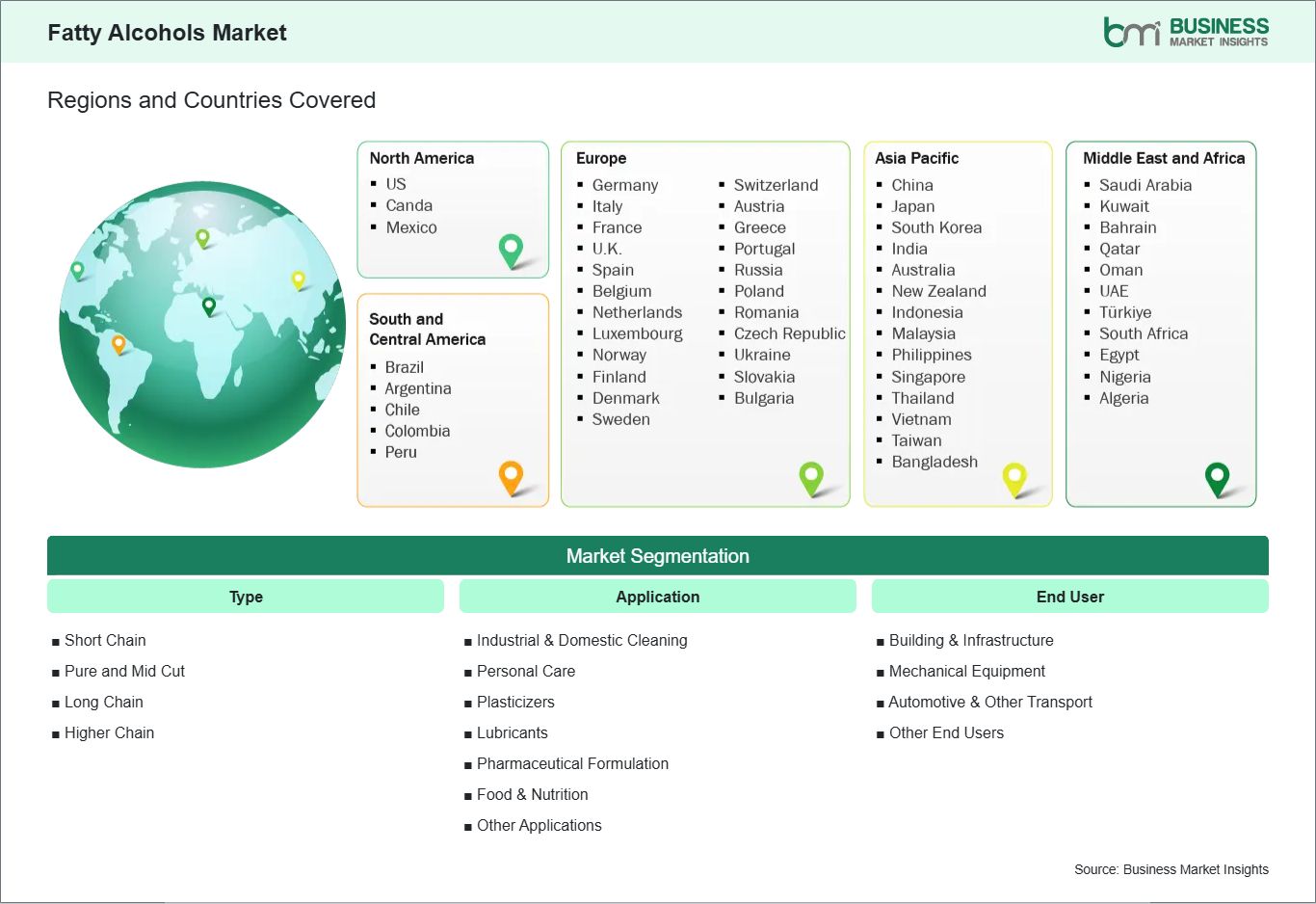
Regions and Countries Covered
North America US, Canada, Mexico
Europe Belgium, Austria, Finland, Denmark, Greece, Poland, Romania, Russia, Ukraine, Czech Republic, Slovakia, Bulgaria, Italy, Luxembourg, Germany, Switzerland, France, Netherlands, Norway, Portugal, Spain, Sweden, United Kingdom
Asia-Pacific Australia, China, India, Japan, South Korea, Indonesia, Malaysia, Philippines, Singapore, Thailand, Vietnam, Bangladesh, New Zealand, Taiwan
South and Central America Brazil, Argentina, Peru, Chile, Colombia
Middle East and Africa Bahrain, Kuwait, Oman, Qatar, Saudi Arabia, United Arab Emirates, Turkiye, South Africa, Egypt, Algeria, Nigeria
Market leaders and key company profiles
  • Wilmar International Ltd.
  • Kao Corporation
  • Kuala Lumpur Kepong Berhad
  • Musim Mas Holdings
  • Godrej Industries Limited
  • Procter & Gamble
  • WF L.L.C.
  • Sasol
  • Emery Oleo Chemicals
  • Royal Dutch Shell Plc.
Get more information on this report

Fatty Alcohols Market Report Coverage and Deliverables:

The "Fatty Alcohols Market Size and Forecast (2022 - 2033)" report provides a detailed analysis of the market covering below areas:

  • Fatty Alcohols market size and forecast at global, regional, and country levels for all the key market segments covered under the scope
  • Fatty Alcohols market trends, as well as drivers, restraints, and opportunities
  • Fatty Alcohols market analysis covering key trends, regional framework, major players, regulations, and recent developments
  • Industry landscape and competition analysis covering market concentration, heat map analysis, prominent players, and recent developments for the Fatty Alcohols market
  • Detailed company profiles, including SWOT analysis

Fatty Alcohols Market Geographic Insights:

The geographical scope of the Fatty Alcohols market report is divided into five regions: North America, Asia Pacific, Europe, Middle East & Africa, and South & Central America. The Fatty Alcohols market in North America is expected to grow during the forecast period.

The market position of North America in the fatty alcohols market is strong, especially because of the well-established market for personal care, cosmetics, and home care products. Fatty alcohol plays a vital role as an essential component of shampoos, soaps, detergents, and skin care products. North American consumers are demanding mild and effective product forms, which makes fatty alcohol a preferred choice to produce mild product forms.  The market for industrial and home care cleaning agents is another factor that contributes to the market position of North America. Fatty alcohol-based surfactants play a vital role as they are effective as well as compatible with modern, environmentally friendly product forms.

Moreover, North America is known for developing sustainable product forms that are environmentally friendly, which makes fatty alcohol a preferred choice to produce plant-derived fatty alcohol. Challenges in North America include feedstock cost volatility, especially for vegetable oil-derived alcohols, and strict regulatory requirements for both personal care and industrial applications. Nevertheless, the region`s mature supply chain, focus on innovation, and strong demand for high-performance, sustainable formulations reinforce North America`s dominance and leadership in shaping trends for the global fatty alcohols market.

global-market-geography
Get more information on this report

Fatty Alcohols Market Research Report Guidance:

  • The report includes qualitative and quantitative data in the Fatty Alcohols market across type, application, and geography.
  • The report starts with the key takeaways (chapter 2), highlighting the key trends and outlook of the Fatty Alcohols market.
  • Chapter 3 focuses on the research methodology of the study.
  • Chapter 4 includes ecosystem analysis.
  • Chapter 5 highlights the major industry dynamics in the Fatty Alcohols market, including factors that are driving the market, prevailing deterrents, potential opportunities, as well as future trends. Impact analysis of these drivers and restraints is also covered in this section.
  • Chapter 6 discusses the Fatty Alcohols market scenario, in terms of historical market revenues, and forecast till the year 2033.
  • Chapters 7 to 9 cover the Fatty Alcohols market segments by type, application, and geography across North America, Europe, Asia Pacific, Middle East and Africa, and South and Central America. They cover the market volume, revenue forecast, and factors driving the market.
  • Chapter 10 describes the competitive analysis with the heat map analysis for the key players operating in the market.
  • Chapter 11 describes the industry landscape analysis. It provides detailed descriptions of business activities such as market initiatives, new developments, mergers, and joint ventures globally, along with a competitive landscape.
  • Chapter 12 provides detailed profiles of the major companies operating in the Fatty Alcohols market. Companies have been profiled on the basis of their key facts, business descriptions, products, financial overview, SWOT analysis, and key developments.
  • Chapter 13, i.e., the appendix, is inclusive of a brief overview of the company, list of abbreviations, and disclaimer.

Fatty Alcohols Market News and Key Development:

The fatty alcohols market is evaluated by gathering qualitative and quantitative data post primary and secondary research, which includes important corporate publications, association data, and databases. A few of the key developments in the fatty alcohols market are:

  • In February 2025, KLK OLEO (Kuala Lumpur Kepong Berhad) announced that it expanded its global footprint by establishing a new representative office in Mumbai, India, strengthening its presence in key growth markets for oleochemicals including fatty alcohols.
  • In October 2023, Sasol Limited announced that it entered into a partnership with Solugen to develop sustainable, bio-based ingredient blends, expanding collaboration on next-generation formulations relevant to fatty alcohol applications in home and personal care products.

Key Sources Referred:

  • International Organization for Standardization (ISO)
  • American Society for Testing and Materials (ASTM International)
  • Bureau of Indian Standards (BIS)
  • Environmental Protection Agency (EPA), USA
  • European Chemicals Agency (ECHA)
  • Central Pollution Control Board (CPCB), India
  • Ministry of Chemicals and Fertilizers, India
  • American Chemistry Council (ACC)
  • Indian Chemical Council (ICC)
  • European Chemical Industry Council (Cefic)
  • Specialty Chemical Association of India (SCAI)
  • Company Websites
  • Company Annual Reports
  • Company Investor Presentations
The List of Companies - Fatty Alcohols Market
  • Wilmar International Ltd.
  • Kao Corporation
  • Kuala Lumpur Kepong Berhad
  • Musim Mas Holdings
  • Godrej Industries Limited
  • Procter & Gamble
  • WF L.L.C.
  • Sasol
  • Emery Oleo Chemicals
  • Royal Dutch Shell Plc.
Frequently Asked Questions
How big is the Fatty Alcohols Market?

The Fatty Alcohols Market is valued at US$ 7.05 Billion in 2025, it is projected to reach US$ 10.43 Billion by 2033.

What is the CAGR for Fatty Alcohols Market by (2026 - 2033)?

As per our report Fatty Alcohols Market, the market size is valued at US$ 7.05 Billion in 2025, projecting it to reach US$ 10.43 Billion by 2033. This translates to a CAGR of approximately 5.02% during the forecast period.

What segments are covered in this report?

The Fatty Alcohols Market report typically cover these key segments-

  • Type (Short Chain, Pure and Mid Cut, Long Chain, Higher Chain)
  • Application (Industrial & Domestic Cleaning, Personal Care, Plasticizers, Lubricants, Pharmaceutical Formulation, Food & Nutrition, Other Applications)
  • End User (Building & Infrastructure, Mechanical Equipment, Automotive & Other Transport, Other End Users)

What is the historic period, base year, and forecast period taken for Fatty Alcohols Market?

The historic period, base year, and forecast period can vary slightly depending on the specific market research report. However, for the Fatty Alcohols Market report:

  • Historic Period : 2022-2024
  • Base Year : 2025
  • Forecast Period : 2026-2033
  • Who are the major players in Fatty Alcohols Market?

    The Fatty Alcohols Market is populated by several key players, each contributing to its growth and innovation. Some of the major players include:

  • Wilmar International Ltd.
  • Kao Corporation
  • Kuala Lumpur Kepong Berhad
  • Musim Mas Holdings
  • Godrej Industries Limited
  • Procter & Gamble
  • WF L.L.C.
  • Sasol
  • Emery Oleo Chemicals
  • Royal Dutch Shell Plc.
  • Who should buy this report?

    The Fatty Alcohols Market report is valuable for diverse stakeholders, including:

    • Investors: Provides insights for investment decisions pertaining to market growth, companies, or industry insights. Helps assess market attractiveness and potential returns.
    • Industry Players: Offers competitive intelligence, market sizing, and trend analysis to inform strategic planning, product development, and sales strategies.
    • Suppliers and Manufacturers: Helps understand market demand for components, materials, and services related to concerned industry.
    • Researchers and Consultants: Provides data and analysis for academic research, consulting projects, and market studies.
    • Financial Institutions: Helps assess risks and opportunities associated with financing or investing in the concerned market.

    Essentially, anyone involved in or considering involvement in the Fatty Alcohols Market value chain can benefit from the information contained in a comprehensive market report.

    Available Report Formats

    pdf-format excel-format pptx-format
    Buy Now
    Sales Assistance
    +1 646 791 7070 (US & UK)
    Customization Form

    Please tell us your area of interest
    (Market Segments/ Regions and Countries/ Companies)